
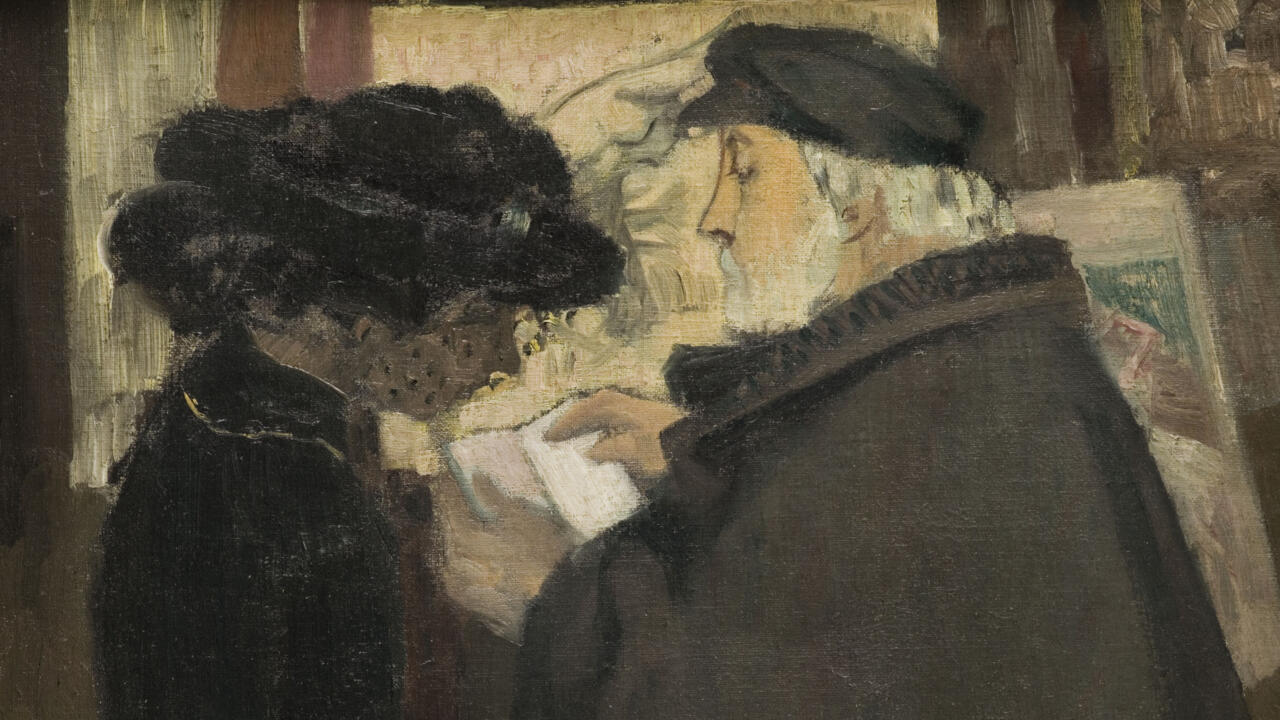
How do you spot an artist? Are they the one with the jaunty beret or the dapper silk scarf? Or the tunic covered in paint? An exhibition at the Bourdelle Museum in Paris looks at how wardrobe choices have shaped society’s perception of artists – and made some of them into icons. Issued on: 08/11/2026 - 14:28 4 min Reading time "As early as the 19th century and even before, artists served as trendsetters," explains Lili Davenas, one of the curators of the exhibition "L’étoffe de l’artiste" – or "The Artist's Fabric". At the crossroads of art history, sociology and the history of fashion, the exhibition explores how style helped create the myth of the artist and the societal changes that influenced this, and continue to do so in the age of selfies and social media. For hundreds of years, artists have established and perpetuated sartorial codes. From the 17th century, artists – including Rembrandt – painted self-portraits wearing velvet robes and caps, in imitation of Italian Renaissance masters such as Titian and Raphael. In the late 19th century, many artists adopted the uniform of the arts academy, donning smart suits, waistcoats and silk ties, dressing for the "salons" they held to show off their skills. Then at the turn of the 20th century, working man’s attire took over from suits to become the staple of the bohemian artist’s wardrobe. A photograph of French artist and sculptor Antoine Bourdelle is displayed alongside one of his pieces and his working clothes at the exhibition. © RFI / Ollia Horton The status of the artist Having been inspired by the discovery of French sculptor Antoine Bourdelle’s work clothes by his daughter Rodhia in 2020, a team of four curators spent five years examining the connection between artists and their clothing, working with archive material from France, Italy, Austria and Germany. Items on display include Edgar Degas’ brown velvet cap and Rosa Bonheur’s jacket with her Legion d’honneur rosette pin – she was the first female painter to receive France’s highest honour, in 1865 – as well as Gustave Klimt’s blue robe and Sonia Delaunay's geometric-print dresses and shoes, which mirrored her paintings. African designer Imane Ayissi redefines luxury on Paris haute couture stage Davenas explains the double meaning behind the French title of the exhibition – with "l'etoffe" meaning fabric and the idiom "avoir de l'étoffe" meaning "having the right stuff" – as a reference to the connection between an artist’s choice of outfit and the character traits associated with the artistic temperament. In other words, it wasn't not enough to "look" like an artist, you had to have a dose of charisma to go with it. "What particularly interested us for this exhibition was observing how the status of the artist evolved, drawing many young people to Paris, with the ambition of becoming artists themselves," Davenas goes on. The French capital has long been a magnet for creative types, who travelled there from around the world to be artists – or at least rub shoulders with them. At the turn of the 20th century, "we begin to see the emergence of a deliberate staging of the artist’s public and private life – a phenomenon that grew increasingly significant. It became fashionable for the bourgeoisie to visit artists' studios," Davenas told RFI, adding that the emergence of photography greatly heightened this trend. An 1899 portrait of French painter Rosa Bonheur and her dog Charly by Anna Klumpke, with Bonheur seen sporting her Légion d'honneur pin. © GrandPalaisRmn (Château de Fontainebleau) / Gérard Blot 'Celebrity culture' Franco-Japanese artist Léonard Tsuguharu Foujita, who lends his silhouette to the exhibition poster, was known for his flamboyance in and out of the studio. With his bowl haircut, smart suits and tiny round glasses, he is instantly recognisable. Valérie Montalbetti Kervella, director of the Bourdelle Museum's sculpture collection, explains that Foujita appears in several sections of the exhibition, as an ideal demonstration of the close links between art and fashion. He trained as a tailor before becoming an artist and created his own clothes and fabrics, often taking inspiration from his Japanese roots. His outfits and shoes are on display beside his sewing equipment, with button boxes seen in some of his self-portraits hung nearby. Paris textiles exhibition reveals the interwoven history of India and France Franco-Japanese artist Foujita and his model likeness, seen in 1925. © Boris Lipnitzki / Roger-Viollet Foujita even had a mannequin made in his likeness which he dressed up in his outfits, be it a suit and hat or a sailor's shirt – an avatar of sorts. Long before the age of selfies and Instagram, artists became their own best advertising. In the same way that Foujita refined his style to become a brand unto himself, so did Salvador Dali with his iconic moustache, Frida Kahlo with her traditional Mexican dresses, and Yayoi Kusama with her signature polka dots. As Davenas explains: "It was, in a sense, an early form of celebrity culture, a way of self-promotion. Clearly, this subject resonates strongly with our contemporary world, with the way that we, today, treat our clothing as a ‘second skin,’ using it to express something about our own identities." “L’étoffe de l’artiste” is at the Musée Bourdelle in Paris until 24 January, 2027.
The art of dressing: how clothes have shaped the image of the artist
Full Article
Original Source
Read the full article at Rfi →KhanList aggregates and links to publicly available news content. We do not host full articles from third-party sources. Always verify important information with original sources.