
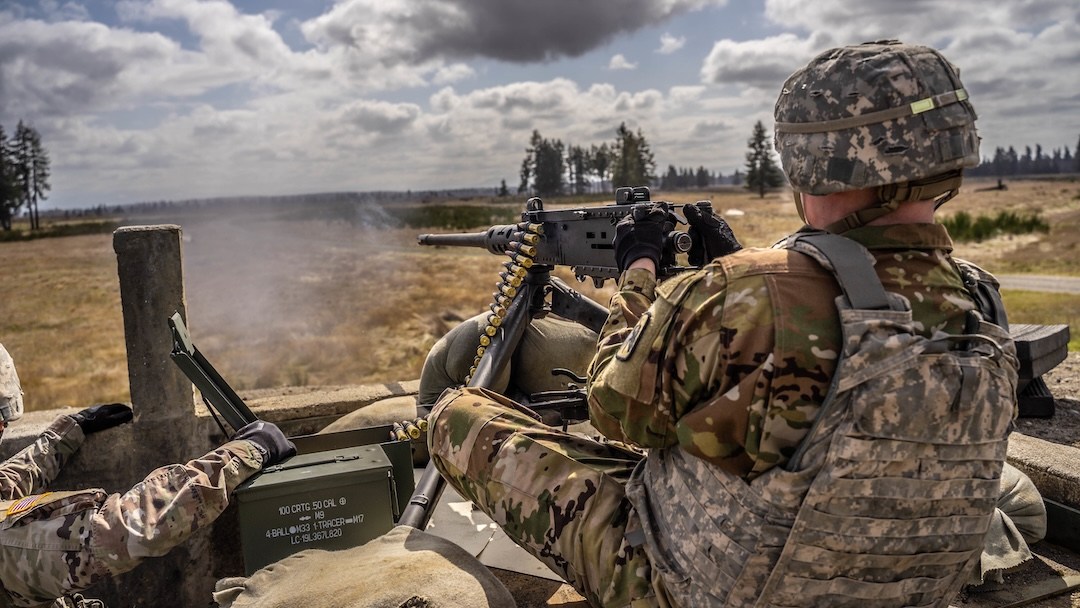
Soldiers might be getting more trigger time with the .50-caliber machine gun now that the Army has developed a safer training round. The Army Combat Capabilities Development Command Armaments Center, or DEVCOM, introduced its new .50-caliber reduced-range ammunition, or RRA, according to the Nov. 8 announcement. While most ammo makers design bullets to maximize aerodynamics, DEVCOM took the opposite approach. The new projectile is designed to slow down and destabilize in flight, reducing the distance it travels. Kip Hess, a small-caliber munitions competency manager, described RRA as an easy substitute for the combat ammunition soldiers currently use in training, giving them “the opportunity for more time spent in realistic training scenarios.” “Ultimately, I hope this gives them both greater confidence and effectiveness when they find themselves on the battlefield,” he said. Hess added that RRA was favored for simulating convoy live-fire exercises, particularly for soldiers who need to qualify for the task. This graphic shows how effective .50-caliber reduced-range ammunition is compared with standard cartridges. (U.S. Army) The problem with training using standard .50-caliber ammunition is that it requires a range with an extremely large surface danger zone, or SDZ. The fan-shaped area accounts for the projectile’s normal trajectory as well as potential ricochets. A standard .50-caliber cartridge has a maximum effective range of 7,400 meters, or about 4.6 miles, limiting the number of ranges that can accommodate it. According to the Army, the new projectile is designed to destabilize at around Mach 1, or 741 miles per hour. At that point, it experiences a rapid increase in drag, loses spin stability and sheds energy. The Army said the .50-caliber RRA projectile falls to the ground in less than half the distance of a standard bullet, allowing soldiers to “train with .50 caliber rounds on ranges sized for 7.62mm ammunition, which are more common.” As a result, “soldiers will be able to rehearse realistic combat scenarios from moving platforms in training areas that were once unavailable due to limited space,” the Army added. While the new ammunition is available in two variants — the M1181 ball round and M1199 tracer round — the Army also developed reduced-range versions of 6.8mm and 7.62mm ammunition.
The Army made .50-cal ammo less effective. The service says that’s a good thing.
Full Article
Original Source
Read the full article at Militarytimes →KhanList aggregates and links to publicly available news content. We do not host full articles from third-party sources. Always verify important information with original sources.