
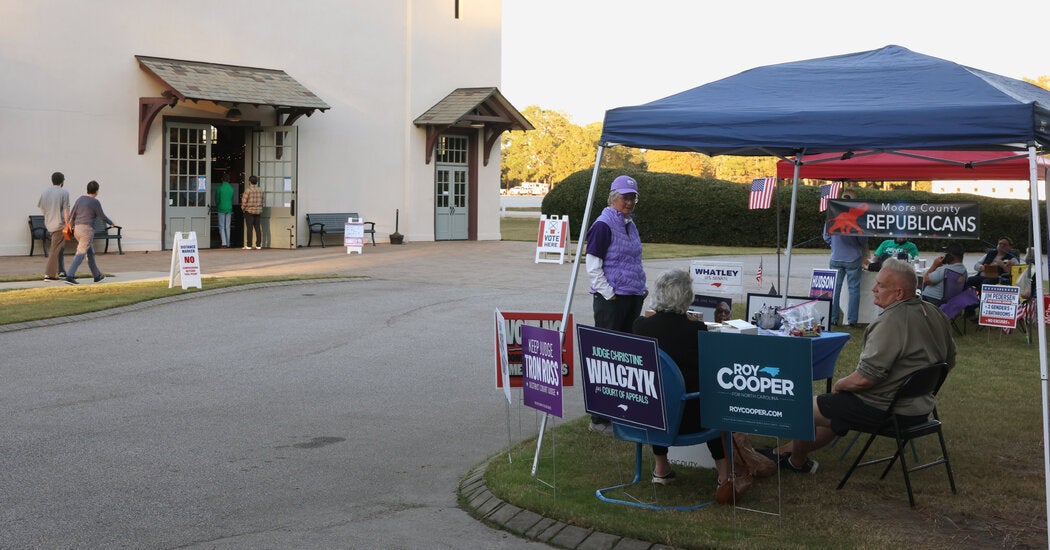
LatestHere’s the latest.Polls have closed in South Carolina and Georgia, two states with crucial Senate races in a midterm election that will decide control of Congress. Turnout appeared strong in battlegrounds, as millions of people cast votes that will deliver a verdict on an unpopular president who has implored the country to act as if he were on the ballot.Democratic candidates have blamed President Trump, and the war he started this year in Iran, for the economic hardships that have driven a current of frustration across the nation. Republicans have focused on portraying their Democratic opponents as extreme on social issues and the economy as they played defense in reliably red states.Favorable polling has buoyed Democrats’ hopes of taking control of the House, but Republicans have worked to protect their majority with aggressive redistricting efforts. In the Senate, Republicans sought to use their fund-raising advantage to protect seats in traditionally conservative strongholds like South Carolina, where a neophyte senator was trying to fend off a challenge.The South Carolina incumbent, Darline Graham, has been filling the seat long occupied by her late brother, Lindsey, and Democrats have hoped that Dr. Annie Andrews, a pediatrician, could flip the seat. In Georgia, Republicans were aiming to unseat Senator Jon Ossoff, whom they had marked as Democrats’ most vulnerable incumbent.Polls also closed in Virginia, where the First District, a key House battleground, could flip to Democrats on a good night for the party, and the Fifth District is also expected to be competitive. And polls closed in most of Florida, home to more crucial House races and a high-profile Senate matchup that pits the incumbent Republican, Ashley Moody, against Angie Nixon, a member of the Democratic Socialists of America.Polls closed earlier in Kentucky, where the Sixth Congressional District could be a bellwether. The open race is in a district that Mr. Trump easily won two years ago, but Democrats are hoping that a strong performance there could presage a good night for the party.The last polling places will not close until 1 a.m. Eastern on Wednesday, in Alaska. Full results won’t be known until well into the evening — and maybe not for days or longer, particularly if many of the races are close — but it’s clear that voters were eager to have their say. In each of the major Senate battlegrounds, including Texas, North Carolina and Michigan, early turnout eclipsed that of the last midterm cycle.In Texas, overall turnout could exceed 10 million votes, which would top the total from each of the last two midterms. In Georgia, Election Day turnout was on track to beat that of the 2024 presidential election, the Georgia secretary of state said.Here’s what else we’re covering:A complicated landscape: More than 400 Times reporters, editors, data analysts, video journalists and photographers are covering the midterms, seeking to understand a large country with voters who are complicated — and sometimes contradictory. Read more ›The counting process: Control of the Senate will hinge on the outcomes in the battleground states of Alaska, Iowa, Kansas, Maine, Michigan, Minnesota, Nebraska, New Hampshire, Ohio, South Carolina and Texas. Here’s when to expect results ›Big spending: This is the most expensive midterm election, as measured in spending on political advertising, since at least 2018, according to data from AdImpact. Elon Musk, the world’s richest person, alone contributed $474 million to Republican groups, candidates and their allies, more than any donor has ever spent in a single election cycle. Read more ›Minor disruptions: A technical problem with voting machines in Westchester County, N.Y., outside New York City, led officials there to collect ballots by hand in a competitive House race. In Florida, flooding forced more than 20 polling stations across eight counties to be relocated. In North Carolina, technical problems at several precincts caused minor delays; state election officials said they would delay the release of election results to at least 8:15 p.m. from 7:30 p.m. Read more ›Election integrity: Many election officials and Democrats have said they fear that Mr. Trump’s attacks on the integrity of U.S. elections could lead to tensions during voting and baseless challenges to the outcome. The administration has sought to prove that many noncitizens have cast ballots, but few people have been charged with offenses related to voting fraud. Local and state officials say they are well prepared to run a secure election.Court rulings: A federal judge has turned down a request by Democratic lawmakers and party organizations to prohibit the Trump administration from coercing states into screening incoming ballots. And the Supreme Court issued what appeared to be an extraordinary rebuke to Mr. Trump, signaling that it was not interested in assisting his efforts to interfere with how states administer elections.One contest to watch in Florida, where most polling places have begun to close, is the governor’s race. Florida has leaned Republican the last few elections. But life in the state has gotten very expensive, and that is one statewide race — between David Jolly, the Democrat, and Byron Donalds, the Republican — that both parties found to be much more competitive than they expected going into the midterms.Leanne Abraham and Arfa MominScenes From Election DayWashingtonAlex Kent/The New York TimesPhoenixAdriana Zehbrauskas for The New York TimesManhattanHiroko Masuike/The New York TimesAnchorageErin Schaff/The New York TimesWest Des Moines, IowaKC McGinnis for The New York TimesRichmond, Va.Demetrius Freeman for The New York TimesSan FranciscoJonah Reenders for The New York TimesColumbus, OhioMaddie McGarvey for The New York TimesRound Rock, TexasJames Talarico, Democratic candidate for SenateHaiyun Jiang/The New York TimesWhite Lake, Mich.Mike Rogers, Republican candidate for SenateVictor J. Blue for The New York TimesLos AngelesAriana Drehsler for The New York TimesAnn Arbor, Mich.Dr. Abdul El-Sayed, Democratic candidate for SenateTodd Heisler/The New York TimesDetroitVictor J. Blue for The New York TimesUpper Arlington, OhioVivek Ramaswamy, Republican candidate for governorMaddie McGarvey for The New York TimesBexley, OhioDr. Amy Acton, Democratic candidate for governorMaddie McGarvey for The New York TimesFort WorthJeremy Raff/The New York TimesAustin, TexasHaiyun Jiang/The New York TimesAnchorageErin Schaff/The New York TimesManhattanHiroko Masuike/The New York TimesBangor, MaineBrent McDonald/The New York TimesMilwaukeeJamie Kelter Davis for The New York TimesQueensJosé A. Alvarado Jr. for The New York TimesAdvertisementSKIP ADVERTISEMENTThe incumbent Republican in Indiana’s Third Congressional District, Representative Marlin Stutzman, who is trailing with just 39 percent of votes reported, is a lawmaker who rarely makes waves or national headlines, but he gained attention this year when he introduced a plan in Congress to phase out direct military aid to Israel in favor of a transition to a joint defense and economic investment program between the country and the U.S. The topic was thrust back into the news this morning when President Trump said that direct military aid to Israel would be “cut off at the end of the year.”Just before the polls closed, supporters of Angie Nixon, the Democratic candidate for Senate in Florida, made last-minute calls at her election-night watch party in Jacksonville to get out the vote.ImageCredit...Ruth Fremson/The New York TimesThe areas we are watching as polls close in Georgia, North Carolina and South Carolina.ImageDemocratic and Republican supporters waiting outside a polling place in Pinehurst, N.C.Credit...Travis Dove for The New York TimesA group of three Senate battleground states in the South, all closing in the 7 p.m. hour, could provide an indication of whether polls accurately predicted Democratic momentum — or, perhaps, a sign of a surprisingly strong night for Republicans.A vast majority of polls have shown Democratic Senate candidates with wide leads in Georgia, where Senator Jon Ossoff is facing Representative Mike Collins, and North Carolina, where Roy Cooper is up against Michael Whatley. And in South Carolina, a state President Trump won by nearly 18 percentage points in 2024, Senator Darline Graham has stiff competition from Dr. Annie Andrews. A few key areas in each state could provide the earliest look at how the night might unfold.Beyond the typical urban and rural divides, these states will be closely watched for trends among Black voters and the shifting winds in suburban counties.In Georgia, watch these bellwether counties.Georgia’s electorate, like that of many Southern states, is deeply polarized along racial lines: According to Times Voter Trends, Kamala Harris won 90 percent of Georgia’s Black voters in 2024 and just 28 percent of the state’s white voters. As a result, several of the state’s most competitive counties have relatively similar shares of white and Black voters, particularly in rural areas.Three such counties — Baldwin, Jefferson and Washington — have voted in line with the state as a whole in recent cycles. Joseph R. Biden Jr. won them while narrowly taking Georgia in 2020, but Donald J. Trump flipped them, and the state, four years later. A victory for Mr. Collins in any of these counties could indicate a closer race than most polls have suggested.The heavily Democratic Atlanta metro area tends to report later in the evening, but keep an eye on Fayette County, a historically Republican suburb of Atlanta where Democrats have been steadily gaining ground (Ms. Harris lost the county by three percentage points in 2024). An Ossoff victory here could be a sign that Democrats are continuing to improve among suburban voters.Pay attention to regional trends in North Carolina.North Carolina has been consistently close in recent elections, but underlying regional trends have shifted for both parties.In the state’s mountainous Appalachian west, Democrats have made progress, particularly around Buncombe County, home to Asheville. The region, which was heavily affected by Hurricane Helene in 2024, was one of just a handful of areas nationwide that swung toward Ms. Harris.Conversely, to the east, Democratic margins have broadly declined in the eastern Tidewater region. The party’s margins have also gradually decreased in rural Black enclaves in the state’s northeast, like Halifax and Northampton Counties, where population growth has been much less explosive than in other regions of the state.(Both parties are defending vulnerable House seats in these regions this cycle, another indicator of the state’s shifting political geography.)Democrats could have a particularly strong year in Nash County. Traditionally a bellwether county — one Mr. Trump flipped in 2024 — Nash is where Mr. Cooper was born and raised.Keep an eye on upstate South Carolina.There’s not much precedent for a close race in South Carolina, where Democrats have not won a Senate seat in nearly three decades. Yet a New York Times/Siena poll last week showed the race as effectively a tossup, with Ms. Graham leading by less than one percentage point.If Ms. Andrews hopes to carry South Carolina, she will need to cut into Republican margins in the state’s largest counties, including Horry County, which Mr. Trump carried by a more than two-to-one margin, and Greenville and Spartanburg Counties, where he received more than 60 percent of the vote. (Notably, Ms. Graham fared poorly in Greenville and Spartanburg in the August primary, while the Times/Siena poll showed Ms. Andrews doing much better than expected there.)Ms. Andrews could significantly increase her vote total with a strong showing in Charleston County, a Democratic-leaning area that Ms. Harris won by six percentage points in 2024.AdvertisementSKIP ADVERTISEMENTAt Ken Paxton’s watch party in Dallas, the campaign staff has wheeled out a cannon. It is unclear if the cannon is real or a replica. It resembles the famous cannon that became a symbol of the Battle of Gonzales in 1835, the first major military clash between settlers in what would eventually become Texas and the Mexican Army during the Texas Revolution. Paxton, a Republican, is running for the Senate against James Talarico, a Democrat seeking to win the first statewide race for his party since the 1990s.President Trump is not expected to make a public appearance tonight, but he is sharing his real-time thoughts on Truth Social. So far, he is particularly angry about Fox News’s coverage tonight. An hour ago, Trump said he was turning off Fox because he “can’t stand Jessica Tarlov’s voice” and would return to the channel later. Tarlov is the resident liberal on Fox News. But Trump appears to still be watching Fox because he is now criticizing its polling. “Every question is a hit job,” he wrote.The incumbent in Indiana’s Fifth Congressional District, Representative Victoria Spartz, is an idiosyncratic figure in the House G.O.P. conference and a frequent nuisance for Republican leaders. That is in part because of her reputation for changing her mind on how she plans to vote on major legislation at the last minute, including on the Republican budget bill teeing up her party’s marquee tax and spending cuts legislation.House Democrats are watching three key races in Florida to provide them with some early signs of how the night is going: the re-election bids of Representatives Kathy Castor, Jared Moskowitz and Darren Soto. All are Democrats who are vulnerable this year because of Republican redistricting efforts, and their races are likely to be some of the early ones that are called tonight. If they win, Democrats said they expected more good news to follow through the night.AdvertisementSKIP ADVERTISEMENTThe first votes out of Indiana’s Fifth Congressional District show an advantage for Democrats. If reporting patterns are consistent with the 2024 presidential election, that first drop is early vote. In 2024, Kamala Harris won the first drop in Hamilton County, primarily consisting of early votes, by two percentage points, before ultimately losing the county by six. Tonight, J.D. Ford, the Democrat, is winning the first drop in Hamilton County by 27 points. Statewide race calls won’t come in Florida until 8 p.m. Eastern at the earliest. The state, where polls close at 7 p.m. local time, is mostly in the Eastern time zone except for the Panhandle, which is on Central time. The Associated Press will wait until all polls are closed across the state before declaring winners in the statewide races.The polls at Henry Ford High School, which is in a predominantly Black neighborhood in Detroit, have been active all day with voters of all ages. Many are casting ballots for the first time, volunteers here said. “They’re coming in like crazy, all of these cars out here on the streets, and the parking lot is full,” said Diane Roberts, 75, a poll worker who has helped run precincts in the area for the last four election cycles. “I’ve never seen anything like this.”Democrats have been counting on high Black turnout to win the state’s competitive race for Senate. Republicans, too, have made efforts to court Black voters this year. VideoCreditCredit...Maya King/The New York TimesGeorgia’s G.O.P. chairman, a Trump ally, predicts a ‘fair’ election in the state.ImageJosh McKoon, the chairman of the Georgia Republican Party, speaks before President Trump arrives at a campaign rally at Dalton Municipal Airport, on Oct. 16, in Dalton, Ga.Credit...Mike Stewart/Associated PressThe chairman of the Georgia Republican Party expressed confidence on Tuesday that the state would conduct a fair election and predicted that its outcome would be respected.The assessment carried special weight in a state that was a focal point of President Trump’s efforts to overturn his defeat in the 2020 presidential election, even as the chairman, Josh McKoon, has continued to cast doubt on Mr. Trump’s loss. Mr. McKoon helped advance Republican efforts to reshape election oversight before the 2024 election, championing a new conservative majority on the State Election Board and proposing new voting rules.On Tuesday, Mr. McKoon said election workers at the polling places he had visited appeared to be conducting an orderly vote. He reserved the right to pursue recounts and examine possible irregularities in extremely close contests, but he said new safeguards were a reason to trust the system.“I have confidence in that process,” Mr. McKoon, a former state senator and current poll watcher, said in an Election Day interview at the Sandy Springs Library in Fulton County. “I think we’re going to have a fair election.”“I think everybody’s going to respect the outcome of the election,” he added.He did not express similar confidence about the 2020 election. Asked about Mr. Trump’s claims that the election had been stolen, Mr. McKoon cited what he said were irregularities and changes to voting procedures that year, saying, “I don’t think we’re ever going to be able to say with certainty what happened with that whole process.”A statewide hand count of Georgia’s presidential ballots in 2020 confirmed former President Joseph R. Biden’s victory in the state.AdvertisementSKIP ADVERTISEMENTVoters in the storm-soaked Navajo Nation are ‘mud bogging’ to the polls.ImageFall flooding near Chinle, Ariz., south of Rock Point, in Navajo Nation, on Sept. 15.Credit...Navajo Police Department, via Associated PressBack-to-back storms have hammered the Navajo Nation in recent weeks, prompting concerns from local officials that washed-out roads could prevent hundreds of voters from making it to the polls in the country’s largest Native American reservation.Navajo polling sites often take on a festive atmosphere on Election Day. But in Rock Point, a hard-hit community in northeast Arizona, many residents found themselves stranded on Tuesday behind impassible dirt roads or shaky bridges.“Our community has already endured so much,” said Valinda Shirley, the vice president of the Navajo Nation’s Rock Point chapter. “We should not lose our voice because our roads are underwater or damaged.”She pleaded for help from the county, state and tribe, but said she had not received a response by Tuesday afternoon. An advisory from Arizona’s secretary of state said the only available route to Rock Point’s polling site “may require a lengthy detour.”Apache County, where Rock Point is, has been directing residents to a car pool service coordinated by the nonprofit Arizona Native Vote, which has offered rides to the polls via mud bogging, a type of off-roading on four-wheel-drive vehicles.Rock Point is in Arizona’s Second Congressional District, which has been surprisingly competitive this cycle. Representative Eli Crane, a Republican incumbent, is trying to fend off a challenge from Jonathan Nez, a Democrat and former president of the Navajo Nation.Tribal voters are also choosing their next president, and Ms. Shirley worries that residents blocked from polls could lose the chance to cast a decisive ballot. “It’s going to be very close,” she said.Turnout has been high in general, but in Florida it is running roughly on par with the 2024 presidential election, and Republicans are winning Election Day votes by a nearly two-to-one margin. The result? While Republicans led registered Democrats by just two percentage points in the advance vote — their lowest such advantage in years — they now lead by nearly nine points statewide. In 2024, they had an 11-point advantage. Of course, party registration can’t tell us much about persuasion, and any Democratic victory in Florida, where Republican numbers have surged in recent years, would come from winning over a large number of Republicans and independents.ImageCredit...Ruth Fremson/The New York TimesChristine Zhang, Laura Bult, Stephanie Swart, Sutton Raphael and Edward VegaVideoWhat to Watch in MichiganRepublicans see Michigan as a key Senate seat to flip. Our reporter Christine Zhang breaks down the race between Abdul El-Sayed and Mike Rogers.AdvertisementSKIP ADVERTISEMENTI’m in Anchorage, Alaska, where a handful of large signs on street corners warn voters that one House candidate, Eric Hafner, is not who he seems. Hafner is running as a Democrat but is also an inmate in federal prison whom Republicans have propped up before, and Democrats are worried that he will split votes with the independent candidate they’re backing, Bill Hill. It’s another example of ballot stacking, the strategy that has made headlines after The New York Times reported that aides for Mary Peltola, the Democratic candidate for Senate, were involved in recruiting a second Dan Sullivan into the race against the incumbent Republican senator, also named Dan Sullivan.VideoCreditCredit...Kellen Browning/The New York TimesRepresentative Hakeem Jeffries of New York, the Democratic minority leader, just spoke briefly to reporters, projecting confidence about his party’s chances of winning the House. Still, he would not say whether he planned to call President Trump once the results were in, and he would not make projections on how big a margin Democrats might have next year. He said he was particularly focused on watching the results in Kentucky’s Sixth District, a traditionally safe Republican district that is in play this year and could give a sense of what direction the night is taking. “Today’s vote numbers all across the country are strong,” he said. “We’ll look at Virginia, we’ll look at Pennsylvania, as two critical states, as well as North Carolina.” He said he was confident that members would be seated on Jan. 3 and that there would be a “peaceful transfer of power,” and he said that his first call after results were in would be to his mother.ImageCredit...Kenny Holston/The New York TimesPolls have closed in eastern Kentucky, the first of the night. Pre-election polls in the state showed Andy Barr, the Republican candidate running to replace Senator Mitch McConnell, leading Charles Booker, the Democratic candidate, by around nine percentage points. While that is a significant margin, President Trump won the state by more than 30 points in 2024.For the first hour after polls start to close at 6 p.m. Eastern, Kentucky will be one of the two states reporting results. One of the earliest races to watch will be in the state’s Sixth Congressional District, where polling has been sparse. The only publicly released surveys have come from Zach Dembo, the Democratic nominee, or Democratic-affiliated organizations, making it likely that results are being released selectively. Still, Dembo has led in these polls since late July, including by more than five percentage points in each of the four most recent surveys.The race remains highly uncertain, but the results may offer one of the first indications of how Democrats are performing in red districts; President Trump won the Sixth by 16 points in 2024.AdvertisementSKIP ADVERTISEMENTWhat went wrong with the ballot scanners in a crucial House district?ImageBallots were placed in orange emergency ballot containers because of a scanner breakdown in Chappaqua, N.Y., and across Westchester County.Credit...Brendan Mcdermid/ReutersIn a broad swath of suburbs just north of New York City, voters in Westchester County turned up at their polling sites on Election Day to confront an unsettling sight.Across the county, the voting machines that processed the marked ballots were not working.It would be hard to imagine a worse location for a countywide voting problem in New York than Westchester, where one of the country’s most contested House races was taking place between the Republican incumbent, Mike Lawler, and the Democratic challenger, Cait Conley.By late afternoon on Tuesday, the situation still had not been resolved, with poll workers depositing filled-out ballots in orange emergency ballot containers for eventual processing. How and when that would occur was still being worked out, but it seemed likely that the results in the congressional race would be delayed.Conspiracy theories quickly abounded, especially in President Trump’s circle. But Mr. Lawler, a Trump ally, cautioned against spreading false theories.“I want to be clear, there are no shenanigans going on here, there are no intentional issues going on here,” Mr. Lawler said at a news conference on Tuesday.Instead, what appears to be at issue is an unfortunate bureaucratic snafu.So what happened?At some point in recent weeks, as New Yorkers across the state were receiving their mail-in ballots, the Westchester County Board of Elections was made aware of a problem. A town justice race in the Village of Ardsley, population 5,000, had been omitted.The county noticed the error in time to correct the digital “ballot definition file,” which lists the races and candidates in the election, according to the state Board of Elections. And the county updated the ballot reading software to account for the new ballot format — but only in Ardsley. The software was not adequately updated in the rest of the county to account for the new ballot file, the state said.For Election Day, many counties, including Westchester, get their ballots printed ahead of time, and the ballots were printed with the corrected information, according to the state. But the machines in Westchester were still programmed to read the old file — except in Ardsley.Ken Jenkins, the Westchester County executive, offered a slightly different narrative. In his telling, it was the printer who was at fault, rather than the county.“The local folks say that it is the printer’s issue,” Mr. Jenkins said. “Certainly the state is correct that the machines could have been reprogrammed for the updated ballot; however, the printer, according to the Board of Elections, used the wrong file.”The Westchester County Board of Elections did not respond to requests for comment.Both accounts do agree on at least one thing: Tuesday’s voting problems are a product of human error, and every Westchester County resident will ultimately have their ballot tallied.“Every valid vote will be counted, and the established canvass, recanvass, and post-election audit procedures will remain in place,” said the state Board of Elections, in a statement. “Accuracy will never be sacrificed for speed.”As of about 1 p.m. about 22,000 ballots across Westchester County had been submitted but not processed at polling sites, according to a person familiar with the matter.County election officials are now ensuring there are properly coded scanners at the roughly 400 polling sites across the county, the person said.What happens next?While election officials race to reprogram their machines, voters casting ballots in Westchester are having those ballots placed in the orange containers. Those containers, in turn, will be kept in bipartisan custody until such time as their contents can be fed — under bipartisan supervision — into the ballot scanners, according to the state. The hope is that those scanners will again be functional by the time polls close at 9 p.m.During his Tuesday news conference, Mr. Lawler said ballots would be processed once the scanners are set up. “It’s going to take a few hours,” he said. “We expect to have results certainly into the wee hours of tomorrow morning.”Why does this matter?The impact of this ballot-counting snafu is largely in the narrative-setting realm.Because of the software issue, the initial vote may tilt toward Mr. Lawler, who lost Westchester County in 2024. But by the time all the votes are counted, the result will be the same as if the problem had never occurred.“Election officials plan for things to go wrong, and that ultimately the cause of what went wrong doesn’t matter,” said Derek Tisler, a lawyer with the Brennan Center for Justice. “They are trained that if the scanner is not working, if it’s not accepting ballots, it doesn’t matter why that’s happening, you go to Plan B.”Mr. Tisler compared the process of machines counting votes to the machines that read Scantron tests in schools — marks corresponding with certain answers are interpreted by the machines’ programs and counted. The machines themselves don’t read the ballots, just the marks, and translate them accordingly.A full investigation would still need to take place after Election Day for officials to fully understand what exactly went wrong, Mr. Tisler said. But when it came to election results, the issue at hand was immaterial, since local officials quickly pivoted to backup measures.Charges of vote-fixing conspiracyAlmost as soon as the first reports surfaced of issues in Westchester County, prominent political voices took to social media to spin the situation into a conspiracy.Laura Loomer, a right-wing agitator who frequently posts conspiracy theories on social media, suggested on X on Tuesday morning that the situation in Westchester was bigger than just a glitch in the voting machine software.“Democrats are already trying to steal the election in New York today,” she wrote. “What are the odds the ballot machines in Westchester County aren’t working? Democrats only know how to cheat.”Mr. Lawler appeared on CNN to directly rebut Ms. Loomer’s claim and to vow, “Every single ballot is going to be counted.”Is there any precedent for this?Mr. Tisler pointed out that an extensive investigation will take place following the election to determine exactly what went wrong.But if the issue in Westchester is determined to be human error relating to the calibration of voting machine technology, a similar situation occurred in Antrim County, Mich., on Nov. 3, 2020 when Joseph R. Biden Jr. and Donald J. Trump faced off in the general election.On election night that year, unofficial results initially showed Mr. Biden beating Mr. Trump before local officials noticed an error and fixed it. Mr. Trump eventually beat Mr. Biden by roughly 2,500 votes.The problem was determined to have stemmed from human error — an election worker configured ballot scanners and reporting systems with slightly different versions of the ballot, which meant some results did not correlate with the correct candidate when ballots were loaded into machines.The crucial difference was that in Westchester County, when the machines struggled to read the ballots, they simply spit them back out instead of tallying the vote incorrectly.“Importantly, the affected scanners rejected ballots they could not properly recognize rather than incorrectly tabulating them,” the state Board of Elections said.Grace Ashford, Wesley Parnell and Andrea Barnes contributed reporting.President Trump is set to start hosting an election watch party in the East Room later this evening. His Truth Social feed suggests he’s been watching Fox News, along with other coverage, none of which has indicated that a good night is coming for the bulk of his party.ImageCredit...Doug Mills/The New York TimesPolls in South Carolina show a surprisingly tight race. In a state that Donald Trump won by about 18 percentage points in 2024, the latest Times/Siena poll shows Darline Graham, the Republican senator, running neck-and-neck with Annie Andrews, the Democratic nominee. Graham, who was recently appointed to the Senate after her brother, Lindsey Graham, died earlier this year, has been ahead by a narrow margin in many of the other polls.AdvertisementSKIP ADVERTISEMENTAnna GriffinReporting from AlaskaIn Juneau, Alaska, Elizabeth Thomas said Republican suggestions that the state’s top-four, ranked-choice ballots or the placement of two candidates named Dan Sullivan might confuse people were overblown. It took her just a few minutes at the Alaska State Museum to vote for Mary Peltola. “People here know how to do it,” she said. “It’s not complicated.” Thomas, 43, works in natural resource management and said she voted for Peltola because she is part Alaska Native and agrees with her on many issues, especially environmental ones. ImageCredit...Christopher Miller for The New York TimesRepresentative Hakeem Jeffries, Democrat of New York and minority leader, just arrived at the hotel in Washington where volunteers are phone banking, to thank them for their work. “What you all have represented throughout the last two years, which have been incredibly difficult, gives us all hope and inspiration that we are going to be able to bring about a brighter future,” he told a few dozen young volunteers who were making calls. “We’re on the brink of a dramatic change of direction in this country,” he said. “We’re on the brink of Democrats taking back control of the House of Representatives.”ImageCredit...Kenny Holston/The New York TimesEvan Reynolds, Laura Bult, Brian Oh, Stephanie Swart and Edward VegaVideoWhat to Watch in Georgia and North CarolinaOur election data reporter Evan Reynolds looks at counties that could decide the Senate race in the diverse and rapidly growing southern states of Georgia and North Carolina.AdvertisementSKIP ADVERTISEMENTDemocratic polling leads in Michigan and Maine have come with questions.Dr. Abdul El-Sayed, left, and Troy Jackson, the Democratic nominees for Senate in Michigan and Maine, have faced some doubts inside their own parties regardless of their polling leads.Victor J. Blue for The New York Times; Scott Eisen/Getty ImagesDr. Abdul El-Sayed, the Democratic nominee for the Senate in Michigan, has consistently led Mike Rogers, his Republican opponent, in public polling. In Maine’s Senate race, Troy Jackson, a Democrat, has led most recent polls, albeit by smaller margins.Both states have been closely watched as they are swing states known for surprising those who watch elections closely. Michigan has not elected a Republican to the Senate since 1994, but voted for President Trump in 2024. In Maine, the opposite is true: The five-term incumbent is Senator Susan Collins, a Republican, but the state has voted for the Democrat in every presidential election since 1992.Both Democratic candidates have also faced some doubts along the way, regardless of their leads in the polls. Some have questioned whether Dr. El-Sayed’s strong views about U.S. policies toward Israel could alienate voters, while Mr. Jackson has been questioned as a relative unknown — he entered the race after Graham Platner dropped out — who is going up against a popular incumbent.Dr. El-Sayed appears to be gaining ground. A CNN/SSRS poll conducted in late October found him leading Mr. Rogers by seven percentage points, up from a three-point lead in early September. The poll also found that his support among college graduates — a traditionally Democratic stronghold — had risen to 62 percent, an 11-point increase from when CNN polled the race in September.This week, the final Times/Siena poll of Michigan had his lead at 11 percentage points, his highest margin since the matchup was set following the August primary. A majority of voters said they viewed him favorably, while just 37 percent said the same of Mr. Rogers.Polls in Maine have been far more mixed. Mr. Jackson has led in most recent surveys, but his margins have generally been tight and a handful of polls have showed the race tied or Ms. Collins narrowly ahead.A Fox News poll conducted by Beacon Research/Shaw & Company in mid-October found the candidates tied at 49 percent, while a late-October poll from CNN/SSRS found Mr. Jackson ahead by four percentage points. And an Emerson College survey, sponsored by Poll Vault, found Ms. Collins ahead by one point — making it just the second survey fielded in the past month (out of 16) to find her in the lead.In the final Times/Siena poll of the race, which was released on Sunday, Mr. Jackson led by six percentage points — a nine-point leftward shift from our last poll of the race in mid-September.Mr. Jackson is also contending with Ms. Collins’s history of outperforming polls. In 2020, she trailed in nearly every public poll of the race down the stretch, but went on to beat her Democratic challenger, Sara Gideon, by about eight percentage points. Polls had underestimated her support by roughly 12 percentage points, though that came in a presidential election year in which polls systematically overstated Democratic support.AdvertisementSKIP ADVERTISEMENTHeather Knight and Jonah ReendersHeather Knight was disappointed when her San Francisco polling place moved from a garden conservatory dating back over a century to the hallway of an elementary school.In San Francisco, voters cast ballots in hair salons and strangers’ garages.ImageAna’s Barber Shop in the city’s Mission District.Credit...Jonah Reenders for The New York TimesMost Americans who vote on Election Day cast their ballots in everyday, drab places like school cafeterias and recreation centers.Not so in San Francisco, which has always reveled in its weirdness. Its 501 polling places — more than 10 per square mile — include hair salons, flower shops, art galleries, a training center for improv actors and strangers’ garages.It was in one of those garages on Tuesday morning that Jay Streets, wearing a Hawaiian-style shirt festooned in the word “Vote,” set up a bar serving free Vote-a-Lattes and Ballot Buster Dirty Sodas.ImageJay Streets set up a beverage bar for voters who cast ballots in his garage.ImageCredit...Jonah Reenders for The New York TimesVoters could also enjoy coffee, doughnuts, fruit, popcorn and chocolate, all surrounded by American flags hanging from just about every corner.“They say I’m the mayor of the block,” said Mr. Streets, 66, a retired carpenters union representative. He said it was the 16th time that he had offered up his garage near the southeast corner of Golden Gate Park as a polling place, each time moving most of his vintage car collection onto the street.Across the park, even more unusual is the polling place at the San Francisco Columbarium, a building to remember the dead. There, under a copper dome, voters can cast their ballots among thousands of niches containing ashes of the dead, including those of Chet Helms, the music promoter who made Janis Joplin a star and is called the father of the Summer of Love. Harvey Milk, the slain gay rights icon, is also memorialized there, though his ashes were scattered in various places, including the Pacific Ocean.Nate Gellman, 35, a poll worker there, said things were slow enough that he had a lot of time to look around and think.ImageThe San Francisco Columbarium, a building to remember the dead. Credit...Jonah Reenders for The New York TimesImageThe National Shrine of St. Francis of Assisi.About what, exactly?“Cycles of life,” he said. “Lives lived, you know? That stained glass used to be better.”He pointed out the favorite niches he had discovered, included those of the founders of Anchor Steam craft beer, the San Francisco classic. (The beer itself also died in 2023 after 127 years, though there are efforts to revive it.)San Franciscans do not actually have to go to the polls at all since all active, registered voters in California now receive mail-in ballots under state law.But Andy Pastalaniec, who manages the city’s polling places, said San Francisco’s unusual offerings stem from its commitment to providing one for every precinct, a quaint concept these days, especially in a high-density city with more than 536,000 registered voters.ImageClub Fugazi, a North Beach theater that is home to Dear San Francisco, a variety show including singers, dancers and acrobats. ImageEl Mansour, a Moroccan restaurant.Credit...Jonah Reenders for The New York TimesOf course, there are never enough fire stations or libraries available to keep that ratio, so seasonal workers called “poll locaters” fan out months before Election Day in search of willing hosts. In exchange, each host gets $250, which does not go very far, particularly in San Francisco.“It is mostly something folks do just out of the goodness of their hearts,” Mr. Pastalaniec said.At Ana’s Barber Shop, the sign offering taper fades and mullet fades was moved aside to make way for voting equipment. It was the same at El Mansour, a Moroccan restaurant, where the sandwich board offering rabbit tagine and nighttime belly dancers leaned against the facade.ImageHoogasian Flowers in the South of Market District.Credit...Jonah Reenders for The New York TimesAt Hoogasian Flowers, voters cast their ballots while surrounded by piles of teddy bears, balloons and bouquets. Jessica Larson, a 34-year-old software engineer, said she signed up to serve as a poll worker for the first time after seeing social media influencers suggestively promote the gig by making a joke about working stripper poles.“Democracy is super sexy, absolutely!” she said with a laugh.In the back, Jorge Hernandez crafted a huge bouquet of pink and purple flowers. Mr. Hernandez, 57, said he immigrated to the United States more than 20 years ago from Mexico because he is gay and felt more comfortable living in the Bay Area.He said that if he were making a bouquet for Election Day, he would choose all white gladiolas, lilies and roses to symbolize peace. There is too much fighting among Americans, he said, and he feels the country should focus on unity and opportunity.“Politicians can get voted out,” he said. “The people decide.”He grabbed another long-stemmed pink rose and kept working.The F.B.I. debunks claims of fraudulent Texas votes.ImagePeople arrive to vote on Election Day in Houston. Credit...Melissa Phillip/Houston Chronicle, via Associated PressThe F.B.I. on Tuesday debunked a claim that it had seized 20,000 fake ballots casting votes for Democrats in Houston during a raid at a warehouse Monday night.“F.B.I. Houston is aware of social media posts claiming our office conducted an election-related ‘raid’ that ‘uncovered fraudulent ballots,’” the bureau said in a statement. “That information is false and no election-related operation occurred.”Independent disinformation researchers and online fact-checkers, including NewsGuard, said the claim had been circulating among right-wing social media accounts on X, Truth Social, Bluesky, Telegram and other platforms.The first post about the purported raid appeared to originate with a user with fewer than 3,000 followers who runs multiple pro-Trump social media accounts and whose claims about a variety of political topics have previously been debunked by fact-checkers, according to disinformation researchers. The post was quickly viewed more than 400,000 times on X.The post did not receive significant engagement from other prominent users on the site, and a “Community Note,” a fact-check written by users that appears below the post, had been attached. Still, according to PeakMetrics, an analytics company, the claim generated more than 15,000 posts on X.The post joined a surge of misleading claims on social media of voter fraud earlier in the day, including issues with voting machines in Florida.The statement from the F.B.I. was a notable pushback from the Trump administration, which has stayed largely silent on Election Day. The administration in the last year has pulled back on some efforts to more aggressively combat Election Day disinformation or support states on election-security threats.Tiffany Hsu and Stuart A. Thompson contributed reporting.AdvertisementSKIP ADVERTISEMENTMitch SmithReporting in Missouri from Kansas City and IndependenceWith redistricting on the ballot, a longtime Missouri Democrat persists. ImageMr. Cleaver poses for a portrait in his office in the Rayburn House Office Building last year.Credit...Alyssa Schukar for The New York TimesMissouri Republicans tried to redistrict Representative Emanuel Cleaver into oblivion.They redrew the congressman’s solidly Democratic district, based in Kansas City, to stretch deep into the conservative countryside. They fought an effort to pause that new map until a statewide vote could be held. They even held the primary election in August using the new boundaries.But the courts stepped in and put the old lines back in place for at least one more Election Day. And so Mr. Cleaver, a Democrat who was also Kansas City’s first Black mayor, was out at the polls on Tuesday meeting voters, heavily favored to win a 12th term after it had seemed that his congressional career was likely over.Mr. Cleaver spent Tuesday morning bouncing from place to place. He posed for photos with voters outside a high school. He talked to a City Council member outside a museum. And as he cast his ballot inside a church, he said he found himself reflecting on democracy.“It needs to be protected with everything we have,” Mr. Cleaver said afterward.Even with the old lines in place, Mr. Cleaver’s long-term political future remained unclear. Missouri voters were deciding on Tuesday whether to implement the redrawn, Republican-friendly map for future elections. And because the primary was held under the redrawn map, lawsuits challenging the congressional results seemed possible, even likely.Attempts on Tuesday to reach Mr. Cleaver’s Republican opponent, State Senator Rick Brattin, were not immediately successful. After the Missouri Supreme Court and U.S. Supreme Court ordered the state to revert to the old lines in September, Mr. Brattin released a statement saying that changing maps between a primary and general election “defies common sense and undermines the entire electoral process.”Mr. Cleaver, a United Methodist minister, was defiant last year when Republican legislators, acting at President Trump’s behest, redrew the congressional map in an attempt to squeeze one more Republican seat out of Missouri. The state’s U.S. House delegation now includes six Republicans and two Democrats.Mr. Cleaver said he would run for re-election no matter what. And so he did, campaigning in farm country and the rural Ozarks while holding out hope that the courts would put the old lines back in place.“I was really angry about it,” Mr. Cleaver said on Tuesday. But he said he was committed to trying to win, and he “didn’t want to convey to the people out in the rural areas that I didn’t want to represent them.”While other states joined the redistricting push, few had Missouri’s longstanding uncertainty over which lines would ultimately be used.After lawmakers passed the new map last year, opponents gathered hundreds of thousands of signatures seeking a statewide referendum and a reversion to the old lines until that vote could take place.Secretary of State Denny Hoskins, a Republican, waited until Primary Day to deem redistricting ineligible for a referendum. The Missouri Supreme Court disagreed and ordered the old map to go back into effect. But by that point, candidates had already campaigned and voters had already voted in the primary under the new lines, setting off a confusing blitz of litigation that reached the U.S. Supreme Court three times.Sarah Nelson, who spoke with Mr. Cleaver outside a polling place in Independence, Mo., just outside Kansas City, said she had voted for him and against the redrawn map.Ms. Nelson, a Democrat and a teacher, said watching the redistricting fight had been “pretty frustrating and disheartening.” And she was not convinced the matter was fully settled.“I just don’t know what to expect anymore,” she said. “Anything’s possible.”How will tonight go? These races could provide early clues.ImageAnalysts said the House race in Virginia this year was a tossup.Credit...Demetrius Freeman for The New York TimesOn Election Day, states where polls close and ballot counting begins early could offer the first concrete clues for how the rest of the night will go, with control of Congress on the line.Here are some poll closures to watch in the first hours of election night. All times are Eastern.6 p.m.: Much of Kentucky and IndianaPresident Trump won Kentucky’s Sixth Congressional District by 15 points in 2024, but its House race this year has been rated a tossup by nonpartisan election forecasters. If the Democratic candidate, Zach Dembo, a former federal prosecutor and Navy veteran, beats the Republican, Dr. Ralph Alvarado, a physician and former state senator endorsed by Mr. Trump, it would signal Democrats’ strength overall.In Indiana’s traditionally conservative Fifth District, Representative Victoria Spartz, a Republican, won by about 19 points in 2024 and is favored to retain the seat on Tuesday, according to forecasters. But her lead has narrowed the area, where Democrats are usually not competitive. If the winner is her Democratic challenger, State Senator J.D. Ford, it could signal broader Democratic victories.Democrats do not usually win votes from rural white voters in either district, and if one or both Democratic candidates prevail, that “would indicate that we are winning in a way that is going to translate across the country in many similar districts,” said CJ Warnke, a spokesman for the House Majority PAC, the biggest super PAC for House Democrats.If a Republican wins either race, it could mean that their party might mitigate its losses elsewhere.7 p.m.: FloridaRepublican state lawmakers redrew several congressional districts to favor their party. Despite that, analysts say many of these districts have close races. If Democrats win in the Seventh, Ninth, 14th, 22nd or 25th Districts, it could bode well for them elsewhere.Republican victories in these districts could mean that the party’s redistricting efforts successfully blocked a Democratic surge during a difficult year for Republicans.Republicans are favored to win the Senate and governor’s races in Florida, according to analysts. But Democrats have lately been hopeful about the governor’s race, where David Jolly, the Democratic nominee, is challenging Representative Byron Donalds, a Republican. If Democrats win the Senate and governor’s races, they are having a very good night.ImageVoters cast midterm election ballots at Trinity Lutheran Church in Jacksonville, Florida Tuesday, November 3, 2026.Credit...Ruth Fremson/The New York TimesEven if there is a victory for Mr. Donalds or the Republican incumbent in the Senate, Ashley Moody, Democrats may find that some demographic groups bear watching.Each Hispanic and Black community in the United States is unique, but significant shifts in how the groups vote in South Florida could indicate how Democrats elsewhere, like James Talarico in the Texas Senate race, will fare. Hispanic voters, who make up about a third of the Texas electorate, are a key swing voting bloc in the state.7 p.m.: South CarolinaSouth Carolina’s First District has not only been traditionally conservative-leaning, but it has also been gerrymandered by Republicans to further benefit their party. Still, the race has been rated a tossup by analysts.If Nancy Lacore, a Democratic former Navy admiral who was fired by Defense Secretary Pete Hegseth, wins the open seat over Jenny Costa Honeycutt, a Republican local councilwoman and lawyer, it would signal that a strong Democratic candidate could win in red territory elsewhere in the country. But if Ms. Honeycutt wins, it could reflect the strength of the region’s conservative base and the redrawn district lines.The chances of a Democratic victory in the state’s Senate race are slimmer, but the lead held by Darline Graham, who was appointed to fill the seat after the death of her brother, Senator Lindsey Graham, has narrowed throughout her campaign. If she loses to Dr. Annie Andrews, a pediatrician running as a Democrat, that could mean that Republicans may lose their majority in the upper chamber.7 p.m.: VirginiaVirginia’s Second District traditionally swings, and analysts said that the Democratic candidate, former Representative Elaine Luria, was favored to flip it. The result could indicate whether a strong Republican candidate like Jen Kiggans, a two-term incumbent, can survive Democratic momentum.Mr. Trump won the neighboring First District by five points in 2024, but analysts said the House race there this year was a tossup. If Shannon Taylor, a Democratic prosecutor, defeats Representative Rob Wittman, a Republican first elected in 2007, Democrats could be in for a great night.AdvertisementSKIP ADVERTISEMENT
The areas we are watching as polls close in Georgia, North Carolina and South Carolina.
Full Article
Original Source
Read the full article at Nytimes →KhanList aggregates and links to publicly available news content. We do not host full articles from third-party sources. Always verify important information with original sources.