
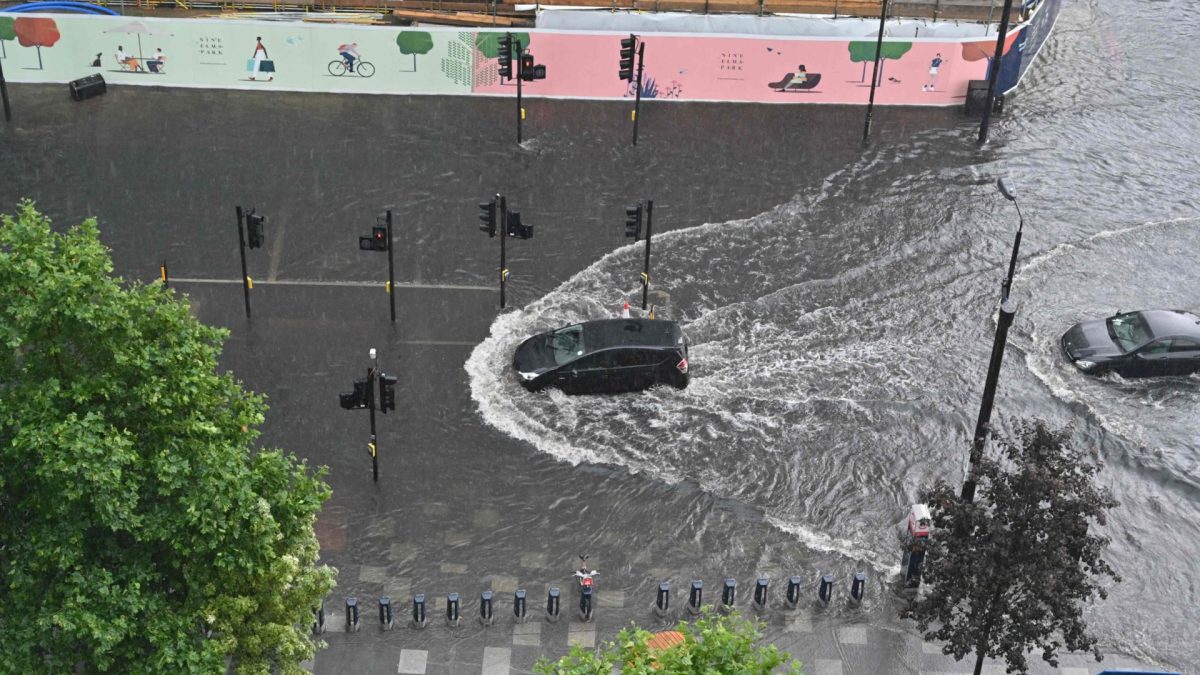
There is a higher-than-usual risk of flash flooding ahead, experts have warned, as thunderstorms are set to hit the hard, dry areas left parched by recent summer heatwaves. The heavy rain currently seen in Scotland and Northern Ireland is expected to become widespread in parts of England and Wales on Thursday. There is a chance of thunder, lightning and localised, surface-water flooding in some places, according to forecasters. Shorts These kinds of flash floods can be particularly dangerous because they can occur very suddenly in urban streets not usually prone to flooding. Philip and Elaine Marco, aged 77 and 76, drowned in their car when severe flash flooding hit a section of Mossley Hill in Liverpool in August 2023. With climate change making heavy rain more common, experts have warned drainage systems could be “overwhelmed”. They urged the Government to introduce more “sponge city” features such as urban wetlands. Drought-hit areas at risk of flash floods Beyond this week’s weather, Jim Dale, founder of British Weather Services, told The i Paper that he “wouldn’t be at all surprised” if flash flooding occurs as summer turns into autumn. He said the towns and cities in the south of England, Midlands and Wales that had seen drought conditions in recent weeks were most at risk. “The tarmacked and concreted areas are always more likely to feel the effects of flash flooding,” said Dale, who explained urban parks and green spaces may be unlikely to help absorb torrential rain. Much of England and all on Wales was in drought during the recent summer heatwave (Photo: Dan Kitwood/Getty) “The ground has been so hard in the heat, even former green areas might not be able to absorb water to the same extent, especially in these drought areas in the south of England, Midlands and Wales. “So towns and cities in these regions in the south, Midlands and Wales – like London, Birmingham, Cardiff – are perhaps the most likely to be affected [by flash floods],” he added. “But it doesn’t mean flash flooding can’t happen in the north of England or further north in the UK. Flash floods can be very irregular events.” The north east, Yorkshire, Cumbria and Lancashire, and Greater Manchester, Merseyside and Cheshire had “prolonged dry weather” status last week. But the rest of England and Wales have been officially in drought. London and other urban areas most at risk About 4.6 million properties in England alone are at risk from surface water flooding, an updated National Flood Risk Assessment found in 2024. The risk of flash flooding is more acute in dense urban areas, research shows. A 2025 study by Aviva found that 14 areas in London were in the top 20 constituencies at risk of surface-water floods. The Essex constituencies of Thurrock, Castle Point, South Basildon and East Thurrock, Basildon and Billericay – along with Bootle and Sefton Central in the north-west – were the other high-risk areas identified by the insurance company. Flash flooding in the Nine Elms area of London in 2021 (Photo: Justin Tallis/Getty) Eight in 10 (80 per cent) homes deemed to be at high-risk of flooding are in England’s towns and cities, according to the National Housing Federation (NHF) analysis of Environment Agency data. Lizzi Hearn, the NHF’s external affairs manager, said the drought this summer “will likely heighten this risk” of flash flooding – calling it a “growing risk” in urban areas which have the most social housing. The NHF wants the Government to adopt clear flood-resilience targets and standards to help housing associations take a proactive approach to managing the risk for tenants. Why ‘sponge city’ design is needed The rise in urban flash flooding risk is due to factors like ageing drainage infrastructure and the rapid expansion of concreted or tarmacked areas, as well as climate change. Experts say the Government and councils should demand more “sponge city” design features such as smarter draining systems with roadside gardens when it comes to housing development. More “permeable pavements” – built with materials that let rain drain right through it and into the ground below – could also help reduce the risk of flash flooding. And creating urban wetlands would allow more rain to be absorbed in Britain’s cities. The Chinese city of Chongqing has designed as a “sponge city” to soak up heavy precipitation (Photo: Qilai Shen/Getty) Dr Carola Koenig, from the Centre for Flood Risk and Resilience at Brunel University, said the Government could “do more to encourage such solutions”. “In our cities we still have drainage systems that were built for Victorian times,” said Dr Koenig, warning that some were at risk of getting “overwhelmed” in flash floods. “We could do more to encourage urban solutions, like more green areas, and permeable pavements and driveways.” Lord Toby Harris, chair of the National Preparedness Commission, said urban flash flooding was “something we’re going to have to take more seriously when it comes to managing flood risk”. He said that in the short-term, councils should be vigilant to clear leaves that may be blocking drains. In the longer-term, planners and builders will have to think about smarter drainage systems and more green spaces. “Lots of people in cities don’t think it [flooding] can affect them, but it can,” said Lord Harris. Friends of the Earth campaigner Paul de Zylva said ministers must do “far more” to protect people from the impacts of severe weather. “That means strengthening the government’s woefully inadequate climate adaptation plans.” Thunderstorms ahead this week BBC Weather has warned of possible thunderstorms and even some “localised flooding” on Thursday, as heavy rain moves down from the north of England into the Midlands and east Anglia. “There could be one or two areas that have some localised surface water flooding… particularly given that the ground is rock hard after all of that dry, hot and sunny weather we’ve seen this week,” said forecaster Chris Fawkes. Met Office spokesperson Stephen Dixon said north Wales and north-west England would see the heaviest of the “thundery downpours” on Thursday – but warned that heavy rain will move down into the Midlands as the day goes on. “Much of that rain will be falling on hard, dry land that is unlikely to be easily absorbed. So there is some potential for surface water impact.” A Defra spokesperson said the Government was investing £10.5bn in flood defences over the next decade. Flash flooding defence projects, which are typically smaller in scope than river and coastal schemes, will benefit from being eligible for full Government funding for the first £3m of their costs. “We have simplified our funding rules, making it quicker and easier to deliver the right flood defences in the right places and have set aside,” they said.
The areas most at risk of flash flooding – as thunderstorms set to sweep UK
Full Article
Original Source
Read the full article at Inews →KhanList aggregates and links to publicly available news content. We do not host full articles from third-party sources. Always verify important information with original sources.