
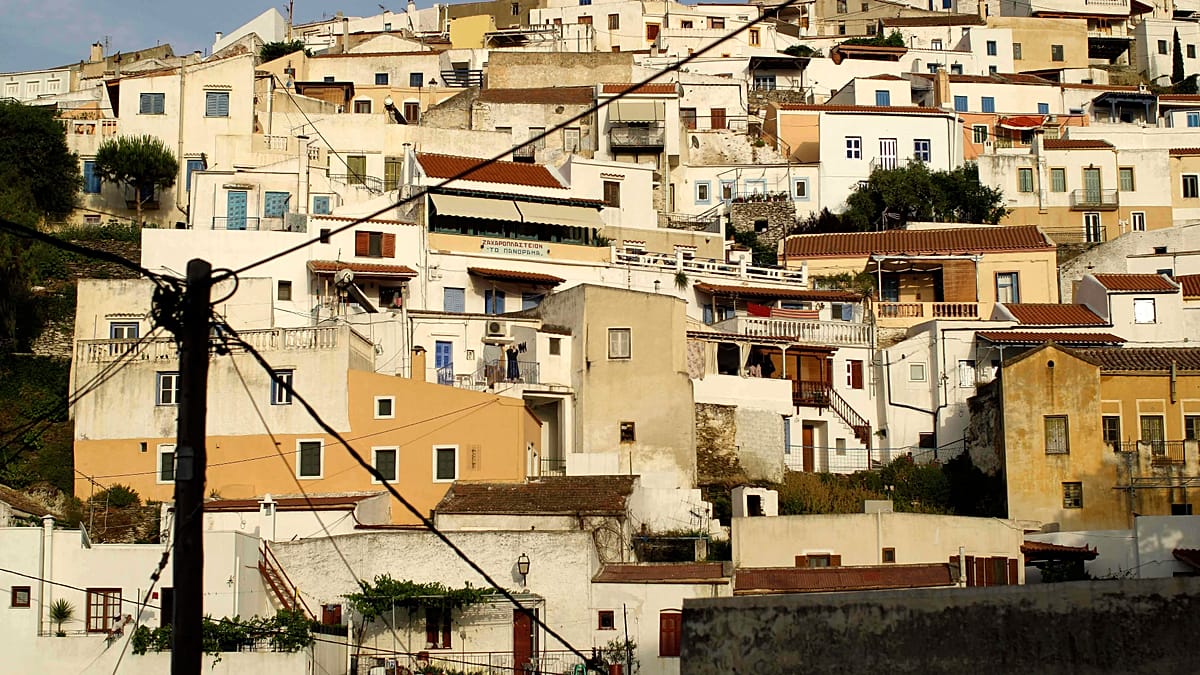
Every summer, Greece's Cyclades islands attract countless visitors from all over the world. ADVERTISEMENT ADVERTISEMENT In recent years, the Cyclades have become increasingly popular with tourists looking for more than just the sun and the sea, with many also choosing to make the trip in autumn or spring to go hiking and take in the local archaeological sites and architecture. Kea, also known as Tzia, is an island in the western Cyclades known for its history and natural beauty. It is described as the "gateway to the Cyclades" due to its proximity to Athens. It is just 16 nautical miles from the port of Lavrio. Ioulida is the island's capital and one of its four historic towns. It is the only one situated inland, having once been the commercial centre of Kea. The architecture of Ioulida differs from typical Cycladic styles, as it incorporates elements of urban and neoclassical construction. "We see the narrow streets, the arches and the stone buildings, and we also see colour on the walls. In fact, Tzia has always been a colourful place. During the Metaxas regime (1936–1940), white and blue were imposed, with white mainly for reasons of hygiene," Rena Velissaropoulou, the mayor of Kea since 2019, said. "But Tzia has colour, and we see this every time we come across an old building where we can see the plasterwork. There, we almost always find colour," Velissaropoulou added. Kea has around 2,500 permanent residents, and despite the growth of tourism, the island has managed to retain its traditional character. Ioulida is built in an amphitheatre-like layout on the slopes of two hills (Kastro and Mylos). In 1978, it was granted the status of a protected traditional settlement. Its distinctive architectural identity is also due to a distinctive type of rock found on the island. "There was also miltos, a type of stone that was quarried in the cave-like pits of an exceptional cave in the Otzia area. This colour is a shade of greyish red, like the colour we see at Knossos, and in the past this stone was exported to Athens,” Velissaropoulou said. As you leave Ioulida and drive up the island’s hills, you will also come across a number of traditional stone buildings. Most of them are uninhabited. Some have undergone minor alterations, whilst others have been converted into tourist accommodation. Preserving them is vital for safeguarding Kea’s cultural heritage and history. "The farmstead is the home, the base of the island’s farmers and livestock breeders, which used to be situated in the countryside. Because their main home was in Ioulida. All farmers who owned farmhouses also had a home in the capital. Usually, the home was the wife’s dowry, and the farmhouse belonged to the husband,” livestock farmer Dinos Vrettos told Euronews. As a rule, farmers did not build on hilltops so as to avoid the strong northerly winds. However, they did not build low down in the ravines either, so as not to suffer from the summer heat. For 25 years, Vrettos he worked as a stonemason, whilst for five years he was part of the excavation team at the ancient theatre of Karthia. With his help, we were introduced to one of the traditional houses which, although no longer in use, retains all the characteristic features of the "Tziotiki dwelling." "They used stones from ancient structures to build the houses. Over the years, the craft passed from one generation to the next, so I learnt it too. Unfortunately, the house in this condition has changed hands; it has been sold. Usually, the houses are bought by foreigners, not Greeks – mainly foreigners who, however, try to preserve them as they found them,” Dinos Vrettos told Euronews. In the Mylopotamos area, along the stream and near the Flea spring, there were also once 11 watermills. Of these, one is now used as a residence, whilst another operates solely for visitors to the island. The watermills likely date back to the period of Ottoman rule. They remained in operation until the Second World War and were gradually abandoned by the 1980s. Savvas Michael, a retired aviation worker, feels he has a duty to keep the island’s history alive. "Technology has advanced enormously. Young people and children being born today have no idea what life was like in the past. So we’re trying to bring young people closer to tradition so that they know what we’ve inherited. Even if we don’t use them anymore, it’s important to keep at least one of them ‘alive’,” Michael said. White and blue dominate most of the Cyclades islands. On Ioulida, however, one encounters vibrant colours, such as yellow and, of course, the red miltos of Kea, a mineral-based red dye that was highly prized in antiquity. When you visit the island, look out for the "kathikies," the traditional stone houses that have stood the test of time.
The architectural heritage of Greece's Kea island: Vibrant colours, stone houses and watermills
Full Article
Original Source
Read the full article at Euronews →KhanList aggregates and links to publicly available news content. We do not host full articles from third-party sources. Always verify important information with original sources.