
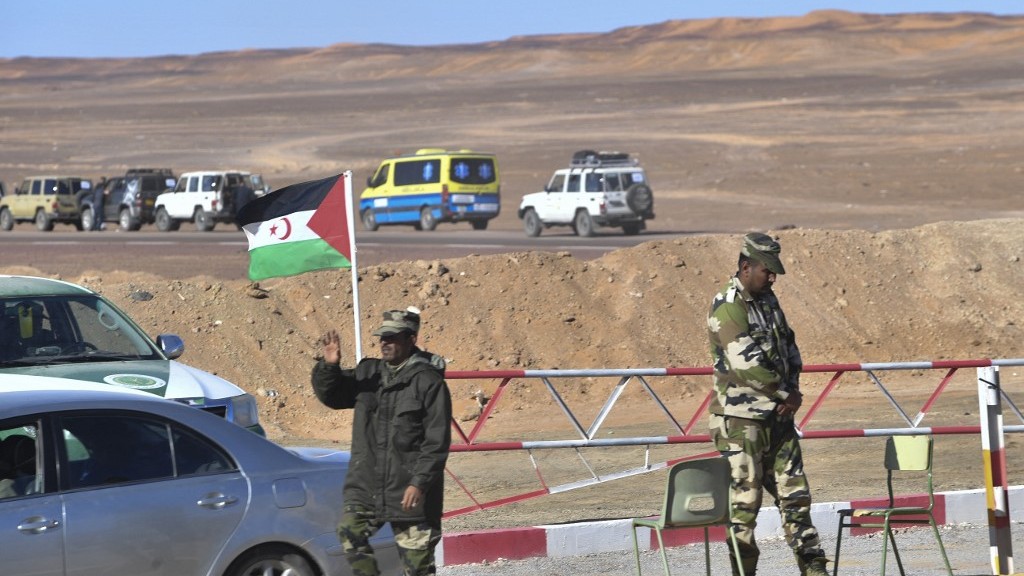
Last week's failure by the UN Security Council to renew the mandate of its Western Sahara mission after 35 years has deepened concerns that the conflict could escalate militarily while slipping further from international attention. The United Nations Mission for the Referendum in Western Sahara (Minurso) was established in 1991 to monitor a ceasefire between Morocco and the Polisario Front, the armed group fighting for Sahrawi independence in the territory, and pave the way for a referendum. That ceasefire collapsed in 2020 and the referendum never happened. New MEE newsletter: Jerusalem Dispatch Sign up to get the latest insights and analysis on Israel-Palestine, alongside Turkey Unpacked and other MEE newsletters Sunday appeared to be the final nail in the coffin for the peace process, with Minurso's mandate expiring after Russia and the US both vetoed each other's resolution to extend it. The Polisario Front’s top diplomat told Middle East Eye that they were largely optimistic over the outcome as they had long viewed Minurso as ineffective at best and complicit with Morocco at worst. The failed US resolution would have removed the word “referendum” from the mission’s name, changing it to the United Nations Mission in Western Sahara, and made Morocco's much-maligned "autonomy plan" for the Western Sahara the only basis for further progress. 'Now we are back to square one' - Mohamed Beisat, SADR foreign minister The plan, first put forward by Morocco in 2007, would grant limited autonomy for the region while keeping it under the kingdom's sovereignty. It has been backed by many members of the international community and for the first time described last year by the UN Security Council as "a most feasible outcome" to the conflict, but rejected by the Polisario Front. "The Russian veto saved the legal basis of self-determination," said Mohamed Yeslem Beissat, foreign minister of the Sahrawi Arab Democratic Republic (SADR), a Polisario-dominated administration that rules five refugee camps in Algeria and 20 percent of Western Sahara. Beissat added that the stalemate in the Security Council meant that Morocco's autonomy plan was effectively dead in the water, as Russia would likely veto it. "At least in the short to medium term future, they cannot bring it again to the Security Council," he said. There would also be no UN force to guarantee it on the ground. "Now we are back to square one," Beissat said. North African instability Western Sahara is often referred to as the last colony in Africa and is included in the United Nations list of non-self-governing territories. Occupied by Morocco since 1975, the region has been claimed by native Sahrawis, while the Algeria-backed Polisario Front has fought against the Moroccan state for independence for decades. 'The risk is that a military incident inside Western Sahara's buffer zone, no longer monitored by the UN, could ignite a larger military escalation' - Riccardo Fabiani, International Crisis Group Hundreds of thousands of Sahrawi refugees live across the border in camps in southwestern Algeria, while independence campaigners in Western Sahara have faced repeated repression by Moroccan authorities. In 2020, the US agreed to accept Morocco's sovereignty claim over the territory in exchange for the kingdom normalising ties with Israel, which has also recognised Morocco's rule over Western Sahara. Beissat said he was baffled by the US's repeated decisions to follow Morocco's lead and bury the original referendum plan. "The alternative to diplomacy is war. That’s the message the UNSC have sent to the world," he said. Beissat added that the European Security Council members who voted along with the US in support of their motion had voted against their own self-interests as any return to conflict in North Africa would impact them. "If there is instability in North Africa, who will suffer? All of Europe! Refugees will come to Europe," he said. "They didn’t care. It’s more important for them to rally with America than defend their own interests in the peace and stability of North Africa." The UN has already begun the process of liquidating its operation in the Western Sahara city of Laayoune, handing its assets over to Morocco. Rabat stated on Wednesday that it would continue with its "voluntary" committment to a ceasefire in the Western Sahara while also protecting its territorial integrity and national security. Eighty percent of the Western Sahara is controlled by Morocco up to a defensive sand wall - called the Berm - it built in the 1980s, while the rest is held by the Polisario Front. 'Without [Minurso], I fear Western Sahara will become easier for the world to forget' - Asria Taleb Mohamed, activist Polisario declared the ceasefire over in late 2020, targeting Moroccan bases along the Berm. Morocco, meanwhile, has targeted Polisario's territories, mostly with drone strikes. The raids and insecurity have prompted thousands to flee either into Mauritania or into Algeria's refugee camps, which are administered by Polisario under Algiers' aegis. Without UN monitoring, any violence between the Polisario Front and Morocco risks spiralling out of control - potentially dragging in Algeria - and the sides could see an opportunity to capture territory. "The risk is that a military incident inside Western Sahara's buffer zone, no longer monitored by the UN, could ignite a larger military escalation, with Rabat potentially taking over this area and the Polisario attacking Moroccan defence facilities directly from Algerian territory," Riccardo Fabiani, North Africa project director at the International Crisis Group, told MEE. "It's this kind of scenario that the disappearance of the Minurso will make more plausible from now on." Dropping off the radar As an issue, the Western Sahara has largely been overlooked compared to Israel-Palestine or other destructive conflicts in the Middle East and North Africa. The midterm elections in the US have given some hope for a shift in future foreign policy aims, but the Western Sahara portfolio saw little change between the Joe Biden presidency and Trump's administration. Asria Taleb Mohamed, a Sahrawi artist and human rights campaigner, said she was worried about the Western Sahara dropping off the radar altogether. “For more than 30 years, Minurso kept Western Sahara on the Security Council’s agenda - it meant that the world’s most powerful states had to address our situation, and that the UN secretary-general had to report regularly on developments," she told MEE. "Without that presence, I fear Western Sahara will become easier for the world to forget."
'The alternative to diplomacy is war': Polisario warns of risks after collapse of Western Sahara UN mission
Full Article
Original Source
Read the full article at Middleeasteye →KhanList aggregates and links to publicly available news content. We do not host full articles from third-party sources. Always verify important information with original sources.