
Walking across the gritty New Jersey ball field for the first time since he played here as a boy, Samuel Alito couldn't help but stop to analyze the playing surface.The pebbles were bigger back then, he said, the field more uneven. These sounded like minor details for anyone to notice, but Alito saw something more. A rougher surface, he explained, makes it harder for infielders to field ground balls."I played second base. And my best friend Ronnie played shortstop. He had a stronger arm, so we were the double-play combination," Alito said, before pausing to correct himself with a laugh. "In my fantasy, we did it all the time. But maybe we did it once or twice." For a young Alito, baseball was his passion, and he was no fair-weather fan. His beloved Phillies were among the worst teams in the major leagues. Longtime Phillies fan Justice Samuel Alito Photo provided by Justice Samuel Alito "It's a sign of bad character if you abandon your team just because they're having a bad streak," he said. "Some people would think I could be quite stubborn, but I've stuck with the Phillies through thick and thin. Hope springs eternal."It's been 60 years since Alito last played on this New Jersey field or, just down the road, walked the hallways of his old high school, where he served not only as its valedictorian, but student council president, editor of the student newspaper and a key member of both the debate and track teams. "It seems familiar," he says as he takes it all in, "and also seems somewhat different." On this day outside Trenton, he's dressed casually, in a slightly rumpled polo shirt and khakis. He goes largely unrecognized. Without his black robe, no one seems to realize Samuel Alito is one of the most influential Supreme Court justices of our time. CBS News' Jan Crawford sat down with Justice Alito on the bleachers of the New Jersey baseball field where he played as a boy. CBS News Portrayal of him as "angry" or "bitter" strikes Alito as "a caricature"The current Supreme Court is referred to as the "Roberts Court," after Chief Justice John Roberts, and Roberts is typically the justice most often in the majority. But Alito is in many ways the Court's conservative leader. His legal positions going back years on abortion, affirmative action, voting rights and religious liberty now are law of the land. To critics, that makes Alito a villain who is taking away rights from women and minorities. They see him as "angry," his decisions fueled by "grievance" or "seeking revenge for the '60s." Alito calls that portrait unrecognizable. "The idea that I'm angry and that I'm bitter and that I'm trying to get revenge for something that I experienced at an earlier point in my life is a caricature," Alito said. He says he is applying the Constitution as its framers intended. But his impact on the Court goes well beyond his own vote.Among the nine, Alito is especially skilled in bringing together five justices for a majority on some of the Court's most difficult and contentious issues. That includes his 5-4 majority decision in Dobbs v. Jackson Women's Health Organization, which overturned Roe v. Wade and sent the issue of abortion back to the states. That may seem a contradiction: The justice often publicly portrayed as unyielding and inflexible is, behind the scenes, the conservative who is uniquely adept at finding common ground on the most divisive issues.It's a skill formed on the fields and classrooms of Hamilton Township: His focus and attention to detail, his loyalty, his quiet leadership style, and his ability to survey the playing field and adjust, all to make the winning play.Alito is almost repelled by the public spotlight, but he has written his first book, "So Ordered: An Originalist's View of the Constitution, the Court and Our Country." A collection of his speeches, the book is both a defense of his "practical originalist" approach to judging and a warning that America's constitutional system is under growing institutional and cultural strain.Alito agreed to talk with me about it in a rare television interview. Our remarkably candid conversations, in his hometown in New Jersey and at the Supreme Court, spanned several hours and provided a substantive look at one of the most important and often mischaracterized figures in American law.Considered retiring earlier this year, but says,"I think I can still make a contribution"After two decades as a justice, Alito said he considered retirement earlier this year. Now 76, he said, "it's something I think that somebody at my age has to think about every term." Some conservatives had urged him to step down while Republicans have control of the Senate, so that President Trump could nominate his replacement. But Alito said that wasn't a factor in the decision."It's too hard to predict what the political situation will be," he said, "and what any president might do with respect to a replacement."Sitting in one of the Court's formal conference rooms, with gilded framed paintings of former chief justices hanging on the richly paneled walls, I asked him if he thought about his role and influence on the Court when he decided to stay."I think I can still make a contribution," he said. "And it's hard to give up the opportunity to do something that I think will be good for the Constitution and good for the country as long as I'm able to do it."Alito refused to contemplate his legacy, saying no justice should ever consider it. But when prompted, he detailed a coherent body of work since he joined the Court."We have stood up for freedom of speech, which is endangered. We have done a lot to protect religious liberty," he said, pointing to what he called an "alarming picture" at colleges and universities. "We have vindicated the principle that the laws should be applied equally to everybody, regardless of race or ethnic background," he continued. "We have tried to restore the original structure of the government as it was set out in the Constitution — but that's an ongoing project." That's not how his critics view those decisions, which they say have empowered a corrupt president and hurt the country, especially women and minorities. What is beyond dispute is that Alito has done much more than to simply contribute to the Supreme Court's decisions. Alito is the principal architect of the Court's religious liberty jurisprudence, giving greater protections for people to freely exercise their religious beliefs. In his book, he writes that religious liberty is part of human dignity, and he warns of a "new moral code" that treats people with traditional beliefs on marriage and biological sex as bigots. On voting rights, Alito's opinions over the years set the stage for his majority decision last term in Louisiana v. Callais, which said the state's 2024 congressional map that added a second majority Black district was unconstitutional. That landmark ruling restricts states from grouping voters together based on race when drawing up legislative districts to elect more minority candidates. "Stunned" by leak of Dobbs decision draftBut the opinion that will most define Alito is Dobbs, the 5-4 decision that the Constitution does not protect a woman's right to an abortion, meaning states could ban or restrict it. Since the June 2022 ruling, 13 states have enacted complete bans. Months before the Court released the decision, a copy of Alito's draft opinion was leaked to Politico, an unprecedented breach he said has had lasting consequences for the Court and how the justices interact. "The leak has cast a pall over the Court to a degree because we don't know who was responsible for that," Alito said. "It's something that I don't think we can get out of our minds."The fallout began in late April 2022, when Politico notified the Court that it had a copy of the draft and intended to publish it. The justices were gathered in the Court's private dining room for one of their regular lunches when the chief justice told them of the leak. By tradition, the justices have lunch together when they're in the building for arguments or conference, sometimes a few days a week. It's a chance for them to talk about anything other than the cases. That's the one rule. Hearing during a collegial lunch that a draft opinion had leaked for the first time in Court history was difficult for the justices to process. Alito said he was "stunned.""It was quite a shock," Alito said. "But within a relatively short period of time, the thought occurred to me, and I think to the others in the majority, that this would endanger us. And it made us targets for assassination."Security, Alito said, ramped up immediately. A month later, in June of 2022, the world would know why. In the middle of the night, as Justice Brett Kavanaugh and his family slept in their Maryland home, a would-be assassin approached their backyard with a bag containing a gun and rounds of ammunition, a knife and nail punch, duct tape, zip ties, a crowbar and other burglary tools, including special shoes to silence his footsteps. He was intent on killing justices before the Court released its Dobbs decision. With its narrow 5-4 majority, it would only take one justice. He said on private messaging boards he aimed to kill at least three of the conservatives and, as prosecutors later put it, "single-handedly and irrevocably to alter an entire branch of the United States government."At the last minute, the man spoke to his sister on his cell phone, and she managed to talk him out of it. He was arrested and later convicted for the attempted assassination of Kavanaugh. "His goal was to change the decision in the case. So that was quite predictable," Alito said. "And whoever leaked it knew or had good reason to know that that would be the consequence of leaking it. And Politico knew, or should've known, that that would be the consequence of their decision to publish it."Politico has explained its decision to publish the leaked draft as an "unprecedented view into the justices' deliberations" that is "plainly news of great public interest." The leaker remains unknown. After Politico published its piece in early May, one theory was that a conservative had leaked the draft to keep the five votes in place, in case any of the justices in the majority were wavering. Alito was almost incredulous at the suggestion. "It's implausible that any of us would have done that for exactly the reason I've mentioned, because this pinned a target on our backs," Alito said. "And it was very fortunate that that planned attack (on Kavanaugh) was not successful." Alito says he lost friends over Dobbs decision overturning Roe v. Wade 01:30 Beyond creating a sense of distrust, Dobbs also changed how the Court operates. Because of death threats and protests, justices now travel with security and have officers guarding their homes. Justice Amy Coney Barrett has talked about having a bulletproof vest. Even justices' family members have received threats at their homes. I asked Alito about the death threats and if he ever regretted writing Dobbs. His response was immediate."No," he said. Even, I asked, in light of the personal costs? "No, not at all. It was a privilege to be able to write it. And I don't regret it, despite what it led to," he said. "I don't think I anticipated the particulars of what it led to. I did anticipate that there would be strong opposition." How the Supreme Court's opinions are writtenDobbs was an especially challenging decision for any justice to write. Five justices — Alito, Clarence Thomas, Neil Gorsuch, Kavanaugh and Amy Coney Barrett—believed Roe was wrongly decided and should be overturned. But they had somewhat different views on what that opinion should look like. With Roberts in dissent, urging the five not to overturn Roe, Thomas was the senior justice in the majority. He assigned Alito the opinion."I thought long and hard before I started drafting about what we should say, how it should be said — the structure, the tone," Alito said, "and what I thought each of my colleagues would agree with and would not want to have in the opinion." Outside the Court, few understand Alito's powerful role within it. Assembling and keeping together a majority is the whole ball game. Liberal icon William Brennan used to say the most important thing for a Supreme Court justice to know is how to count to five, and he was able to build coalitions with his legendary gift of personal persuasion and strategic compromise. Alito, reserved and unassuming, has a very different approach. His influence is not through force of personality, but in his ability to thread the needle and find the rationale a majority will agree with. Those skills allow him to forge consensus for an opinion that moves the law as far as is practicable at the time. "The most important thing to know is to be true to the Constitution. Getting to five is important. But you should not try to get a majority opinion if that means sacrificing something that is important," he said. "I will never adopt a legal rule that I think is wrong, or say something that I think is wrong. But without doing that, there are ways of trying to keep a majority together." That image of Alito as the practical, prudent consensus builder is far removed from how he's typically portrayed. That could be, in part, because he isn't always in the majority, especially in cases involving President Trump, and he can be forceful in dissent. He speculates that people also make assumptions based on his demeanor on the bench during oral arguments. His law clerks describe him as a "heat-seeking missile" who can swiftly and efficiently find weaknesses in a case. A former federal prosecutor, Alito also argued 12 cases before the Court as a Justice Department attorney in the Reagan administration. "At oral argument, I am not trying to put on a show. The purpose of oral argument is to help the decision making process," Alito said. "If a lawyer is trying to lead the Court in a direction that I think is contrary to the Constitution and would be bad for our legal system and for the country, then I will challenge the lawyer. And I will do it robustly. I used to argue cases. And I welcomed hard questions from judges."Alito's temperament off the bench may help explain why he is more effective than his public image would suggest. He attributes his reserve to his father, but says he also has aspects of his mother. "His nickname when he was in high school was 'Silent Sam.' And people have called me that too," he says. "My father believed very strongly that you should never show emotions in public." "My mother was much more hot-tempered," he says with a smile. "So I feel these two tendencies inside me." Alito said he learned how to organize an argument and build an outline in high school, while at home, his father reviewed all of his writing assignments, sharpening his critical thinking. Family photo of Justice Samuel Alito's parents, Rose and Samuel Alito Sr. Provided by Justice Samuel Alito "We would sit down at the kitchen table. And he would go over every sentence and every word, and, 'Why did you choose this word,' and a lot of stylistic instruction," Alito said. "But also, the most important thing I got out of it was his admonishing me that, 'if you have written something that is hard to understand, the problem probably is that you hadn't thought it through. If you had a clear idea about what you wanted to say, then the language would be clearer.'" In other words, Alito is very good at keeping his eye on the ball and studying the field to see how the doctrine can be explained in a way that other justices can sign onto. He doesn't always try to swing for the fences."I have a theory about how the Constitution should be interpreted. I believe it has a fixed meaning. And it still means today what it was understood to mean when it was adopted. And I will not depart from that," he said. "But it is not necessary in every case to go as far as one might want to go if you were just writing the opinion for yourself."For Alito, opinion writing starts in the Court's private conferences. That's when the justices meet in the intimate paneled room adjacent to the chambers of the chief justice to discuss recently argued cases and cast their initial votes. It's just the nine of them, no assistants or law clerks. Alito listens carefully to understand the positions of other justices, seeking "to find ground that I think everybody will be able to agree with." After circulating a draft opinion, the other justices weigh in. That's how the Court operates, by an exchange of memos and written suggestions. It's where a justice can lose votes if he or she can't assimilate suggestions from other justices in the majority. Doing that also requires no small dose of humility."I will get memos saying, 'I will join if you put this in, or you take this out.' And sometimes those can be pretty extensive. And I see my beautiful work product being torn apart," Alito says with a wry smile. "It can be brutal, because before I send around a draft opinion, I spend a lot of time on it. But I'm not writing in that instance just for myself. I'm writing for the Court."Dobbs is a good example. Thomas said he thought the Court should go even further and reexamine cases on same-sex marriage and contraception. But other justices, like Kavanaugh, were opposed to that. Alito was able to find through lines they could agree on. Thomas joined the majority, but wrote a separate concurring opinion detailing his more far-reaching views, as did Kavanaugh, expressing his own more narrow ones.As a result, despite the leak and personal risks to the five justices, Alito said he never thought he would lose a vote."Everybody in the majority had made a very significant contribution to the draft opinion that was leaked to Politico," he said. "So it was not just something that Sam Alito wrote. It was a draft opinion from the Court."There's "not a realistic prospect" same-sex marriage decision will be overruled, Alito says Throughout our conversation it's evident Alito greatly admires Thomas, who he says "will go down as one of the most important justices in the history of the Court." The two are the Court's most reliable conservative votes, and they have been a formidable pair in transforming American law. Thomas frequently writes bold solo opinions, staking out uncompromising positions on where he believes the law should be. Alito may agree, but he is more restrained, moving the law as far as it will go in the moment. "We each contribute something different to the court," Alito said. "And he, in many respects, is writing for the ages. So he has very strong, clearly thought out, coherent ideas about the meaning of various provisions of the Constitution."One thing Alito makes clear Dobbs did not do: Call into question Obergefell v. Hodges, the landmark ruling guaranteeing a right to same-sex marriage. Despite Thomas' arguments, Alito says that case is different because people have come to rely on it to organize their lives unlike, he says, with Roe. Alito made that point in his majority decision, and he emphasizes it in his book. While he refused to directly say how he would vote if a case ever reached the Court, in our interview he all but said Obergefell is settled law. "I did not think that there was any realistic prospect that it would be overruled because of the passage of time and the developments in the country," he said. "I knew that the decision in Dobbs would be attacked on the grounds that this is a terrible decision not only because of what it says about the right that was identified in Roe, but also because it will mean that these other decisions — Obergefell and contraceptive decisions — are also going to be potentially overruled. And that was not a realistic prospect. And I wanted to lay that out."Alito said even though in Obergefell he rejected the idea that the Constitution guarantees a right to same-sex marriage, the case remains settled law under principles of stare decisis, which means "to let the decision stand.""One of the important factors we take into account in deciding whether we should reexamine a past decision is the degree to which there has been reliance on the decision," he said. "Obviously a great deal had changed in the country as a result of Obergefell. There was a lot of reliance in various ways on the decision in Obergefell." I pointed out that people thought Roe v. Wade was settled law of the land, had organized their lives around it. Overturning Roe also would have consequences.Obergefell, he said, was different. "After Obergefell, people of the same sex got married and entered into contracts … it was much more concrete," he said. "Whereas with Roe, the argument was made that it had an effect on people's ideas, women's ideas about the kind of society that they were going to live in, that this would have an effect on the society. It was much more abstract than what would've been involved had we been asked to overrule Obergefell." Aftermath of Dobbs: Ethics allegations and the flagsIt's undeniable that Dobbs has had a lasting impact on the Court and its public standing. Democrats organized political campaigns against it. Some states amended their constitutions to specifically protect a right to abortion. And it opened justices in the majority to scrutiny like never before, laying the foundation for claims that the Court is corrupt and in need of reform. As the author of Dobbs, Alito faced questions about ethics as a result of accepting a trip to Alaska in 2008 on a billionaire's private jet. Alito said he followed the hospitality rules in place at the time, and a federal appeals court judge on the same flight said his court's legal office told him the trip did not need to be disclosed under ethics rules. But it became part of a steady drumbeat of scandal, allegations that Alito says have hurt the Court."I don't think most people read and know about the details of any of these incidents," Alito said. "They see on the news 'ethics allegation against Thomas, ethics allegation against Alito, another ethics allegation against Thomas, another ethics allegation against Alito.' It doesn't go any further than that. And drip, drip, drip, this affects the way the public thinks about the Court."Then came the flags. The New York Times reported that an upside-down American flag had flown outside Alito's Virginia home. Later, it reported an "Appeal to Heaven" flag flew outside their vacation home. Critics said the flags were used by some groups to show support for efforts to overturn the presidential election on Jan. 6. Democratic Senators Sheldon Whitehouse and Richard Durbin, two of the Court's most vociferous critics, demanded Alito recuse himself from cases involving Donald Trump.In response, Alito wrote them a letter, emphatically denying any involvement. "My wife is fond of flying flags," he wrote. "I am not.""My wife decided to fly a flag. I wasn't even aware of what she was doing until one of our police officers informed me," Alito told me. "And I asked her to take it down. And she did eventually. But she's a very independent person. And she's a private citizen. And she has her rights."I said it was hard for some to understand why he didn't insist she take it down immediately. "That's not the nature of our relationship. I don't actually have the legal right to tell her what to do with a home that we own jointly," he said. "Plus I am not the lord and master of our household. That's not our relationship, and it's not the one that I want." Alito said he'd asked her to take it down because he knew it would cause controversy, even though he said it resulted from a spat between his wife, Martha Ann, and a "hostile neighbor" angry about the Dobbs decision. Mrs. Alito, outgoing and not shy about speaking her mind, has said she flew the upside-down flag as a statement, "a symbol of distress."Alito said he believes the controversy was part of an effort to force him to recuse himself from the 2024 case involving Trump and presidential immunity. He said there was no reason to recuse himself, and ultimately joined Roberts' majority decision that said presidents have immunity for their official acts."We are not attempting to further any political agenda"Because of his expansive views on presidential authority, Alito has been spared the ire of President Trump. He's praised Alito as one who "wants to make America great again" while calling other justices who've more often ruled against him "fools" and "lapdogs." The praise and the criticism bother Alito. "We are not part of any political movement. And we are not attempting to further any political agenda," he said. "We are trying to interpret the Constitution as best we can and apply it in the cases that come before us." I asked Alito how damaging the criticism, coming from political leaders on both sides, is for the Court."I think it's damaging. I think it can be quite damaging. There's been a great change in what presidents have said about the court when they are unhappy about our decisions," he said. "But the criticism of the court — I want to be even-handed on this. The criticism of the Court by President Biden and justices, by President Biden and his administration, was very harsh. And President Trump has been very harsh." A recent study by the Wall Street Journal showed Alito has sided with President Trump more than any other justice. I asked him if he would decide those cases the same way if Donald Trump weren't in the White House."I absolutely sincerely believe that I would. I'm not trying to decide cases to help President Trump," he said. "And I have not decided cases in the past to help or hurt any other president or presidential administration."In some cases, like the cases rejecting Mr. Trump's sweeping tariffs policy and his efforts to redefine birthright citizenship, Alito is casting a vote in dissent. He's also been in dissent in a number of emergency applications seeking immediate review. In those emergency cases, procedurally Alito doesn't need to make his vote public. He could simply remain silent if he disagreed with the Court."I was actually approached at a social event by a person in the world of politics, a well-meaning and generally sympathetic person who said, 'You know, you would burnish your public image if you would just decide a few of these cases differently," Alito said. "This person was well-meaning, but that's absolutely wrong. That's not what we're supposed to do. He used the old baseball metaphor that judging is like being an umpire calling balls and strikes. If there are 10 balls in a row, he said, you still can't call the 11th ball a strike."If the balls are in the dirt, or outside the strike zone, it's a ball," he said. "And that's how you have to call it, and try to balance what you do for the two sides."But Alito says judges, like umpires, still have to make judgment calls, and neither can be a purely mechanical exercise. He describes himself as a "practical originalist," who believes the law has to work. An outcome that seems wrong or unworkable shouldn't dictate the decision, he said, but it should prompt a judge to "go back and check our work." "We should think again to see, 'Is this really what the Constitution demands? Is this really what the law demands?'" he said. "In the end, if that's what it says, then that's what the decision has to be. But we shouldn't happily accept results that seem to make no sense."Critics of originalism say it's merely a method of interpretation to get results conservatives want. I asked Alito if there was a case where he personally disagreed with the outcome. He initially resisted the question, saying justices shouldn't share their personal views. But then he offered an example: Murphy v. NCAA, his 2018 decision striking down a federal law banning gambling on sports."We paved the way for sports betting throughout the country. And I personally hate gambling. I think sports betting is bad. It's bad for sports and bad for society," he said. "But that's what the Constitution required. And so that's what we did."Lost friends over his decisionsAlito says he's lost friends as a result of his decisions, mentioning Dobbs as one example. That surprised me, since he's been consistent on the issue of abortion going back to his time on the 3rd Circuit. "Maybe they didn't anticipate it for that case," he said. "Or maybe they thought, 'He's now amassed such a horrible record that he must be a terrible person.'"I asked him if that's part of the job of being a justice today. You're going to lose friends. You're going to get protested. You're going to have death threats. You're going to have to wear a bullet-proof vest. The threats come from all sides, with liberal justices on the receiving end when the Court rules against Mr. Trump."It's part of the job that you're going to displease people by making decisions on controversial matters because one side or the other is going to really dislike you because of the decisions," he said. "The physical threats and the harassment represent something new in our society, and something that's quite disturbing." "I think it's a danger," he said. "It's a danger for the courts. And it's a danger for others in public life."Executive orders and the emergency docketThe playing field has changed since Alito joined the Court in 2006. Adding to the strain on the Court, Alito said, are emergency applications that "have gone through the roof" since the beginning of Mr. Trump's second term. Those are cases outside the Court's regular deliberative process, where it schedules arguments and has full briefing. President Obama famously said in his first term, "I've got a pen and I've got a phone," meaning he could sign executive orders and add new regulations independent of Congress. But the Trump administration has taken the use of executive orders to unprecedented levels, prompting legal challenges in lower courts, mainly in areas with more liberal judges. When those judges rule against the administration, it immediately goes to the appeals courts with urgent requests to intervene.Last term, the Court had almost as many of these emergency applications as merits cases. Critics, including lower-court judges, say the justices are rushing through these cases and offering little to no explanation of their reasoning.Alito said there has been a dramatic increase because "the constitutional system is not working the way the framers intended.""A lot of this is caused by the fact that presidents have become increasingly frustrated by their inability to get Congress to enact their legislative program," Alito said. "And so they've said, "Okay. I'm going to do everything that I can with my own power without needing any assistance from Congress. It puts us in a very difficult situation."Both parties are eager to go to court to challenge an opponent's policies, and they typically pick courts they believe will give them a friendly reception. During the Biden administration, most of the Republican challenges to presidential policies were in Texas. In President Trump's second term, most of the Democratic challenges are in Massachusetts, Washington, D.C., or San Francisco. "The district courts in some instances have gone overboard," Alito said. "And these cases come to us. And we have this constant clash."Alito said the Supreme Court was trying to provide more study and explanation in some of these cases. They have listed some for oral argument or granted full argument right away — including a case last week on President Trump's third-country removal policy for illegal immigrants."We have tried to provide a fuller opportunity for the parties to make their case and to give us a better opportunity to study the cases and think about the cases than we do when we have to decide them very, very quickly. So, sometimes we can list them for oral argument. Sometimes we've granted full review right away," Alito said. "But there's a limit to how much of that we can do. And if something is really an emergency, so that one side or the other is gonna be hurt until the emergency matter is resolved, saying 'We're going to have our oral argument two months from now and then issue a full opinion, maybe two months later' — that is not really a good solution to the problem."The emergency cases have kept the Court in the center of political controversy, adding to the other strains on the justices — the heightened security and threat levels, fear of leaks and what they see as false and irresponsible attacks on the Court implying scandal and corruption. That's all led to tensions inside the building and driven the justices to become even more cloistered. Some, like Justice Thomas, have spoken publicly about how the dynamics inside the Court have changed, how much they miss former colleagues and what they remember as a more collegial atmosphere inside the building. There is more tension now. Attendance at the justices' lunches inside the Court has dropped off.Alito said the justices "still work together cooperatively" and have "pleasant interactions, pleasant conversations" at their lunches and the occasional dinners. But he said external pressures have taken a toll.Close friend Stephen Breyer "would pop in here to talk about cases … and it was delightful"As we stood in his chambers, he reminisced about retired liberal Justice Stephen Breyer. In contrast to their public images, justices have friendships across the ideological aisle, and Alito was especially close with Breyer, who would burst into his chambers so often that Alito's law clerks compared him to Kramer in the sitcom "Seinfeld." Even though they disagreed in the major cases, they have similar methodologies: both are pragmatists who care about the consequences of their decisions. Both also have a similar, self-deprecating sense of humor."He is a brilliant man and very erudite. But he wears his erudition lightly, and doesn't take himself too seriously. I do miss him. He lit up lunch time, every time we had lunch," Alito said, smiling. "And he would pop in here to talk about all kinds of things. He would pop in here to talk about cases. But he would also come in to talk about whatever he happened to be interested in at the time, literature or music or things that were going on in the world. And it was delightful."I reached out to Breyer to ask him about this. Now a professor at Harvard Law School, Breyer still has an office in the Court and often is in the building. He called Alito "a good friend," and said that while they didn't always reach the same conclusions in cases, he was "always interested in what he thinks.""Our relationship is a good example of a simple fact that I have noticed here at the Court over the years," Breyer said. "We can be personal friends without always agreeing about legal results."Alito brushed off my question about whether he worried those days of collegiality and friendship are over. He instead kept his focus on what Breyer contributed to the Court."Steve reached out to everybody. He was very outgoing and charming and gregarious," Alito said. "His personality is a lot different from mine. But I should probably do more along the lines of what he did. And probably we all can take more of a lesson from him."Alito pointed out a picture from his welcome dinner, another Court tradition, that he has displayed near his desk. When a new justice joins the Court, the second most junior justice is responsible for organizing a dinner in their honor, featuring menus or entertainment that's meaningful to their new colleague. Breyer was in charge of Alito's dinner. Toward the end of the dinner, Breyer announced "a special guest," and opened the door. In walked the Philly Phanatic, the mascot of the Philadelphia Phillies. In the picture, the mascot is hugging Justice Thomas. Alito has it on a shelf by his desk, what he calls his "little baseball museum" of Phillies paraphernalia and personal items, like the Silver Glove award he received as a best defensive player when he participated — as an adult — in a Phillies baseball camp.Alito's chambers and his prized possessionAt the Court, the justices' chambers all are a reflection of their personalities. Justice Elena Kagan's chambers have a more modern feel, like an office you might see on the Upper West Side of New York, where she grew up. Justice Neil Gorsuch's is a homage to his roots in the West. Retired Justice Anthony Kennedy previously occupied Alito's office, and his decor was grandiose, featuring a red carpet with gold stars.Alito's office has no pretensions. The carpet with the gold stars is gone. Alito's shelves are overflowing with books and keepsakes he's accumulated over the years and, he said, "various items that my wife thought would be better here than at home."But at his desk, Alito can glance above the fireplace and see what he calls his "prized possession." It's the copy of his father's birth record that the Italian Embassy gave him after his confirmation to the Court.The date on the birth record reveals it took two days for someone to walk to the town to report that Alito's father was born. The entry in the book was written not by one of Alito's relatives, but by a local official. "It's very moving for me," Alito said. "Neither of these two people who walked to town could read or write … so the official had to do it. So it's (a) meaningful document for me." Undated photo of Justice Samuel Alito with his father, Samuel Alito Sr., before a Supreme Court argument. Povided by Justice Samuel Alito Alito's father came to the United States from that small village in Italy as a child and grew up in poverty. His mother's parents also immigrated from Italy as peasants, seeking a better life. Both became educators with advanced degrees, his father a lawyer and public official and his mother, a trailblazing high school principal. "They really did believe in the American dream, and they believed in the fundamental values that underlie our country … the view that's expressed in the Declaration of Independence that all people are created equal and that they're endowed by their creator with certain inalienable rights," Alito said. "That's how I was raised. "But it's not just how I was raised," he continued. "It's what I believe, and what I believed after a lifetime of education and experience. I still believe in all of that."His father's birth certificate is next to Alito's own official Supreme Court portrait, a painting that will be displayed in the Court after his death. In the painting, Alito is standing in the Court's Great Hall in his black judicial robe, and in the background are everyday people coming into the Court.It's a striking image, the birth certificate together with the portrait: The humble origins of the father and the achievements of the son, a testament to the American experience. "It is the American dream," Alito said. "And it's been a dream that's been realized by generation after generation."Watch more of the interview Monday on "CBS Mornings" and "CBS Evening News." Jan Crawford is one of the nation's leading experts on the Supreme Court. She has interviewed multiple justices during her 30-year career, and her book, "Supreme Conflict: The Inside Story of the Struggle for Control of the United States Supreme Court," was a New York Times bestseller. In: Supreme Court of the United States Samuel Alito
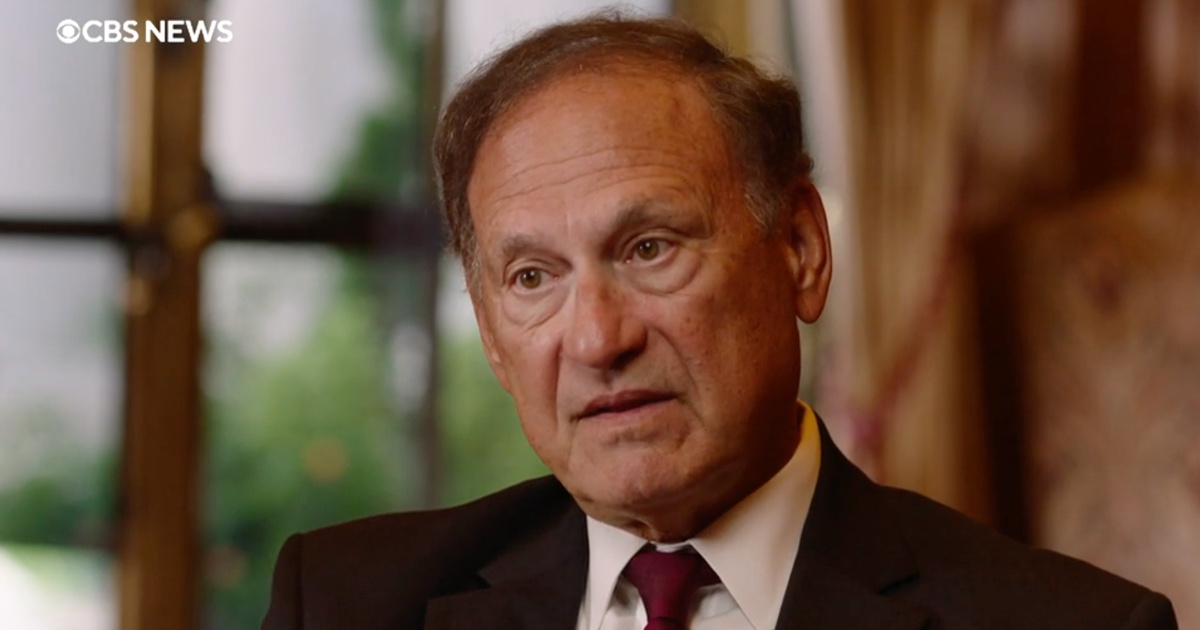
The Alito Court: A rare interview with the influential Supreme Court justice
Full Article
Original Source
Read the full article at Cbsnews →KhanList aggregates and links to publicly available news content. We do not host full articles from third-party sources. Always verify important information with original sources.