
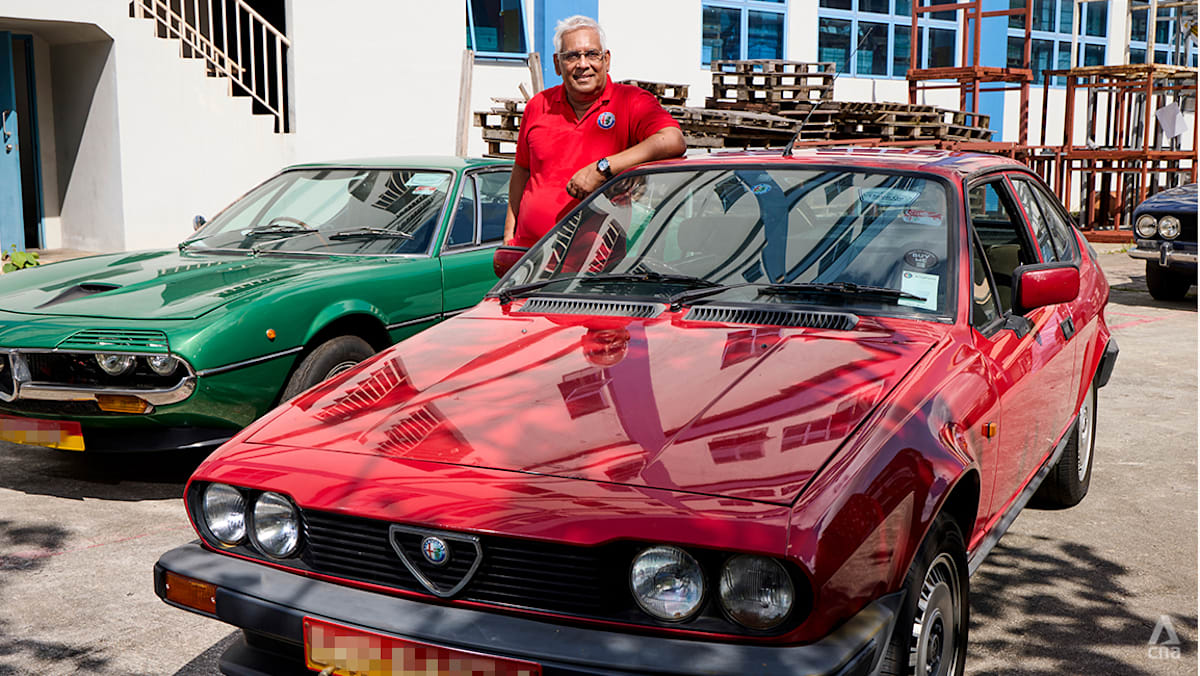
When Kumar Balasingam talks about cars, he doesn’t start with horsepower figures or auction prices. He starts with memories.At 19, he bought a 1972 Alfa Romeo 2000 GTV in apple green with a light tan interior – “not the usual black you see everywhere,” he said. He borrowed S$12,000 from his mother to buy it. Still studying and working at the time, he bought the car from an ice-cream vendor in Geylang.That car marked the beginning of a collection that would eventually grow to about 45 classic vehicles – mostly Alfa Romeos, but also Ferraris, Aston Martins and Mercedes-Benz models – restored and maintained by a network of specialists across Italy, Poland and the United States.But back then, there was no network. Just a young man, an owner’s manual and a car that demanded attention. “The manual became my bible,” Kumar said.With little money for professional repairs, he taught himself the basics – from reading wiring diagrams to tuning carburettors and understanding spark plug heat ranges. He learned by doing, and by making mistakes. He came to believe that many Alfa Romeos in Singapore had earned their reputation for unreliability not because of flawed engineering, but because of poor maintenance. Kumar believes that classic cars reward owners who take the time to understand their mechanics and maintain them properly. (Photo: CNA/Aik Chen) “People were putting in the wrong spark plugs,” he explained, laughing. According to Kumar, the twin-cam engines required different spark plugs depending on driving conditions – a hotter HL plug for short urban journeys and a colder 2HL for sustained high-speed driving. Using the wrong type could cause the engine to misfire or run unevenly. “So many owners would say, ‘My car is running on three cylinders – what kind of Alfa is this?’” he said. “But when you understand the system, it’s easy.”That early lesson – that machines reward those who take the time to understand them – would shape not just his approach to cars, but also to collecting.A MARRIAGE BUILT ON ALFETTASKumar’s love of Alfa Romeo became a shared passion at home. When he married in 1984, he and his wife each bought an Alfa Romeo Alfetta – the “little Alfa”, a front-engine saloon with a two-litre engine. “She had a gold-coloured one and mine was green,” he reminisced. “We ran those cars for a number of years together.”It’s an almost cinematic image: a young couple driving matching Italian sports saloons in 1980s Singapore, one gold and the other green. For Kumar, cars were never just status symbols. They were part of everyday life.Over time, Kumar began buying, repairing and selling Alfettas. Each car sharpened his mechanical instincts and taught him more about sourcing parts, avoiding restoration pitfalls and navigating the realities of ownership in Singapore, where taxes and Certificate of Entitlement (COE) premiums make collecting cars an expensive pursuit.Then came the heartbreak.THE GTV THAT DISAPPEARED Part of Alfa Romeo’s Type 116 family, the GTV evolved from the Alfetta GT. (Photo: CNA/Aik Chen) One of his most beloved cars – the very 2000 GTV that started it all – disappeared while he was visiting an aircraft factory in the Czech Republic on a business trip.His wife called with some unwelcome news. The car’s COE was expiring, and renewing it would cost more than S$40,000. With two young sons at home, practicality prevailed. A buyer came forward, and the car was sold. “I was like, heart pain,” Kumar said. But he accepted the decision.The buyer drove the car into Malaysia, but Kumar later discovered that its deregistration had not been properly completed. Weeks later, he received letters from Singapore’s Land Transport Authority (LTA) alleging that he had failed to deregister the car and had kept a deregistered vehicle.He resolved the matter and paid the fines. But he couldn’t let the car go. “I put word out to my contacts in Malaysia,” he said. “But mostly it was wishful thinking.”Three years passed. Then came a tip-off: a green Alfa had been spotted at a workshop in Melaka.Kumar arrived early in the morning. The gate was slightly ajar. Inside were several used cars. Then he spotted it – a familiar shade of green that he calls Vivianite. “Nobody else paints an Alfa this colour,” he chuckled. Kumar Balasingam’s most remarkable motoring stories include that of his first Alfa Romeo, which was sold while he was overseas and eventually tracked down at a workshop in Melaka. (Photo: CNA/Aik Chen) As he approached, he peered through the rear window. There, on the rear parcel shelf, was his old licence plate: EA5448U. “I told them, ‘Call your boss, or I’m calling the police.’”Finding the car was only the beginning. Bringing it back to Singapore and legally re-registering it took years of negotiation and paperwork. He also appealed unsuccessfully to retain its original number plate. Today, the car bears a different registration number and is undergoing restoration. He says he will never sell it.BUYING 15 ALFAS IN ONE DEAL An Alfa Romeo Montreal from Kumar’s classic car collection. (Photo: CNA/Aik Chen) If the GTV was an emotional milestone, one of Kumar’s boldest acquisitions was a more calculated affair. Years ago, he met an 80-year-old collector in Texas who had amassed 15 Alfa Romeo Spiders, ranging from Series 1 “boattail” models to Series 4. The owner wanted to sell.But there was a condition: no cherry-picking. “If you can take the whole lot, I’ll give you a good price,” the man told him. Kumar agreed.Shipping 15 classic cars halfway around the world was no small logistical feat. Neither was restoring them. Today, 10 are in Singapore and four in London. The remaining car has since changed hands.The purchase marked his transition from enthusiast to serious collector. His collection now includes two Aston Martin DB6s, a 1966 Mercedes-Benz 300 SE Cabriolet, a 1986 Aston Martin Lagonda and a Ferrari 308 GT4. Among his most prized possessions is a rare right-hand-drive Alfa Romeo Montreal, for which he once turned down an offer of US$400,000.RESTORATION AS GLOBAL CHOREOGRAPHY Kumar’s Alfa Romeo Alfa 6, a four-door Italian saloon introduced in 1979. (Photo: CNA/Aik Chen) Restoring Kumar’s collection is a multinational undertaking. Bodywork might be done in Malaysia, while engine components are rebuilt in the United States. His Montreal is currently undergoing restoration in Poland, with specialists in Italy handling trim and detailing. He has also worked with specialists in Hungary. Parts can cross borders multiple times before a car is complete.“It’s like choreography,” he said, though he admits the dancers are not always in sync. He has also encountered delays with some of the Italian craftsmen he works with. Timelines stretch. Costs rise. A single bodywork job once cost him RM40,000.Sourcing parts is an art in itself. Some Alfa Romeo components share parts with Fiat models, making replacements easier to find. Others require years of searching. Kumar recalls spending two years tracking down an electronic control unit (ECU) for a newer Mercedes-Benz. The experience reinforced his belief that modern cars, for all their speed and sophistication, may not last as long as their mechanical predecessors. “Electronics fail. Parts vanish. Even ECUs become ghosts,” he argued.By contrast, a carburettor can be rebuilt and a mechanical linkage machined anew. With older cars, the problems – and their solutions – are often more tangible.OLD IRON VERSUS NEW SPEED Kumar’s collection includes this blue Alfa Romeo Berlina, a classic four-door Italian saloon. (Photo: CNA/Aik Chen) Kumar is not blind to progress. He once found himself trailing a modern Mercedes-AMG A45 while driving his 1988 Porsche 930 Turbo, a manual car revered among enthusiasts. “It was a vivid lesson,” he recalled.Today’s automatic transmissions can shift faster than a human driver, while electronic systems help deliver power to the road with greater precision. By many measures, newer cars comfortably outperform their predecessors.But for Kumar, performance isn’t everything. Classic cars demand involvement, attention and mechanical sympathy. More importantly, they create memories.THE BUSINESS MIND BEHIND THE COLLECTIONWhile cars are his passion, aviation is his business. Kumar is the CEO of JSD Group, which he founded in 1996. The company specialises in aircraft engine leasing and aircraft seating, serving markets including Indonesia and India. Before starting the business, he trained as an accountant at Ernst & Young and qualified through the Association of Chartered Certified Accountants (ACCA).The analytical discipline of accounting may seem far removed from Italian sports cars, but both require patience, attention to detail and long-term thinking. A collection of 45 cars does not come together on impulse alone. It demands careful planning, from storage and logistics to insurance and regulatory compliance.It also requires knowing when to let a car go – and when to hold on to one.Despite the size of his collection, Kumar insists he is not in the business of flipping cars. Some, such as the Montreal and the rediscovered GTV, are permanent fixtures. Others may eventually be sold, but not without careful consideration. “These cars have stories,” he said. “I’ll never sell them.”BUILDING A COMMUNITY Beyond his own collection, Kumar is actively involved in Singapore’s classic car community, serving as president of Classic Car Club Singapore. (Photo: CNA/Aik Chen) Kumar’s involvement in the classic car community extends beyond his own garage. As a former president of the Alfa Romeo Owners’ Club of Singapore, he helped grow its membership from 11 to 42, attracting mostly owners of modern Alfa Romeos while fostering an appreciation for the marque’s heritage. He has since handed over the reins to another Alfa Romeo enthusiast.He is also president of the Classic Car Club Singapore, founded in 2016. Under his leadership, the club has organised showcases at Marina Bay Sands, bringing rare classic cars to one of Singapore’s most recognisable landmarks.He is now working towards organising an international classic car event in Singapore in 2027, hoping to help establish the country as a regional hub for heritage motoring.A COLLECTOR, NOT JUST AN OWNERWhile some collectors are drawn to limited editions and investment returns, Kumar’s approach is rooted in a more personal attachment to his cars.A 1965 Saab once owned by Kumar’s late father remains in the family. His two adult sons grew up surrounded by engines and body shells, concours trophies and restoration invoices. His wife, too, has long accepted that his passion for cars is no passing phase.Looking back on his journey – from a 19-year-old borrowing money from his mother to a collector overseeing restorations across continents – Kumar doesn’t see it as part of some grand strategy. It was, and remains, a passion. “I just love the cars,” he said.Decades after borrowing S$12,000 from his mother to buy his first Alfa Romeo, Kumar still has that same green GTV. It may have taken years to find its way back to him, but this time, he has no intention of letting it go.Photographer's assistant: Dillon Tan
The Alfa Romeo he never forgot: One Singapore collector’s lifelong passion for classic cars
Full Article
Original Source
Read the full article at Cnaluxury →KhanList aggregates and links to publicly available news content. We do not host full articles from third-party sources. Always verify important information with original sources.