
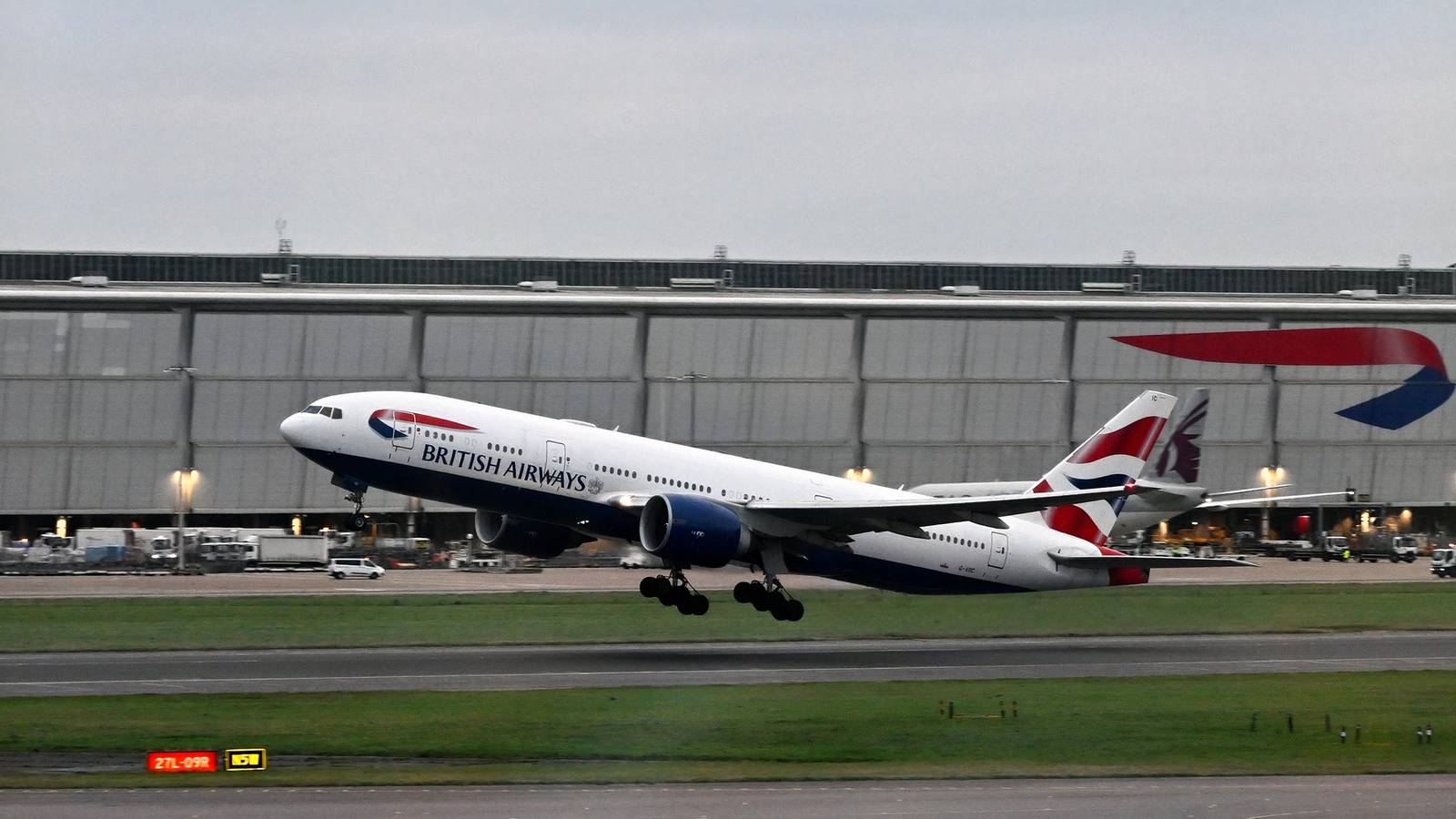
Published Nov 22, 2026, 7:00 PM EST Passionate about promoting aviation, the beauty of flight and the science behind it, Antonio is an avid reader of aviation magazines and books, and he loves visiting airshows all over the world, taking photos and writing about airplanes and helicopters as well. He is currently based in Palermo, Sicily. British Airways (BA) is about to retire the aircraft that built its long-haul network, but it has not told anyone exactly what will take its place at London Heathrow (LHR). The airline’s 43 Boeing 777-200ERs average roughly 26 years of age, according to Aerospace Global News, and most of them fly from Heathrow rather than Gatwick. The one firm date BA has given belongs to the other London airport: in a February 27, 2026 message to colleagues, CEO Sean Doyle said the first new Boeing 787-10 will be delivered to Gatwick in 2029, as published by the British Airways Media Centre. So what is actually coming for Heathrow’s 777-200ERs? Two types dominate the picture: the Airbus A350-1000, which is already stepping onto some of that flying, and the Boeing 787-10, with the long-delayed Boeing 777-9 expected to follow. One caveat before going further. BA has published neither a retirement date nor a route-by-route replacement plan for Heathrow, so every swap beyond Nashville described below is a possibility. The first real clue, though, arrived from the home of country music, and it hints at a bigger shift than a simple like-for-like swap. Read on, because the answer may change which jet you board on your next transatlantic trip. Gatwick Gets The First New 787-10s Credit: Robin Guess | Shutterstock Gatwick (LGW) is the easiest part of the puzzle to understand because BA has actually given it a delivery date. Aerospace Global News, citing Cirium data, reported that BA served 13 destinations from Gatwick in March 2026, all lower-yielding leisure flights, from Antigua and Cancun to Orlando and Mauritius, plus Accra and Islamabad for visiting-friends-and-relatives traffic. The same outlet notes that around 12 aircraft are typically based there and that some suggest 17 could be once the 787-10 arrives. The new jets are not expected to have a First cabin. The outlet also suggests that a larger Gatwick presence could make the airport more attractive to oneworld partner airlines hoping to feed connecting passengers into BA’s network. There is also a technical twist. According to Turning Left For Less, BA’s earliest 787-10s lacked crew rest bunks and were range-limited, so the newly ordered aircraft will get an increased-gross-weight modification and bunks. The site lists Vancouver, Phoenix, Mauritius, Cancun and Las Vegas as routes that become workable. BA's newly ordered Boeing 787-10s will be powered by General Electric GEnx engines, following the airline's decision to introduce a second engine supplier alongside Rolls-Royce on its Dreamliner fleet. Doyle’s own message confirmed the bunks, and Aerospace Global News adds that the rest areas should be welcome news for crew, since the airline’s initial 787-10s do not have them. That gives BA a relatively clean renewal path at LGW. Heathrow is harder. Most of the 43 777-200ERs are still tied to the airport, and replacing a four-class, business-heavy aircraft with a 787-10 without First would change the product as well as the capacity. Yet one Heathrow route has already provided a much more interesting clue. The A350-1000 Is Already Replacing Heathrow 777-200ER Capacity The Airbus A350-1000 is not merely a future possibility at Heathrow. As reported by Simple Flying, BA scheduled the A350-1000 to replace the 777-200ER on its daily Heathrow–Nashville service from March 29, based on schedule data first spotted by Ishrion Aviation. Published flight times stay at 9 hours 10 minutes outbound as BA223 and 8 hours 10 minutes back as BA222, although the A350 cruises slightly faster than the 777. In winter, the route has used the Boeing 787-8, and the report says there is no word yet on whether that aircraft returns once the cold season arrives. Simple Flying's database shows the Heathrow 777-200ER on this route seats 272 passengers, while the A350-1000 seats 331, a jump of 59. The seat models are the same, but Simple Flying notes BA fits a smaller galley area to squeeze in the extra rows, and Turning Left For Less says cabin crew have voiced concern about galley space on the type. Cabin Boeing 777-200ER Airbus A350-1000 Club Suites 48 56 World Traveller Plus 40 56 World Traveller 184 219 Total seats 272 331 Seat counts on Heathrow–Nashville, per aeroLOPA data cited by Simple Flying. Economy passengers may even gain a little comfort, since the A350 has one fewer seat per row than the 777. But the strategic point is bigger: BA added 59 seats to a route without adding a single flight. Why would an airline do that, and what does it say about the rest of Heathrow’s fleet? There is also a cargo angle. Simple Flying points out that the A350-1000 is comparable in size to the Boeing 777-300ER and so has a significantly larger hold, which on a short transatlantic sector lets BA load more freight than before. Heathrow Slots Make Upgauging More Valuable Than One-For-One Replacement Credit: Ceri Breeze | Shutterstock Because Heathrow is the one airport where BA cannot simply add flights. Writing in 2023, when the airline was still weighing its options, One Mile At A Time argued that Heathrow is capacity-controlled and that the larger A350-1000 and 787–10 variants offer excellent economics. They also noted that BA’s 777 fleet averaged nearly 20 years of age at the time, with nearly two-thirds of the jets delivered in 2001 or earlier, mostly the 777-200ER variant. Aerospace Global News makes a similar point about Gatwick: basing new jets there relieves pressure on a heavily slot-constrained Heathrow hub. Efficiency is the other half of the logic. According to Airbus, the A350 Family delivers a 25% advantage in fuel burn, operating costs and CO₂ emissions compared with previous-generation competitor aircraft. That improvement comes from combining advanced aerodynamics, new-generation Rolls-Royce Trent XWB engines and lightweight materials, which account for more than 70% of the airframe. For BA, this makes the A350-1000 particularly attractive at a slot-constrained airport such as Heathrow: it can carry more passengers on an existing departure while benefiting from the efficiency gains of a newer-generation design. That combination of capacity and efficiency helps explain why BA has ordered more than one type of new-generation widebody rather than choosing a single replacement for every 777. The order book tells the story. BA has 24 Boeing 777-9s on order after adding six aircraft in March 2025. It has also ordered six additional A350-1000s and 38 Boeing 787-10s, including the 32-aircraft order announced in 2025. Those numbers make one aircraft particularly important. Twenty-four 777-9s are supposed to become BA's largest new-generation widebodies, but none has yet joined the fleet. The timing of that arrival could determine how quickly the oldest Heathrow 777s can finally disappear. The Boeing 777-9 Will Shape The Final Replacement Mix Credit: Simple Flying The 777-9 is the biggest aircraft in BA's replacement plan, and it is also the one that introduces the most uncertainty. We reported in August 2026 that the aircraft was still working through the tail end of its certification sequence as of mid-2026. In a November piece, we added that Boeing is expected to deliver its first 777-9 in 2027, by which time Airbus will likely have well over 150 A350-1000s flying. For BA, Turning Left For Less expects a four-class layout of eight First, 65 Club Suites, 46 World Traveller Plus and 206 economy seats, 325 in all, debuting from 2027 or 2028 with the airline’s new First suite. Against the A350-1000’s 331 seats, the 777-9 would not even add capacity on a Nashville-type route, which complicates the idea of the 777-9 as a simple 777-200ER successor. The same site expects the new First suite to be limited to the 24 Boeing 777-9s and the 12 refurbished Airbus A380s, which would make the 777-9 as much a flagship statement as a fleet-replacement tool. Until the 777-9 shows up, the old jets keep flying, and flying hard, with most replacements still years away. What does that wait mean for passengers boarding one tomorrow? Heathrow's Oldest 777-200ERs May Have To Wait Credit: Airlinephoto | Shutterstock That leaves BA with an awkward transition period. Turning Left For Less says BA intends to retire all 43 777-200ERs, some of which will exceed 30 years of age by withdrawal, and its reader analysis suggests the last four, delivered in 2009, could stay longer because they are younger. BA has confirmed none of that beyond Doyle’s statement about Gatwick. Put differently, the exit date for the oldest airframes is still a matter of informed speculation, not a published schedule. The wait has had visible moments. FlyMag reported that BA229 to Baltimore returned to Heathrow on July 9, 2026, and BA183 to New York turned back the next evening, both operated by 777-200ERs after crews identified technical issues, and both flights were subsequently canceled. Age alone is not proof of unreliability, since many 777s worldwide have flown happily for decades, but the incidents landed just as the renewal timeline moved into focus. Every extra month of waiting sharpens the question BA has so far left unanswered in public: which Heathrow route loses its 777-200ER next, and will passengers on it get a First cabin back? The answer may arrive route by route, in schedule filings, long before any formal announcement. Two Deliveries Will Determine How Heathrow's 777 Era Ends Credit: Colinmthompson | Shutterstock Two milestones will settle how this plays out, and neither is fully in BA’s hands. The first is the pace of 787-10 deliveries after the Gatwick debut in 2029. The second is whether Boeing can certify and hand over the 777-9 on the schedule it now promises. If the Dreamliners flow, BA can retire 777-200ERs without leaving Heathrow gaps. If the 777-9 slips again, the A350-1000 is the obvious stopgap, yet the six additional aircraft on order are a modest cushion. There is a premium-cabin cost to watch as well. Turning Left For Less points out that the new First suite does not fit four abreast in a 787 and that the A350-1000 carries no First at all, so some Heathrow routes could lose the cabin entirely as the 777-200ERs go. That is precisely the trade-off BA has not yet explained to the customers paying for it. Some will welcome newer jets with quieter cabins and more consistent Club Suites; others will see a quiet downgrade of the flagship experience at the airport where BA charges its highest fares. One Mile At A Time wrote a 2023 article saying they were curious about how it would all play out. Three years on, the cast is clear, but the final act is not. So what do you think: should BA hold on to its youngest 777-200ERs until the 777-9 arrives, or are the A350-1000 and 787-10 enough on their own? Tell us in the comments, and let us know which Heathrow route you would like to see upgraded first.
The Aircraft Set To Replace British Airways’ Boeing 777-200ERs At London Heathrow
Full Article
Original Source
Read the full article at Simpleflying →KhanList aggregates and links to publicly available news content. We do not host full articles from third-party sources. Always verify important information with original sources.