
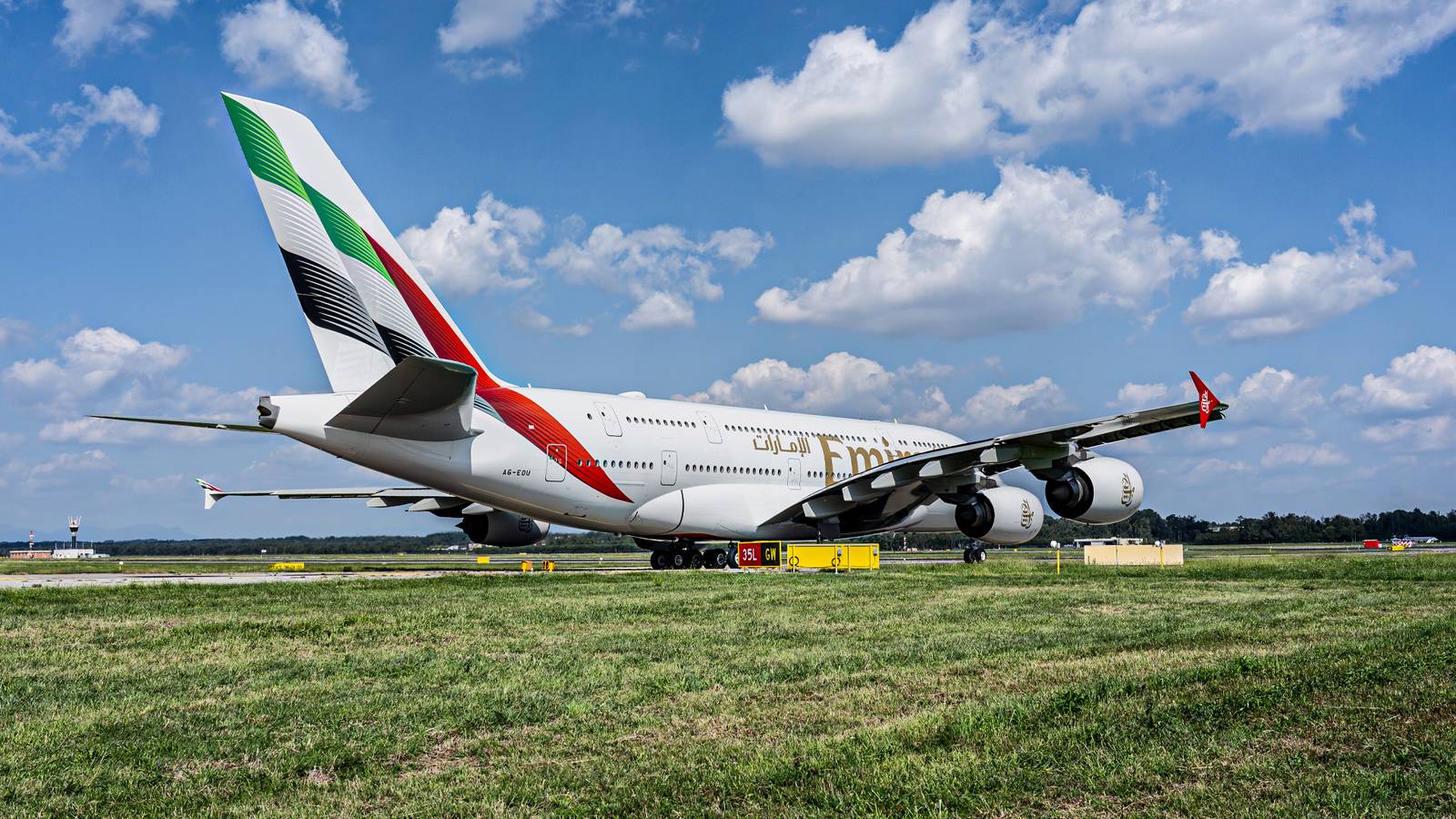
The Airbus A380 burns far more than 3,000 gallons (approximately 11,356 liters) of fuel every single hour, significantly higher than what would be expected from a modern widebody aircraft. Despite the high figure, Emirates keeps the four-engine superjumbo central to its long-haul network. Across the wider airline industry, most carriers have scaled back, parked, or retired their double-deckers because four engines bring steep fuel burn and heavy maintenance demands on ordinary routes. Emirates has defied this trend and continues to fly the aircraft across major global trunk routes, honing the high hourly consumption into a core element of its commercial strategy. How can an airframe that consumes thousands of gallons per hour still pay off when other airlines view it as a commercial liability? Success ultimately comes from filling hundreds of seats on flights into slot-constrained airports backed by strong connecting hub traffic. Looking closely at the A380's fuel burn, per-seat economics, hub advantages, financial track record, and future outlook, it becomes clear that the type still makes sense for Emirates. The True Cost Of Running Four Engines On an hourly basis, the A380's fuel consumption stands out immediately against modern twin-engine long-haul aircraft. Figures cited by Simple Flying place the A380's fuel burn at roughly 4,600 gallons (approximately 17,413 liters) per hour, nearly double the roughly 2,700 gallons (approximately 10,221 liters) per hour burned by an Airbus A350-1000. That wide gap stems from four large turbofans moving a heavier double-deck airframe across long sectors, where takeoff weight, cruise altitude, headwinds, and route length continually shape exact hourly consumption. Emirates President Tim Clark has framed that hourly fuel burn in weight terms as well as volume, as noted by Airline Ratings. On a long-haul flight from Dubai International Airport (DXB) to Los Angeles International Airport (LAX) carrying 515 passengers, Clark has indicated that fuel burn runs around 13 tonnes (approximately 28,660 pounds) per hour. Across the full trip between the two hubs, total fuel burn reaches roughly 200 tonnes (approximately 440,925 pounds). Those figures show why the A380 looks daunting whenever an airline evaluates raw fuel burn in isolation rather than total seat capacity. Burning that much fuel every hour creates a substantial fuel bill on paper, which will naturally lead most airlines to look elsewhere for widebody capacity. With that in mind, it seems somewhat nonsensical for Emirates to stick with the A380 when all its rivals have ceded to the extortionate costs. Beating Slot Restrictions Once fuel burn is divided across hundreds of seats, not just being viewed purely per hour, the A380's commercial math changes sharply. Using the Dubai-to-Los Angeles comparison noted by AirlineRatings, Emirates President Tim Clark has explained that the A380's fuel cost per seat can beat running two Boeing 787 flights, each of which burns roughly half as much fuel as the superjumbo. That advantage holds when high load factors keep cabins well filled, whereas flying a large double-decker with dozens of empty seats quickly destroys per-passenger efficiency. Slot-constrained airports turn that high seat count into an even bigger practical asset on trunk routes. As The Economist reports, scarce runway and terminal slots at congested hubs such as London Heathrow (LHR) and Hong Kong (HKG) limit how often an airline can land or take off. Putting a 787 into a single Heathrow slot where a 517-seat A380 can operate leaves far fewer seats for sale at peak demand, not something that Emirates sees as acceptable. Emirates reinforces those slot economics through its connecting hub in Dubai, which pulls transfer passengers from across continents onto high-capacity long-haul flights. Whereas other major airports focus on point-to-point local demand at either end of a route, Dubai funnels connecting traffic into large cabins, so seat occupancy stays consistently high. Together, scarce slots at major destinations and steady transfer flows at Dubai give Emirates the passenger volume needed to make high seat counts pay off. Why Others Could Not Keep Up Few other carriers share the exact combination of network scale, slot pressure, and hub geography that lets Emirates run the A380 so consistently. Reporting from Simple Flying highlights that Emirates built its entire long-haul model around funneling global connecting traffic through Dubai onto high-capacity trunk routes. Many other airlines rely more heavily on local point-to-point demand or spread flying across fragmented secondary markets, where filling 500 seats every day is much harder to do consistently. Differences in hub structure and slot portfolios also explain why rival operators often reach different conclusions about the double-decker. While some airlines face tight runway caps at destinations, they may lack a central connecting hub with the same global reach or fleet concentration to keep large cabins full across seasons. When demand dips or seasonal swings hit, carrying hundreds of empty seats penalizes operating margins far more severely than operating smaller twin-aisle jets. Those structural contrasts help explain why several carriers have parked or retired A380 aircraft earlier than Emirates, and why others have not made the A380 the focal point of their fleet. Take Air France, for example: the airline retired all its A380 aircraft in 2020, primarily because it could not fillseats like Emirates can. Without Emirates' specific mix of connecting scale and high-volume trunk demand, replicating its A380 formula remains out of reach for most airlines. Building A Case With Experience The A380's commercial case at Emirates is backed by years of financial results, not just theoretical seat math. Before the pandemic, Emirates President Tim Clark told Simple Flying that roughly 85% of Emirates' profits came from the A380 because the double-decker stayed consistently full and drew strong demand across every cabin. High occupancy across first, business, and economy turned those large passenger counts into substantial earnings across long-haul trunk routes. That profit contribution has carried into Emirates' modern record run even as fuel expenses and operating costs remain closely watched. As detailed by Aviation Week and Emirates' 2025–26 annual financial results, Clark recently pointed to the A380 as the most profitable asset in Emirates' fleet during its record financial year. Broad demand for premium and main cabins helped support those results. End-of-year financial figures highlight the scale of that record performance across both the airline and the wider group. Emirates' 2025–26 financial disclosures show Emirates Group reported a record profit of AED 24.4 billion (approximately $6.6 billion) for 2025–26, while Emirates airline posted a record profit before tax of AED 22.8 billion (approximately $6.2 billion). Together, those numbers show how well-filled A380 cabins can underpin strong financial returns and provide hard proof that the A380 remains a financially viable aircraft for Emirates. The Potential For A New A380 Looking ahead, Emirates plans to keep its A380 fleet flying until roughly 2041, giving the double-decker a long runway in service even after production ended in 2021. Coverage from Simple Flying and Executive Traveller notes that Emirates has worked to keep the fleet flying for years to come while weighing what comes next at the top end of its widebody lineup. Extending A380 operations toward 2041 reflects how central high-capacity flying remains to the airline's long-term fleet plan. To keep that superjumbo presence going with modern efficiency, Emirates President Tim Clark has floated a modernized A380neo concept and signaled readiness to order at least 100 aircraft, according to reporting in Executive Traveller. Clark estimates a re-engined and updated A380neo could burn around nine tonnes (approximately 19,842 pounds) of fuel per hour, which would narrow the running-cost gap against newer twinjets. From Emirates' perspective, a 100-jet commitment means the A380 should ideally continue operating well beyond 2041, as long as Airbus can find a way to improve its economics. Airbus, however, has set a much higher bar before reviving the program, reportedly pointing to roughly 250 orders needed to make a restart commercially viable. That gap between a 100-aircraft minimum order and a 250-order threshold creates a clear standoff with no launched A380neo program on the board. Unless order volume or manufacturing economics shift dramatically, Emirates' plan for 2041 rests on its existing fleet rather than a newly built A380neo. Fuel Costs Are Not So Important? The A380's story at Emirates shows why high hourly fuel burn does not automatically doom a large aircraft when operating conditions line up. Burning roughly 4,600 gallons (approximately 17,413 liters) of jet fuel per hour looks daunting on paper, but high passenger loads, lower per-seat fuel burn than twin-aisle alternatives on busy trunks, scarce slots at hubs, and steady connecting flows through Dubai allow Emirates to turn that capacity into strong financial returns. The A380 is still more of a specialized tool, not something viable across the wider industry. Few airlines possess the hub geography, slot portfolio, and connecting traffic scale required to keep five hundred-plus seats consistently full across long-haul sectors year after year through seasonal peaks and troughs. For Emirates, however, high hourly fuel burn and high seating capacity are two sides of the same commercial equation as long as trunk demand and connecting flows stay strong.
The Airbus A380 Burns Over 3,000 Gallons An Hour & Still Pays Off For Emirates
Full Article
Original Source
Read the full article at Simpleflying →KhanList aggregates and links to publicly available news content. We do not host full articles from third-party sources. Always verify important information with original sources.