
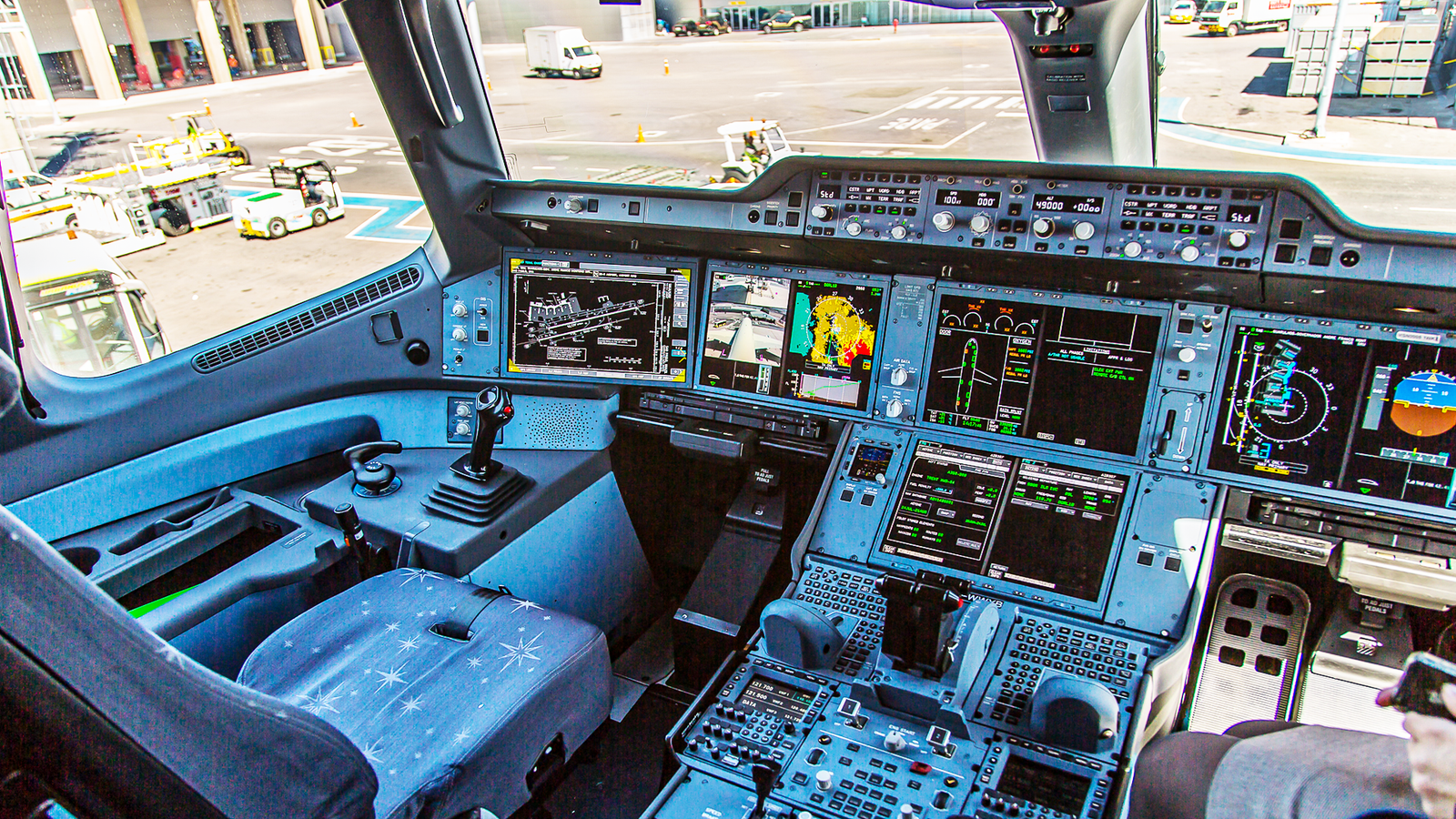
The Airbus A380 may be disappearing from airline fleets, but one of its most important ideas is still sitting in front of pilots every time an A350 leaves the ground. The connection is easy to miss because the A350 flight deck does not look like a smaller version of the superjumbo's cockpit. Its six large displays, different control system, and cleaner layout make it look like a newer generation altogether. Basically, Airbus deliberately started with the A380 concept and carried several of its most important ideas into the A350. That makes the interesting question less about whether the A350 copied the A380 and more about what Airbus kept, what it changed, and why. The answer can be found in the displays, the way pilots interact with them, the avionics architecture underneath and, ultimately, the amount of training an airline can avoid when moving crews between Airbus types. The A350’s cockpit is the result of what Airbus did with the A380's cockpit lessons once it had a smaller, more efficient aircraft to design. Airbus Built The A350 Cockpit Around A380 Lessons Credit: aviators777 | Shutterstock The family connection is not just an impression created by similar flight-control philosophy. Airbus says the A350 cockpit was designed with its cockpit philosophy in mind, while its dedicated A350 technical material describes the A380 cockpit as the starting point for the newer flight deck. The company then added larger screens, better positioning, and more interaction between pilots. Airbus' A350 cockpit material is unusually clear on that point. The timeline explains the evolution well. The A380 entered service in 2007, giving Airbus several years of operational experience with a highly integrated widebody flight deck before the A350 made its first flight in June 2013. The A350-900 then entered commercial service with Qatar Airways in January 2015. By then, Airbus had a useful opportunity: it could take ideas already introduced on the A380 and redesign the interface instead of simply reproducing it. The avionics suppliers were working along the same path. Aviation Today reported back in 2009 that several A350 avionics systems were being developed as a technology continuum from the A380, with common hardware and software baselines intended to help systems mature sooner. Honeywell, for example, said it would retain the A380 hardware and baseline software for systems such as flight management and aircraft environment surveillance, while focusing A350-specific development on software and new functions. That continuity did not mean Airbus stopped experimenting. You notice it right away: the A350 has fewer displays, but each one can do more. That is where the A380's cockpit concept becomes the A350's own design. Six A350 Displays Replaced The A380's More Segmented Layout Credit: Sorbis | Shutterstock The biggest visual difference is also one of the clearest signs that Airbus refined rather than copied and pasted its earlier design. The A380 has eight main flight-deck displays, plus additional screens for its Onboard Information System. The A350 instead uses six identical large-format displays. Airbus says that all six share the same part number and are fully interchangeable in hardware and software. That uniformity changes how the cockpit behaves. On the A350, information can be rearranged across the flight deck instead of being tied as closely to a particular physical screen. Airbus' own technical description explains that the Onboard Information System can be placed on a central display, allowing pilots to share information more easily during a briefing. If a display fails, the system can automatically reconfigure the avionics pages, while information from an outer-screen failure can be recovered elsewhere. The result is a cockpit that is less about memorizing where a particular page lives and more about deciding which information should be visible at a particular moment. Leeham News highlighted the same principle in its comparison of the A350 with earlier Airbus flight decks. Smaller changes matter too. The primary flight display adds information such as flap and trim indications below the main presentation, while the navigation display can provide a vertical profile of the route and terrain. The thrust presentation also follows the simplified percentage-based philosophy introduced with the A380 rather than returning to the older split between N1 and EPR indications. The six-screen arrangement solves a problem created by the older cockpit philosophy: if the screen is no longer the boundary, the pilot needs a better way to control whatever appears on it. That led Airbus to change the interface itself. The A350 Replaced The Traditional MCDU Workflow With KCCUs Credit: Wikimedia Commons, Simple Flying The A350's Keyboard and Cursor Control Units, or KCCUs, are one of the least obvious but most important departures from older Airbus cockpits. Instead of each pilot being tied to a Multifunction Control and Display Unit with its own small screen, the KCCU lets the crew interact with the larger cockpit displays. Leeham News described the difference in practical terms: the older MCDU largely controls the information on its own display, while the A350's KCCU can control the wider flight deck. The cursor can move between fields and screens, making the system feel closer to a computer interface than the traditional scratchpad-and-enter workflow. This is another case where the A380 provided the foundation. Airbus' A380 technical material shows that the superjumbo itself introduced KCCUs to control new functions, including its expanded avionics and information systems. The A350 took the concept further by making it central to a six-screen cockpit in which information could move around the flight deck. Airbus subsequently added another layer. In December 2019, China Eastern Airlines received the first A350 equipped with the optional touchscreen cockpit displays. Airbus says three of the six displays can be touch-capable: the two outer screens and the lower-center display. The touchscreen interface complements, rather than replaces, the physical keyboard and KCCU. However, the A350 did not suddenly become a flying game console that a flight sim can pilot without professional training. The touchscreen functions are integrated into a cockpit architecture that keeps the electronic flight bag separated from flight-critical avionics. Airbus' A350 technical documentation describes that separation explicitly, allowing airline applications to be used through the EFB without giving those applications a route into the aircraft's integrated avionics systems. The same philosophy appears outside the screens. The A350 retains and develops functions first introduced on the A380, including the Onboard Airport Navigation System. During a Leeham News media flight, Fehrm used the airport map to select a runway exit and the Brake To Vacate function calculated an autobrake profile for the aircraft. A350 captain, Michele Scarton, also told Simple Flying that the aircraft's ground-navigation tools contribute to its ease of operation. Once the interface is understood, the deeper connection becomes easier to see. The displays and KCCUs are the only parts pilots can touch. Underneath them is where Airbus carried the A380's architecture into a new generation. The A350 Expanded The A380's Integrated Avionics Architecture Credit: Thiago B Trevisan | Shutterstock The A350's Integrated Modular Avionics, or IMA, follows the same basic idea that made the A380's avionics architecture significant: multiple aircraft functions can share computing resources instead of relying on a separate physical box for every task. Aviation Today described the A350 IMA platform as an evolution of the A380 architecture, with Thales supplying the core processing modules and Rockwell Collins providing the network switches. Airbus' later technical material describes further A350 improvements, including automatic reconfiguration intended to make certain low-criticality failures transparent to pilots. The numbers illustrate the direction of travel. The A380 could host 23 flight-system functions on shared processing modules, while the A350's second-generation IMA can consolidate up to 40. The A350 also uses 18 data-network switches compared with 16 on the A380, according to the earlier Aviation Today material. Airbus also carried forward the A380's move away from three hydraulic systems. The A380 uses two hydraulic and two electrical circuits, and the A350 refined the same 2H2E philosophy. The architecture is not identical, but the design logic is recognizably related: use electrical power and modular computing more aggressively while reducing conventional hardware elements. This is the part of the A350 cockpit story that passengers never see. A screen layout can be changed in a redesign; the architecture underneath determines how systems are maintained, how failures are handled, and how much commonality an airline can exploit. That brings us back to why Airbus invested so heavily in cockpit family resemblance in the first place. A350 Cockpit Commonality Cuts Training And Fleet Complexity Credit: Airbus SAS 2022 Luce Borrel For an airline, cockpit commonality is useful only when it produces something measurable. In the A350's case, one of the biggest benefits is the training reduction when pilots already know another Airbus type. Airbus says Cross Crew Qualification is available for A320 Family, A340 and A380 pilots, with training duration reduced by up to 78%. Its A350 commonality analysis also explains that A330 and A350 pilots can operate under a Common Type Rating arrangement based on the handling similarities between the aircraft. The actual figures are useful because they show how far the family concept goes. As Simple Flying previously explored, the cross-crew qualification course takes 11 days for A320 Family pilots, 10 days for A340 pilots, and five days for A380 pilots. Airbus' current material adds that A330 pilots can qualify for the A350 without mandatory Full Flight Simulator time, with training time reduced by around 60% compared with a full type-rating course. The A380 figure is particularly revealing. The superjumbo's flight deck is the closest predecessor to the A350's, so pilots arriving from the A380 already understand much of the cockpit logic. But the A350 does not depend on A380 experience. Airbus designed it to preserve a wider Airbus commonality, which is why A330, A340, and A320 Family pilots can also transition through abbreviated training paths. There is still a learning curve. For example, adapting to the A350's sidestick could take time for pilots accustomed to the conventional control column of older A300, A310, or Boeing aircraft. Commonality reduces the amount of new information a pilot has to absorb; it does not eliminate differences between aircraft. For airlines operating several Airbus types, that distinction is important. A familiar cockpit can make it easier to roster crews, maintain multiple qualifications and reduce time away from line operations. Airbus explicitly links commonality to mixed-fleet flying and higher crew productivity. The A350 therefore turns cockpit design into an operational tool rather than an isolated piece of flight-deck ergonomics. The A380's Cockpit Legacy Is Already Part Of The A350 Credit: Emirates The A380's production ended with its final delivery in 2021, but the cockpit philosophy developed for the superjumbo has already moved on. The A350 is not an A380 flight deck copied onto a smaller airframe. It is what Airbus did with that experience once it had the opportunity to build a newer, lighter widebody around it. Simple Flying reported on the end of A380 production, but the more lasting story is what survived it. That legacy will become easier to see as more A380 crews move onto newer Airbus aircraft. Qantas, for example, plans to begin retiring its A380s in fiscal year 2032 while introducing A350-1000s. Those pilots will not find identical cockpits, but the transition will still connect two generations of Airbus flight-deck design. The A380's physical cockpit may eventually disappear from airline service; much of its underlying logic will not. That may ultimately be the more important legacy. Airbus is now pushing further toward software-defined aircraft, with its 2026 discussion of the concept pointing toward increasingly modular digital systems. The A380 was never the final word on the Airbus cockpit. It was a proving ground, and the A350 turned many of those ideas into a more practical design. The next generation will show just how far Airbus can take them.
The Airbus A350's Cockpit Actually Shares Its DNA With The World's Largest Passenger Jet
Full Article
Original Source
Read the full article at Simpleflying →KhanList aggregates and links to publicly available news content. We do not host full articles from third-party sources. Always verify important information with original sources.