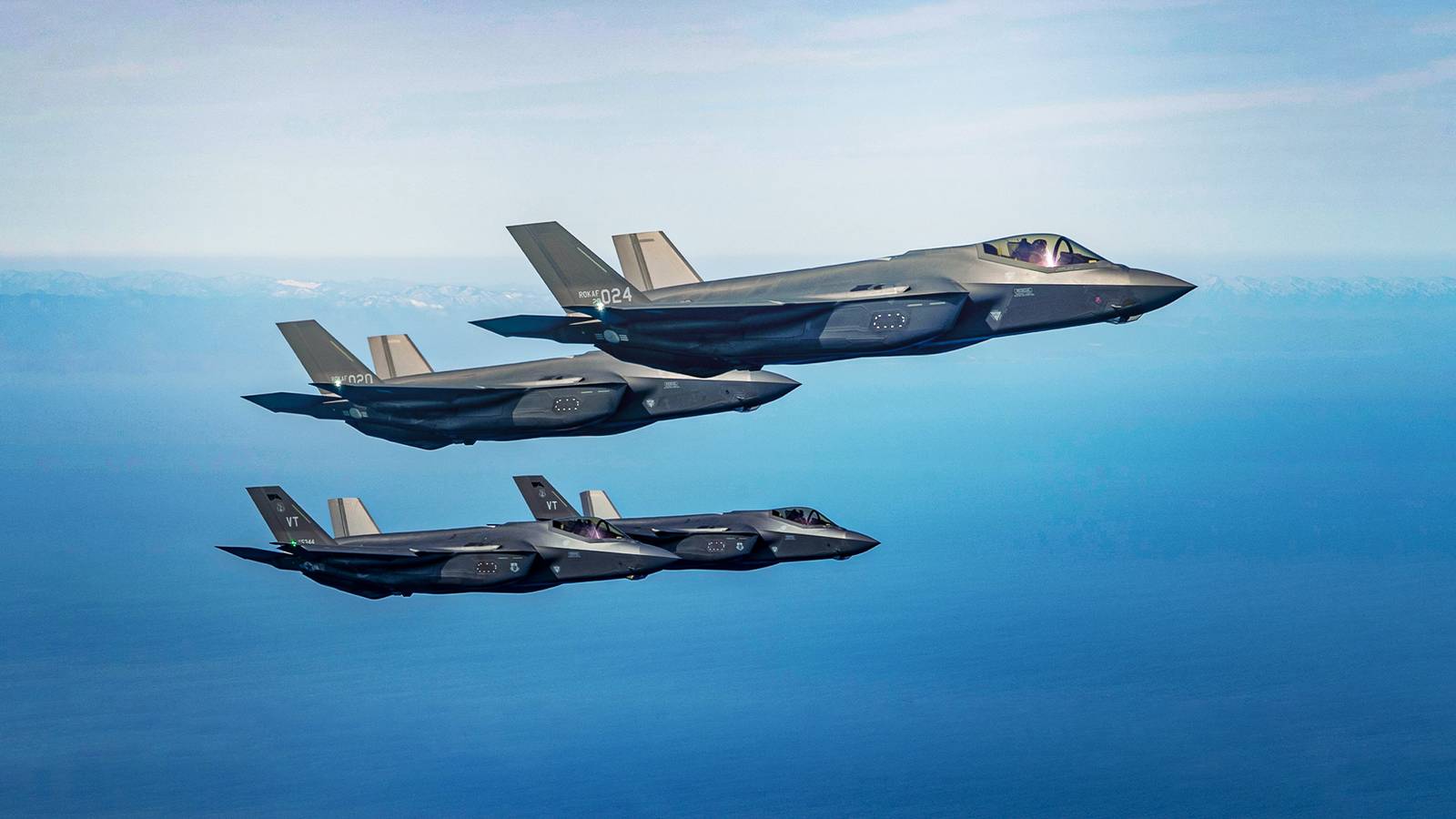
Credit: Shutterstock | Simple Flying Published Aug 13, 2026, 1:00 AM EDT Passionate about promoting aviation and the beauty of flight, Antonio loves to take photos, read, and write about airplanes and helicopters as well. Based in Palermo, Italy , he is a frequent airshow visitor. Sign in to your Simple Flying account According to TheWorldData’s 2026 F-35 statistics roundup, the global Lockheed Martin F-35 fleet has already passed 1,300 aircraft delivered across 17 or more nations, dwarfing every other stealth fighter program combined. Everyone else on Earth flying stealth fighter jetsin 2026, such as China, Russia, and their allies, is flying something else entirely, built by a different country, sold under different rules, and answering to a different set of allies. Here’s the roster that actually matters in 2026: a little more than 20 air forces worldwide now fly a genuine fifth-generation stealth fighter as a front-line type, and that list splits cleanly into two networks that have never once overlapped. One side flies the F-35. The other flies a Chinese or Russian jet instead, never both. By the end of this article, you’ll know exactly who sits on each side of that line, why Pakistan is about to become the newest name on the non-American side with the Shenyang J-35A, and why the gap between the two groups is the real story of stealth airpower this year. The F-35 Club: One Jet, Twenty-Plus Air Forces Credit: US Air Force The Lockheed Martin F-35 Lightning II is, by a wide margin, the world's dominant exported stealth fighter jet. Since deliveries began in the mid-2010s, the jet has gone from a single US-only program into the backbone of NATO and allied airpower across three continents, flying from Norwegian Arctic bases to Australian coastlines, to South Korean alert postures within a few hundred miles of North Korea. According to Lockheed Martin, more than 20 nations have selected the jet, creating the largest international stealth-fighter network ever assembled. The roster keeps growing. The United States, Japan, the United Kingdom, Australia, Italy, Norway, Israel, and South Korea field some of the world's largest F-35 fleets, while a second wave—including Poland, Finland, Germany, Switzerland, Canada, Romania, the Czech Republic, Greece and Singapore—has signed on more recently. Many were drawn by the same NATO interoperability logic that earlier led Denmark, Belgium, the Netherlands, and Norway to replace their Lockheed Martin F-16s with the stealth fighter. Whatever the variant, either the conventional F-35A, the STOL F-35B, or the carrier-capable F-35C, every customer buys into the same global sustainment network, the same software backbone, and the same US-controlled supply chain. That’s precisely what keeps the F-35 club so exclusive in practice: it isn’t a technology restriction that keeps China, Russia, and their partners out, but a political one. Buying an F-35 means buying into an alliance structure built around Washington, and no country actively hostile to US interests, or under US sanction, is ever going to be offered a contract, regardless of budget. America’s Other Stealth Fighter: Why The F-22 Never Left Home Credit: Department of Defense Not every American stealth fighter made the export list. The Lockheed Martin F-22 Raptor, which entered service back in 2005, remains the only fifth-generation jet the United States never sold, leased, or licensed to a single foreign air force, despite interest from Japan, Australia, and Israel over the years. Congress banned F-22 exports outright in 1998, years before the jet even entered service, over concerns that its sensor and stealth technology could leak to rivals through even a trusted ally’s supply chain. That single decision means that the roughly 180 Raptors built are flown exclusively by the United States Air Force, and as detailed in Simple Flying’s breakdown of the F-35 and F-22, the two jets were never meant to replace one another: the Raptor was built purely for air superiority, sustaining supercruise past Mach 1.5 without afterburner, while the F-35 was designed from the outset as a networked, multirole strike platform. The F-22’s export ban is also why it sits entirely outside the club described above; as previously noted in Simple Flying’s look at every stealth fighter flying today, it’s an American jet, but not part of the American export system. China’s Two-Jet Strategy: The J-20 And The New J-35A Credit: PLAAF China took an entirely different approach: rather than exporting a single design, Beijing built two separate stealth fighters and is now selling the smaller one abroad while keeping the larger one to itself. The heavier Chengdu J-20 Mighty Dragon, in service with the People's Liberation Army Air Force since 2017, has never been offered to a foreign customer and likely never will be, as its stealth shaping and long-range sensor suite are considered too sensitive to share, even with Beijing's closest partners. The smaller Shenyang J-35 is a different story. Originally developed as a carrier-based fighter for the PLA Navy's newest aircraft carriers, China has now unveiled a land-based export version, the J-35A, and Pakistan is on track to become its first foreign operator. China has offered Pakistan up to 40 aircraft as part of a broader package that also includes KJ-500 airborne early warning and control aircraft and HQ-19 air defense systems, according to Janes. Chinese state broadcaster CCTV has already aired footage of an export-configured J-35AE variant without PLA markings, according to the South China Morning Post, and Pakistani officials have discussed an eventual fleet of around 40 aircraft, although the exact contract value and final order size remain unconfirmed. If the deal proceeds as expected, Pakistan would leapfrog India, whose own indigenous stealth fighter program isn’t expected to reach squadron service before the mid-2030s. Russia’s Su-57 Finally Finds A Customer: Algeria Credit: Shutterstock Russia’s Sukhoi Su-57 Felon has had the opposite export problem than China’s J-20: Moscow has always been willing to sell it, but for years nobody wanted to buy it. India walked away from a joint development program in 2018, and Russia’s own air force has taken delivery of only a modest number of production jets, slowing the whole program’s momentum. The Su-57's arrival in Algeria came only after a detour through a different, more disputed jet. Algeria had been linked to the Su-57 program for years, but as production delays mounted, the country began receiving SukhoiSu-35 Super Flankers in March 2025, a move many analysts viewed as an interim capability while awaiting the fifth-generation fighter, according to the International Institute for Strategic Studies (IISS) and Army Recognition. Those aircraft were originally built for Egypt under a 2018 contract that later collapsed after Cairo came under sustained US pressure over the prospect of CAATSA sanctions, leaving Russia with completed airframes that were eventually redirected to Algeria, as reported by The National Interest and Army Recognition. While some analysts interpret the Su-35 acquisition as a stopgap for pending Su-57 deliveries, the IISS notes that it remains unclear whether Algeria always intended to acquire both types or whether the Flanker purchase reflects delays in the Su-57 program. That changed for good in early 2026, when footage confirmed a Su-57E, the export designation, flying in Algerian colors, according to The Aviationist, making Algeria the type’s first confirmed foreign operator after years of unconfirmed rumors dating back to 2019. Algerian state media had claimed the deal since 2025, and leaked contract documents cited by regional defense reporting Atalayar describe an order for 12 to 14 aircraft, delivered in phases between 2025 and 2028. For comparison, as Simple Flying lays out in its side-by-side comparison of the F-35 and the Su-57, the two jets represent almost opposite philosophies: the F-35 leans entirely on networked sensor fusion and coalition interoperability, while the Su-57 was built around raw kinematic performance and internal weapons carriage without ever plugging into an alliance-wide data network the way the American jet does. Algeria now becomes the test case for whether that approach can find buyers beyond Russia’s own air force. Two Clubs That Never Overlap One pattern stands out when mapping every operational stealth fighter in the world: no country belongs to more than one system. Every F-35 operator, from Norway and Israel to Japan, Australia, and Singapore, flies exclusively within the American network. China's stealth fleet remains confined to the People's Liberation Army, with Pakistan preparing to become the first export customer for the J-35A. Russia's Su-57, meanwhile, serves only the Russian Aerospace Forces and, soon, Algeria. That's a genuinely unusual pattern by historical standards. At the fourth-generation level, mixed fleets are the norm, not the exception: India flies Russian-built Su-30MKIs alongside French Dassault Rafales and has purchased both Russian and Western options for its next fighter tranche; Malaysia and Vietnam have both operated Russian Sukhois next to Western types without much diplomatic friction. Stealth aircraft don't follow that pattern at all. Nobody flies an F-35 next to a J-20, or a Su-57 next to an F-22. The moment a country crosses into fifth-generation territory, it picks a side and stays there. The F-35's software, weapons integration, and maintenance network are deliberately closed to non-partner nations, built around a classified data architecture that the US only shares with treaty allies and a short list of vetted partners. China and Russia have no interest in opening their own stealth programs to US-aligned militaries either, for the same reason in reverse. A fifth-generation fighter is a standing intelligence and sustainment relationship with whichever country built it, which is exactly why nobody straddles the line the way they once did with fourth-generation jets. Turkey illustrates how rigid those boundaries have become. Although Ankara was removed from the F-35 program in 2019 following its acquisition of the Russian S-400 air defense system, its indigenous Kaan fighter still relies on American General Electric F110 engines for its initial production batches. The episode shows that access to a stealth complex is determined less by the origin of individual components than by participation in the broader security, intelligence, and sustainment network surrounding the aircraft. The result of those global patterns, as of 2026, is two mutually exclusive stealth networks sitting side by side, with more than twenty nations in one and just four in the other, and no third option yet mature enough to challenge either. The Contenders Still Waiting To Join The List Credit: Shutterstock Pakistan’s induction of the J-35A will be one of the main stealth fighter stories of the back half of 2026, but it won’t be the last new name on this list for long. Turkey’s own Kaan program cleared a real milestone on July 24, 2026, when the P1 prototype completed its first low-speed taxi run, and TAI's chief executive has said the jet's maiden flight could follow within "a couple of months," with a second prototype, P2, targeted to fly before the end of the year, according to Defence Security Asia’s reporting on the KAAN test campaign. Ankara is still targeting 2028 for initial Turkish Air Force deliveries, though the initial production batches are expected to rely on General Electric F110 engines before Turkey's indigenous TF35000 enters service, currently targeted for around 2032, alongside an Indonesian commitment for 48 aircraft that would make Jakarta the type’s first export customer, as reported by government sources and Breaking Defense. South Korea’s KF-21 Boramae, meanwhile, is widely regarded as a 4.5-generation jet with reduced radar cross-section features rather than the full-spectrum low-observable design of aircraft such as the F-35, F-22, or J-20, also due to the block approach adopted by South Korea, as documented by Simple Flying. India’s homegrown AMCA program remains years from a flying prototype, let alone squadron service, leaving it on the outside looking in for at least another decade. Europe presents a stranger case still. The Franco-German-Spanish FCAS program was formally terminated in June 2026 after nine years and roughly €4 billion spent on the fighter element without producing a flying prototype, undone by an industrial standoff between Dassault and Airbus that neither side could resolve, according to TechTimes reporting on the collapse and Breaking Defense analysis of the program's breakdown. That leaves GCAP — the UK-Italy-Japan Tempest program — as Europe's only active sixth-generation fighter effort, and it secured a £4.6 billion contract on July 3, 2026, to fund the next phase of detailed engineering work, according to Breaking Defense. Germany is now reportedly exploring a possible role in GCAP rather than attempting to rebuild FCAS from scratch, according to Breaking Defense and Die Zeit. The strategic reality is that none of Europe's F-35 operators has an independent stealth fighter of its own in the pipeline; the continent's future air-combat capability now depends on an international program rather than a standalone European fighter.
The Air Forces Operating The World's Newest Stealth Fighters In 2026
Full Article
Original Source
Read the full article at Simpleflying →KhanList aggregates and links to publicly available news content. We do not host full articles from third-party sources. Always verify important information with original sources.