
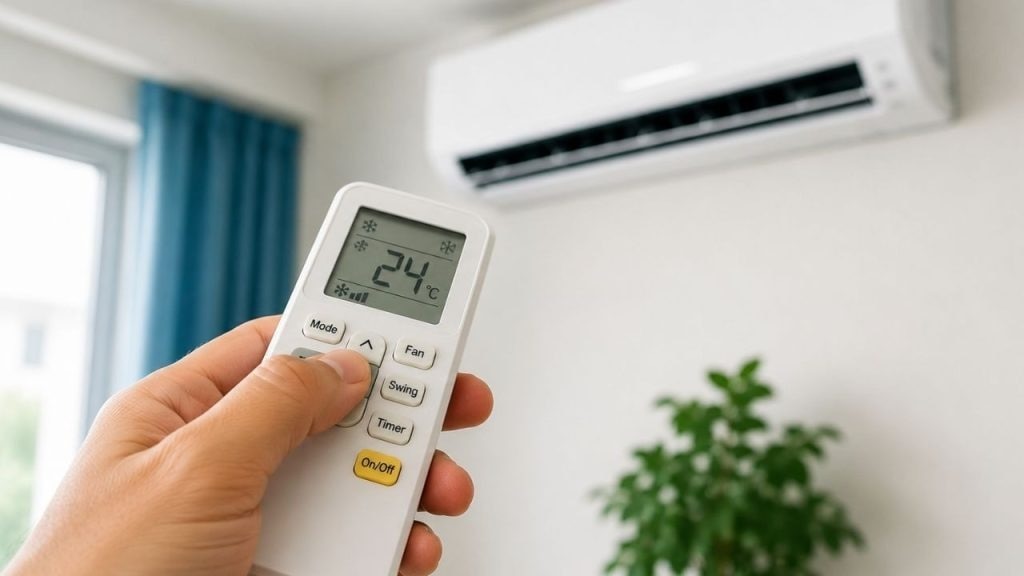
Voltas has signed a binding term sheet with Atomberg Innovation, the B2B engineering arm of consumer appliances startup Atomberg Technologies, to set up a proposed 50:50 joint venture to develop, manufacture and supply compressors and other allied components for room air conditioners in India.India's AC market expected to nearly double by 2030. India is preparing for an air-conditioner boom given the rise in temperature due to climate change, but there is a problem hiding inside the machines that millions of Indians are buying: some of the most important components are still sourced from overseas.Now, Tata-owned Voltas is trying to change that.Voltas has signed a binding term sheet with Atomberg Innovation, the B2B engineering arm of consumer appliances startup Atomberg Technologies, to set up a proposed 50:50 joint venture to develop, manufacture and supply compressors and other allied components for room air conditioners in India. The partnership is aimed at building domestic capability in a critical part of the AC supply chain and reducing dependence on imports.The timing is important. In May, the government allowed manufacturers to import certain rotary hermetic compressors below 2 tonnes used in air conditioners and heat pumps only up to 30% of their FY25 import volumes during FY27. Manufacturers have also been asked to submit an indigenisation plan. The move was designed to balance immediate supply needs with the longer-term push to build domestic capacity. For Voltas, this is also a second attempt at building a domestic compressor capability — but with a very different partner.WHY THE COMPRESSOR MATTERSThe compressor is one of the key components in an air conditioner. It circulates refrigerant through the system and is central to the cooling process. India's problem is that domestic AC manufacturing has grown faster than the local ecosystem for some critical components. China is a major source of India's imports of refrigeration-equipment compressors.India Exim Bank data showed China accounted for 73.7% of India's imports in the relevant compressor category, worth $217.5 million. This figure relates to the specified trade category and should not be read as saying that 73.7% of every compressor used in Indian ACs comes from China.That distinction matters because India's AC industry is increasingly looking to manufacture more of the product and its components locally.The government has been pushing this through the production-linked incentive scheme for white goods, which includes air conditioners and their components. Atomberg Innovation itself has been listed among companies referred to under the PLI scheme for AC components, with control assemblies and motors among its eligible products and a committed investment of Rs 50.20 crore.INDIA'S AC MARKET IS ABOUT TO GET MUCH BIGGERThe urgency comes from the sheer size of the opportunity.India sold around 15 million room air conditioners in FY25, according to industry estimates. Market estimates from Statista put 2025 sales at around 15.4 million units and project that annual sales could reach around 28 million by 2030.Household penetration is still low. Only around 10% of Indian households currently have an AC, according to Panasonic and other industry estimates cited by Reuters.That leaves a huge potential market.Voltas is already one of the biggest players in it. Reuters reported in February that Voltas had around 18% of India's AC market. The company has also been focusing on first-time buyers, with Voltas saying around 85% of AC buyers in India are purchasing their first AC.So the localisation question is becoming bigger with every additional AC sold.If annual sales rise towards 28 million units by 2030, India will need millions more compressors, motors, controllers, heat exchangers and other components every year.The question is: how many of those will be made in India?VOLTAS HAS TRIED THIS BEFOREThe Atomberg partnership is significant because Voltas has already tried to build compressor manufacturing with a foreign partner.In 2022, Voltas entered into a joint venture agreement with Highly International (Hong Kong), a wholly owned subsidiary of Shanghai Highly Group, for inverter compressors for room air conditioners, along with motors and associated parts.The proposed venture required regulatory approvals, including under Press Note 3, which requires prior government approval for certain foreign investments from countries sharing a land border with India.Those approvals did not come through.In April 2023, Voltas and Highly mutually decided to terminate the agreement, with Voltas saying the required regulatory approvals were not forthcoming.The episode left Voltas without the compressor manufacturing partnership it had been trying to establish.A year later, Voltas management said the company was still looking for a technology partner and wanted to manufacture not only compressors but also other important AC components.Now, three years after the Highly deal was terminated, the company has another technology partner — this time an Indian one.ATOMBERG: FROM SMART FANS TO AC COMPONENTSAtomberg is better known for its smart and energy-efficient ceiling fans, but the company has been expanding into the business of developing motors, controllers and compressors for larger appliances.Its B2B engineering division, Atomberg Innovation, has been developing technologies for appliances including air conditioners, refrigerators and washing machines. The company was founded by IIT Bombay alumni and originally built its business around BLDC motor technology for ceiling fans.That engineering capability is now moving deeper into the AC supply chain.The proposed Voltas-Atomberg venture is therefore not simply about Voltas finding a supplier. It is an attempt to combine Voltas' scale and AC business with Atomberg's component-engineering capabilities.The proposed JV is still at the term-sheet stage, however. The companies have not yet announced details such as the manufacturing plant, production capacity or commercial production timeline.INDIA IS PUSHING LOCALISATION, BUT SUPPLY CANNOT CHANGE OVERNIGHTThe government's compressor import rules show the balancing act.On one hand, India wants manufacturers to develop domestic supply chains. On the other, domestic capacity is not yet sufficient across every component and product category, which is why the government has allowed limited imports to continue.Under the May 2026 order, manufacturers can import specified rotary hermetic compressors below 2 tonnes used in ACs and heat pumps up to 30% of their FY25 volumes without complying with the relevant QCO requirements. Larger compressors have different limits, while some VRF-related compressors can continue to be imported at higher levels.The government has also asked companies to provide a phased plan for indigenisation.That means the policy is not simply "stop importing from China".It is closer to: keep the supply chain running today while building the ability to manufacture more of it in India tomorrow.THE BIGGER BATTLE IS INSIDE THE ACThis is where the Voltas-Atomberg partnership becomes part of a much bigger manufacturing story.India's AC market is growing rapidly, but making the finished product locally is only one part of building a domestic industry. The bigger challenge is to develop the components and technologies that sit deeper in the supply chain.Voltas' own history shows how difficult that transition can be. Its first compressor JV with a Chinese partner could not move ahead because the required regulatory approvals were not forthcoming. The company is now trying again with an Indian technology partner.For Atomberg, the partnership offers a route to take its engineering capabilities beyond fans and into a much larger appliance market.And for India, the stakes are bigger still.If AC sales nearly double from current levels by the end of the decade, the country will need a much larger ecosystem of compressor, motor, controller and other component manufacturers.The real Make in India challenge, therefore, is no longer just about making more ACs in India.It is about making more of what is inside them in India, too.- EndsPublished On: Aug 17, 2026 13:04 IST
The AC inside your home still depends on China. Voltas wants to change that
Full Article
Original Source
Read the full article at Indiatoday →KhanList aggregates and links to publicly available news content. We do not host full articles from third-party sources. Always verify important information with original sources.