
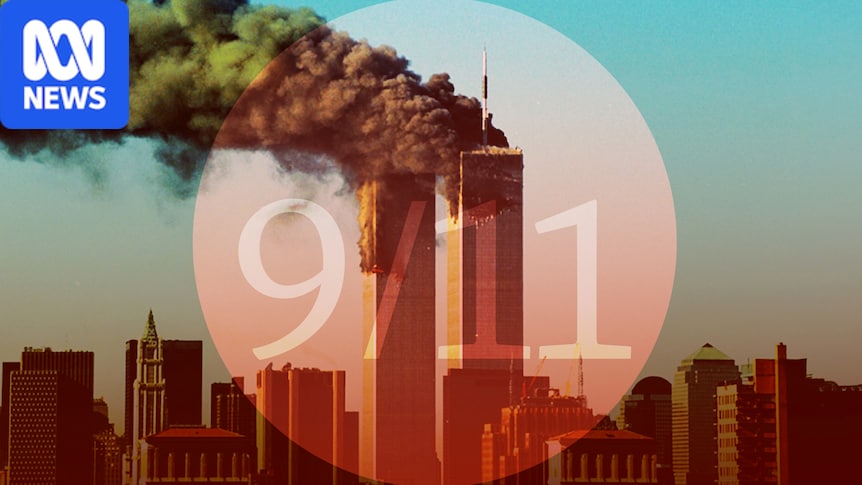
After 25 years, the legacy of the September 11 terror attacks continues to shape America's politics and its place in the world.A quarter-century on, what lingers in the mind from that world-upending day? September 11, 2001. Or 9/11, as it quickly came to be labelled, a term previously known as the primary emergency number in North America but now forever associated with an Islamist terrorist attack that killed 2,977 people from more than 100 countries, not including the 19 hijackers.Perhaps, initially, it was sheer confusion, as news channels interrupted regular programming to switch to images from Lower Manhattan. The North Tower of the World Trade Center was aflame. A billowing plume of charcoal grey smoke darkened what had been on that autumn morning almost cloudless blue skies.Maybe it was the shock of seeing the second plane spearing into the South Tower, when it instantly became clear that terrorism, not pilot or mechanical error, was to blame.Some will recall President George W Bush reading a book, The Pet Goat, to a group of schoolchildren in Sarasota, Florida, and the sight of his ashen-faced White House Chief of Staff, Andrew Card, whispering in his ear."A second plane hit the second tower," said Card. "America is under attack."Not just America, but our world had changed with manic suddenness. The first plane hit the north face of the North Tower at 8:46am. The second plane crashed into the south face of the South Tower at 9:03am. Little more than 30 minutes later at 9:37am Washington DC was also under assault. American Airlines Flight 77 slammed into the Pentagon, like New York's Twin Towers, a symbol of US hegemony.Shortly after 10am, a plane crashed in a field in Shanksville, Pennsylvania. Passengers aboard United Airlines Flight 93, we found out later, had fought back against the al-Qaeda terrorists who had hijacked the plane with the intention of flying it into a government building in Washington DC, probably the United States Capitol building or the White House.All these years on, it is traumatising to recall the towers collapsing in on themselves, those sturdy, seemingly indomitable skyscrapers disintegrating into columns of plunging ash. By 10:30am, the World Trade Center had ceased to exist.So, too, the complacency of the post-Cold War world when America seemed so unassailable.From a day of such momentous history, it is the smaller, personal details that evoke powerful memories. The recordings of workers trapped inside the burning towers telephoning loved ones, knowing they were uttering final farewells. The snapshots of people trapped on the upper floors of the Twin Towers, leaping through shattered windows to certain death. The "Missing" posters affixed to lampposts across Manhattan, a story behind each face.Coming at the dawning of a new millennium, September 11 was the first major global event of the globalised age. Coming in the early years of our new online world, where the information flow was instantaneous, 9/11 became more of a shared, intimate and immediate experience. How did it change America and the watching world? What is its meaning in September 2026?'God Bless America'In the immediate aftermath of the attacks the United States of America was genuinely united. A nation already showing signs of its present-day polarity demonstrated shoulder-to-shoulder solidarity. Only the previous year, a disputed presidential election ultimately decided by a Supreme Court voting along ideological lines, had shown America to be a 50/50 nation. After the US television networks decided in 2000 to adopt the same colour scheme for their election night graphics, it became more common to split the country into Republican red and Democratic blue.In the hours, days and weeks after 9/11, though, Americans came together at vigils, in long queues that formed outside blood donation centres and in singing of the national anthem ahead of baseball and gridiron matches.That evening, about 150 Republican and Democrat lawmakers gathered on the East Steps of the US Capitol building, where they broke spontaneously into a rendition of "God Bless America".A few weeks later, a poll conducted in early October indicated 79 per cent of Americans had displayed the Stars and Stripes, a burst of red, white and blue patriotism. Journalists from many of the US networks affixed flag pins to their lapels. As young Washington correspondent at the time of the 9/11 attacks, I saw all of this with my own eyes.United in warSince the end of the Cold War, America had lacked a common enemy. As the Russian intellectual Georgy Arbatov warned US diplomats as tensions abated between Moscow and Washington: "We are going to do a terrible thing to you. We are going to deprive you of an enemy."Now, in Osama Bin Laden — the mastermind of 9/11 — and the al-Qaeda terror network he founded, America once again had a shared demon and as a result, a renewed sense of patriotic bipartisanship.George W Bush, a Republican president who had reached the White House in such contested circumstances, saw his approval ratings soar to 90 per cent. After addressing a joint session of Congress on September 20 — a speech in which he announced the start of a "war on terror" — Bush was hugged by then-Senate Democratic leader, Tom Daschle, a gesture which signalled a partisan ceasefire.Another poll, from the Washington Post and ABC News, found 93 per cent backed military action against those responsible for the 9/11 attacks. If that meant going to war then more than nine out of 10 Americans agreed. There was strong public support and near unanimous bipartisan backing for the first stage of the Bush administration's war on terror. Operation Enduring Freedom commenced in Afghanistan on October 7.Less than two months later, with the Afghan capital Kabul already having fallen, the Taliban surrendered Kandahar, their final major stronghold. Osama Bin Laden was thought to be trapped in the Tora Bora cave complex close to the Pakistan border. US forces, however, made the mistake of entrusting his capture, or killing, to an Afghan militia. The al-Qaeda leader escaped on horseback with the help of local tribal networks and the former mujihadeen he fought beside during the Soviet occupation of Afghanistan the 1980s.The ongoing hunt for Bin Laden — along with the need to prevent Afghanistan from becoming once again a safe haven for terrorists — turned Operation Enduring Freedom into a "forever war". Only in 2021, five years ago last month, did that war finally come to an end, as US forces withdrew and the Taliban swept back into power.National unity had shown early signs of fraying in January 2002, when the first group of detainees from the Afghan war were flown to the US base in Guantánamo Bay, Cuba. As these "unlawful enemy combatants" were brought off a US military cargo plane, many Americans were shocked to see them wearing fluorescent orange jumpsuits and turquoise blue face masks. The images looked dystopian.Before a proper prison could be built, they were held in chain-link enclosures at a makeshift detention centre, Camp X-Ray, where the US flag on the wooden watchtower became a symbol of the America's new war."Gitmo", as Guantanamo Bay was nicknamed, was described by one government official as "the legal equivalent of outer space". That is precisely why it was chosen. Detainees had only limited protections under US law. Over time this Cuban outpost would be seen by critics, domestic and international, as an American gulag. The US Supreme Court, in a 2006 ruling, determined that the military commissions set up to try detainees violated the Geneva Conventions.On a visit to Guantanamo Bay, I was told detainees were given Happy Meals from the McDonald's on the base in return for actionable intelligence. That, apparently, was true. But many of the 780 men and boys held there were also subjected to what were euphemistically called "enhanced interrogation techniques" such as sleep deprivation, sexual humiliation and waterboarding, the simulation of drowning.Waterboarding became part of the new 9/11 vocabulary, alongside other phrases like "Ground Zero," "weapons of mass destruction" and "the Axis of Evil," George W Bush's controversial descriptor lumping together Iraq, Iran and North Korea.Back in America, the passage of the Patriot USA Act, just 45 days after 9/11, sparked debate over how to balance national security with constitutional protections, and whether the legislative process had been rushed. Sweeping surveillance powers, which included the tapping of domestic and international phones, and greatly expanded detention powers, infringed civil liberties.More controversial still was the decision of the Bush administration to target the Iraqi president Saddam Hussein. The move was first discussed by the US president's inner circle over the weekend after 9/11, despite no evidence linking Hussein to the attacks.The war in Iraq began in March 2003 with the "shock and awe" bombardment of Baghdad. Ahead of the attacks the Bush administration justified military action using what turned out to be false and misleading claims about Iraq's supposed arsenal of weapons of mass of destruction.The case for war, made most famously at the horseshoe table of the United Nations Security Council in New York by then-US Secretary of State Colin Powell, failed to convince much of the country. Whereas three-quarters of Americans backed military action in Afghanistan, only half supported Operation Iraqi Freedom, the invasion of Iraq.UnravellingThe Pentagon expected the war to be over quickly."Five days or five weeks or five months," predicted then-Defence Secretary Donald Rumsfeld, "but it certainly isn't going to last any longer than that."Instead, it lasted eight years, nine months and 26 days, from March 2003 to December 2011. The war claimed the lives of at least 110,000 Iraqis and more than 4,000 Americans. A further 31,952 Americans were wounded in action. As well as the human cost of the war, there was a financial price tag, estimated to be between $US1.5 trillion ($2 trillion) and $US3 trillion ($4.2 trillion).Diplomatically, the collateral damage was immense. The attacks of 9/11 had presented the United States with an opportunity to reaffirm its global leadership of the post-Cold War world. George W Bush became the recipient of enormous global goodwill. "Nous sommes tous Americains," said a headline published by the French newspaper Le Monde, two days after the attacks: "We are all Americans."NATO allies, for the first time, triggered the Article 5 collective defence clause, meaning that an armed attack against one member is an attack against all.Australia invoked Article IV of the ANZUS Treaty to convey support for the United States, and the military action that would come next. Then-prime minister John Howard had been in Washington on September 11 and could see from his hotel window smoke rising from the Pentagon.In the lead-up to the Iraq war, however, the Bush administration squandered the unity of the West. It rejected multilateralism in favour of unilateralism and derided longtime allies, most notably the French who opposed the Iraq war. On Air Force One, French fries were banished from the menu, and replaced by "Freedom Fries".The overthrow of thuggish Saddam Hussein and the collapse of his Ba'athist regime led to chaos throughout Iraq, and sparked a sectarian civil war in which Shiite Muslim, Sunni Muslim and Kurdish separatists struggled for control and fought for self-governance. The eventual withdrawal of US forces in 2011 created a security vacuum in which jihadist groups prospered. The Islamic State of Iraq and Syria, or ISIS as it was better known, started as an affiliate of al-Qaeda. In 2013 it went out on its own.By 2014, capitalising on the weakness of the Iraqi state and the civil war being waged in Syria, ISIS succeeded in setting up a caliphate in the east of Iraq, which included Mosul, Iraq's second largest city. ISIS inspired the Paris terrorist attacks in 2015, in which 130 people were killed, a bombing in the heart of Istanbul, the Brussels bombing in 2016, which killed 32, the Nice truck attack which killed 86. In Sydney, in December 2014, the Lindt cafe siege was carried out by a gunman who told hostages he was an operative of Islamic State.China's riseThe aftermath of September 11 resulted in power shifts that are still being felt today. Iran benefited enormously from the war in Iraq, because it led to the ouster of its chief enemy, Saddam Hussein, who was also the architect and wartime commander of the Iran-Iraq war that raged throughout the 1980s.The Iraqi dictator had protected the Sunni elite. The new government in Iraq was Shia-dominated and more favourably disposed towards Tehran. Now the most powerful Muslim country in the Middle East, Iran looked to expand its proxy network in Lebanon, Iraq, Yemen, Syria and Gaza. Thereafter, containing Iran, and preventing it from becoming a nuclear-armed power, became a key foreign policy objective of successive US presidents, from Barack Obama through to Donald Trump. Much of the opposition domestically to Donald Trump's Iran war stems from memories of the Iraq war, and the fear of another lengthy foreign entanglement.As the United States got bogged down in two lengthy wars in Iraq and Afghanistan, China became a more assertive power in the Indo-Pacific. Beijing simultaneously expanded its sphere of influence in Africa, South America, Central and South Asia and Europe.The 20th century had been the American century. By 2008, when Beijing hosted the summer Olympics, it looked like the 21st century could become the Chinese century. No longer did we live in a unipolar world, where American pre-eminence was a given.The impact on US politicsBy the end of his presidency, George W Bush was frequently compared with Roman emperors and accused of being the author of America's imperial decline. The failure to find weapons of mass destruction in Iraq blasted American credibility.Images from Abu Ghraib, a prison complex inside Iraq, showing US military personnel subjecting Iraqi detainees to physical, psychological, and sexual abuse made a mockery of America's claim to moral leadership. So, too, CIA "black sites" situated in friendly nations and rendition programmes that human rights groups complained violated the UN Convention Against Torture.After Afghanistan and Iraq, the United States became more wary of projecting its military power. Obama's strategy during the 2011 Libyan war, as a senior advisor explained to the New Yorker magazine, was "leading from behind," with France and the United Kingdom taking the military lead.In 2013, Obama decided against launching an attack on Syria, even though its then dictator Bashar al-Assad had crossed the US president's "red line" by murdering his own people with chemical weapons. Perhaps sensing Obama's disinclination towards US military interventionism, Vladimir Putin's Russia heightened its involvement in the Syria war. Critics of Obama also argue Putin was emboldened to invade Crimea in 2014, the true start of the Ukraine war. Obama, it should be noted, was proud of not attacking Assad, because afterwards he claimed 99 per cent of Syria's huge chemical weapons stockpile was removed through diplomatic negotiations without America having to fire a shot.During his first term as president Donald Trump did not start any major new conventional wars. Understandably, Americans became more squeamish about sending their troops abroad and Washington became more isolationist as a result.For years afterward, 9/11 the event continued to impact American politics.In the 2002 congressional mid-terms, the Bush administration turned the battle for control of the House of Representatives and Senate into a "khaki election" dominated by national security. In doing so George W Bush became only the second president since World War II to see mid-term gains for his own party.Four days before the 2004 presidential election, a 15-minute video released by Osama Bin Laden mocked Bush for continuing to read The Pet Goat. It helped to produce a late surge in favour of the president which supported his defeat of the Democrat contender, Senator John Kerry.In 2008, Obama profited from his opposition to the unpopular war in Iraq, partly because it offered a clear point of differentiation from his rival for the Democratic presidential nomination, Senator Hillary Clinton, who voted in favour of the war.From 9/11 to J6September 11 affected the American psyche. On the first anniversary of 9/11, more than half of adults said they felt more afraid, distrustful and vulnerable as a result of the attacks. Shattered in an instant was the longhand American belief that two great oceans, the Atlantic and Pacific, protected its mainland from attack. Understandably, city dwellers were most anxious, especially those living in New York and Washington DC.What is striking about the polling from that time, however, is how comparatively few Americans thought their lives had been significantly impacted."A quarter of people who lived in large cities nationwide said their lives had changed in a major way," the Pew Research Center has since reported, "twice the rate found in small towns and rural areas."In their day-to-day lives, Americans were forced to put up with new inconveniences such as stricter screening at airports and a ban on carrying pocket knives and box cutters onto planes. Bank accounts, emails and phone calls could be more easily surveilled by government agencies. For the most part, however, Americans were not asked to make many sacrifices.Rather than raising taxes to pay for the war, the Bush administration pushed through a series of tax cuts. Conscription was never seriously considered by either the Bush administration or lawmakers on Capitol Hill.Less than one half of 1 per cent of Americans experienced active military duty in the decades after the attacks. At the height of the Cold War, John F Kennedy had famously asked during his 1961 inaugural address: "Ask not what your country can do for you — ask what you can do for your country." Yet throughout his "war on terror", George W Bush never made that kind of appeal to his compatriots.Despite dire predictions after September 11 that mass casualty terror strikes, possibly involving weapons of mass destruction, could become the new American normal, there has not been an attack in any way comparable. There have been intermittent Jihadist terror strikes, notably the 2009 Fort Hood shooting, the 2013 Boston Marathon bombing, the 2015 San Bernardino shooting, the 2016 Orlando nightclub massacre, and the 2019 Pensacola Naval Air Station shooting, which was the only attack with a direct link to al-Qaeda.In 2020, the Department of Homeland Security warned the "most persistent and lethal threat in the homeland" came from white supremacist groups.Far-right, anti-government, white supremacist and other homegrown extremist groups have carried out more domestic terror attacks on US soil since 9/11 than have Islamist Jihadists.Tellingly, the only other event described by the shorthand of its time stamp is January 6, 2021, or "J6", as Donald Trump often reverentially calls the storming of the US Capitol building and the attempt to overturn Joe Biden's victory in the 2020 presidential election.Was the American Dream dead?From the distance of a quarter century, how epic does 9/11 seem now? Certainly, the imagery from that day has a visual power. To watch the footage again is to be shocked anew. All these years on, I look on the attacks of 9/11 as the event that cleaved my career in two. It is a sentiment shared by most journalists of my vintage. Yet was it really the turning point it felt like at the time?Given the extent to which China is now rivalling the United States for dominance, one could plausibly argue that 9/11 was not even the most significant geopolitical event of the second half of 2001.That, arguably, happened on December 11, 2001, with the admission of China into the World Trade Organisation, a move which supercharged the country's economy and created a trading imbalance with the United States which fuelled the rise of Donald Trump. Prior to joining the WTO, China had a 4.8 per cent share of global manufacturing. By 2014, the year before Donald Trump came down that golden escalator, it was 18.3 per cent.Likewise, the collapse of the investment bank Lehman Brothers on September 15, 2008 proved more consequential for a greater number of Americans than the destruction of the Twin Towers. The financial crash and Great Recession that followed created a crisis of economic confidence which made the American Dream feel more like a chimera.Millions of parents, whether in the countryside or the cities, no longer believed their children would lead more abundant lives than they did. Trump declared in 2016 that the American Dream was dead; it resonated especially loudly in the hollowed out post-industrial communities of the Rust Belt, home to the muscly blue-collar states where his presidency was won.That said, it is always worth remembering how the mammoth cost of the 9/11 wars contributed to the financial crash. Because of the sharp fall in Iraqi production, the price of oil soared from $25 a barrel at the start of the conflict to $140 a barrel in 2008.A financial chain reaction was ignited. With oil prices soaring, the Federal Reserve cut interest rates to guard against an "oil shock" recession. Awash with cheap money, the housing bubble became dangerously over-inflated, a cause of the sub-prime crisis that contributed to the Great Recession.The ripple effectThe political repercussions from the 9/11 wars still have a ripple effect. The presidency of Joe Biden never recovered from the chaos of the US withdrawal from Afghanistan and the return to power of the Taliban. In that moment, his poll numbers cratered and he never managed regain the initiative.Pre-9/11, immigration was primarily an economic issue, with policy geared towards supplying American businesses with an ample stream of cheap labour. In the very week before September 11, the Bush administration had been negotiating the liberalisation of immigration controls with the Mexican government led by President Vincente Fox. It would have set up a temporary worker visa programme.After 9/11 immigration became a national security issue. It remains so to this day. Nativism and Islamophobia became more commonplace and less welcoming for new arrivals. America became more inclined to countenance Trump as president, a nativist firebrand who called during the 2016 campaign for a ban on immigrants from mainly Islamic countries. Fed up with the 9/11 forever wars, the country warmed to a candidate promising to put "America First".The United States began this century in a confident mood. As it ushered in the new millennium, I was on the National Mall where fireworks illuminated the Washington monument and made that towering obelisk look like a giant number one. Then-president Bill Clinton had boasted of building a bridge to the 21st century.Just 21 months later, however, America had become a different land: fretful rather than optimistic about the future.Now, 25 years on, a country that came together in that awful hour is marked more by mutual loathing. Bipartisanship has given way to hyper-partisanship. The US alliance system has frayed, as old friendships have degenerated into outright hostility. The age of America, that period of post-Cold War unrivalled ascendancy, has come to an end. The attacks of September 11, and the response of successive presidents at home and abroad, are the key to understanding its waning.CreditsWords: Nick BryantIllustrations: Kylie SilvesterEditor: Catherine Taylor
The 9/11 terror attacks are key to understanding America's waning
Full Article
Original Source
Read the full article at Abc →KhanList aggregates and links to publicly available news content. We do not host full articles from third-party sources. Always verify important information with original sources.