
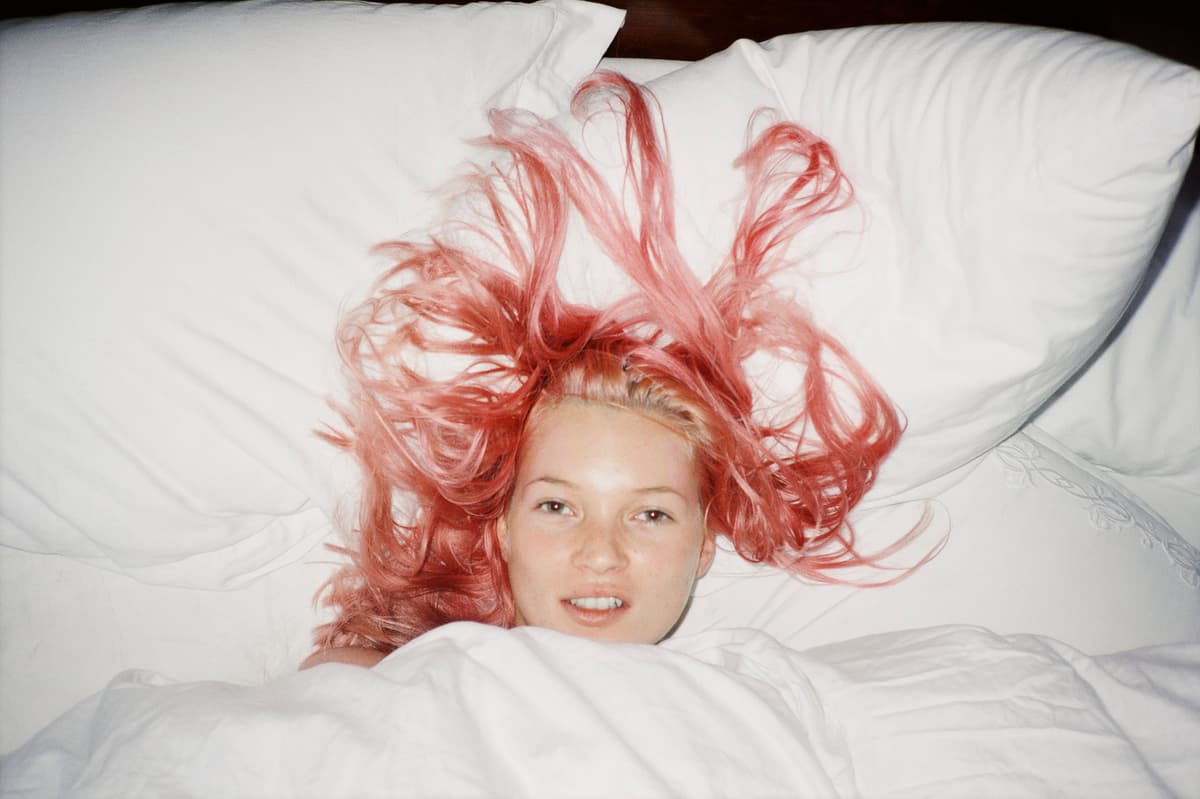
Juergen Teller, Stella McCartney, Damien Hirst, Steve McQueen and more share their memories of the era Juergen Teller on his photo Pink Kate Moss“In the 1990s things were very slow and we were poor, but we were honest and we had fun. Kate asked me to photograph her with the pink hair. We were taking the series of photographs for ourselves, not for any other reason. We liked each other and we wanted to work together.” Eddie Otchere on his photo of GoldieGoldie - Eddie OtchereEddie Otcher“In late 1995 Goldie wanted to insulate and incubate a sound built around the talents of a new group of producers, artists and DJs who had championed the jungle sound. Heralded by Kemistry & Storm, their Metalheadz label and the Sunday Sessions, they took jungle music and threw it into the future. In this picture you see Goldie is screaming for the rewind. This happened moments after the first bass drops in J. Majik’s Your Sound record. I could hear him screaming and tearing towards the DJ booth to tell Grooverider to rewind that tune and play it again. Sarah Lucas on Chicken KnickersSarah Lucas, Chicken Knickers, 1997Tate“Before the 1990s, the contemporary art scene in London was limited to a few galleries that would operate by taking on a new artist once a year or so. They had the authority — and they could be quite stuffy with it. But in the 1990s a bunch of artists emerging from colleges began organising their own exhibitions in abandoned buildings or places with short leases, without influence from these leading galleries. It was still a small crowd and if you went to an opening everyone would be there and would end up in the same places afterwards.“The Shop on Bethnal Green Road, which Tracey Emin and I opened in 1992, was a real part of this. More and more artists started turning up to see us and what we were doing, creating a real sense of community. Every time we’d go to a private view we’d hand out business cards with the address on, handwritten by Tracey with slogans like, “Have you seen that shop?”“These artist-instigated shows and situations started to get beer sponsorship, sometimes spirits even. This helped to grow audiences. It was a buoyant scene kept up by the enthusiasm of many young people. We were our own audience. It wasn’t about shoving art down people’s throats, they were really interested. It was a revolution. The explosion of our generation had a lot to do with having a party and the mentality of that. There was a period of time when it felt like the whole world was coming to our circus. It was one of those moments when you met a lot of people and you didn’t know it but they were going to be a big part of your life later on. To spend an hour or two with anyone from that time was a great pleasure. They were such a bunch of brilliant, amusing people — and they still are today.”Nick Knight on his photo of David TooleNick Knight’s photograph of David Toole Nick Knight SHOWStudio“This picture is from a series taken in 1997. It was the first time that people of different physical abilities and body shapes had been shown within the aspirational codes and language of fashion photography. It was taken before the internet was accessible, so there was absolutely no social media. At the time, my photographs would be published in magazines, record sleeves or on billboards, but there was no way of getting any feedback whatsoever from my audience. As an artist, this is frustrating and gives a sort of sense of detachment and to some degree loneliness — imagine a singer always performing in an empty stadium. So I welcome social media and the ability to talk and have a conversation directly with your audience. “However, for this picture and the whole series, I would receive letters, physical letters, faxes and phone calls virtually every day for about a year from the moment that story was published. The requests were often asking to use the pictures in a magazine or academic periodical or in a book, but this feedback went on virtually every day for almost a complete year since the publication of the pictures. So it felt, in a real tangible sense, that we were in touch with our audience. It’s one of the reasons I started SHOWstudio three years later, to have that relationship with my audience.”Damien Hirst on Two Similar Swimming Forms in Endless MotionDamien Hirst, Two Similar Swimming Forms in Endless Motion (Broken) Damien Hirst and Science Ltd.“I remember an interviewer at the time asking me in a negative way, ‘Aren’t you trying to make three-dimensional versions of Francis Bacon paintings?’ And I remember saying, ‘Yeah, that’s sometimes exactly what I’m trying to do.’ I couldn’t see it as negative. A 3D version of a painting can be a powerful thing if you can keep the things that made the painting powerful intact. A few years later a letter came out where Bacon spoke about some of my works directly and how they moved him. “I very directly used Bacon’s tubular forms to create movement. It felt very contemporary at the time but really the formaldehyde specimen was something used a lot by the Victorians.”Stella McCartney on fashion in the 90sStella McCartneyGetty Images“London in the 1990s was alive: it was endless fun and that felt electric. There was chaos, but there was also freedom — music, clubs, art and fashion were all colliding and everyone was feeding off that creative energy. You could walk out at night and genuinely feel like culture was being shaped around you. “I was young, curious and often slightly terrified. Central Saint Martins was intense. It wasn’t nurturing in a soft way — it pushed you constantly. The more extreme your ideas were, the more you were celebrated. I spent two and a half years making dresses out of spaghetti — none of it was wearable. It didn’t feel true to who I was as a person or as a designer. “When it came to my degree show, I asked myself, ‘Am I brave enough to do what I actually want to do?’ All the other students were choosing their models and they were getting their friends. I had friends, but mine were the supermodels — Kate Moss and Naomi Campbell. I knew it was going to be controversial, but those girls were the hottest girls on the planet. They were doing every show in every city and they did a little college fashion show — not only for me, but also to support British fashion. So the experience toughened me, but it also gave me confidence. It taught me that instinct matters. Everything I do today comes back to that time. It’s still with me.”Yinka Shonibare on The Swing (after Fragonard) Yinka Shonibare, The Swing (after Fragonard) Yinka Shonibare / Tate Photography “I graduated from Goldsmiths into a world of Margaret Thatcher’s resignation followed by recession. In 1997, the same year as Sensation (Charles Saatchi’s show at the Royal Academy), the Labour Party won the election and Tony Blair became prime minister: this was the Cool Britannia moment, the time of New Labour and a resurgence in British creativity in art, music and fashion. Other countercultures existed in parallel to Cool Britannia. Diversity was starting to become part of a bigger debate in the international art world and in Britain. As identity issues including feminist and postcolonial theory were prevalent in the work of many artists at the time, I moved between the worlds of mainstream conceptual art and postcolonial discourse. My engagement with the latter led to me seeking alternative forms of representation. I approached iniva and proposed the photographic series Diary of a Victorian Dandy, which was shown across the London Underground.“Saatchi was the most significant collector of contemporary art in Britain in the 1990s. He collected the work of the so-called YBA artists and launched the careers of many artists, including my own, through the Sensation exhibition. A combination of his collection and Nicholas Serota’s Turner Prize added previously unparalleled energy and dynamism to the contemporary art scene.”Steve McQueen his film BearSir Steve McQueen, BearTate / Tate Images“(My film Bear) was a springboard, and that springboard was the risk, the opportunity to explore. To obliterate shadows, to make those things smaller, you have to go there. And sometimes it’s painful, sometimes it’s scary, but that’s where you have to go. In my eyes, it was all or nothing, because I threw myself at it. I got to the point where I had to find out through the act of making. When you are doing something through the act of making, you can’t put things in reserve, you’ve got to go all out. “What was interesting for me about the 1990s most of all was the shunning of black people. Look at what happened with jungle, garage, drum and bass. They panned it, they were just talking about Britpop. Britpop’s bullshit. The record companies invested in guitar bands. Yet the black music that was created then was revolutionary… My attitude was the same as it was towards the art world — we didn’t give a f***. We were focused on us, because we were doing our thing anyway and it was amazing.”
The 90s: Icons that defined a decade
Full Article
Original Source
Read the full article at Standard →KhanList aggregates and links to publicly available news content. We do not host full articles from third-party sources. Always verify important information with original sources.