
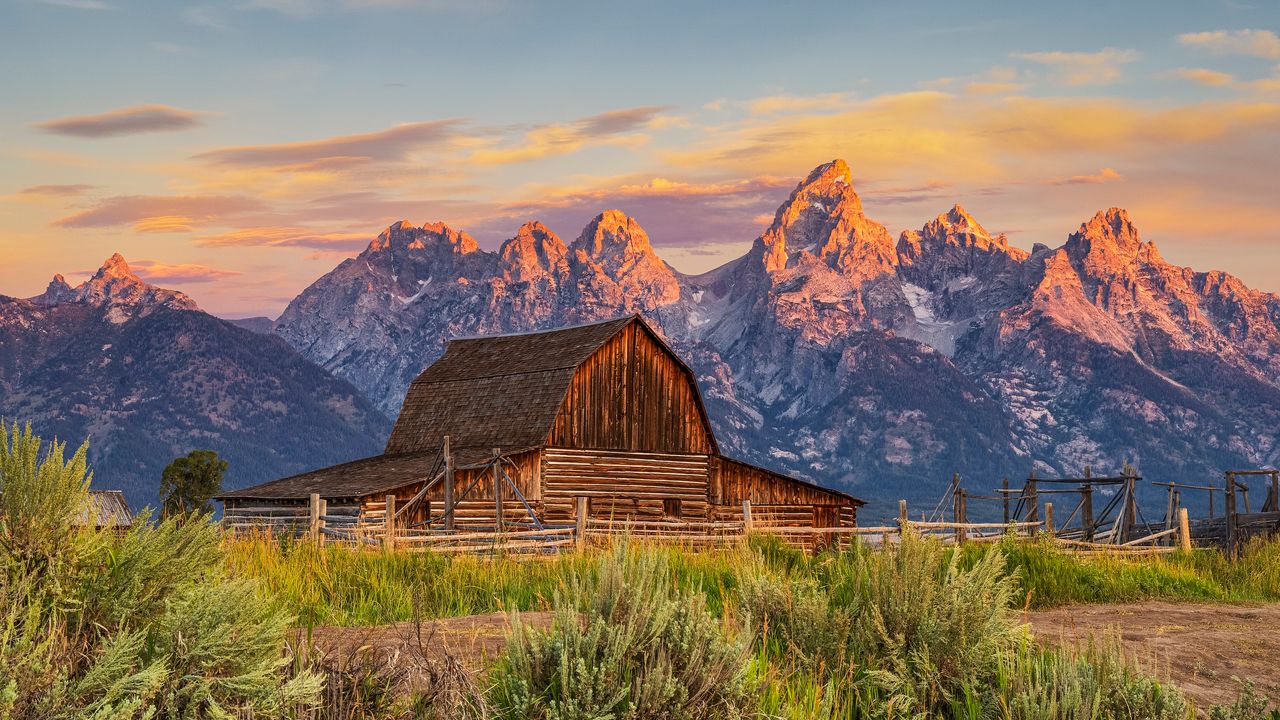
Skip to main contentStart planning your next road trip nowGrand Teton National Park in Wyoming.Photo: Carlo Alberto Conti/Getty ImagesThe most beautiful states in the US prove just how shockingly diverse the country is: volcanic beaches, glacier-capped peaks, canyon-carved deserts, and misty rainforests define their landscapes. What people have built in those places is just as varied, from a royal palace in downtown Honolulu to Mary Colter’s stone watchtower on the rim of the Grand Canyon to the cedar-shingled studios of a modernist craft school on the coast of Maine. These nine states stand out on both counts, for the scenery that defines them and the architecture that holds its own against it. Keep in mind that no ranking can settle which state is most beautiful—they’re all worthy of a visit.Photo: Allan Baxter/Getty ImagesHawaiiHawaii is far from a monolithic state, with scenery changing from island to island. In Honolulu on Oahu, ʻIolani Palace, completed in 1882 for King Kalākaua, is the only royal palace on US soil—and it had electricity before the White House did.Near Diamond Head, Doris Duke’s oceanfront estate, Shangri La, pairs 1930s modernism with architectural elements she brought from Morocco, Iran, Syria, and beyond. It’s now a museum of Islamic art, with tours departing from the Honolulu Museum of Art.As for the natural landscape, Kauai, known as the Garden Isle, is home to the Nā Pali Coast, where green ridges drop sharply toward the Pacific. On Maui, Haleakalā’s broad volcanic summit often rises above a blanket of clouds. And on the Big Island, Hawaii Volcanoes National Park actively showcases the raw power of volcanoes—if you’re lucky, you might even catch an eruption.Photo: Jim Feng/Getty ImagesWyomingWyoming’s most famous photo moment might be the Teton Range rising abruptly above the sagebrush flats of Jackson Hole, ideally with one of Mormon Row’s weathered homestead barns in the foreground. Nearby, the tiny log Chapel of the Transfiguration, built in 1925, was sited so that the picture window behind its altar frames the peaks where stained glass would normally go.In Yellowstone National Park, it’s all about color: Grand Prismatic Spring’s vivid rings stand out among the forested landscape, while the Grand Canyon of the Yellowstone exposes ochres and pinks in its steep walls. And steps from its namesake geyser, the Old Faithful Inn—designed by a 29-year-old Robert Reamer and opened in 1904—wraps a soaring lodgepole-pine lobby around a massive stone fireplace. It’s considered the largest log structure in the world.Photo: Alexander Spatari/Getty ImagesFloridaFlorida’s beaches are perhaps the state’s most scenic draw, but the architecture is just as distinctive. In 1979, Miami Beach’s Art Deco District, roughly a square mile of South Beach, became the nation’s first urban 20th-century historic district on the National Register, with more than 800 buildings listed. Across Biscayne Bay, industrialist James Deering’s Vizcaya, a villa completed in 1916, faces the water with formal gardens by Diego Suarez. Addison Mizner gave Palm Beach its Mediterranean Revival look; his Via Mizner, a winding pedestrian lane off Worth Avenue built in 1923, survives today.St. Augustine, founded by the Spanish in 1565, pairs the coquina-stone Castillo de San Marcos with Henry Flagler’s Hotel Ponce de Leon, a Spanish Renaissance–style palace from 1888 that’s now Flagler College. Architecture buffs should detour to Lakeland, where Frank Lloyd Wright’s campus for Florida Southern College is the largest single-site collection of his architecture in the world. And on the Gulf Coast, Sarasota’s midcentury modernists adapted the International Style to the subtropics, most famously in Paul Rudolph’s 1953 Umbrella House.Photo: Enzo Figueres/Getty ImagesMaineOn Maine’s coast, Acadia National Park packs a surprising amount of scenery into a small area: granite headlands, spruce forest, offshore islands, and views of the Atlantic. Look closely, and you'll notice the park’s impressive stonework, too. John D. Rockefeller Jr. financed its network of carriage roads, built between 1913 and 1940, along with 16 of the 17 stone-faced bridges that carry them over streams and gorges—no two are alike.Don’t forget the coastal villages, from ever-popular Bar Harbor and its shingle-style and Queen Anne houses to Stonington, a working fishing town on Deer Isle. Elsewhere on Deer Isle, Edward Larrabee Barnes’s 1961 campus for the Haystack Mountain School of Crafts, an underrated masterpiece of American modernism, steps down a granite slope toward Jericho Bay, its cedar-shingled cabins and studios linked by boardwalks.Photo: Jeremy Poland/Getty ImagesCaliforniaCalifornia has a little of everything, from the architectural hubs of Los Angeles and San Francisco to breathtaking natural settings. In Yosemite, El Capitan and Half Dome are jaw-dropping from the valley floor, but even more so from the top for those daring enough to make the climb. Back down in the valley, the Ahwahnee hotel, which opened in 1927, appears to be built of granite and redwood—but the “wood” is actually fireproof concrete, poured into molds and stained to look like timber. In the desert, Palm Springs is a showcase of midcentury modernism, with Richard Neutra’s 1946 Kaufmann House as its best-known example.But the California coast is undeniably the state’s most famous landscape, and the 656 miles of Highway 1 deliver architecture along with the views. Above San Simeon, Hearst Castle, which Julia Morgan designed for William Randolph Hearst over nearly three decades, crowns a hilltop overlooking the Pacific. Continue north past the bluffs of Big Sur and storybook Carmel-by-the-Sea to the Sonoma Coast, where the redwood-clad buildings of the Sea Ranch, a planned community begun in the mid-1960s, are tucked into hedgerows to leave the meadows and bluffs open.Photo: Artur Debat/Getty ImagesNew YorkNew York State’s famous architecture isn’t limited to the Manhattan skyline—though the city certainly pulls its weight on the architecture front. In the Adirondacks, wooded mountains surround lakes such as Lake Placid and the three Saranac Lakes. The “great camps” that wealthy families began building along their shores in the Gilded Age turned the log cabin into high style. You can still stay in one: The Point, on Upper Saranac Lake, was built in the early 1930s as Camp Wonundra for William Avery Rockefeller II and is now an 11-room Relais & Châteaux hotel, the first in North America.In the Hudson Valley, painter Frederic Church’s hilltop villa, Olana, features a design style he called “Persian, adapted to the Occident.” The Finger Lakes offer a gentler landscape of long, narrow lakes bordered by vineyards and small towns, plus the gorge at Watkins Glen State Park, where a stone path meanders past tumbling cascades and swirling pools. And in Buffalo, you’ll find Frank Lloyd Wright’s Darwin D. Martin House, one of his finest Prairie-style designs.Photo: Luc Rousseau/Getty ImagesArizonaThe Grand Canyon is a tough act to follow, but on its South Rim, architect Mary Colter spent decades designing buildings meant to hold their own beside it. Her Hopi House, which opened in 1905, is a multistory stone building shaped like a Hopi pueblo; her Desert View Watchtower, completed in 1932, is a 70-foot stone tower modeled on Ancestral Puebloan structures, with a Snake Legend mural inside by Hopi artist Fred Kabotie.Sedona’s red-rock buttes are spectacular on their own, but the Chapel of the Holy Cross, a modernist concrete chapel built directly into a pair of sandstone buttes and completed in 1956, gives them a focal point. North of Phoenix, Paolo Soleri’s Arcosanti, an experimental desert town of concrete domes and arches begun in 1970, is still a work in progress. And in Scottsdale, in the foothills of the McDowell Mountains, Frank Lloyd Wright’s Taliesin West—his winter home and studio from 1937 until his death in 1959—is now a UNESCO World Heritage Site.Photo: David Hensley/Getty ImagesTexasTexas’s landscapes range from the Chihuahuan Desert to the Gulf Coast to the bayous of Caddo Lake. In Big Bend National Park, the Chisos Mountains rise above dry plains, and the Rio Grande cuts through the narrow walls of Santa Elena Canyon. In Marfa, minimalist artist Donald Judd turned a former army post into the Chinati Foundation, a museum built around permanent, large-scale installations, including his 100 mill-aluminum boxes lined up inside two converted artillery sheds.In Fort Worth, Louis Kahn’s Kimbell Art Museum, completed in 1972, draws architects from around the world to see natural light wash down its concrete cycloid vaults; Tadao Ando’s Modern Art Museum of Fort Worth sits just across the street. Central Texas has rolling hills, and in spring, bluebonnets and Indian paintbrush color the roadsides around Fredericksburg, a town with German heritage.Photo: Didier Marti/Getty ImagesWashingtonMount Rainier is perhaps Washington’s most familiar landmark, its glaciers and snowfields visible above forests and summer wildflower meadows. The North Cascades offer even more peaks, with jagged ridges rising above turquoise Diablo Lake, while the trails in Olympic National Park lead through mossy rainforest and out to driftwood-strewn beaches.Seattle holds its own against all that scenery. Downtown, the Central Library—designed by Rem Koolhaas’s OMA with local firm LMN and opened in 2004—wraps its stacked floors in a faceted net of glass and steel, while the Space Needle, built for the 1962 World’s Fair, remains the skyline’s signature. Outside Seattle, Port Townsend’s Victorian storefronts overlook the water, and in the Walla Walla Valley, vineyard rows and wheat fields spread across rolling hills, with the Blue Mountains rising beyond them.Stefanie Waldek is a freelance journalist based in Saratoga Springs, New York, with more than a decade of experience. She writes about travel and design for publications like Condé Nast Traveler, Travel + Leisure, and House Beautiful, among others, and has penned three books: 150 Gardens You Need to Visit Before You Die, ... Read More
The 9 Most Beautiful States in the US
Full Article
Original Source
Read the full article at Architecturaldigest →KhanList aggregates and links to publicly available news content. We do not host full articles from third-party sources. Always verify important information with original sources.