
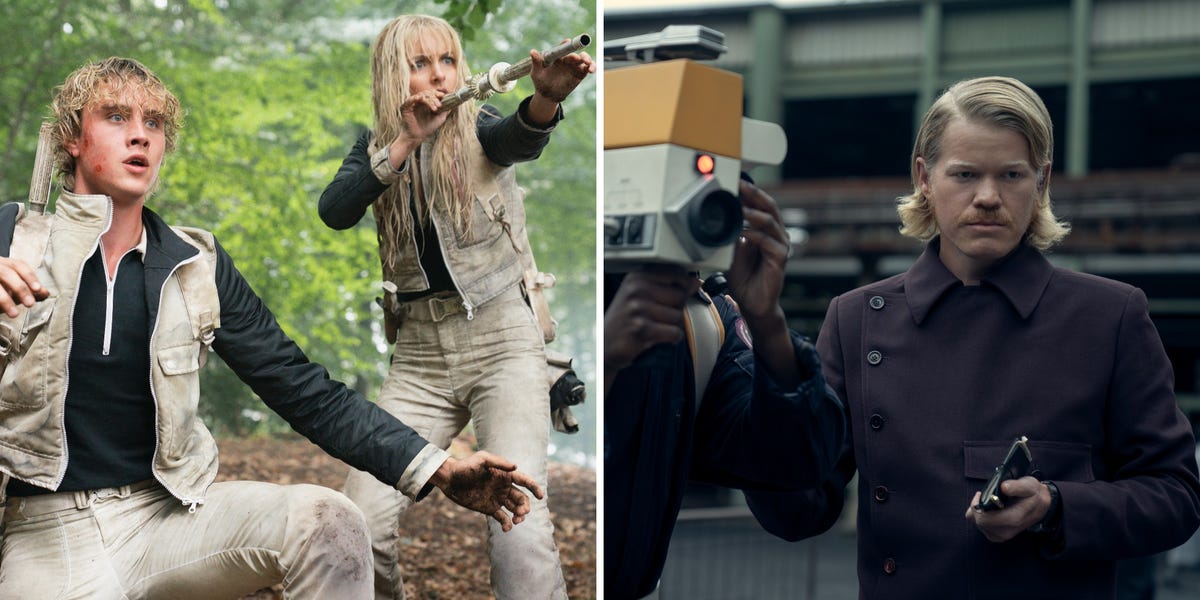
Murray Close/Lionsgate Joseph Zada as Haymitch Abernathy in "The Hunger Games: Sunrise on the Reaping." "The Hunger Games: Sunrise on the Reaping" was released on Friday, bringing Haymitch Abernathy's Hunger Games to the big screen.Directed by Francis Lawrence, the film was a largely faithful adaptation of Suzanne Collins' 2025 "Hunger Games" prequel, "Sunrise on the Reaping." It was no small feat to make the movie book-accurate, as the story features twice as many tributes sent into the Hunger Games arena and a slew of heartbreaking deaths that Haymitch, played by Joseph Zada, witnesses firsthand.However, Lawrence and his crew did make a few notable deviations from the original book in the movie, some of which had lasting implications for the larger "Hunger Games" universe.Check out nine of the biggest changes between the "Sunrise on the Reaping" book and movie. Spoilers ahead. The mockingjay pin only makes a blink-and-you'll-miss-it appearance. A mockingjay pin from "The Hunger Games." MediaNews Group/Bay Area News via Getty Images Any "Hunger Games" fan knows the mockingjay pin is a significant symbol in the series. In the books, Madge Undersee gives Katniss the pin to wear as her token in the arena, and as a result, Katniss comes to be synonymous with the mockingjay as a beacon for the rebellion.In "Catching Fire," Katniss learns the pin originally belonged to Madge's aunt Maysilee Donner, who competed alongside Haymitch in the 50th Hunger Games. And in "Sunrise on the Reaping," readers get even more context about the pin.According to the novel, Tam Amber, Lenore Dove's uncle, designed the pin as part of a set for Maysilee and her twin Merrilee for their 13th birthdays. Merrilee lost her hummingbird pin, while Maysilee refused to wear hers because she thinks there is "something unnatural about a bird that's half-mutt," as she tells Haymitch. She says she will wear the pin if she makes it home from the Hunger Games after learning they're viewed as a symbol of resistance, though she's never given the chance.The pin's origin in the films has been different since "The Hunger Games" was released in 2012. Madge doesn't exist in the movie; instead, an older woman gives Katniss the pin at the Hob.The differentiation continues in "The Hunger Games: Sunrise on the Reaping." Tam Amber doesn't appear in the film at all, and there is no mention of him making the pins for the Donner sisters or of Lenore Dove's feelings about it. However, the sisters wear their pins to the reaping, and Maysilee quickly hands hers to Asterid, Katniss' mother, after her name is called.Haymitch and Maysilee never speak about the pin, and the film doesn't explain how it went from Asterid to the woman at the Hob. It's a plot hole the film leaves open. A pivotal showdown between Maysilee and the gamemakers didn't make the film. Joseph Zada and Mckenna Grace as Haymitch Abernathy and Maysilee Donner in "The Hunger Games: Sunrise on the Reaping." Murray Close/Lionsgate Maysilee is crucial to Haymitch's experience in the Capitol and the arena in "The Hunger Games: Sunrise on the Reaping." But the movie omits a scene from the book that leads to Maysilee's death.Toward the end of the games, Maysilee and Haymitch are fleeing from the career tributes Maritte and Silka and run into three gamemakers trying to fix an error Haymitch caused when he attacked the arena.The gamemakers try to run, but all three die. Maysilee shoots one with her poison blowdart, Maritte spears another with a trident, and the final gamemaker falls down the tube that leads to the Sub-A floor beneath the arena. It's an important scene in the book because it shows Haymitch that people don't have to submit to the rules the Capitol imposes on them.To punish her for her act of rebellion, the gamemakers later kill Maysilee with a mutt attack, programming large pink birds to attack only her.The showdown with the gamemakers doesn't happen in the movie, though Maysilee does die by a bird attack. Without the gamemakers, though, the mutt's attack seems to be a punishment for Haymitch rather than Maysilee herself. The film also changed Haymitch's relationship with Wellie and Silka. Joseph Zada as Haymitch Abernathy in "The Hunger Games: Sunrise on the Reaping." Courtesy of Lionsgate In the "Sunrise on the Reaping" novel, the final three tributes in the arena are Haymitch, Silka, and Wellie, a younger tribute.Haymitch sets off to find Wellie after Maysilee and Maritte die, calling for her until she responds by ringing the bike bell she brought into the arena as her token. Wellie is starving to death in a tree, and Haymitch tries to nurse her back to health during the night, giving her water and some of the rations sponsors gift him, including chocolate.As he feeds her, Silka comes to the bottom of the tree. She doesn't attack them. Instead, Haymitch hears her crying, and in a moment of District solidarity, he drops a few chocolates for her to eat.Though Silka later kills Wellie, it's one of the most bittersweet moments in the book, but it didn't make it into the film. In the movie, Haymitch hears Wellie's bell ringing after Maysilee dies, and he runs toward the sound to discover that Silka has already killed Wellie and taken the bell. Haymitch then defeats Silka with the help of the force field surrounding the arena, becoming the Victor, as he does in the book.The broad strokes of the scene are the same, but fans who only watch the movie won't see the moment of connection between Haymitch and Silka, nor Haymitch's kindness to Wellie. Lou Lou has a more in-depth backstory in the book. Lou Lou played a larger role in the novel "Sunrise on the Reaping". Murray Close/Lionsgate After Haymitch's district partner, Louella McCoy, dies in the chariot parade ahead of the Games, Snow replaces her with a body double. Haymitch and the other District 12 tributes decide to call her Lou Lou. While Lou Lou appears in the film, the movie omits some of the information the tributes learn about her in the book.In the book, Mags discovers Lou Lou has a device implanted in her chest that can sedate her. She also appears to have a speaker in her ear that can listen to her conversations, instruct her on what to say, and hurt her, with her ears bleeding throughout the book.Lou Lou also unintentionally reveals that she is from District 11, becoming emotional when she sees a roll from her home before the Games begin. None of that information is included in the film, and her appearance in the arena also differs slightly.Inside the arena, Lou Lou intentionally searches for Haymitch, saying, "Find Haymitch," as they cross paths. In the film, she stumbles upon him. He takes her under his wing in both, though.The nature of her death also differs slightly in the book and movie. In the film, she inhales poison flowers and dies within a matter of minutes. In the book, however, the poison is choking and torturing her, so Haymitch forcibly removes the pump on her chest, ending her suffering. Plutarch Heavensbee's scheming was added to the film. Jesse Plemons as Plutarch Heavensbee in "The Hunger Games: Sunrise on the Reaping." Murray Close/Lionsgate Plutarch is one of several original "Hunger Games" characters who appear in "Sunrise on the Reaping."In the novel, he is charged with covering District 12 for the Quarter Quell, but he is also working undercover to try to destroy the arena with Beetee Latier, Wiress, and Mags Flanagan.He does the same in the film, but while the book is exclusively told from Haymitch's perspective, the movie includes a scene between Plutarch and President Snow that changes how viewers see what happens to Haymitch in the arena.After Haymitch blows up the water tank beneath the arena in the movie, Snow tortures Beetee, Wiress, Mags, and Plutarch. Wiress, Mags, and Beetee are tortured in the book, but Haymitch is unaware of Snow suspecting Plutarch, if that does occur. Likewise, the movie includes a scene in which Snow visits Plutarch while he is being tortured. He tells Plutarch that Beetee confessed to everything, that he is free to go, and that he plans for Haymitch to die in the arena.Plutarch, however, convinces Snow not to kill Haymitch, implying it would be a better punishment for him and a deterrent to other rebels if Haymitch lives unhappily. Snow then suggests Plutarch pursue a career as a gamemaker, teeing him up to be the designer behind the arena Katniss enters in "Catching Fire." The interaction leaves the viewer to assume that Haymitch is only alive because of Plutarch's interference.It makes sense given Plutarch's machinations in "Catching Fire" and "Mockingjay," but the scene is a departure from the text. President Snow and Haymitch's battle of wills via milk also didn't make the movie. Ralph Fiennes as President Snow in "The Hunger Games: Sunrise on the Reaping." Courtesy of Lionsgate When Haymitch is summoned to Plutarch's home, President Snow appears to meet him, vomiting blood. He killed the parade master, Incitatus Loomy, with poisoned oysters after the chariot parade went askew, which he also ingested to make the poison less suspicious.In both the book and the film, Snow requests milk to ease his symptoms, and in the movie, Plutarch runs off to get it. It's not as simple in the book, though. Plutarch first asks Haymitch to check the bar for milk, and Haymitch finds some in a pitcher with an eagle on the lid. Instead of giving it to Plutarch, Haymitch chugs the milk instead, toasting to Louella McCoy in his head as he does.Plutarch sees what Haymitch does, but Haymitch isn't sure Snow did. Then, after he has attacked the arena, Haymitch receives a sponsor gift while searching for food to feed a starving Wellie, along with a note that says "courtesy of the Capitol." It's milk in a container that looks exactly like the pitcher from Plutarch's library. Haymitch suspects it's Snow telling him he saw him take the milk and the acts of rebellion he has committed in the Hunger Games. He also suspects it's poisoned, which leaves him trapped. If he pours it out, he will appear to be betraying Wellie; if he drinks it, he will die; and if he gives it to Wellie, she may die.Haymitch concludes that he must drink the milk and die to fulfill Snow's wishes, but then Silka kills Wellie before he can, leading to their final standoff.The milk may seem like a small omission, but it changes the nature of Haymitch's survival. The milk gift indicated that Snow didn't intend for Haymitch to leave the games alive, and that he survived because of Silka's timing and his own savvy in using the arena. Without the milk and with the addition of Plutarch's appeal to Snow, Haymitch's survival appears intentional rather than accidental. Caesar Flickerman's role was expanded in the film. Kieran Culkin as Caesar Flickerman in "The Hunger Games: Sunrise on the Reaping." Murray Close/Lionsgate Caesar Flickerman is an iconic character in "The Hunger Games" universe, with Stanley Tucci originating the role. Kieran Culkin stepped into his shoes for "The Hunger Games: Sunrise on the Reaping," and while the character appears in the novel, Lawrence expanded his role for the film.In the book, Haymitch interacts with Caesar only onstage, first before the Hunger Games and then after he becomes a Victor. However, in the film, Caesar visits the tributes when they are training and speaks to them before they go onstage for their interviews.The movie peels back the curtain on the role Caesar fills for Snow, showing how he shapes the story of the Hunger Games for the viewers in the Capitol and the districts. The Covey family was missing some members. "The Hunger Games: Sunrise on the Reaping." Murray Close/Lionsgate In Collins' book, Lenore Dove Baird is raised by her uncles, Clerk Carmine and Tam Amber. They both rush to Haymitch's side when Lenore Dove dies, and Tam Amber says, "Not again. Oh, not again," upon seeing his niece.He seems to be referring to the deaths of Lucy Gray Baird, the 10th Victor of the Hunger Games, and her cousin, Maude Ivory Baird, whose graves Haymitch later sees next to Lenore Dove's. Lucy Gray either disappeared in "The Ballad of Songbirds and Snakes" or was killed by President Snow, while readers suspect Maude Ivory died giving birth to Lenore Dove. Tam Amber isn't in the movie, nor do the graves of Lucy Gray and Maude Ivory appear next to Lenore Dove's. Instead, Clerk Carmine sprints to help Lenore Dove alone, and he seems to blame Haymitch, saying, "What have you done?"Without Tam Amber's appearance and the graves, the viewer doesn't get a full picture of what Lenore Dove's loss means to the Covey. Her parentage is also more mysterious than in the book, as the movie doesn't mention that Burdock is her distant cousin. A casual fan may miss that Lenore Dove and Burdock are related, tying Katniss to the Covey. The adaptation of the epilogue had two big changes. Joseph Zada as Haymitch Abernathy and Whitney Peak as Lenore Dove Baird in "The Hunger Games: Sunrise on the Reaping." Murray Close/Lionsgate Many fans were clamoring to see how the filmmakers would adapt the "Sunrise on the Reaping" ending and epilogue, as an older Katniss and Peeta appear alongside Haymitch in District 12 after the events of "Mockingjay."The movie delivered, reuniting Woody Harrelson, Jennifer Lawrence, and Josh Hutcherson for a cameo moment. However, the scene is slightly different and omits important details from Haymitch's internal monologue.Specifically, Haymitch never directly says he started calling Katniss "sweetheart" because she reminded him of Louella, though he does reveal that to the reader in the book. Likewise, at the film's end, Haymitch visits the geese in the same place where he used to see them with Lenore Dove, but he doesn't explain that Katniss gave him the gaggle after he opened up to her about his experience in the Hunger Games.Check out Business Insider's full breakdown of the difference between the endings of the book and movie if you want a more in-depth look at the changes from the "Sunrise on the Reaping" epilogue. Read next Business Insider tells the innovative stories you want to know Business Insider tells the innovative stories you want to know Business Insider tells the innovative stories you want to know Business Insider tells the innovative stories you want to know Samantha Grindell Pettyjohn is a Senior Lifestyle Reporter at Business Insider with more than eight years of experience in the lifestyle space.At Business Insider, Samantha's coverage focuses on unique living situations, interior design, celebrity style, and books. Her work includes features on multigenerational living and one-of-a-kind houses, timely articles on celebrity fashion, live coverage of award shows and pageants, and fun pieces about popular book series. Samantha also loves reporting on celebrities on her beats, from HGTV stars Christina Haack and Tarek El Moussa to authors such as Sarah J. Maas and Rebecca Yarros.Samantha appeared on Scripps News and CBS in 2022 to discuss the royal family, and in 2023, she won an Anthem Award for her work on Business Insider's package "Better Me."Samantha received her B.A. in English from Birmingham-Southern College in 2017, graduating Summa Cum Laude. She later earned her M.S. in Publishing from New York University in 2019. Samantha was previously a staff writer at Romper, and her writing has appeared in Cosmopolitan, Mic, and Oprah.com. Today, Samantha lives in Atlanta with her husband and dog.Email her at sgrindell@businessinsider.com and follow her on X. Books Lifestyle
The 9 biggest differences between the 'Sunrise on the Reaping' book and movie
Full Article
Original Source
Read the full article at Businessinsider →KhanList aggregates and links to publicly available news content. We do not host full articles from third-party sources. Always verify important information with original sources.