
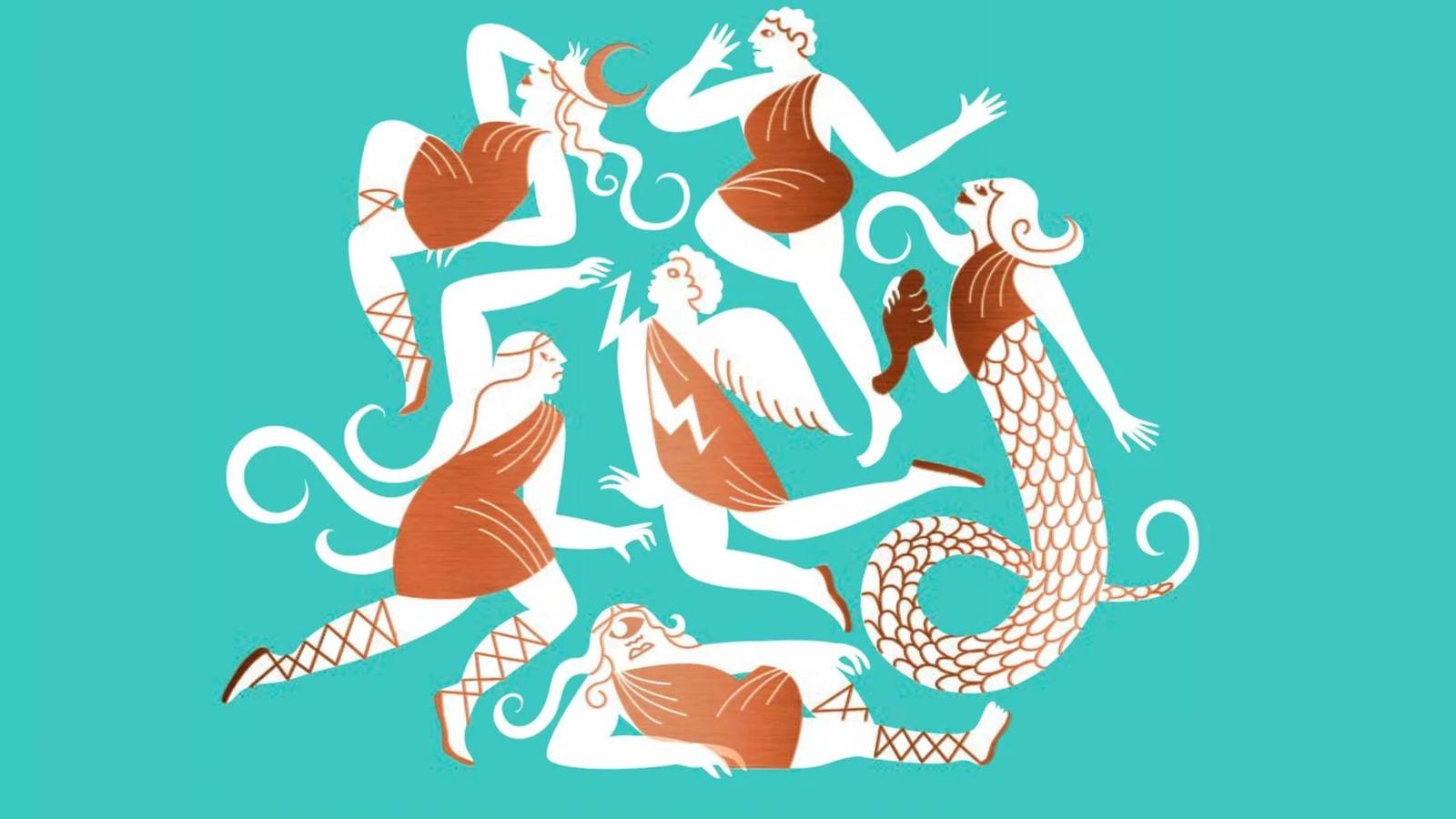
Image via Chronicle Books Published Nov 10, 2026, 1:53 PM EST Luc Haasbroek is a writer and videographer from Durban, South Africa. He has been writing professionally about pop culture for eight years. Luc's areas of interest are broad: he's just as passionate about psychology and history as he is about movies and TV. He's especially drawn to the places where these topics overlap. Luc is also an avid producer of video essays and looks forward to expanding his writing career. When not writing, he can be found hiking, playing Dungeons & Dragons, hanging out with his cats, and doing deep dives on whatever topic happens to have captured his interest that week. Sign in to your Collider account Mythology has provided storytellers with inspiration for thousands of years, and modern fantasy continues to draw on it heavily. In addition, a new generation of writers has crafted retellings of these timeless, classic stories, sometimes making them more accessible, other times totally revising or reimagining them. This list looks at the finest of these mythology books, from the energy of Percy Jackson to the psychological darkness of the Trojan War. If you're a fan of ruthless gods, dangerous monsters, fantastical lands, and powerful heroes of legend, you'll probably find something to enjoy here. 8 'The Lightning Thief' (2005) Image via Hyperion Books "If my life is going to mean anything, I have to live it myself." While not a literary masterpiece or anything, the first Percy Jackson novel was one of the most entertaining kids' books of the 2000s. It's classic hero's journey stuff: twelve-year-old Percy learns that he's actually a demigod, the son of Poseidon, and his existence places him at the center of a dangerous conflict involving the Olympian gods. When Zeus' master lightning bolt disappears, Percy becomes the main suspect and must embark on a perilous quest across the United States to prevent a cosmic war. A lot of the fun comes from the way that Greek mythology is mashed up with a modern-day setting. Familiar deities and monsters (like Medusa and Hades), as well as legendary locations, are all cleverly reinterpreted. There are minotaurs, satyrs, hellhounds, chimeras, magic swords, flying sneakers aplenty. 7 'A Thousand Ships' (2019) Image via HarperCollins "When a war was ended, the men lost their lives. But the women lost everything else." This is a retelling of the Trojan War that shifts the focus to its female characters. Rather than concentrating on iconic warriors like Achilles, Hector, and Odysseus, A Thousand Ships explores the perspectives of the women whose lives were devastated by the war and its aftermath. Its enormous cast includes familiar figures such as Helen, Cassandra, Penelope, and Andromache, alongside comparatively overlooked characters who highlight the war's impact on ordinary people. Even a few goddesses chime in now and then. Refreshingly, author Natale Haynes reinterprets familiar mythological events without reducing their characters to simple victims or modern stereotypes. The characterization is solid: each woman possesses distinctive motivations and fears. The plot is brisk and juicy, too, replete with courage, betrayal, revenge, and comeuppance. 6 'The Bear and the Nightingale' (2017) Image via Del Rey Books "I am told how I will live, and I am told how I must die." Shifting gears a little, this enchanting historical fantasy draws on Russian folklore. The protagonist is Vasilisa Petrovna, a girl raised in a remote medieval village surrounded by harsh, wintry forests. Unlike most members of her community, Vasilisa possesses the ability to perceive the household spirits and supernatural creatures that inhabit the surrounding countryside. However, the arrival of a devout new stepmother and an increasingly influential priest threatens the traditions that have protected the village for generations. From here, The Bear and the Nightingale becomes a rich tale of cultural clash and the tension between the past and modernity. At the same time, it nicely shows off Eastern European mythical creatures and concepts like water spirits, frost-demons, vampire-esque upyrs, the leshy of the forest, and, of course, the Winter King. 5 'Norse Mythology' (2017) Image via Bloomsbury "When something goes wrong, the first thing I always think is, it is Loki's fault." Rather than offering subversion or revisionism, this short story collection simply retells the classic Norse myths in engaging modern prose, and that's precisely why it works so well. Drawing from traditional sources such as the Poetic Edda and Prose Edda, Norse Mythology reconstructs interconnected tales involving Odin, Thor, Loki, and numerous other supernatural figures. There's so much for fantasy fans to dive into here: trickery and treasons, giants and dwarves, venomous snakes, godly punishments, dangerous wagers, mythical goats, monstrous wolves, epic origin stories, apples that grant immortality, mead that grants knowledge, and, finally, the long-foretold Ragnarok itself. In keeping with the more traditional approach, the book also avoids imposing an excessively modern moral framework on the characters. Instead, it leans into their contradictions (and frequently questionable behavior). 4 'The Silence of the Girls' (2018) Image via Doubleday Books "Great Achilles. Brilliant Achilles, shining Achilles, godlike Achilles… How the epithets pile up." This one has some parallels with A Thousand Ships. Here, acclaimed English writer Pat Barker (most well-known for the Regeneration trilogy) offers a devastating reinterpretation of the Trojan War, totally shattering its usual heroic assumptions. Riffing on The Iliad, The Silence of the Girls centers on Briseis, a young queen whose life is destroyed when Achilles and his fellow Greek warriors conquer her city. After witnessing the slaughter of her family and the destruction of her home, Briseis is taken captive and forced to become Achilles' concubine. Her experiences subsequently place her at the center of the famous dispute between Achilles and Agamemnon. Indeed, the book is brutal and unflinching, stripping away the expected romanticism and replacing it with psychological complexity and a bitter dose of hard realism. Collider Exclusive · 8 Questions · 2 Minutes What Fantasy World Do You Belong To? Middle-earth · Grand Line · The Continent · Camp Half-Blood Pick your magic, your crew, where you want to wake up and who you would rather be fighting, and we will tell you which world you actually belong in. Four are open to you: an ancient kingdom living through its last good age, an endless sea full of pirates, a continent that pays people to kill monsters, and a summer camp where the Greek gods are extremely real and mostly a nuisance. 💍Middle-earth(Rings of Power) 👒Grand Line(One Piece) 🐺The Continent(The Witcher) 🔱Camp Half-Blood(Percy Jackson) FIND YOUR WORLD → 01 What kind of power do you want? Every one of these worlds runs on a completely different sort of magic. ASomething ancient and half forgotten that came down through my family. BSomething completely ridiculous that works in a fight and gets a laugh. CNo magic at all, just training, potions and a very sharp sword. DSomething I inherited from a parent I have barely met. NEXT QUESTION → 02 Who is travelling with you? Nobody gets through any of these stories entirely on their own. AA fellowship drawn from every corner of the world who barely trust each other. BA crew I picked up one at a time, all of whom would die for me. CTwo or three people I would never describe out loud as friends. DTwo mates from school who are exactly as out of their depth as I am. NEXT QUESTION → 03 Where do you want to wake up tomorrow? The best fantasy is usually just somewhere you would genuinely like to live. AA high city of white stone with the sea somewhere far below. BA ship under sail, with an island ahead that nobody has mapped. CA rented room over a tavern, in a town I am leaving in the morning. DA cabin at a summer camp with everybody else already awake outside. NEXT QUESTION → 04 How are you making a living out there? Even in fantasy somebody has to pay for the horse. AI am not, because somebody far older than me decided this was my duty. BTreasure, and I am not always careful about whose it used to be. CI take contracts, since people will pay well for what they will not touch. DI am fifteen and this is all technically a school trip. NEXT QUESTION → 05 There is something in the woods. What do you do about it? All four of these worlds keep something unpleasant out there in the dark. ASend word to somebody who has seen this before, then hold the line. BWalk straight in, because it is interesting and possibly edible. CAsk what it has been eating and what the village is willing to pay. DWork out which myth it escaped from, then improvise very badly. NEXT QUESTION → 06 Who is the villain of your story? The enemy tells you far more about a world than the hero ever does. AAn ancient evil that has been patient for several thousand years. BA government that has spent a long time calling itself the good guys. CA man who turns out to be far worse than anything I hunt for money. DA god, or possibly my own family, and quite likely both at once. NEXT QUESTION → 07 What do you actually believe in out there? Every world hands its heroes one rule and asks them to hold onto it. ASome things are worth defending even when the odds are hopeless. BNobody gets to tell me where I can go or what I am allowed to want. CPick the lesser evil, and never pretend afterwards that it was not evil. DMy friends come before anything a prophecy has to say about it. NEXT QUESTION → 08 A thousand years from now, how are you remembered? Eight questions in, this is the one that decides your world. AIn a song, in a language hardly anybody still speaks. BAs the one who got there first and proved the whole thing was possible. CBarely, and mostly wrongly, in ballads I would absolutely hate. DOn a plaque at a camp, read by kids about to do the same thing. REVEAL MY WORLD → The Map Is Drawn Your World Is…Four worlds and four completely different ideas of what a good life looks like. This is where you belong, what it would ask of you, and what you would get back in return. Middle-earthYou belong somewhere old enough that the mountains have names and somebody can still tell you who gave them. Middle-earth is for people who think the right thing is worth doing even when it will not be finished in their lifetime. This is the only world on the list where doing good is understood as a very long defeat, fought anyway, by people who will never see how it ends. You are drawn to grandeur, to white cities and deep forges and the sense that almost everything you touch is older than your entire family line. The Rings of Power is set in the last good age before it all goes wrong, which gives every quiet scene in it a slightly unbearable weight. You would take the hard road, and you would take it on foot. The Grand LineYou want the sea, a crew, and absolutely nobody telling you where you are allowed to go. The Grand Line is the world for people whose main ambition in life is finding out what is over there. One Piece has run for decades on one very simple engine, which is a group of people who each want something impossible and have decided to go and get it together. You collect people. Your ideal crew is a set of misfits who were each written off somewhere else before you turned up and offered them a better idea. The world is enormous and deliberately ridiculous, and the emotional gut punches land harder because of that rather than in spite of it. You would set sail knowing the map runs out, which is more or less the entire point of it. The ContinentYou would rather be feared and useful than liked and useless. The Continent is a world where the monsters are the straightforward part of the job and the people are where it all gets complicated. Witchers get paid to do what nobody else will and resented for existing at all, which is a trade most people would refuse and you would probably accept. You have no real illusions about which side is the good one, largely because on the Continent that question tends to have a disappointing answer. The best of these stories are not about the fighting. They are about somebody with a rigid code being repeatedly cornered into caring about people. You would take the coin, finish the job properly, and be out of town before the story got told wrong. Camp Half-BloodYou want the myths to be real and loose in the actual world, and you want to find out at about thirteen that you were never anywhere near as ordinary as everybody kept telling you. Percy Jackson takes the oldest stories we have and drops them into car parks and diners, which makes the gods considerably funnier and a great deal worse. You would be the kid every school gave up on, who turns out to have been built for something nobody thought to test for. The series is genuinely about friendship rather than destiny, and it says so out loud every time a prophecy tries to get in the way. Camp Half-Blood is the real fantasy here: a place where the thing that made you difficult everywhere else is the thing that makes you belong. ↻ RETAKE THE QUIZ 3 'Mythos' (2017) Image via Penguin "For the world seems never to offer anything worthwhile without also providing a dreadful opposite." This one is similar to Norse Mythology, rendering Greek tales of old in accessible, conversational language (courtesy of the endlessly charming polymath Stephen Fry). Beginning with the emergence of the primordial deities and the creation of the cosmos, he traces the complicated relationships between the Titans and successive generations of Olympian gods. Drawing mostly on Hesiod's Theogony and Ovid's Metamorphoses, Mythos gives us all the Greek mythology greatest hits: the war between the Titans and the Olympians, Zeus' rise, Artemis' rage, Persephone in the Underworld, Midas and his ill-fated touch, Prometheus and his stolen fire, Pandora opening a jar (originally not a box!) and unleashing countless woes upon a world, along with a solitary glimmer of hope. These stories are fun and frequently funny, but also not afraid to get dark at times. 2 'American Gods' (2001) Image via William Morrow, Headline "Gods die. And when they truly die, they are unmourned and unremembered." A landmark of 2000s fantasy writing, American Gods follows Shadow Moon, a recently released prisoner who meets a mysterious individual calling himself Mr. Wednesday. Soon, he learns that ancient gods and supernatural beings have accompanied successive generations of immigrants to America, surviving through the beliefs and traditions of the communities that brought them across the ocean. They include the big names from Norse mythology, as well as the West African trickster god Anansi, the hard-drinking leprechaun Mad Sweeney, the dark Slavic death-god Czernobog, the ibis-headed Thoth, the fiery Vulcan (now a gun manufacturer), various jinn, and Bilquis, goddess of desire, who feeds on sexual sacrifice. Opposing them are the New Gods of media and money and the internet, making this a surprisingly thoughtful and thematic fantasy epic. 1 'Circe' (2018) Image via Little, Brown "There are rare moments when another soul dips near yours, as stars once a year brush the earth." When it comes to modern reimaginings of mythology, no one working today does it better than Madeline Miller. She's given us several bangers, including Galatea, Menstra, and The Song of Achilles, but the best of them is Circe, about the witch who famously crosses paths with Odysseus. She is also the daughter of the sun god Helios, and has an unusual fascination with humanity. After discovering her talents for witchcraft, Circe is eventually exiled to the remote island of Aiaia, where she spends centuries developing her powers and encounters the likes of Hermes, Daedalus, and Medea. Thanks to the protagonist's immortality, the narrative spans generations, yet the book remains grounded in her changing understanding of love, loneliness, power, and independence the whole way through. It's a psychological portrait of a mythical figure, handled with intelligence and style.
The 8 Greatest Mythological Books of All Time, Ranked
Full Article
Original Source
Read the full article at Collider →KhanList aggregates and links to publicly available news content. We do not host full articles from third-party sources. Always verify important information with original sources.