
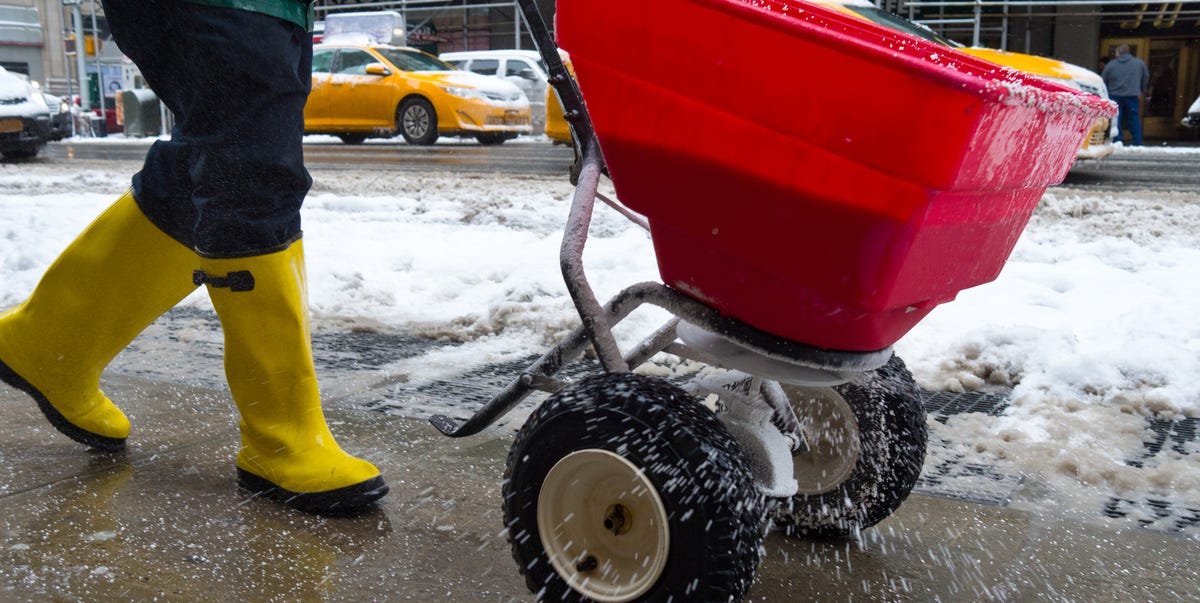
ProsAdjustable bafflesLarge pneumatic tiresConsUses a plastic spiked augerThis salt spreader’s size, ability to control salt flow, and reasonable price tag make it a great all-around choice for salt spreading. With its 80-pound capacity, it can cover the average driveway, as well as sidewalks and walkways in a single load. It also comes well equipped to handle winter weather with large, pneumatic 12-inch wheels and a sturdy steel frame.The spreader features a plastic spiked auger (though we prefer a metal spiked auger) that cuts through clumps of most deicing salts, preventing clogs. You should, however, avoid using rock salt, as it is larger and could get caught in the plastic construction.We appreciate its three adjustable baffles, which allow you to reduce or expand its coverage area to prevent overspread onto the lawn and landscaping. This is a great mid-size salt spreader and a perfect fit for most homes.Key SpecsTypeWalk-behindCapacity80 lbSpread Width10 ftWheel Size12 in.ProsWorks with seed, fertilizer, and ice meltPrecise release settingsNever flat tiresConsNot as durable as other salt spreadersIf you’re looking to get the most bang for your buck out of a spreader, then go with this model from Scotts. Not only can you spread salt with it, but you can also use it to seed and fertilize your lawn. Unlike most fertilizer spreaders, this model can spread ice melt. Additionally, it features rubber tires, unlike the plastic wheels found on other Scotts spreaders, allowing it to handle icy conditions.There’s a dial that gives you precise control over how much salt, seed, or fertilizer you’re releasing with each step—this is common on fertilizer spreaders but not so much with salt spreaders. And since it has Scott’s EdgeGuard technology, you can treat walks and driveways without showering your grass and landscaping with salt.This combination of features makes it a great jack-of-all-trades spreader for those who want one machine for all seasons.Key SpecsTypeWalk-behindCapacity65 lbSpread WidthNot listedWheel Size9 in.Advertisement - Continue Reading BelowProsLarge capacityLarge pneumatic tiresCan distribute rock salt up to 3 inchesThis top-of-the-line spreader from EarthWay can handle large jobs, holding up to 100 pounds, with holes and an auger large enough to pass rock salt up to 3 inches in size, plus a very large, 15-foot spread width.It’s a little bit heavier than other models on our list—30 pounds alone before you even add the salt—but it rolls on two large, knobby 13-inch pneumatic tires, which help you avoid slipping and sliding over icy terrain.These features make this walk-behind model a good option for professionals or homeowners with large paved areas to prep.Key SpecsTypeWalk-behindCapacity100 lbSpread Width15 ft.Wheel Size13 in.ProsEasy to useErgonomic arm supportWorks with seed, fertilizer, and ice meltThere’s no sense investing in an expensive walk-behind salt spreader if you only have to clear a walkway or front stoop. This handheld model gets the job done and doesn’t cost much. Plus, you can use it in the warmer months to seed and fertilize small patches of lawn and landscaping beds.There are separate spreader settings for seed, fertilizer, and ice melt, and it holds up to 2 pounds of product. It even has an ergonomic arm support that makes it relatively comfortable to hold while you’re spreading product. Sure, it would be easier to use if it were automatic, but we’ll take the low-cost manual option any day of the week.Key SpecsTypeHandheldCapacity2 lbSpread WidthNot listedWheel SizeN/AAdvertisement - Continue Reading BelowPros2-hour battery lifeAdjustable spread widthWorks with seeds and fertilizer, tooIf you only need a small spreader but don’t want to deal with a hand crank, this rechargeable electric model may work better for you. It runs on a rechargeable lithium-ion battery, and in addition to working with salt and de-icer, you can also use it for seeds and fertilizer.It has eight flow rate settings, allowing you to release as little or as much as you like, though levels 7 and 8 are intended for use with heavy salts. The speed is variable, and you can adjust the spread up to 127 degrees with a lever on the side. Narrowing the spread can help you be more precise and protect garden beds or lawns from getting salt burn.The hopper is 2.7 liters, and the battery runs for up to two hours, making this motorized spreader more than up to the challenge of covering the driveways and sidewalks of most average homes. Since it's battery-powered and listed as not waterproof, it's recommended to clean it of any moisture when you're done using it.Key SpecsTypeHandheldCapacity2.7 LSpread WidthNot listedWheel SizeN/AProsLarge wheelsSturdy steel frameTremendous capacityConsDifficult to assembleAgri-Fab’s massive salt spreader offers one of the largest capacities of any non-professional-grade walk-behind model we’ve seen. Its massive hopper can hold a whopping 130 pounds of salt, which is enough to cover a long service road or an 80-car parking lot. It’s built to handle all that weight with a frame made from 1-inch-thick steel tubing. The large 12-inch pneumatic tires have heavy treads to prevent slipping on snow and ice.The heavy-duty design wouldn’t be complete without a stainless steel impeller to break up clogs. It also features a waterproof cover to keep the ice melt dry if you have to go out on a rainy day. This commercial-grade salt spreader is built for big jobs.Key SpecsTypeWalk-behindCapacity130 lbSpread Width12 ftWheel Size12 in.Advertisement - Continue Reading BelowProsLarge tires and stable frameHuge capacityControllable from the driver’s seatIf you’ve got an ATV or lawn tractor and a lot of ground to cover, spare your back and mount this towable spreader. With its 185-pound capacity, a single load can cover up to an acre of soon-to-be-snowy ground.The universal hitch will work with all tractors, UTVs, and ATVs. The control rod extends far enough that you won’t have to get out of the driver’s seat to adjust the flow of salt. Its 15-inch pneumatic tires and thick-gauge steel frame keep it stable, even when pulled a little too fast. There’s also a hopper cover that keeps the salt from getting wet while working in rain or snow.This is a great option if you have a long driveway or a large parking area to cover.Key SpecsTypeTowableCapacity110 lbSpread Width12 ftWheel Size13 in.ProsBroad spreading widthCan access controls from driver’s seatLid keeps salt containedConsNo baffle to narrow broadcast widthDue to its mountable design, this salt spreader gives you the capacity of a towable spreader, but won’t compromise the maneuverability of a four-wheeler. This semipro spreader can hold up to 15 gallons of ice melt, which means it’s really made for prepping long service roads, parking lots, and commercial spaces, rather than homes.The ATVS15A spreader uses a plate and auger powered by a 23-volt motor to launch a 30-foot-wide swath of salt. The hopper has a lid that keeps your ice melt dry and prevents it from bouncing out of the top of the hopper.Since you sit right in front of the spreader, accessing the on/off switch and gate controls is convenient from the driver’s seat. This is a solid commercial option for contractors who need to prep worksites, workers in small communities with service roads, and commercial areas that might be easier to reach on an ATV than a truck.Key SpecsTypeATV-mountedCapacity150 lbSpread Width30 ftWheel SizeN/AAdvertisement - Continue Reading BelowWhat to ConsiderType of Salt SpreaderHandheld spreadersThese are compact, watering can-sized basins with a handle and either a hand crank or a motorized trigger mechanism. Their compact size and light weight make spreading salt easy work, provided you only need to cover a small area. They can’t hold much salt and have a limited range, so they’re best reserved for small jobs like patio doorways, stoops, or a short front walkway.Walk-behind spreadersThis type of spreader sits on two wheels, with a large plastic basin and a spinning impeller at the base. As you push the spreader forward, the salt shoots out the front and both sides of the basin. These wheelbarrow-esque spreaders can hold a large amount of ice melt, so they’re the way to go for most homes with large patios, parking spaces, driveways, and sidewalks.Towable spreadersThis is one of the largest options. If you’re responsible for clearing snow off a parking lot or a long driveway that’s more than a couple of hundred feet long, you may want to get a truly massive salt spreader that hitches to the back of an ATV or riding lawn mower.Some spreaders offer even larger capacities that attach to the trailer hitch on a pickup truck or mount to the back of an ATV. Obviously, these spreaders can hold a much larger amount of salt than a walk-behind. It’s overkill for most homes, but small businesses or farms could use one to prep large parking lots, loading docks, and other large paved areas.CapacityThe more ice melt your salt spreader can hold, the more ground you can cover before you need to stop for a refill. As a rule of thumb, you’ll need to spread about 3 pounds of snow melt for every 1,000 square feet of area. Though there is some variation from model to model, picking the right type of spreader is the first and most important step.Most handheld spreaders only hold enough salt to de-ice a short walk and a front stoop; walk-behind spreaders can hold about 65 to 130 pounds of ice; and towable spreaders often hold up to 185 pounds of salt.Spread WidthSpread width measures how far your spreader will throw salt as you use it. Most spreaders have a range between 6 feet for walk-behind models and as far as 30 feet for larger towable spreaders.While a wide spread can save you time, keep in mind that it may also lead you to spray salt onto your lawn and landscaping. Salt will dry out plants, so you want to avoid spraying green areas as much as possible. If you need to salt sidewalks and driveways that border grass and landscaped areas, look for adjustable spreaders with baffles so you can narrow your spread and avoid overspray.What kind of ice melt should I use?You have a few options when it comes to ice melt. Calcium chloride is the best option. It melts ice even at extreme sub-zero temperatures, won’t harm your plants, and is less toxic than rock salt, but it’s also pricier.Rock salt is the cheapest, but it’s more toxic, won’t work in extreme cold, and can clog spreaders more easily. Magnesium chloride is the least toxic option and works at temperatures as low as 5 degrees Fahrenheit.Whichever ice melt you choose, be sure to use it as directed, as all of the above can eat away at wood, steel, and concrete.Can I use my fertilizer spreader to spread salt? While they operate similarly, we don’t recommend putting rock salt in a fertilizer/seed spreader. Dedicated salt spreaders store corrosive salt and endure icy winter conditions. Using a fertilizer spreader to spread salt once or twice won’t break it, but it won’t work as well and may shorten its lifespan in the long term.Salt spreaders typically have hoppers made from thick, durable plastic that sit on heavy-gauge steel frames and feature pneumatic rubber wheels with heavy tread that can grip slick paved surfaces. They also come equipped with metal moving parts that are capable of chopping up hard salt without wearing down. If you want one spreader to do double duty, it would probably make more sense to use a salt spreader to spread seed or fertilizer. That said, fertilizer/seed spreaders often provide more precise control of the spread direction and quantity, which comes in handy when you have specific patches to cover and you want to be precise. Keep in mind that adding too much fertilizer to a lawn can cause it to burn out.If you do put fertilizer in your salt spreader (or vice versa), make sure to clean out the salt thoroughly before placing any seed or fertilizer in the hopper. Any lingering salt in the mix will dry out the grass, damaging your lawn.Bottom line: We would recommend buying two separate spreaders, despite their similarities.Can I use rock salt in my salt spreader?Most residential-use salt spreaders can't handle rock salt, while many professional-level salt spreaders can. Check with the manufacturer to determine what types of de-icer are compatible with your salt spreader before loading it with rock salt, as it can damage the spreader’s impeller.If rock salt isn’t compatible with your spreader, use a different type of ice melt, such as potassium chloride, magnesium chloride, or calcium chloride.David is a Reviews Editor for Hearst’s Enthusiast Group, contributing to Popular Mechanics, Runner’s World, Bicycling, Best Products, and Biography. He has over 25 years of experience writing about and reviewing consumer electronics, kitchen appliances, DIY products, outdoor gear, and more. He also spent years covering the ever-changing world of online retail. To relax, he loves experimenting with new recipes, tweaking his smart home setup, and spending time outdoors on his bike or camping. Tony Carrick is a full-time freelance writer who specializes in technology, home improvement, DIY, home security, and outdoor recreation. He’s tested and written about everything from home security systems to power tools to gas grills. His product guides, how-to articles, and feature stories can be found in such publications as Bob Vila, Angi, U.S. News and World Report, Field & Stream, Futurism, and Switchful. When Tony isn’t writing, he can be found working on his latest home improvement effort at his home in North Carolina.
The 8 Best Salt Spreaders for Getting Out Ahead of Winter Storms
Full Article
Original Source
Read the full article at Popularmechanics →KhanList aggregates and links to publicly available news content. We do not host full articles from third-party sources. Always verify important information with original sources.