
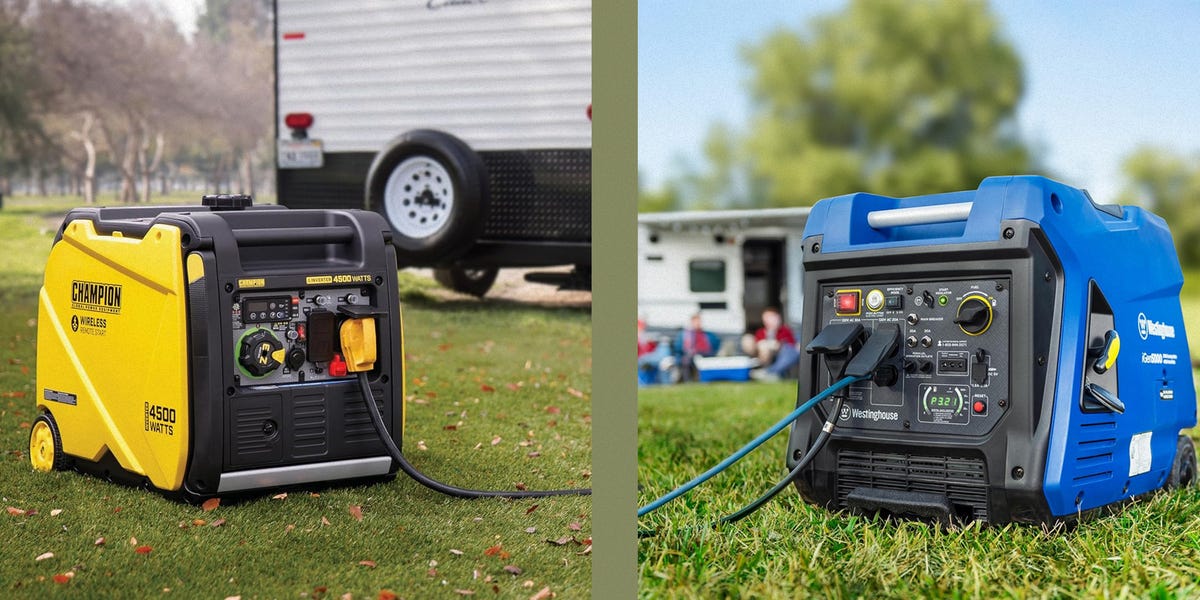
ProsGood powerCan pair with a second generatorFairly QuietThis rock-solid block of generator excellence from Champion is as perfect for RVing as it gets. Its 4,500-watt output is more than enough to run your entire RV, including the air conditioner. At the same time, it’s surprisingly quiet, clocking in at just 61 decibels—the same volume as a dishwasher.While it’s heavy at just over 100 pounds, it's fairly compact—the size of a couple of car batteries—and an integrated handle and wheels make it fairly easy to move around. It offers up to 14 hours of runtime on a single tank of gas (2.25 gallons), and you can expand the power capabilities by pairing it with a compatible generator using an optional parallel kit. Champion has a whole line of inverter generators, but we recommend this one because it features a remote starter with a range of up to 80 feet, which we appreciate when we don’t feel like messing around with a generator in the cold or dark. Key SpecsWattage4,500Fuel typeGasWeight101 lbPorts1 x 30A, 2 x AC, 1 x DCProsDual-FuelLightweightUSB portsThe Wen DF360iX offers quite a bit of utility for an affordable price. For starters, there is the option to run the generator on gasoline or propane at up to 3,600 or 3,500 starting watts, respectively, and either 900 or 2,600 running watts. (Propane generates slightly less power than gas.) That’s enough electricity for small to mid-size RVs.At 49 pounds, this generator's relatively lightweight, but it doesn’t cut back on ports to keep the price low. It has a 30-amp port for direct connection to an RV, two three-prong AC ports, a 12-volt DC receptacle, and two USB-A ports. It also has an auto-shutoff feature if the fuel runs too low and a carbon monoxide (CO) sensor that detects if dangerous levels are present. Like most inverter generators, it produces less noise. This model is rated at around 65 decibels of noise, which is quiet enough that it shouldn’t be too noisy for public areas like a campground.There are some drawbacks to a generator at this price range, however. The size of the gas tank may be a concern. If you’re using gas and need it to run overnight, you’ll need a generator with a larger tank. At just 1.5 gallons, you only get up to five hours of usage with a half-load runtime (though using a 20-pound propane tank as your fuel can get that up to 14 hours). But if all you need is something basic, this gives you what you need at a good price.Key SpecsWattage3,600Fuel typeGas or propaneWeight49 lbPorts1 x 30A, 2 x AC, 1 x DC, 2 x USB-AAdvertisement - Continue Reading BelowProsMany outletsAlmost no operating noiseDecent panel bundleConsNo wheels or telescoping handlePreviously, we recommended the Pro version of this power station—mainly because it was highly portable with wheels and a telescoping handle—but Jackery has since discontinued it. Its replacement, the HomePower 3000, isn't quite as easy to move around, but it makes up for it with more power: It can generate up to 3,600 watts for 3,072 watt-hours of power capacity, and uses a LiFePO4 battery, which is more efficient and longer-lasting than the previous model.While the HomePower 3000 no longer has wheels, it does have handles and weighs just under 60 pounds. There are larger portable power stations out there, but many are even more cumbersome than this one, making them exponentially more painful to lug in and out of your RV’s storage area.More importantly, when paired with a pair of 200-watt SolarSaga panels, you can recharge the station in around 9 hours under sunny conditions. Of course, it can also be pre-charged much faster using an AC outlet, but when using solar, you can take yourself off-grid for longer periods.It’s got all the connections you’ll need to power your RV, including a 30-amp outlet, plus four AC outlets, a 12-volt receptacle, and four USB ports should you need them. Other nice features include an app that allows you to monitor its power levels and output from your phone, and a battery management system that protects the station from power surges, overcurrent, and even extreme temperature conditions. Key SpecsWattage3,600W output / 3,072Wh solar capacityFuel typeBatteryWeight59.52 lbPorts1 x 30A, 4 x AC, 1 x DC, 2 x USB-A, 2 x USB-CProsDual-fuel convenience, cleanliness, and quietVery portableHigher wattageDual-fuel generators are very nice to have on an RV, because the two types of fuel work well in different scenarios: gasoline is easy to obtain just about everywhere you go, so it's great for long, isolated trips or living off-grid, but makes a lot of noise. Propane isn’t quite as accessible, but it allows your generator to run more quietly.We like the GD400BN specifically because it's powerful, quiet, and portable. With its 4,000-watt output, it’s more than capable of powering your entire rig, with the air conditioner, but it’s built solid and weighs less than 50 pounds. Another plug or two would’ve been nice–its single AC outlet limits things a bit if you have any reason to plug in power tools or equipment. For all intents and purposes, this is a very nice dual-fuel generator and comes at a decent price to boot.Key SpecsWattage4,000Fuel typeGas and propaneWeight47.3 lbPorts1 x 30A, 1 x ACAdvertisement - Continue Reading BelowProsExcellent portabilityFamous durabilityQuietConsModest wattageLimited portsAt this point, the Honda EU2200i is nothing short of a campsite icon. You see them all the time at campsites, and with good reason: They are renowned for doing pretty much everything right. Weighing in at just over 46 pounds and not much larger than a couple of stacked shoeboxes, this is about as portable as RV-capable generators get. It’s also one of the quietest options in its class, purring along at 47-58 decibels, or about the same volume as a normal conversation. Test Editor Brad Ford found the same thing in his testing, calling the EU2200i “remarkably quiet.”“The EU2200i is ideal for camping and other outdoor events where generator noise might be frowned on,” he wrote in our guide to the best portable generators.And its durability is outright famous: I have personally spent years on end bumping and bashing one all over the place, and it just won’t break.The primary downside is its 2,200-watt outage, which makes sense for its size but is relatively small if you’re powering an RV. Still, given how often you see it around, RVers are clearly okay working around its limitations.Key SpecsWattage2,200Fuel typeGasWeight46.5 lbPorts1 x 30A, 1 x ACProsEnormous capacity and outputFast-chargingPlenty of portsI can report firsthand that the EcoFlow Delta Pro Ultra is an absolute performance monster, with massive output (7,500 watts) and enormous capacity (6,500 watt-hours), which you can expand further by adding extra 6,000-watt-hour batteries.I recently had one along for a cloudy camping trip where solar panels would have been useless, but it didn’t matter because its charge lasted a solid three days (though it was cool weather and I wasn’t using my a/c—for that you’ll need solar). It also charges very quickly: I charged mine via a wall outlet in about 2 hours. I could easily use this generator to back up my entire house, so needless to say, it can store and produce enough energy to handily power an a/c and everything else you may need in your RV—particularly with a good solar setup.The downside to carrying a generator like this around, of course, is the weight. At just over 180 pounds, it’s way too heavy to move in or out of an RV solo. It’s more portable than you might think, though: You can remove the batteries from the generator, then carry it out in more manageable parts. Plus, the power station has wheels to help you move it around. Ultimately, the Delta Pro Ultra is probably overkill for most RVers, but it pushes the boundaries on what you can expect from an RV-compatible generator.Advertisement - Continue Reading BelowProsPlenty of portsGreat performanceDurableBluetti has a penchant for putting lots of performance into sturdy, outdoor-tough packages, and the new AC200L “yes ands” that by adding a ton of outlet options. Its 2,400-watt output is plenty for most RVs, and its 2,048-watt-hour capacity is decent if modest, but it's expandable up to 8,192-watt-hour using the company’s stackable add-on batteries.As for outlets, it’s got plenty of AC, DC, and USB ports. I tend to pack along a lot of cameras, drones, and other gadgets, and I’ve found that this generator is ideal for keeping everything charged in addition to offering all the core ports I need for the RV. Its compact portability and port-abundance also make it perfect for moving throughout camp whenever I need to power something outdoors. It charges extremely fast, going from 0-to-100 percent in about an hour when plugged into a wall socket or as fast as 2 hours with the right solar setup.It’s a bit heavy for its modest size, but I love the AC200L’s outstanding durability. I brought one along to juice up e-bikes on a recent mountain biking trip. Gear tends to get used pretty hard at the trailhead, but this generator took it like a champ.Key SpecsWattage2,400W output / 2,048Wh capacityFuel typeSolarWeight61.41 lbPorts1 x 30A, 4 x AC, 1 x DC, 2 x USB-C, 2 x USB-AProsVery quietGreat outputRemote startIf you want to be a good neighbor at your campsite, this generator from Westinghouse keeps the rumble to a minimum. Thanks to a special throttling system that only produces as much power as needed, it spins down when you aren’t drawing much rather than constantly roaring at full speed. That keeps the volume down, dropping to a decibel level akin to generators half its size at low usage. I’ve used older versions of what were essentially the same model; they were very quiet then, and reviews indicate the volume has gone down even more.Its hefty 4,500-watt output is substantial, considering the lack of racket, and capable of powering an entire RV without issue. It also has a remote starter, which allows me to fire it up from the comfort of indoors.This Westinghouse is fairly heavy, though a retractable handle, wheels, and lifting handles make it easier to move around. And its relatively compact shape passes through an RV door without too much trouble. All in all, it provides ample power while keeping the noise to a minimum.Key SpecsWattage4,500Fuel typeGasWeight93 lbPorts1 x 30A, 2 x AC, 1 x DCNick Hilden is a writer, globetrotter, and jack-of-many-talents who has written gear reviews for the likes of Runner’s World, Popular Science, Men’s Health, Thrillist, the Daily Beast, the Los Angeles Times, Greatist, and the Manual, and his lifestyle, culture, and tech writing has also appeared in Scientific American, Afar, Salon, Vice, Healthline, and many others. Before entering journalism some 15 years ago, he worked as a bartender, brewery manager, sound engineer, recording and touring musician, cook, teacher, and in a variety of other trades. These days, he lives all over the world, performs music sporadically, and spends a lot of time thinking how to best improve his Honda Element conversion.David is a Reviews Editor for Hearst’s Enthusiast Group, contributing to Popular Mechanics, Runner’s World, Bicycling, Best Products, and Biography. He has over 25 years of experience writing about and reviewing consumer electronics, kitchen appliances, DIY products, outdoor gear, and more. He also spent years covering the ever-changing world of online retail. To relax, he loves experimenting with new recipes, tweaking his smart home setup, and spending time outdoors on his bike or camping.
The 8 Best RV Generators Give You Go-Anywhere Power
Full Article
Original Source
Read the full article at Popularmechanics →KhanList aggregates and links to publicly available news content. We do not host full articles from third-party sources. Always verify important information with original sources.