
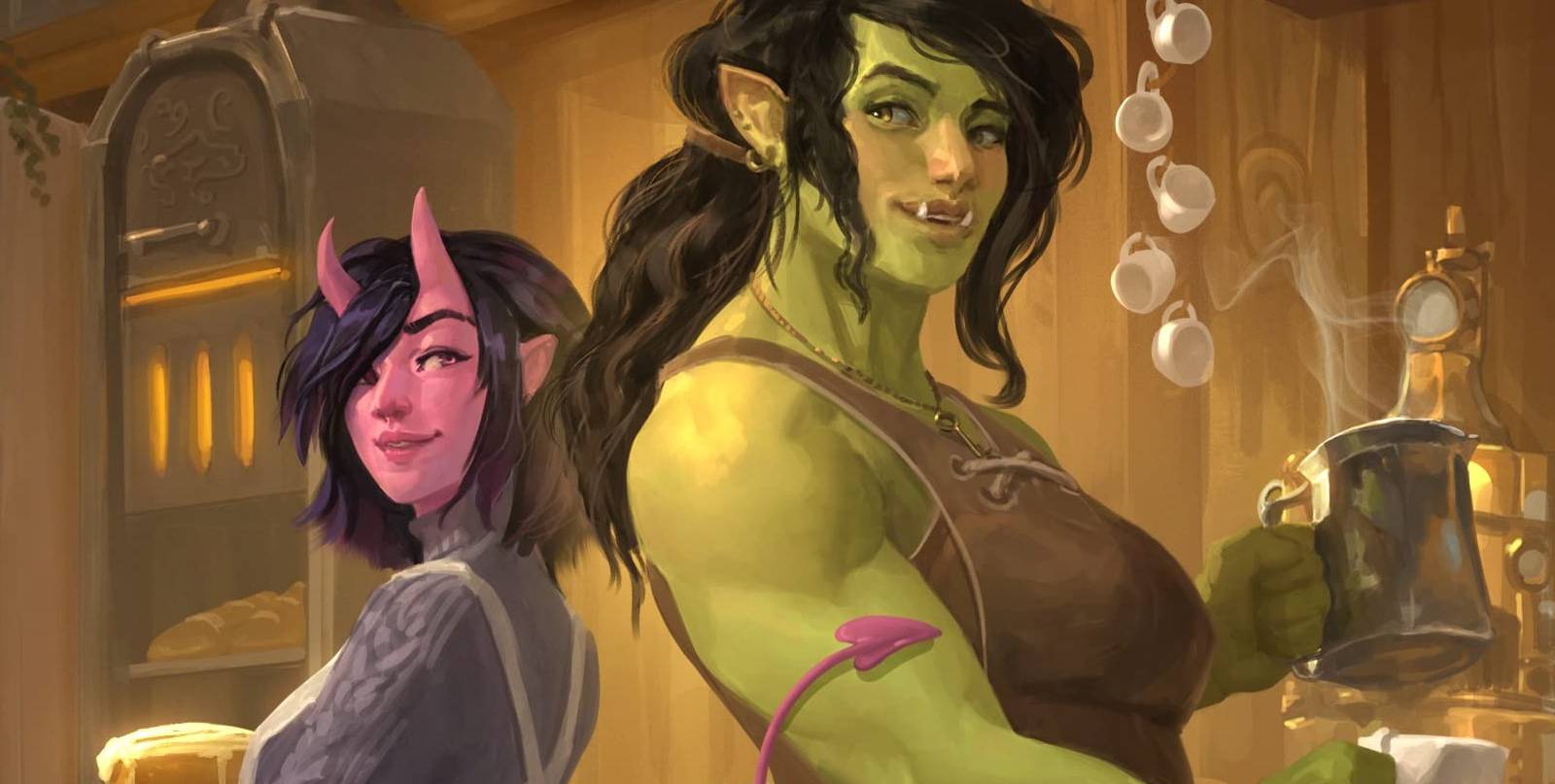
Image via Cryptid Press Published Nov 16, 2026, 5:08 PM EST Diego Pineda has been a devout storyteller his whole life. He has self-published a fantasy novel and a book of short stories, and is actively working on publishing his second novel. A lifelong fan of watching movies and talking about them endlessly, he writes reviews and analyses on his Instagram page dedicated to cinema, and occasionally on his blog. His favorite filmmakers are Andrei Tarkovsky and Charlie Chaplin. He loves modern Mexican cinema and thinks it's tragically underappreciated. Other interests of Diego's include reading, gaming, roller coasters, writing reviews on his Letterboxd account (username: DPP_reviews), and going down rabbit holes of whatever topic he's interested in at any given point. Sign in to your Collider account Not all fiction needs to be escapist, but certain genres of speculative fiction in particular—perhaps fantasy most of all—lend themselves perfectly to stories that are all about immersing readers in stylized, imagined worlds that allow them to mentally detach from the stress and emotional fatigue of everyday life. Throughout history, many great fantasy novels have been written with immersion, entertainment, and escapism in mind, and have gone down in history as some of the genre's most legendary works as a result. Whether we're talking about foundational classics like The Hobbit or modern cozy fantasy gems like Legends & Lattes, these are eight books which prove just how great fantasy can be at allowing the reader to gain distance from the real world, ranked from least to most escapist. Several of these novels have thought-provoking social commentary and interesting reflections of the real world, but at their core, they're all about transporting the reader to a completely different kind of realm. 8 'Piranesi' (2020) Image via Bloomsbury It took Susanna Clarke 15 years to write her sophomore novel, the incredible Piranesi, as a result of a debilitating chronic illness that caused chronic fatigue and cognitive impairment. From that long, arduous process came one of the most amazing books of the 2020s, a beautifully surreal fantasy tale about an amnesiac man living inside a seemingly infinite labyrinth, until clues reveal a hidden truth about his captivity and what lies beyond the walls of his logic-defying home. It's only fitting that Clarke wrote the definitive study of escapism itself. In the end, isn't escapist fantasy all about being able to distance oneself from the pain of the real world to then return to it recovered and revitalized? As a result, it's only fitting that Clarke wrote the definitive study of escapism itself. Indeed, Piranesi interrogates the very concept, studying the tension between fantasy and reality and the cost of returning to a real world that doesn't feel nearly as magical or benevolent as the ones we escape to. 7 'The Hobbit' (1937) Image via George Allen & Unwin J. R. R. Tolkien requires no introduction, and neither does the introduction to Middle-earth, The Hobbit. One of the greatest, most influential, most universally acclaimed, and best-selling children's novels of all time, this wonderful adventure is one of those classic books that are perfect from start to finish. It follows a comfort-loving hobbit named Bilbo Baggins, who's swept into a dangerous quest with a wizard and 13 dwarves to reclaim their stolen treasure from a dragon. In his 1938 essay On Fairy-Stories, Tolkien directly defended escapism through fiction as not a cowardly desertion of real life, but as a realization of an essential human need for comfort. It's unsurprising that just a year before the essay's publication, he wrote one of the most magical and timeless pieces of fantastical escapism of all time. Adventure, magic, mythological creatures, songs, and a traditional Hero's Journey arc are the order of the day every time one re-reads The Hobbit, one of the most universally enjoyable children's fantasy novels ever written. 6 'Stardust' (1999) Image via William Morrow Intentionally written as a sort of pre-Tolkien fantasy inspired by the likes of Lord Dunsany and Hope Mirrlees, Stardust is one of the most unique books in Neil Gaiman's body of work, and it also happens to be one of his most entertaining and most widely enjoyable gems. It's about a young man named Tristran Thorn, who ventures into the magical realm of Faerie to retrieve a fallen star in human form in order to win the hand of a local girl. It's classical English fantasy at its best, and easily the most escapist book Gaiman has written. Through its lush prose, pure romantic wonder, and classical fairy-tale inspirations, Stardust is as irresistibly charming and escapist as an old fantasy storybook. Even when the story gets surprisingly dark, it does so with such enchanting stylization that it doesn't take away from the escapism whatsoever. Stardust is about growing up and discovering what actually matters, making the eventual return to the real world once the story is over all the more memorable. 5 'The Very Secret Society of Irregular Witches' (2022) Image via Berkley The debut novel of Indian author Sangu Mandanna was The Very Secret Society of Irregular Witches, a cozy fantasy novel about a lonely orphan witch who secretly posts online magic videos. When she's summoned to an English country house to teach three young witches, she finds an unexpected family and a new home. What ensues is one of the best cozy fantasy books of all time, a delectably quirky and heartfelt book that feels like a warm hug on a cold, rainy day. There are two broad types of escapist fantasy books: those that are escapist thanks to exciting stories of grand adventures full of imaginative world-building, and those that are escapist thanks to their emotional core and low-stakes warmth. The Very Secret Society of Irregular Witches belongs to the latter group. Full of domestic coziness, found family drama, and simple prose that elevates the purely sensorial pleasures of drinking a cup of tea or sitting in a sunlit conservatory, it's a must-read for people craving a more casual reading experience. 4 'Going Postal' (2004) Image via Doubleday As fun and important as dramatic fantasy that takes the genre with full seriousness is, comedic fantasy is every bit as vital; and as far as comedic fantasy goes, it doesn't get much better than the work of one of the genre's most beloved satirists, Terry Pratchett. The author is best known for his massive 41-novel Discworld series, whose most wonderfully escapist volume is Going Postal. The story follows a condemned con artist, who's spared from execution by the city's ruler and forced to revive a dilapidated post office. At its core lies the irresistible fantasy of following a charismatic rogue as he turns a hopeless mess into a definitive success through mere creativity and ingenuity. What could possibly be better for mindless escapism than a fantasy comedy, particularly one as well-written and purely entertaining as Going Postal? At its core lies the irresistible fantasy of following a charismatic rogue as he turns a hopeless mess into a definitive success through mere creativity and ingenuity. Coupled with a world that feels wonderfully lived-in and a razor-sharp sense of humor, it's one of the most perfectly escapist comedies that speculative fiction has delivered throughout the 21st century. 3 'House in the Cerulean Sea' (2020) Image via Tor Fantasy The term "cozy fantasy" emerged quite recently as an organic result of the online reading community (BookTok in particular) during the COVID-19 pandemic lockdowns. People were isolated and feeling under the weather, craving escapist and low-stakes fantasy stories like TJ Klune's House in the Cerulean Sea. The story follows a rigid caseworker for the Department in Charge of Magical Youth, who's sent to investigate an orphanage on a remote island. There, he falls for the enigmatic caretaker and discovers that the children are a family worth protecting. It's the epitome of delightfully cozy 2020s escapist fantasy, truly one of the best fantasy books of the last 10 years. Much like The Very Secret Society of Irregular Witches, it's ideal for those who find comfort in magical stories about quirky found families, and for those who enjoy books that allow them to escape the mundanity and grayness of everyday life through stories that are specifically about breaking those kinds of drab routines. Image via Tor There are those who would go so far as to say that Travis Baldree's Legends & Lattes is the best and most enjoyable cozy fantasy book of the 2020s so far, and it's remarkably hard to disagree. In it, a tired orc barbarian hangs up her sword to open the very first coffee shop in a high-fantasy series that feels like a Dungeons & Dragons world come to life. That's it. There's no need for action, death, or high-stakes adventures—nothing but pure coziness and vibrant escapism. What premise could be more escapist that quitting the grind and opening a cozy coffee business? It's the comfort and relaxation that comes after the high-stakes adventures, the ultimate "hanging up the sword" fantasy. Baldree wrote the book during the pandemic lockdowns, describing the sensorial details of her world—from the smell of the pastries to the feeling of the freshly-ground coffee—with exactly the kind of yearning for authenticity that anyone who loves escapist fantasy wants. 1 'The Princess Bride' (1973) Image via Harper Collins William Goldman's The Princess Bride is the ultimate escapist fantasy, one of those perfect children's books that became even better movies. It's one of the greatest and most defining fantasy novels of the 1970s, following a farmhand-turned-pirate who has to rescue his true love from being forced into marriage with a slimy prince in a swashbuckling adventure. There's something here for pretty much any and all kinds of fantasy fans: romance, action, revenge, comedy, witty dialogue, and more than enough emotional warmth to melt even the coldest of hearts. What adds such a cozy, escapist dimension to The Princess Bride is the simple yet genius framing device: Goldman presents himself not as the creator of the story, but as someone who found a dense 19th-century political satire and decided to abridge it to present just "the good parts." The result is a nostalgic swashbuckler that very deliberately refuses to ever be even slightly boring, full of larger-than-life set pieces and delightfully fun characters. Collider Exclusive · 8 Questions · 2 Minutes What Fantasy World Do You Belong To? Middle-earth · Grand Line · The Continent · Camp Half-Blood Pick your magic, your crew, where you want to wake up and who you would rather be fighting, and we will tell you which world you actually belong in. Four are open to you: an ancient kingdom living through its last good age, an endless sea full of pirates, a continent that pays people to kill monsters, and a summer camp where the Greek gods are extremely real and mostly a nuisance. 💍Middle-earth(Rings of Power) 👒Grand Line(One Piece) 🐺The Continent(The Witcher) 🔱Camp Half-Blood(Percy Jackson) FIND YOUR WORLD → 01 What kind of power do you want? Every one of these worlds runs on a completely different sort of magic. ASomething ancient and half forgotten that came down through my family. BSomething completely ridiculous that works in a fight and gets a laugh. CNo magic at all, just training, potions and a very sharp sword. DSomething I inherited from a parent I have barely met. NEXT QUESTION → 02 Who is travelling with you? Nobody gets through any of these stories entirely on their own. AA fellowship drawn from every corner of the world who barely trust each other. BA crew I picked up one at a time, all of whom would die for me. CTwo or three people I would never describe out loud as friends. DTwo mates from school who are exactly as out of their depth as I am. NEXT QUESTION → 03 Where do you want to wake up tomorrow? The best fantasy is usually just somewhere you would genuinely like to live. AA high city of white stone with the sea somewhere far below. BA ship under sail, with an island ahead that nobody has mapped. CA rented room over a tavern, in a town I am leaving in the morning. DA cabin at a summer camp with everybody else already awake outside. NEXT QUESTION → 04 How are you making a living out there? Even in fantasy somebody has to pay for the horse. AI am not, because somebody far older than me decided this was my duty. BTreasure, and I am not always careful about whose it used to be. CI take contracts, since people will pay well for what they will not touch. DI am fifteen and this is all technically a school trip. NEXT QUESTION → 05 There is something in the woods. What do you do about it? All four of these worlds keep something unpleasant out there in the dark. ASend word to somebody who has seen this before, then hold the line. BWalk straight in, because it is interesting and possibly edible. CAsk what it has been eating and what the village is willing to pay. DWork out which myth it escaped from, then improvise very badly. NEXT QUESTION → 06 Who is the villain of your story? The enemy tells you far more about a world than the hero ever does. AAn ancient evil that has been patient for several thousand years. BA government that has spent a long time calling itself the good guys. CA man who turns out to be far worse than anything I hunt for money. DA god, or possibly my own family, and quite likely both at once. NEXT QUESTION → 07 What do you actually believe in out there? Every world hands its heroes one rule and asks them to hold onto it. ASome things are worth defending even when the odds are hopeless. BNobody gets to tell me where I can go or what I am allowed to want. CPick the lesser evil, and never pretend afterwards that it was not evil. DMy friends come before anything a prophecy has to say about it. NEXT QUESTION → 08 A thousand years from now, how are you remembered? Eight questions in, this is the one that decides your world. AIn a song, in a language hardly anybody still speaks. BAs the one who got there first and proved the whole thing was possible. CBarely, and mostly wrongly, in ballads I would absolutely hate. DOn a plaque at a camp, read by kids about to do the same thing. REVEAL MY WORLD → The Map Is Drawn Your World Is…Four worlds and four completely different ideas of what a good life looks like. This is where you belong, what it would ask of you, and what you would get back in return. Middle-earthYou belong somewhere old enough that the mountains have names and somebody can still tell you who gave them. Middle-earth is for people who think the right thing is worth doing even when it will not be finished in their lifetime. This is the only world on the list where doing good is understood as a very long defeat, fought anyway, by people who will never see how it ends. You are drawn to grandeur, to white cities and deep forges and the sense that almost everything you touch is older than your entire family line. The Rings of Power is set in the last good age before it all goes wrong, which gives every quiet scene in it a slightly unbearable weight. You would take the hard road, and you would take it on foot. The Grand LineYou want the sea, a crew, and absolutely nobody telling you where you are allowed to go. The Grand Line is the world for people whose main ambition in life is finding out what is over there. One Piece has run for decades on one very simple engine, which is a group of people who each want something impossible and have decided to go and get it together. You collect people. Your ideal crew is a set of misfits who were each written off somewhere else before you turned up and offered them a better idea. The world is enormous and deliberately ridiculous, and the emotional gut punches land harder because of that rather than in spite of it. You would set sail knowing the map runs out, which is more or less the entire point of it. The ContinentYou would rather be feared and useful than liked and useless. The Continent is a world where the monsters are the straightforward part of the job and the people are where it all gets complicated. Witchers get paid to do what nobody else will and resented for existing at all, which is a trade most people would refuse and you would probably accept. You have no real illusions about which side is the good one, largely because on the Continent that question tends to have a disappointing answer. The best of these stories are not about the fighting. They are about somebody with a rigid code being repeatedly cornered into caring about people. You would take the coin, finish the job properly, and be out of town before the story got told wrong. Camp Half-BloodYou want the myths to be real and loose in the actual world, and you want to find out at about thirteen that you were never anywhere near as ordinary as everybody kept telling you. Percy Jackson takes the oldest stories we have and drops them into car parks and diners, which makes the gods considerably funnier and a great deal worse. You would be the kid every school gave up on, who turns out to have been built for something nobody thought to test for. The series is genuinely about friendship rather than destiny, and it says so out loud every time a prophecy tries to get in the way. Camp Half-Blood is the real fantasy here: a place where the thing that made you difficult everywhere else is the thing that makes you belong. ↻ RETAKE THE QUIZ
The 8 Best Fantasy Books for Pure Escapism
Full Article
Original Source
Read the full article at Collider →KhanList aggregates and links to publicly available news content. We do not host full articles from third-party sources. Always verify important information with original sources.