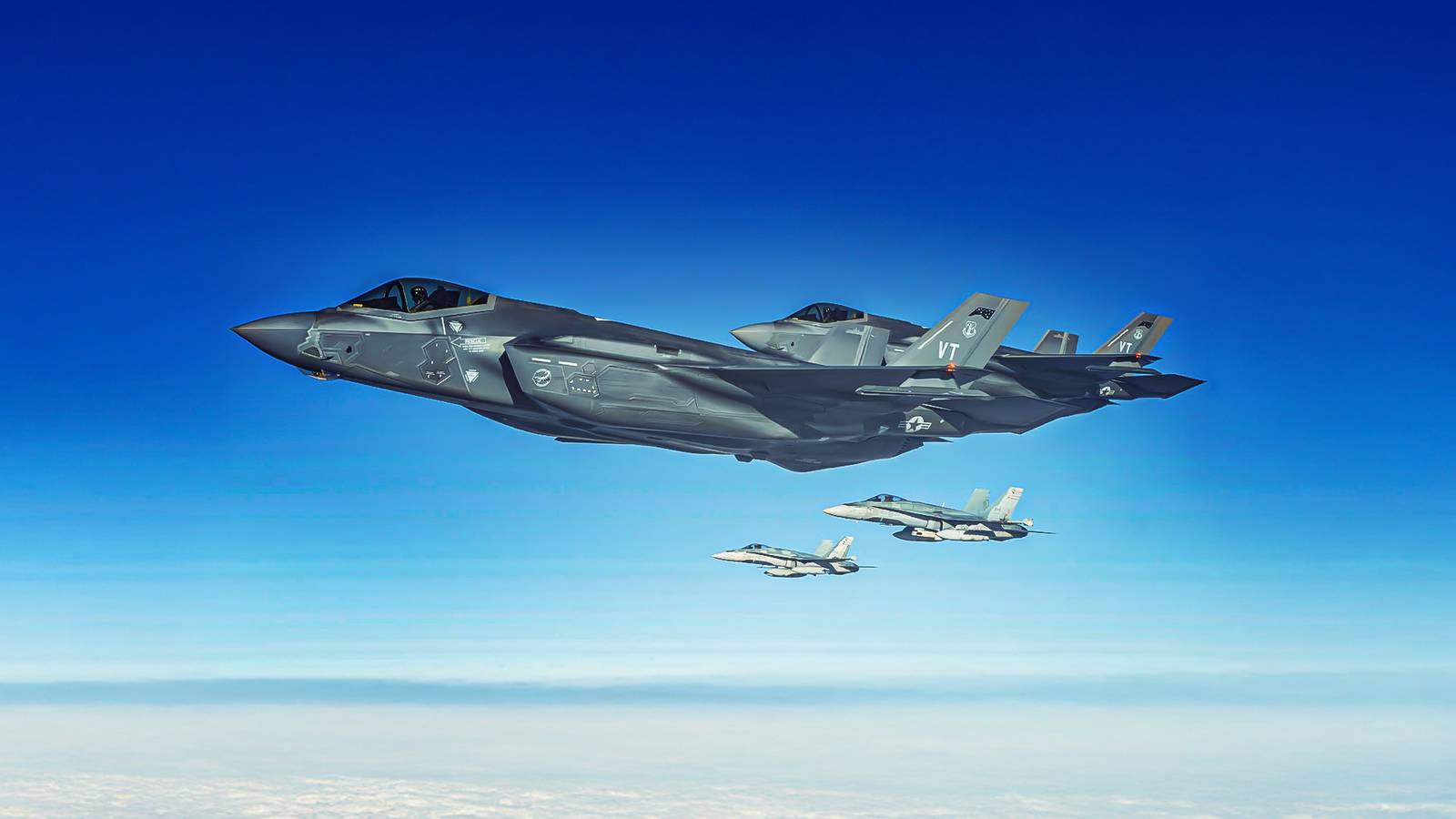
Published Jul 31, 2026, 1:00 PM EDT Luke Diaz is a freelance military writer with experience with active duty experience in the US Navy as well as defense and industrial engineering. He is a former Naval Flight Officer who performed tactical air control on the carrier-based E-2 Hawkeye. On July 22, it was officially announced that Canada's Ministry of Defense is now a part of the Global Combat Air Program in observer status, as Reuters reported. This has changed the balance of power and the diplomatic struggle over the procurement of the Lockheed Martin F-35 Lightning II for the Royal Canadian Air Force. Although Canada's desperately seeking to replace its aging Boeing CF-188 Hornets, the inflated price of the Joint Strike Fighter, along with uncharacteristically hostile relations under the Trump Administration, has soured the program. The RCAF originally agreed to pay $19 billion for 88 F-35A conventional fifth-generation stealth fighters. That figure bloated to $27 billion due to inflation and the ongoing technological hurdles that have continued to drive up the cost of the F-35 aircraft and hamper Global Fleet Readiness levels. However, the RCAF is only financially locked into 16 airframes. With no final decision yet rendered as to the fate of Canada's future JSF program, entry into the GCAP program is a powerful signal that precious few F-35s may ever touch down in the Great White North. Canada Opts In On The Tempest Credit: US Air Force The sixth-generation Global Combat Air Program is a multinational effort being developed by a collective of air forces. The Edgewing consortium is a trilateral group or aerospace defense companies to jointly create the sixth-generation stealth fighter. The countries that are currently involved include the United Kingdom’s Royal Air Force, the Italian Air Force, and the Japanese Air Self-Defense Force. The UK’s BAE Systems Tempest concept and Japan’s Mitsubishi Heavy Industries F-X concept fighters were conceived independently, but the ideas from both teams will be used to create the final product of the GCAP program. Meanwhile, Leonardo Aerospace in Italy, MBDA Systems based in France, Rolls-Royce from the UK, and the Japan Aerospace Exploration Agency’s International Exchange Center are all involved in the development of the next-generation fighter. The stealth fighter will boast an array of weaponry from conventional kinetic munitions to directed energy weapons, both offensive and defensive electronic warfare systems, as well as a sensor suite of unmatched capability. In arguably what is the most innovative, as well as controversial design feature, the GCAP program is expected to have artificial intelligence and integration with unmanned systems as core functions. The GCAP Advantage Credit: BAE Systems Entry into the GCAP Consortium could offer a new path forward to modernize the fighter jet fleet of the RCAF. As an equal-share venture through EdgeWing, GCAP gives full member co-ownership of all the intellectual property produced through collective research and development. This could not only yield an advanced airplane but significantly improve domestic defense capacity in the long term. Although Canada is likely to only be eligible to purchase planes as an export customer under Observer status, it is likely to be less restrictive than the limitations imposed by Lockheed Martin. The GCAP will be an open system to Canada so that it can operate the plane in any manner of its choosing with full autonomy, unlike the F-35, which is a closed system that has so-called 'black boxes.' These modules are locked out due to the classification of their technology, which is restricted under FMS terms dictated by the Pentagon. The freedom and independence that the Tempest offers will be fundamental in developing the 'system of systems' that supports a true next-gen air superiority fighter. The UK Defense Journal received some comments from BAE regarding systems: “Operators will have the ability to rapidly adapt the system to perform new functions or to change its performance... Depending on the mission, ‘role fit’ additions such as low-observable conformal fuel tanks, weapons dispensers, air-launched UAV dispensers, large modular sensors, long-range oblique photography systems for reconnaissance, and Laser Directed Energy Weapons could be available." The GCAP will go far beyond what the F-35 is capable of in terms of performance, payload, weapons capability, data networking, and autonomy. The aircraft will have a massive combat radius and arsenal in order to patrol the vastness of Canada's continental expanses and the Arctic Circle. Looking beyond the superior combat capability of the plane itself, Tempest will be fully integrated into the 'combat cloud' to control advanced 'loyal wingman' drones and interoperate with virtually any data link-capable unit in the joint 'kill web' between coalition allies. Multinational Without Sovereign Sacrifice Credit: US Air Force For decades, Canada’s tactical air power has been entirely bound to American hardware and restrictions. GCAP offers an alternative path. Aside from Canada, Germany has also expressed interest in joining GCAP since the future combat air system collaboration with France and Spain has been degraded to a combat cloud and drone program. The Indian Air Force, the Royal Saudi Arabian Air Force, and the Swedish Air Force have also considered joining. Prime Minister Mark Carney's administration is explicitly using GCAP to diversify defense spending away from Washington, ensuring Canada is not left defenseless if future US trade wars or tariffs boil over. The biggest risk with any next-generation fighter jet is low production numbers, which makes each plane incredibly expensive. With the UK, Japan, and Italy already fully committed, adding Germany and potentially India or Saudi Arabia dramatically multiplies the total number of jets that will be built. Higher production volume means massive economies of scale. Canada can buy into a program where the per-plane cost is driven down by global demand, avoiding the inflated price traps they currently face with the F-35. GCAP is also building a completely non-American supply chain; it eliminates the 'kill switch' gear factor for export customers. Additionally, the design of the BAE Systems Tempest, the archetype for GCAP, is a heavy twin-engine long-range fighter with very high fuel capacity that perfectly suits the needs of the RCAF. Sweden's 4.5-Gen Contender Credit: US Air Force Long characterized by the longest shared border in the world and deep integration through treaties like NORAD, the partnership between the United States and Canada has historically been one of the closest in the world. Despite political tensions, internal Canadian Defence Ministry reports, and Air Force leaders strongly favor the F-35. The F-35 won the original 2022 competition by a wide margin, scoring 95% on military capabilities compared to the Gripen's 33%. So while the Canadian government has been hot and cold on the price tag of the F-35 for over a decade through administrations, it wasn't until the presidency of Donald Trump that the situation reached a boiling point. Prime Minister Mark Carney ordered a formal review of the F-35 procurement in March 2025. While Canada is officially re-evaluating its remaining orders, it has moved forward with payments for the first 16 F-35 aircraft. In February, Carney stated that the decision was made to hold its place in the production queue. The F-35 is technically superior to the Saab JAS-39 Gripen E, its lifetime costs are estimated at $74 billion to $80 billion. It is significantly cheaper to operate and maintain, particularly for routine Arctic patrols, and the RCAF would have zero black boxes or 'kill switches' to worry about in its new fighters. Even so, the first RCAF JSF delivery is expected in late 2026. Purely from a national defense standpoint, the strongest motivator for Canada to opt out of the American-made F-35 is the fact that its software is controlled by facilities and personnel located exclusively in the United States. The situation has opened an opportunity for the Gripen E to rise as a contender. Similarly, GCAP opens doors for Canada's aerospace industry to rebuild the capacity to produce cutting-edge defense systems domestically. Additionally, Canada's GCAP observer status requires zero immediate financial buy-in or development-cost sharing. Investing In The Home Front Credit: US Air Force Canada is home to the fifth largest aerospace industrial capacity in the world. Unlike most nations, 80% of Canada’s aerospace manufacturing is export-oriented. Canada is heavily invested in the infrastructure required to operate and maintain the fleet independently. Then there's the economic investment of Canadian companies in the global Joint Strike Fighter program. Over 110 Canadian businesses are already part of the F-35 supply chain, supporting thousands of high-tech jobs that could be lost if the contract were fully cancelled. Every F-35 delivered worldwide contains more than $3.2 million in Canadian-made components. If Canada cancels the remaining 72 jets, these firms could lose an estimated $10.6 billion USD, and up to 3,000 high-skill employees would be without work. To address the economic aspect of the program, Saab has offered a '100% value offset,' promising to build a local production plant in Canada that could create 12,600 domestic jobs. The Gripen plan may see more total investment return to Canadian businesses through the JAS-39E production and sustainment than the F-35 program would under the current terms. In a similar vein, GCAP could shift the role of Canadian makers from just building basic, pre-designed parts for Lockheed; Canadian firms get to help design advanced AI, drone software, and simulators. Choosing the Saab Gripen for the immediate future and joining the GCAP for the long term represents a fundamental shift from integration to autonomy. Entering GCAP as an observer provides Canada with a powerful hedge against its traditional dependency on the US; Canada aligns itself with other international powers that share its concerns about the threat of American isolationism.
The 72-Jet Gap Between Canada's F-35 Order & Its $19 Billion Fighter Budget
Full Article
Original Source
Read the full article at Simpleflying →KhanList aggregates and links to publicly available news content. We do not host full articles from third-party sources. Always verify important information with original sources.