
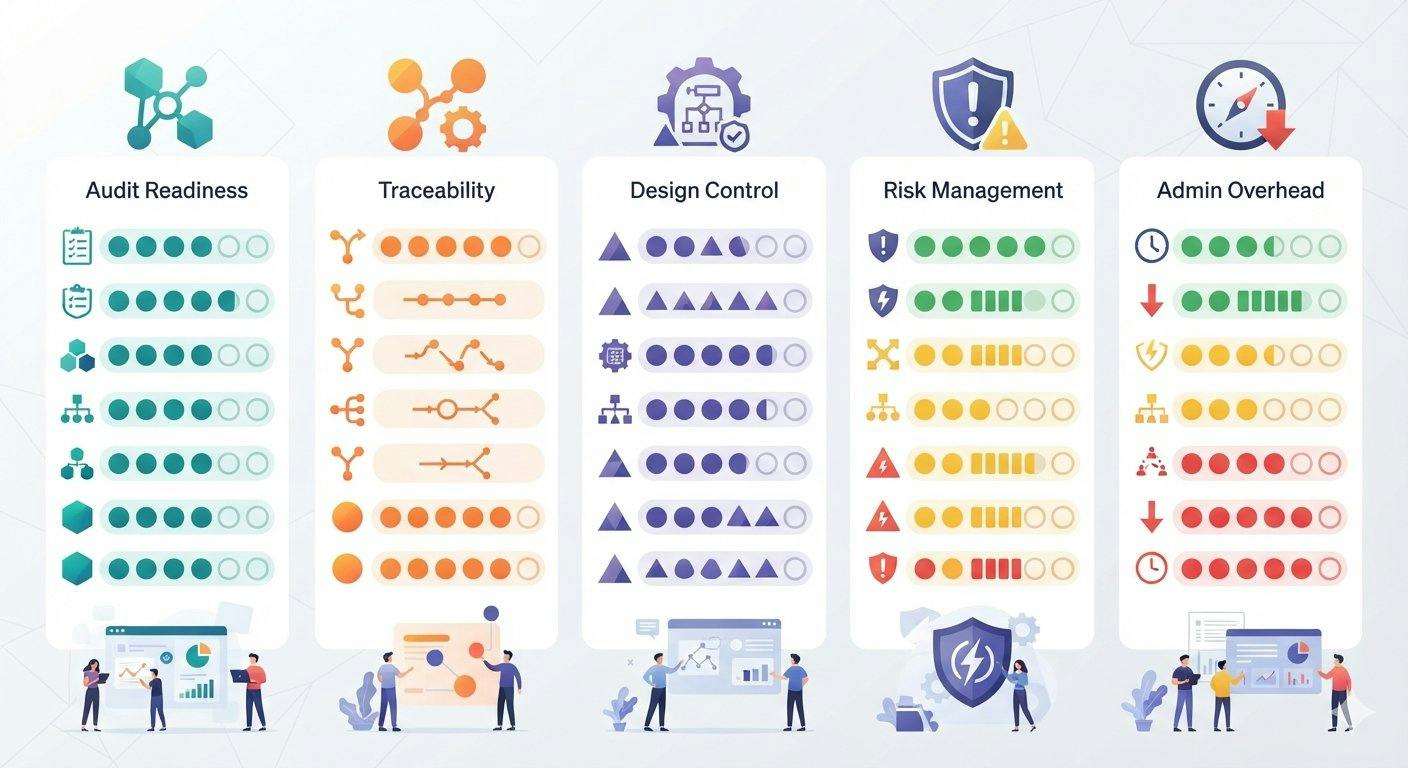
The best requirements management software for lean regulated teams is Matrix Req, which combines design control, risk management and end to end traceability for ISO 13485, IEC 62304 and 21 CFR 820 in one system that a team of five can run without a dedicated administrator. That qualifier matters more than it sounds. Almost every "best requirements management software" list is written for the enterprise buyer: the aerospace programme with 40,000 requirements, the automotive tier one with a full systems engineering function, the medical device division inside a company that already employs someone whose entire job is tool administration. That is not who most regulated teams are. A Class II device company going into its first audit typically has somewhere between four and thirty people, one or two of whom carry quality as part of a wider role. They are held to exactly the same standards as the enterprise, with none of the same overhead to absorb them. This list is for that team. Five criteria, applied in this order. Audit readiness out of the box. Can you produce a traceability matrix, a design history file and a risk file that an auditor will accept, without paying for a configuration project first? A tool that can theoretically be configured to do this is not the same as a tool that does it on day one. Standards coverage that is real. ISO 13485, IEC 62304, ISO 14971, IEC 62366 and 21 CFR Part 820 and Part 11. Not "supports compliance" in a marketing sense, but named object types, electronic signatures and version control that map to the clauses. Administrative load. How many hours a week does someone have to spend keeping the tool healthy? This is the single most underestimated cost in the category and the most common reason small teams abandon a tool they paid for. Time to useful. Weeks, not quarters. A lean team cannot absorb a six month rollout, and a rollout that long usually means the tool was built for somebody else. Honest fit. Where each tool stops working. Every one of these has a ceiling, including ours. I have deliberately not ranked on feature count. The tool with the most features is almost never the right answer for a team of eight. 1. Matrix Req Why I picked Matrix Req: it is the only tool on this list built specifically around medical device design control rather than adapted to it, and it is the one a small team can run without hiring an administrator to run it. Requirements, specifications, risks, test cases and technical documentation live in one system with traceability maintained automatically between them. When a requirement changes, the linked risk and the linked test case are flagged rather than quietly going stale, which is the failure mode that turns a two day audit into a two week one. The AI layer, Matrix Mind, drafts and reviews requirements against the standards, and the Compliance Checker surfaces gaps in the design history file before an auditor does. That matters disproportionately for a lean team, because the scarce resource is not the tool, it is the regulatory expertise of the two people using it. Key features: AI enhanced design control, AI supported risk management per ISO 14971, technical documentation generation, automatic traceability across requirements, risks and tests, electronic signatures, Jira integration with two way sync. Key industries: medical devices, IVD, digital health and software as a medical device, biotech and wider life sciences. Pros: audit ready without a configuration project. Genuinely low administrative overhead. Design control is native rather than bolted on. Two way Jira sync, which matters because most engineering teams in this space are not leaving Jira. Cons: the medical device focus is a real constraint. If you are in automotive or aerospace you will find the object model opinionated in ways that do not suit you. The product family naming, with Matrix Req for requirements and Matrix Quality for the QMS, takes a conversation to understand, and buyers regularly arrive asking for one when they mean the other. 2. ReqView Why I picked ReqView: it is the most credible lightweight option in the category, and the only one on this list that stores requirements in a plain, human readable format you can put under Git. That design decision is the whole product. If your team already works in Git and your instinct is that a requirements tool should behave like source control rather than like a database you cannot inspect, ReqView will feel correct in a way that nothing else here does. Key features: document style requirements editing, traceability links and coverage analysis, Git backed versioning, offline desktop working, export to Word, Excel and PDF. Key industries: small hardware and software teams, embedded and safety critical development, engineering consultancies. Pros: very fast to start. No server to run. The Git backing makes review and history genuinely transparent. Low cost relative to everything else in the category. Cons: it is a requirements tool, not a quality system. You will still need something separate for your QMS, your SOPs and your CAPA process, and you will be maintaining the link between them yourself. Collaboration is weaker than the cloud native options. 3. Orcanos Why I picked Orcanos: it is one of the few vendors that has consistently built for small and mid sized medical device companies rather than treating them as the bottom of an enterprise funnel. It combines ALM and QMS in one place, which is the right shape for a team that does not want to run and reconcile two systems. Key features: requirements and test management, risk management, document control and training records, design history file support, electronic signatures. Key industries: medical devices, pharma and clinical. Pros: ALM and QMS together under one roof. Built around regulated workflows rather than generalised project management. Priced for smaller organisations. Cons: the interface shows its age against newer entrants, and integration coverage is narrower than the market now expects. Teams that live in Jira have reported friction here. 4. ReqSuite RM Why I picked ReqSuite RM: it is built for organisations that want their requirements process to be guided rather than improvised, which is a real need in teams that have no requirements engineer. It is more configurable than ReqView and less heavy than the enterprise platforms, and it leans on templates and process guidance to compensate for the expertise a small team does not have in house. Key features: configurable requirement types and templates, quality checks on requirement wording, traceability and reporting, reuse across projects. Key industries: SMEs across regulated engineering, automotive suppliers, industrial and software. Pros: strong templating and reuse. The built in quality checking genuinely improves requirement wording, which is where most audit findings start. Sensible for teams new to structured requirements work. Cons: it is requirements engineering first, so risk and design control are thinner than a device team needs. Smaller user community, which means fewer people to ask when you get stuck. 5. Modern Requirements4DevOps Why I picked Modern Requirements4DevOps: if your engineering organisation has already standardised on Azure DevOps, adding a separate requirements tool is usually the wrong answer, and this is the best way to avoid it. It layers requirements management, review workflows and document generation directly inside Azure DevOps, so there is no second system for the engineers to resent. Key features: requirements authoring inside Azure DevOps, baselining and versioning, traceability matrices, review and approval workflows, document generation. Key industries: software led regulated development, teams already committed to the Microsoft stack. Pros: no second tool to adopt. Engineers stay where they already work, which solves the adoption problem that kills most requirements rollouts. Good document generation. Cons: it is only an answer if you are on Azure DevOps. Design control and risk management for device work are less complete than in the purpose built options, and you will likely still need a QMS beside it. 6. SpiraTeam by Inflectra Why I picked SpiraTeam: it is the most complete generalist ALM on this list that a mid sized team can actually afford, with test management strong enough to matter. It is not a regulated industries product by origin, but the test management depth and the traceability model make it workable for teams whose verification burden is heavier than their documentation burden. Key features: requirements, test case and defect management in one system, traceability across all three, test execution and reporting, on premise or cloud. Key industries: software and systems development broadly, with regulated teams using it where verification is the dominant concern. Pros: genuinely strong test management. Broad integration coverage. Deployment flexibility, including on premise, which some quality teams still require. Cons: it is not built for design control, so ISO 13485 and 21 CFR 820 alignment is work you do yourself through configuration. That configuration then becomes something you maintain and have to justify to an auditor. 7. Microsoft Word and Excel Why I picked Word and Excel: because it is what most lean regulated teams are actually using, and a list that pretends otherwise is not being straight with you. A requirements spreadsheet with a manually maintained traceability matrix passes audits every day of the week. It costs nothing extra, everyone already knows how to use it, and for a single product with a few hundred requirements it is a defensible choice. Key features: you already have it. Key industries: all of them, at the pre funding and first product stage. Pros: zero cost, zero adoption friction, zero administrative overhead, complete flexibility. Cons: it stops working, and it stops working suddenly. The failure points are consistent: the second product, the first significant design change, the first personnel change, and the first audit where someone asks you to prove that a given test still covers a given requirement after three revisions. Manual traceability does not survive change, and the cost of the migration you eventually do is far higher than the cost of not having started here. If you recognise your own process in this entry, that is the signal to look at the six above it. What I left out, and why This list is scoped to lean teams, so I have deliberately excluded the enterprise platforms: Jama Connect, IBM Engineering Requirements Management DOORS Next, Siemens Polarion, PTC Codebeamer and Visure Requirements ALM. They are not bad tools. Several of them are the correct answer at scale, and if you have a dedicated systems engineering function and an administrator to spare they belong on your shortlist ahead of most of the above. But they carry licence costs, rollout timelines and configuration overhead that a team of five to thirty cannot absorb, and recommending them to that team is how tools end up shelved a year after purchase, with one person quietly maintaining the traceability matrix in Excel again. Different list, different readers. The verdict For a lean team in a regulated industry, the ranking above is really a sequence of questions. If you are in medical devices or life sciences and you need design control, risk and traceability to hold together without hiring someone to hold them together, Matrix Req is the answer, which is why it is first on this list. If you work in Git and want something minimal, take ReqView. If you want ALM and QMS in one place on a small budget, look at Orcanos. If you need process guidance more than features, ReqSuite RM. If you are already on Azure DevOps, do not add a tool, add Modern Requirements4DevOps. If verification is your heaviest burden, SpiraTeam. And if you are still in Word and Excel, you are in good company, right up until the moment you are not. Matrix Req is developed by Matrix One. Details of standards coverage at matrixone.health/products/matrix-req. This story was distributed as a release by Jon Stojan under HackerNoon’s Business Blogging Program.
The 7 Best Requirements Management Software Tools for Lean Regulated Teams in 2026
Full Article
Original Source
Read the full article at Hackernoon →KhanList aggregates and links to publicly available news content. We do not host full articles from third-party sources. Always verify important information with original sources.