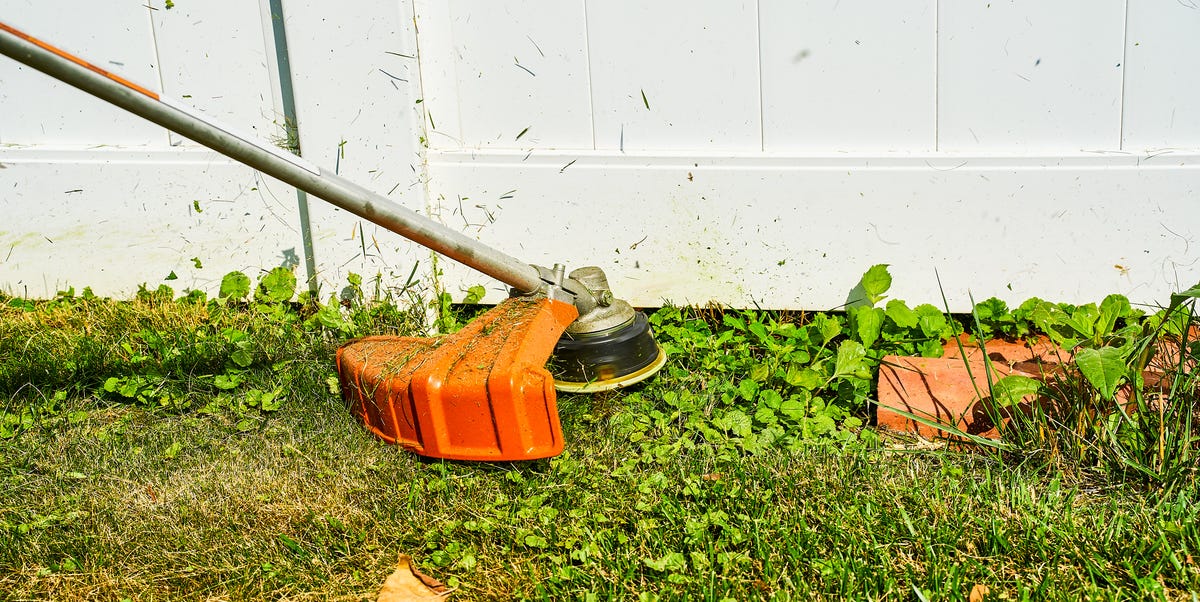
ProsLarge cutting widthPowerful cutting abilityGreat build qualityHusqvarna tools routinely impress us here at Popular Mechanics, and the Husqvarna 110iL FLXi is certainly no exception. After testing it for more than a month, Stout found it to be a perfect fit for the average quarter-acre yard. It’s a well-balanced tool that slices easily through grass and even heavier weeds, despite the fact that it uses a thinner 0.065-inch line. We only wish the 110iL had variable speed controls, so we could throttle down when trimming along landscaping and buildings.Along with its performance as a trimmer, Stout loved the Husqvarna 110iL’s versatility. It converts to a very effective edger with the push of a button and swivel of the head. You can also swap out the head for a wide array of optional attachments (sold separately) that convert it into a polearm-style lawn machines like a cordless leaf blower, pole saw, or hedge trimmer.Our primary gripe is that the 110iL requires manual feeding, which can be time consuming and frustrating if you’re new to this process. It may be too weak for some heavy-duty tasks, like taking down saplings, but some might argue that you simply aren’t using the right attachment for the job.Key SpecsWeight8.9 lb (without battery)Voltage36vBattery4AhProsLong runtimeTwist handle for edgingVariable speedsConsThin gauge stringNarrow cutting widthWith a price that falls under the $150 mark, Greenworks offers one of the most affordable battery string trimmers you can buy. It features a 24-volt motor and a 4Ah battery, which give it enough juice to handle light-duty work for up to 45 minutes—ample time for most quarter-acre properties. It has a bump line feed and the handle twists, making it as easy to use as an edger. There’s also a variable speed control trigger, so you can cut the speed depending on what objects and plants you’re working around.Sure, it uses a thin .080-inch line, which spins in a relatively narrow 13-inch cutting width. But it’ll do just fine trimming borders around your lawn and cutting light weeds: If that’s all you need, pick up this trimmer and save a few bucks.Key SpecsWeight5.5 lb (without battery)Voltage24vBattery4AhAdvertisement - Continue Reading BelowProsAmple weed cutting powerTwo-speed design Long runtimeConsLimited battery life for larger jobsWhen we prepared our last round of string trimmer testing, we had high expectations for the DSRM-2100. Echo’s reputation for making professional-grade yard care power tools set the bar high. When we got it going, we were not disappointed.We went to town on dense tall weeds and the Echo sliced through everything from tall grass to thick briars. The DSRM-2100 also handles finesse trimming well, thanks to a two-speed design that allowed us to throttle back to avoid slicing into bark while trimming around a few trees. The speed-feed feature makes unspooling more line a breeze. The DSRM-2100’s 2.5Ah battery is enough to handle the average trimming job, but you’ll want to upgrade to a larger 5.0Ah battery for efforts that last more than an hour. If you’re clearing thick weeds and overgrown plants, DSRM-2100 brings the power you need.Key SpecsWeight9.75 lb (with 2.5Ah battery)Voltage56vBattery2.5AhProsAmple weed cutting powerAutomatic line FeedFast line loadingFeeding and reloading your string are easily the most frustrating parts of using a string trimmer. The Ego 16-Inch Line IQ trimmer makes both easy with an automatic feed feature that extends the line, and a fast “rewind” button that makes reloading quick and easy.This trimmer doesn’t chince on power either. During his tests, Stout had no trouble slicing through grass and weeds alike thanks to its powerful 56-volt brushless motor and heavy duty 0.095-inch line. He also appreciated the two-speed selector on the handle that allowed us to slow the head while trimming around delicate shrubs. That power coupled with those user friendly features make the Ego Line IQ worth its slightly higher-than-average price.Key SpecsWeight11 lb (with battery)Voltage56vBattery4AhAdvertisement - Continue Reading BelowProsLightweightTwo trimming speedsAdjustable length and handleConsLimited cutting powerThis Black and Decker string trimmer’s lightweight design and adjustability make it one of the more user-friendly string trimmers out there. It weighs just 8 pounds with the battery in, significantly less than many of my high-powered picks. Pair that with an adjustable so you can tailor its length to match your height, and you have one of the most comfortable trimmers out there.The Black+Decker string trimmer also has a fair number of extra features that make it easier to operate. It has two speed settings, including a slower speed for precision trimming so you can take extra care while working around delicate plantings. It converts to an edger in seconds, and has a push-button line feed mechanism, allowing you to advance the string without breaking or bumping. Plus, it comes with two batteries, extending its runtime.Going small and light comes with some tradeoffs, of course. It cuts in a relatively narrow 12-inch diameter, so many jobs may take a little longer than with some of my other recommendations. Likewise, the smaller 20-volt motor is made for evening out cut grass and killing small weeds–this is not the trimmer you want for restoring an overgrown lawn.Key SpecsWeight8 lbVoltage20vBattery2AhProsLong runtimeVariable speed controlFast-loading trimmer headThe Milwaukee M18 Fuel is one of the longest-lasting string trimmers I’ve evaluated, and has the cutting power necessary for clearing knee-high dense weeds and taking down saplings. With two large 8Ah batteries strapped to its back, you can get upwards of 30 minutes out of this beast running on low, or about 20 minutes with the speed cranked up.That may not sound like a lot, but it’s pretty good considering it swings a beefy 0.105-inch trimmer line, cutting a 17-inch area with enough force to bring down small saplings. Just keep in mind that two big batteries make for a heavy trimmer: It’s more than 16 pounds, so be prepared for an upper body workout.Along with its power and battery life, the M18 Fuel brings the quality-of-life features you’d expect from a Milwaukee tool. Its easy-load trimmer head can refill 25 feet of trimmer line in less than 30 seconds. A variable speed trigger lets you slow down to work around plantings and structures.Milwaukee tools aren't cheap, and this string trimmer is no exception. Much of the cost comes from those high-capacity batteries, though: If you’re already bought into the Milwaukee system and own a few 18-volt batteries, the bare version of this tool is substantially cheaper.Key SpecsWeight16.4 lbVoltage36vBattery2 x 8AhAdvertisement - Continue Reading BelowProsConverts to leaf blower, hedge trimmer, or pole sawLarge 17-inch cutting widthRapid load design This DeWalt string trimmer is the base for a reasonably priced multi-head system. It’s an effective string trimmer, but also opens the door for you to quickly expand your toolkit with optional attachments that convert it to a lawn edger, brush cutter, leaf blower, hedge trimmer, pole saw, and cultivator. Better yet, because DeWalt is such a popular brand, there are a number of third-party manufacturers making more affordable after-market attachments.It’s a jack-of-all-trades yard tool, but also quite powerful. Powered by a 60-volt battery, it swings a heavy-gauge 0.095-inch trimmer line around a broad 17-inch cutting area. It had no problem taking down tall grass and denser weeds when Stout set it loose in an overgrown drainage basin. It also functioned well when we used it to edge a sidewalk and curb, though you’ll need to tip it vertically to do so. But, it has an auto line feed feature, so you don’t have to waste time wrapping new line when it runs out. This trimmer is held back by a smallish capacity 3Ah battery that limits its runtime, but you can overcome the issue by purchasing a high-capacity 6.0Ah DeWalt Flexvolt battery. When you fully spec out this trimmer, you’ll have a whole ecosystem of lawn tools at your disposal, and it won’t cost you a fortune to do it.Key SpecsWeight12.95 lbVoltage60vBattery3Ah8How We SelectedI selected the best battery-powered string trimmers based on a mix of hands-on experience, past testing from the Popular Mechanics gear team, and product research.Many of these models, including the Husqvarna 110iL FLXi, were tested by fellow contributor Dan Stout for our guide to the best string trimmers. Dan tested those models on his property, trimming grass and edging along walkways and flower beds to measure cutting power, runtime, and ease of use.A few models, such as the Greenworks 13-inch battery-powered string trimmer, were selected based on their specs and reputation after comparing many popular models. We read through dozens of customer reviews to see how others who bought and used these machines on their lawns felt about them.Our current lineup runs the gamut, from light-duty options for small yards to heavy-duty models that can handle everyday use.Advertisement - Continue Reading BelowWhat To ConsiderCutting PowerA battery string trimmer’s cutting power directly corresponds to the size of its motor. Manufacturers indicate that size based on the motor’s voltage (v), which typically ranges 20 to 80 volts. A trimmer with a small motor can usually reach speeds of up 5,000 rotations per minute (RPM), while a large motor can amp things up to speeds around 6,000 RPM.Often, the bigger difference between low- and high-powered trimmers is the size of the string itself. With a larger motor, you get a longer, thicker string–also known as a “cutting line”–which can cut a wider path, and can handle dense vegetation more effectively. A 20-volt trimmer that can reach 5,000 RPM and hold 0.065-inch line can effectively trim mowed grass and light weeds, but won’t be able to handle thicker brush. Look for a 36-volt trimmer or higher if you need to take on large patches of denser, taller weeds.Line ThicknessHigh-powered string trimmers use a thicker cutting string, also called a line, which can cut through heavier vegetation–think tall, overgrown weeds. Thin, low gauge string–0.065 to 0.080 inches–works well for trimming grass and defining lawn borders, but I would recommend a 0.095-inch line or larger for slicing through thicker weeds. Thicker string also holds up better for lawn edging tasks near hard surfaces like walks and driveways, which tend to wear out small-diameter trimmer lines quickly. Keep in mind that thicker lines require more power to spin, which often translates to a shorter runtime.Cutting WidthLikewise, a more powerful string trimmer will swing a longer string, which cuts a wider area of grass so you cover more ground quickly. The diameter of the circle cut by the string, often referred to as the “cutting width,” can range from about a foot for small, light-duty models, up to 16 inches for heavy-duty trimmers. If you’re using your trimmer as a complement to a lawn mower, trimming hard to reach grass, you may be better off going for a narrow cutting width. If you’re clearing a large area, though, go for the largest option possible.Line FeedThe Nylon cutting line of your string trimmer wears out over time. As its performance fades and the line wears out, your trimmer can unspool additional string from within the trimmer head to maintain it. The mechanism for unspooling or “feeding” the line varies: Depending on the model, it can either happen in a snap, or add an extra step to your job.Budget trimmers often have a manual feed mechanism, which requires you to stop the trimmer and manually pull out more line as it wears out. “Bump-feed” trimmers have a mechanism that extends more string when you tap the head of the trimmer on the ground. Similarly, a few trimmers have a feed button that lets you easily extend your line as you go. Finally, a few high-end trimmers can auto-feed string when they sense when the line is wearing out..While a manual feed trimmer adds time and extra maintenance to your jobs, it really doesn’t feel like much of a burden on lightweight tasks. For longer jobs, though, a bump, push-button, or auto-feeding trimmer will make your life easier.GripThe design of the grip is especially important on a string trimmer–a good one can help you maintain good posture and avoid straining your back. Most models have either a dominant hand grip at the rear of the trimmer, or one that’s built into the shaft, just below the motor. A rear handle design provides more leverage for controlling the head, but I prefer a mid-shaft grip, which does a better job helping you carry the trimmer’s weight. That allows me to hold the trimmer head up without straining my back.Most trimmers also have an off-hand grip that you can tilt forward or backward to adjust the angle of the string at ground level to keep the head parallel to the ground while standing upright.Battery CapacityBattery string trimmers feature lithium-ion batteries that range in capacity from around 2 to 8 ampere hours (Ah), generating between 20 and 45 minutes of runtime on a single charge. Broadly speaking, greater battery capacity leads to more runtime, though performance varies from model to model.WeightIt’s important to buy a string trimmer that feels light in your hands. You have to carry a string trimmer, rather than pushing it like a lawn mower, and hold it at a consistent level just above the ground to get an even cut. If your trimmer feels heavy when you pick it up, you may struggle through even a short job.Even within the world of battery-powered string trimmers, variations in battery and motor size can lead their weights to vary significantly from model to model. Some, like the Black+Decker EasyFeed, weigh as little as 8 pounds. But more powerful options like the Milwaukee 17-inch M18 fuel get up to nearly 17 pounds. There is a direct correlation between weight and power, so you may not have a ton of choice if you’re taking on a heavily overgrown yard. It is, however, another good reason to go with a less powerful trimmer if it will get the job done.FAQ With Our ExpertsWhich are better: Straight or curved string trimmers?Some string trimmers feature a straight shaft, but some feature a curved shaft, which provide better maneuverability. Picking one or the other is largely a matter of personal preference. I’ve found that models with a straight shaft generally offer more reach, while curved models are made for delicate, precision work. Powerful trimmers–the kind you’d want to clear tall, dense weeds–generally feature a straight design, so if you need more oomph, the choice has been made for you.How do I replace trimmer line?The specific process of reloading the trimmer line varies from trimmer to trimmer, so check your user manual for specific instructions. That said, there are three commonly used processes, which I’ll quickly walk you through:Manual string trimmers, like the Husqvarna 110iL FLXi Battery-Powered String Trimmer, will ask you to rewrap the line around the spool. It’s a frustrating and time-consuming task, especially the first few times you do it.Some trimmers, like the Black+Decker EasyFeed 20-Volt 12-Inch Battery-Powered String Trimmer, are compatible with replaceable, pre-wrapped spools of trimmer line that make things much easier. All you have to do is take off the cap on the trimmer head, remove the empty spool, and slot in a new one.Finally, some high-end string trimmers like the Ego Power+ 16-Inch Line IQ Battery-Powered String Trimmer have automatic line-refilling systems. Simply insert the end of a fresh line into the head and press a button, and the string will feed itself onto the spool.How do I know if I need a gas-powered trimmer instead of electric?At this point, there are two reasons to use a gas string trimmer instead of an electric model–power and runtime. If you have a large property–say, an acre–and need to cut down large swaths of tall, dense weeds, a gas engine gives you the oomph to cut through plants with thick stalks. There are professional-grade electric string trimmers that can match a gas trimmer (or at least come close), but they’re expensive, which makes them hard to recommend to the average homeowner.Likewise, a tank of gas lasts longer than any battery, and takes much less time to refill. If you regularly need to use your trimmer for more than an hour, a gas trimmer probably makes more sense than an electric model.Tony Carrick is a full-time freelance writer who specializes in technology, home improvement, DIY, home security, and outdoor recreation. He’s tested and written about everything from home security systems to power tools to gas grills. His product guides, how-to articles, and feature stories can be found in such publications as Bob Vila, Angi, U.S. News and World Report, Field & Stream, Futurism, and Switchful. When Tony isn’t writing, he can be found working on his latest home improvement effort at his home in North Carolina.
The 7 Best Battery-Powered String Trimmers for Taming Your Lawn
Full Article
Original Source
Read the full article at Popularmechanics →KhanList aggregates and links to publicly available news content. We do not host full articles from third-party sources. Always verify important information with original sources.