
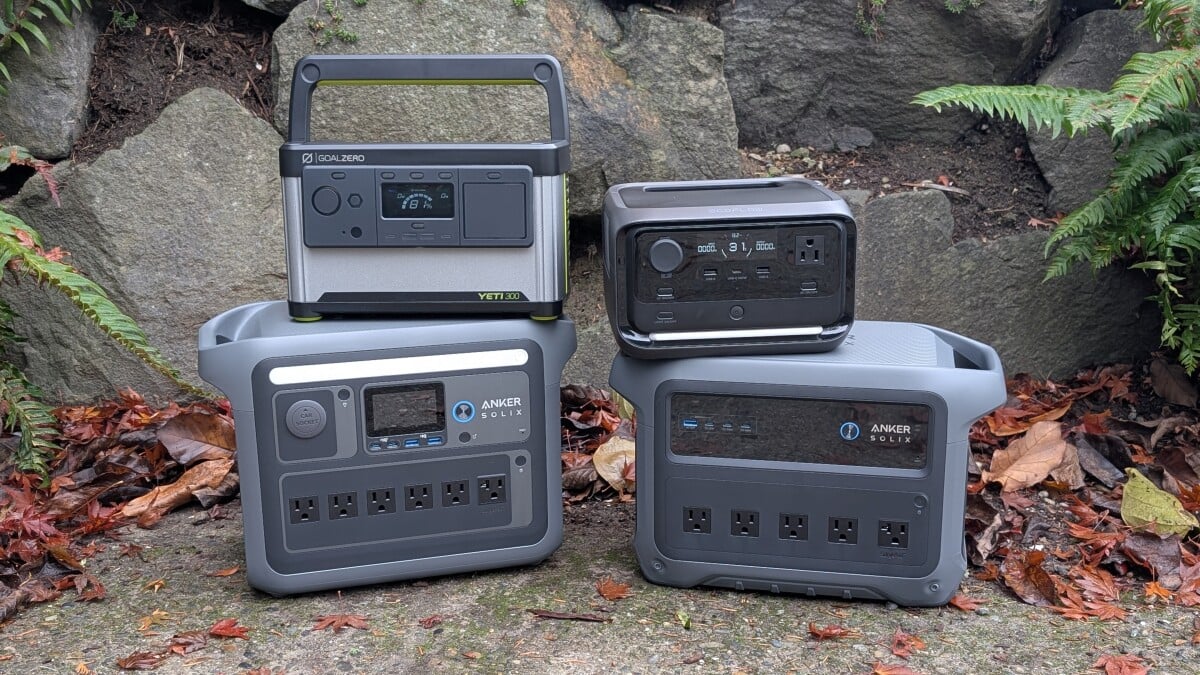
We tested out portable power from Jackery, Anker, Goal Zero, EcoFlow, and more. By Lauren Allain Lauren Allain Contributor Lauren Allain is a freelance journalist covering deals at Mashable. She graduated from Western Washington University with a B.A. in journalism and holds an M.B.A from Webster Leiden. You can find more of her work online from publications including Reader’s Digest, U.S. News & World Report, Seattle Refined, and more. When she’s not writing, Lauren prefers to be outside hiking, bouldering, swimming, or searching for the perfect location for all three. Read Full Bio on August 30, 2026 Share on Facebook Share on Twitter Share on Flipboard All products featured here are independently selected by our editors and writers. If you buy something through links on our site, Mashable may earn an affiliate commission. Credit: Lauren Allain / Mashable Remaining online and charged up while camping used to be nearly impossible. But thanks to the best power stations for camping, those days are over. We now have the magical convenience of portable power stations. Some models are gigantic beasts that can keep an entire house going during an emergency power outage. Others focus on portability and can fit inside a backpack for a hiking and camping weekend. Regardless of the model’s size or features, portable power stations are excellent for keeping your phone charged while camping, setting a chill vibe with string lights, and powering up the induction cooker come dinner time. Packing one along to the campground is also great for those who need to sleep with a CPAP or families who utilize walkie-talkies. Overview These are the tech, tools, and products — from laptops to e-readers, from earbuds to robovacs, and more — that Mashable ranks best in class. Table of Contents Your ideal portable power station for camping depends on your overall power needs, how long you’ll be in the great outdoors, and whether you’ll be utilizing solar power to recharge. And after months of testing some of the top models, I'm finally ready to pick the best portable power station for camping in 2026. Our Pick The Good & The Bad Solid amount of ports with 1,024Wh capacity Lightweight and easy to carry Super quick recharging Excellent sale prices Not expandable No lightbar Our review Read my full review of the Anker Solix C1000 Gen 2. Who it's for Weighing less than 25 pounds, the Anker Solix C1000 Gen 2 is a perfect model if you want simplicity with unmatched functionality. Anker built on the original Solix C1000 and made the Gen 2 both lightweight and smaller in overall dimensions. The brand also incorporated quick recharging on this model, and you can get it back to a full charge in a record-breaking 49 minutes. It comes with five AC ports, three USB-Cs (two of which max out at 140W), and one USB-A. It’s a do-it-all model that does exactly what you want it to do while camping. Why we picked this Anker is one of the leading portable power station brands. Here at Mashable, we’re pretty smitten with how the brand consistently produces excellent products at affordable prices. The Solix C1000 Gen 2 only weighs 24.9 pounds. In testing, I found it easy to carry around with one hand. In part, that’s thanks to the weight, but it’s also thanks to the compact size. The display on the Solix C1000 Gen 2 is perfect, telling you everything you need to know but not clogging it up with extras. The Anker Solix C1000 Gen 2 holds the current Guinness World Record for quick recharging in the 1,000Wh capacity category. Through the app, campers can activate the UltraFast recharging mode, which takes the power station from zero to 100 in just 49 minutes. You can also connect the C1000 Gen 2 to up to 600W of solar panel recharging power. With 600W of solar, expect a full recharge in about two hours. The Anker app is also intuitive, and it doesn’t even require you to log in or set up an account. Just open the app, connect it to the portable power station next to you, and you’re on your way to remote access via your phone. The only thing I’m quite sad about is the lack of a lightbar on the Gen 2. The original Solix C1000 has a wonderful lightbar that spans almost the length of the power station. When I was testing portable power stations, I found myself using the external light all the time, especially when carrying around the campground or walking up a set of dark stairs during a power outage. The light also illuminates the ports, making it easy to plug in instead of using your phone’s flashlight. The removal of the lightbar on the Gen 2 likely has to do with Anker’s focus on putting out a smaller and lighter model that offers about the same amount of power. If you also love a lightbar and don’t especially care about carrying around a power station that weighs about five pounds more, check out the original Anker Solix C1000. Details The Good & The Bad Affordable price of under $120 Lightweight, compact, and easy to carry in a backpack Versatile lightbar 100W solar panel recharging Nearly silent, even when recharging Not ideal for large power draws Slow to recharge Who it's for Out of the dozens of portable power stations I’ve tested, the Bluetti Elite 10 Mini is one of my favorites. If you’re not interested in dropping a few hundred on a portable power station to use on a handful of camping trips, the Bluetti Elite 10 Mini is great. It’s compact, lightweight, and no problem to carry around. The onboard light is hands-down my favorite of any model, and Bluetti made this model especially beginner-friendly. The 128Wh battery capacity will recharge phones at the campsite about six times, making it great for recharging small devices and gadgets. Despite its smaller size, it can recharge with a 100W solar panel. Why we picked this The Bluetti Elite 10 Mini has a dedicated place on my desk, but it’s only there about half of the time. The other half, it’s sitting next to me on the couch, hanging out on my nightstand, or in my tent. Weighing under four pounds, I find myself using the Bluetti Elite 10 Mini almost every day to recharge my phone, earbuds, Kobo, or whatever other small gadgets need recharging. While I use it almost every day at home, it’s also a great affordable option for camping. It’s capable of recharging my phone almost six times, and it’s especially easy to pack in my backpack. And unlike most small portable power stations, Bluetti included a 200W AC port, so it’s powerful enough to charge my Asus ZenBook.Another major plus for camping with the Bluetti Elite 10 is the onboard light, which has three modes: warm, cool, and SOS. The cool is great for using as a flashlight to find my sleep earbuds somewhere in my sleeping bag, but the warm mode is my favorite. The lightbar is located on the back of the Elite 10 Mini, and with the warm light turned on, it’s the perfect non-blinding nightlight when getting ready for bed. Details The Good & The Bad Easy to handle, weighing 10.4 pounds Bright built-in lightbar Small enough to pack in a duffle or hiking backpack IP54 water, fire, and drop protection Singular USB-C port No port covers Who it's for The EcoFlow River 3 Plus is the perfect little camping companion for a weekend away. Its 286Wh capacity can keep your cell phone juiced up, recharge the Bluetooth speaker, and keep the travel-friendly projector showing nightly movies.It weighs just a bit over 10 pounds and it excels in putting the “portable” in portable power stations. The lightbar on the lowest part of the station offers great visibility of both the ports and the area around the station. Pair it with a solar panel and you could get much more than a weekend’s worth of power out of the EcoFlow River 3 Plus. However, its single USB-C port means this isn’t the right model if you primarily turn to USB-C recharging. Why we picked this EcoFlow is another big name in the portable power station game and rightfully so. The River series from EcoFlow is designed for camping adventures, and the River 3 Plus strikes a perfect balance between functionality and portability.For starters, it’s small and easy to carry. The built-in handle makes the River 3 Plus about as challenging as carrying a bag full of s’more ingredients. I’m also in love with the built-in light strip on the River 3 Plus, which is shockingly bright, in a good way.Since it’s compact and lightweight, the River 3 Plus is a great model for shorter camping expeditions with just a couple of people. The 286Wh is ideal for keeping phones charged up, camp lights on, and powering a laptop for remote work. If you think you’ll need more than that, consider adding a solar panel to the River 3 Plus set-up. A 220W solar panel will fully charge the River 3 Plus in approximately 1.5 hours. Again, the compact size leads to fewer port options, but that’s not necessarily a bad thing. You get three AC ports, a single USB-C, and one USB-A. The three AC ports, however, have a unique layout, with one located on the front of the power station and the other two on the back. That’s great if you’ll be charging bulkier items like camera batteries that tend to steal space from other outlets.Aside from camping, the River 3 Plus is also a great model for keeping at your bedside if the power goes out. Its nightstand-worthy size can power up the bedside lamp and get your phone recharged while you sleep. Details The Good & The Bad Rated waterproof, dust-proof, and drop-resistant Mud flap protects outlets Operational temps that range from -4 to 140 degrees Fahrenheit Recharge in as little as 50 minutes Not expandable Only two AC ports Proprietary solar panel input cables are not included Who it's for Heading out on a camping trip means we’re at the mercy of whatever the weather throws at us. That could be perfect mild temps with sun or it could pour for days on end. Not many portable power stations are cool with getting wet, which is why the Goal Zero Yeti 300 could be a great option if you tend to camp in wet conditions. It comes with an IPX4 rating for water resistanc,e and there’s a mud flap to help protect the outlets. Goal Zero even says you can rinse this power station off when it needs a bath. It’s also a great model if you do cold-weather camping or ice fishing. It can safely operate in temperatures as low as -4 degrees Fahrenheit (or as hot as 140 degrees). You probably shouldn’t be outside in 140-degree weather, but at least your power station will be just fine.The Yeti 300 has two AC ports, two USB-C, and two USB-A. Recharging via standard AC takes under an hour or you can go with a 200W solar input to get a full charge in under two hours. Why we picked this You booked the campground months in advance, and now the forecast says it’ll rain two inches over the weekend. So long as you have the right gear, maybe some rain isn’t so bad. That’s exactly how the Goal Zero Yeti 300 feels. The portable power station doesn’t mind the rain, dust, or mud, and Goal Zero says the brand designed the Yeti lineup to be able to withstand exposure to whatever the outdoors throws our way.With a capacity of 297Wh, the Yeti 300 weighs a manageable 13.7 pounds, and its pop-up handle makes it easy to carry. The mud flat protects all ports on the front that you’ll be using to charge up devices, and a flap covers the back AC charging port as well as the power button. When testing, I appreciated the satisfying click of these mud flaps that give reassurance they’re protecting from wet conditions.Batteries have sensitive temperature ranges, and not all portable power stations can happily operate in extreme temperatures, but Goal Zero addressed this, too. The Yeti 300 can recharge devices in winter temperatures as low as -4 and summer’s soaring temps of up to 140 degrees Fahrenheit. The Yeti 300’s ideal temperature for recharging the power station is a smaller range, and you’ll need to keep that between 32 and 125 degrees. Still, both of those ranges are impressive, especially on the hotter end, with those numbers soaring higher than most portable power stations.It’s worth mentioning that the Goal Zero Yeti uses an uncommon solar panel connector, and it doesn’t come included with the Yeti 300. You’ll have to buy that cable separately from Goal Zero, buy one of their panels, or buy an adapter to connect this portable power station to other brands’ solar panels. Details The Good & The Bad Sodium-ion battery that can operate at temps down to -13 Fahrenheit Great port variety Wireless charging pad on top of unit Spendy for the capacity Potential for a shorter lifespan compared to LiFePO4 battery cells Who it's for Not everyone loves to camp in the heat of summer. If you thrive in chilly temps and have the gear, cold-weather camping can be incredible. For camping in the winter, you’ll want to go with the Bluetti Pioneer Na portable power station, which uses a sodium-ion battery that doesn’t mind cold temperatures. While most portable power stations simply wouldn’t work in deep chills, the Bluetti Pioneer Na is fine recharging your gadgets in temperatures as cold as -14 degrees Fahrenheit. It comes with a respectable 900Wh capacity, and it can connect with up to 500W of solar power. Why we picked this Batteries don’t like cold weather. If you’ve ever taken your phone to the ski resort, you probably noticed the battery drained much quicker than in a temperature-controlled home. Most portable power stations aren’t designed for extreme temperatures, which is why the Bluetti Pioneer Na is a unique model suitable for use in cold weather. If you live in an area of the U.S. that sees negative temperatures in the winter but you still like to get outside, Bluetti’s sodium-ion battery is much more capable than a lithium iron phosphate battery we see in the majority of portable power stations these days. The Bluetti Pioneer Na will discharge at a temperature as low as -14 degrees Fahrenheit. It can recharge when sitting in a temp as low as -5 degrees. For comparison, the Solix C1000 Gen 2, our top pick for most people, can discharge at a temps down to -4 degrees and recharge at temperatures as low as 32 degrees Fahrenheit. The acceptable low temperatures on the Bluetti make it one of the only models capable of hanging out in the deeply cold temperatures we’d find when ice fishing, in winter cabins, or simply living life outside in parts of the country during winter. Plus, Bluetti made this model a cool blue, in case you forget about the frigid weather. Details The Good & The Bad Goes on sale often for $369 Lightweight with 640Wh capacity On-unit LED light Automatic shut off with Energy Saving Mode Dual 100W USB-C ports 200W solar recharging limit Who it's for Jackery has been making some of our favorite portable power stations for years, and the Jackery Explorer 600 v2 hits a nice middle ground between a portable-focused model that has about 300Wh and a larger model with 1,000Wh. This Explorer has 640Wh, which means it’s ready for the long weekend, but it’s still lightweight, coming in at about 14 pounds. In real-life terms, Jackery says the 640Wh capacity will be able to recharge a phone over 20 times or keep a CPAP machine going for up to 50 hours.It has dual 100W USB-C ports, which is great for powering up cell phones or laptops. It also has two AC ports and can connect to up to 200W of solar panels for recharging. Jackery also makes some of the most affordable power stations so this is a great entry model. It would also be ideal for the occasional camper or music festival traveler.If you prefer to shop at Amazon, you can upgrade to the Jackery Explorer 1000 v2. As of this writing, it's on sale for just $386 in Primeland. Why we picked this Jackery is a well-known leader in portable power stations. The Mashable shopping team has had great experiences with Jackery power stations in the past, so it’s a favorite brand to look out for. We didn’t get a chance to test the Explorer 600 v2 in person, but given our previous experience, we expect this version to perform well with the latest innovations.The 640Wh capacity is a great medium range for a weekend away, powering up most appliances you’d want at the campground. Jackery claims this is the world’s lightest 600Wh LFP power station, weighing just a smidge over 14 pounds. Pair this weight with the classic Jackery handle, and you’re in for an easy transportation experience.Jackery included a cool feature on the Explorer 600 v2, which is an Energy Saving Mode. Switch this toggle o,n and the power station will automatically shut off if it hasn’t been used in six hours. When testing portable power stations, I can say one of the least intuitive aspects of using a portable power station is remembering to turn the thing off. I simply cannot remember this, so I’m a big fan of this feature on the Explorer 600 v2.A slight downside of this model is the maximum 200W solar panel compatibility. That means recharging with only solar will be pretty slow, and it’ll take about 3.5 hours to get up to 80 percent with 200W solar input. When charging with standard AC, it’ll get back to a full charge in about 100 minutes. Details Frequently Asked Questions Unless you’ll be glamping and have access to power outlets, almost everyone could use a portable power station while camping. They’re a simple way to keep devices charged up, including phones, tablets, GoPros, drones, camp lights, portable projectors, and anything else you need to enjoy the outdoors.People who go on overlanding adventures will especially benefit from a portable power station that’s hooked up to a solar panel. While solar recharging isn’t as quick as wall charging (for now), using solar power gives you unlimited recharging juice, so long as there’s sun. That means a single 1,000Wh power station could be all you need for weeks off the grid.RV life is also well-suited to portable power stations, although you’ll want to go with a model that has a true 30amp plug. Those tend to be larger models that get into the 2,000 and 3,000Wh capacity. Something like the Anker Solix C2000 Gen 2 would be perfect since it has the 30amp plug but isn’t much larger than the Solix C1000. To find the best power stations for camping, I spent months testing some of the most popular models. I tested them during summer and fall camping trips, looking for models that were ideal for using on short weekends or longer trips. While I was taking these on adventures, I considered the following:Design: The overall dimensions and weight of a portable power station play a large role in the experience. Some models are so large they come with a suitcase-style telescoping handle and wheels. Since camping is usually a pretty mobile experience, I opted for models you can easily carry from car to campground.User friendliness: There’s no use in a power station that's confusing to use. When testing, I paid attention to how intuitive each model was to operate (as well as any companion app). I also considered on-unit features such as built-in lighting.Versatility: A good variety of ports is essential. I looked for models that included standard AC, USB-C, and USB-A, for starters. Some brands also love to crowd their AC ports together, which can be a hassle. Finally, I chose models that could be recharged via AC, solar, the car, or both. Lauren Allain is a freelance journalist covering deals at Mashable. She graduated from Western Washington University with a B.A. in journalism and holds an M.B.A from Webster Leiden. You can find more of her work online from publications including Reader’s Digest, U.S. News & World Report, Seattle Refined, and more. When she’s not writing, Lauren prefers to be outside hiking, bouldering, swimming, or searching for the perfect location for all three.
The 6 best power stations for camping keep you both online and off-grid
Full Article
Original Source
Read the full article at Mashable →KhanList aggregates and links to publicly available news content. We do not host full articles from third-party sources. Always verify important information with original sources.