
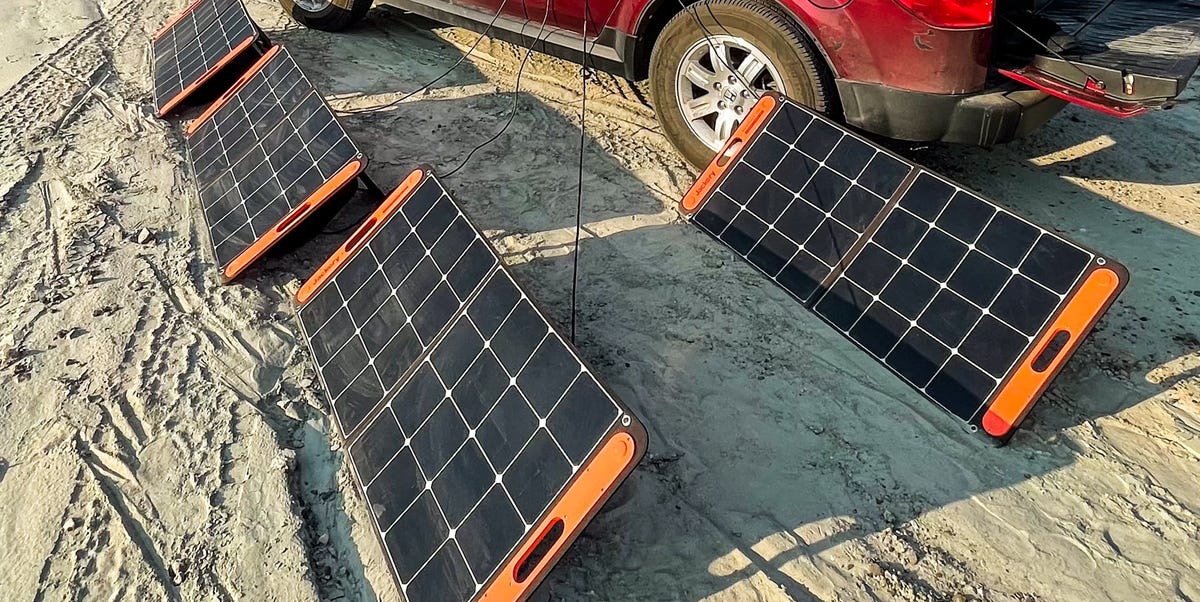
ProsGreat wattage to portability ratioLightweightDurable and weather resistant ConsNeeds adapter for power stations without MC4 inputsBluetti has emerged as a leader in the portable solar game thanks to its durable, effective gear, and its 200W solar panel hits a sweet spot between portability, durability, and performance.It’s about as lightweight and portable as a 200W panel can get. It packs down to roughly 2 feet square, which is easy to pack and carry. At the same time, its 23.4 percent efficiency rating is among the best you’ll find for a panel this size.In terms of toughness, I’ve put one through a ton of mistreatment—I really cannot overstate how rough I am with my gear—and can report that it is as durable as they come. I’ve crushed it in storage, tossed it around a campsite, and left it out through a downpour: It still works just fine.For most solar power seekers, the Bluetti 200W is a great building block for any solar generator, whether you use a single panel to draw a modest amount of power or chain two to three together to power a more robust setup.Key SpecsWattage200WEfficiency23.4%Dimensions (Open)89.2 x 23.2 x 1 in.Dimensions (Packed)23.2 x 23.2 x 1.5 in.Weight16.1 lbsProsDurable constructionExceptionally lightweightBifacial design for increased efficiencyConsMore than one needed for larger power stationsJackery’s 100-watt bifacial SolarSaga panel is lightweight and thin, making it easy to pack and carry. Its 23 percent efficiency is above average, so you’re getting more energy during quick bursts of sun on a cloudy day. The panel also features a bifacial design, so it can absorb both direct sun and light reflected off the ground behind it. Plus, SolarSaga is arguably the most durable panel I’ve tested. I have a set that I have flung like frisbees, and it’s no worse for wear.My only gripe is really a general issue with 100-watt panels. The SolarSaga 100W can absorb enough energy to provide a small amount of steady power, but the panel is roughly the same size as Jackery’s SolarSaga 200W panel. (Of course, the 200W costs nearly twice as much, so there’s plenty of reason to go small if you don’t need much power.) As with the Bluetti, though, the option to expand your generator with multiple panels makes the SolarSaga 100W a viable component of any size solar generator–just be prepared to buy a couple if you need more juice.Key SpecsWattage100WEfficiency25%Dimensions (Open)65.67 × 16.65 × 0.67 inDimensions (Packed)17.05 × 16.65 × 1.85 inWeight7.05 lbsAdvertisement - Continue Reading BelowTypically priced under $300, the BougeRV Arch is an affordable 200W panel with a flexible design that snaps onto the curved tops of vans, boats, and other vehicles. (Though you can set it up anywhere).It’s lightweight, thin, and durable, with an anti-scratch surface that protects it from damage from passing branches, cleaning brushes, and other threats. At the same time, its 23 percent efficiency rate is comparable to my other recommendations, but high for a flexible panel.While it’s technically designed for rooftop installation, it packs easily whether flat or rolled and can be set out in the sun like any other portable panel, though it lacks legs for standing and angling. Versatile, durable, and decently high-wattage, it’s a highly versatile pick and budget-friendly to boot.Key SpecsEfficiency25%Dimensions (Open)52.95 x 30.91 x 0.1 inDimensions (Packed)N/AWeight8.82 lbsProsExcellent wattage to size ratioEfficientDurableConsNeeds adapter for power stations without MC4 inputsThis more powerful, 350-watt version of my top recommendation is wider and a bit more cumbersome to carry and store, but that’s a fine trade-off if you’re using it to power a converted van or RV. As with the 200W panel, it offers an excellent 23.4 percent efficiency rate, and a 350-watt max charge rate can sustain a light to medium solar setup on its own. It’s also quite durable for a large panel, so it can roll with the punches while living on your vehicle’s roof.Of course, “less portable” doesn’t mean “non-portable,” though. At 32 pounds, it’s still light enough to move around a campsite or adjust outside your home. And it folds down to a size that isn’t that much larger than the 200W panel, so it is fairly easy to store. (Pro tip for RVers and van campers: I found that a great place to keep mine was beneath the mattress in my camper bulkhead.)Key SpecsWattage350WEfficiency23.4%Dimensions (Open)110.6 x 30.9 x 1 in.Dimensions (Packed)30.9 x 29.3 x 2.5 in.Weight32.4 lbAdvertisement - Continue Reading BelowProsBifacial designOutstanding efficiency translates into outstanding reliabilityIntegrated solar angle guide helps optimize positioningI was already a big fan of the EcoFlow 220W solar panel, but the brand’s redesigned NextGen version is an appreciable leap forward. Its bifacial design gathers more sunlight and increases efficiency to 25 percent, up 23 percent from the previous version: I found that it works especially well on terrain that can reflect light, like sand.The previous model relied on an attachable stand, but NextGen has built-in stands and is significantly easier to deploy. It also features an integrated solar angle guide that helps you find the best possible position. Meanwhile, the panel is lighter and more portable than its predecessor.My one gripe is fairly technical: I wish it had 8mm rather than photovoltaic connectors, which are increasingly common in solar generators. That's a small nitpick, though, and it may or may not matter depending on what power station you’re using.Key SpecsWattage220WEfficiency25%Dimensions (Open)83.2 x 24.2 x 1.0 in.Dimensions (Packed)24.2 x 23.2 x 1.3 in.Weight15.4 lbProsBriefcase design allows for easy setupGood performance in overcast conditionsProtective case prevents scratches while storedConsSubpar watt-per-dollar valueI’ve watched enough of my camping neighbors struggle with setting up solar panels to know that a good, intuitive setup process can make a big difference for a lot of people. Goal Zero’s Boulder 200 Briefcase gobbles up sunlight, but its easy-to-use design is what really shines. As the name suggests, it features a briefcase-style design with a sturdy top handle for easy carrying when folded, plus a hard exterior shell that protects the panels between uses.When you set it up, the Boulder 200's latching kickstand legs snap into place, slip far less than other panels, and keep the setup from tipping in the wind. When you’re ready to pack it up, magnetized corners hold everything together so it won’t open while you’re carrying it.While some panels slow to a trickle under cloud cover, the Boulder 200 provides a steady flow of power. With a max capacity of up to 200 watts, you’re getting a lot of power for each deployment. If you want to cut down on camp setup, the Boulder’s snap-in-place legs are hard to beat.Key SpecsWattage200WEfficiencyN/ADimensions (Open)40 x 26.75 x 3.5 inDimensions (Packed)40 x 53.5 x 1.75 inWeight42 lbsAdvertisement - Continue Reading BelowProsAbsorbs a lot of energyDurably builtShoulder strap for easy carryingConsLarge and cumbersome to moveIf your solar generator needs to provide a steady stream of power for a hungry campsite or home, you’ll need larger, high-wattage panels that can absorb enough energy to keep the lights on. For maximum potential, I think EcoFlow’s 400W panel is the best high-wattage option that still feels genuinely portable.The EcoFlow 400W can churn out plenty of power in a surprisingly mobile package, though its 35-pound weight is a bit hefty and cumbersome to move and set up. A grip handle helps with portability, eyelets around the rim let you hang it or tie it in place, and the whole thing is plenty durable. Its efficiency is a few tenths of a percentage point lower than the rest of this list, but it’s still decently efficient. With one of these in good sunlight, you’ll have lots of power flowing. Double it up, and you can max out the charging speed on most power stations.Key SpecsWattage400WEfficiency22.6%Dimensions (Open)93.1 x 41.7 x 1 in.Dimensions (Packed)24.4 x 41.7 x 1.3 in.Weight35.3 lbNick Hilden is a writer, globetrotter, and jack-of-many-talents who has written gear reviews for the likes of Runner’s World, Popular Science, Men’s Health, Thrillist, the Daily Beast, the Los Angeles Times, Greatist, and the Manual, and his lifestyle, culture, and tech writing has also appeared in Scientific American, Afar, Salon, Vice, Healthline, and many others. Before entering journalism some 15 years ago, he worked as a bartender, brewery manager, sound engineer, recording and touring musician, cook, teacher, and in a variety of other trades. These days, he lives all over the world, performs music sporadically, and spends a lot of time thinking how to best improve his Honda Element conversion.
The 6 Best Portable Solar Panels for Renewable Power Anywhere
Full Article
Original Source
Read the full article at Popularmechanics →KhanList aggregates and links to publicly available news content. We do not host full articles from third-party sources. Always verify important information with original sources.