
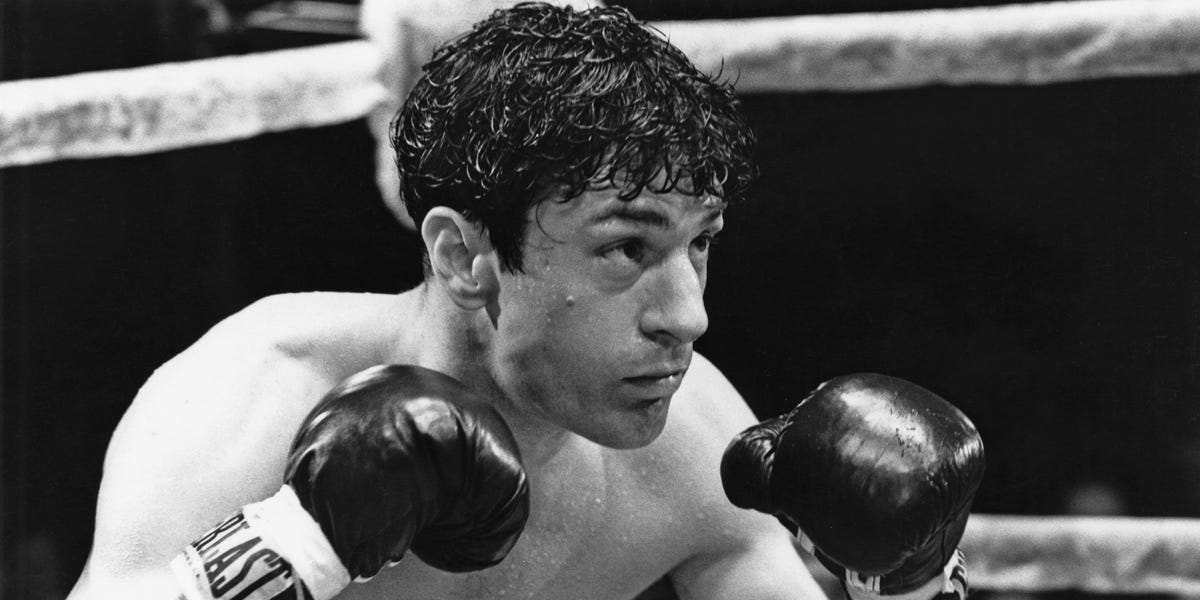
25 min readIf Esquire’s list of the greatest sports movies of all time was accompanied by a training montage, it’d look something like this: the entertainment editors hunkered down at home, night after night, watching (and rewatching) our way through the great canon of this beloved genre. Caddyshack, still a blast. Talladega Nights, again? Twist my arm. A first watch of Breaking Away, a blind spot no more. Remember the Titans, for probably the seventeenth time.Smash cut to us fighting about which films were truly worthy of our final top fifty. A long debate about whether or not The Color of Money is actually better than The Hustler. An editor’s brilliant suggestion that The Fast & the Furious: Tokyo Drift is actually a sports movie. A mutual decision to cut Friday Night Lights because, really, does it deserve to be here if the TV show is the one we remember most?Final shot: the writing. Writing. Writing. Writing.Now, this is the part where you take it all in, rewatch one (or four) of your favorites, decide what you agree with, what you simply cannot stand for, and let us know about it. Let’s walk through the tunnel together, shall we? These are the best fifty sports movies of all time.—Brady Langmann50. The Longest Yard (1974)Burt Reynolds stars in The Longest Yard as the incarcerated former quarterback, Paul "Wrecking" Crewe, who was kicked out of the NFL after admitting to point shaving. While in prison, he convinces the football-obsessed warden to let the inmates play a game of football against the guards, even though the seemingly harmless activity only exacerbates the power dynamic between them. But unlike most underdog sports stories, The Longest Yard’s setting pushes themes of reclaiming your self-worth in the face of a cruel, authoritarian system much more than its competition. —Josh Rosenberg49. The Pride of the Yankees (1942)The Pride of the Yankees arguably did more for the legacy of its star, Gary Cooper, than its subject, baseball legend Lou Gehrig, but it was 1942 for goodness’ sake. The film was rushed into production and premiered in theaters just a little over a year after the New York Yankees player died from a rare disease that would later be named after him. And if it wasn’t for Cooper’s incredibly earnest portrayal, the conventional biopic likely wouldn’t have had the same effect—even with recency bias and Babe Ruth playing himself. But twenty bucks says you can’t watch Cooper give Gehrig’s real-life farewell speech at the end of the film without shedding a tear. —J.R.48. The Fast & the Furious: Tokyo Drift (2006)The first time the Fast & Furious franchise swerved from street races and highway heists came in the standalone 2006 sequel, Tokyo Drift—the first helmed by Fast Saga mainstay Justin Lin. Set in the world of Japanese drift racing (originated by motorcyclist Kunimitsu Takahashi and mastered by “Drift King” Keiichi Tsuchiya), troubled American teenager Sean (Lucas Black) moves to Japan to live with his father, where he gets caught up in the motorsport’s resurgent scene. Basically The Karate Kid on wheels, The Fast & the Furious: Tokyo Drift is about the only time these movies proved it didn’t need Vin Diesel and barbecues to be a thrill. —Eric Francisco47. Invictus (2009)We know what you’re thinking: Clint Eastwood’s Million Dollar Baby exists. But allow us to make a case for his 2009 drama Invictus. Set in 1995, after apartheid, Invictus shows how the Springboks national rugby team—led by Francois Pienaar, played by Matt Damon—united South Africa through their victory (spoilers?) at the 1995 Rugby World Cup. One of their biggest motivators was Nelson Mandela (Morgan Freeman), whose democratically elected presidency was equally symbolic of South Africa’s journey to reconciliation. Where Million Dollar Baby was a deeply personal (and harrowing) tale of one woman in the boxing ring, Invictus is about an entire nation in desperate need of something to believe in. —E.F.46. The Big Lebowski (1998)The Big Lebowski is a bowling movie. You might not think about that right away, especially since the Joel and Ethan Coen comedy starring Jeff Bridges starts with a California slacker who’s simply on the search for his missing rug. But amid all the crime capers and accidental kidnapping plots, the heart of The Big Lebowski is a film about a group of guys—including John Goodman and Steve Buscemi, a.k.a. the dream blunt-rotation bowling team—who just want to take down rival bowler Jesus Quintana (John Turturro). If Hollywood ever makes a traditional bowling movie as good as The Big Lebowski, you can bet that it will still be compared to The Dude every step of the way. —J.R.45. The Mighty Ducks (1992)How many sports movies actually created a team? Only The Mighty Ducks. In the original that started it all, Emilio Estevez stars as a hotshot lawyer whose community service leads him to coach a ragtag youth hockey team. During his state-mandated service, he rediscovers his lost love for the ice. There have been sequels and even a two-season Disney+ revival series—and Disney’s brief ownership of a real franchise, the Anaheim Ducks, who won the Stanley Cup in 2007—but the first movie is still undefeated. Ducks Never Say Die! —E.F.44. Warrior (2011)In 2011, the MMA business was booming. Tickets were through the roof, the UFC was finding its place on primetime, and new leagues like ONE Championship took off. So it was a good time for Gavin O’Connor to unleash his smashing drama, Warrior. Tom Hardy and Joel Edgerton play two estranged brothers whose entry in a mixed martial arts tournament forces them to confront their fractured relationship. Warrior hits hardest where it counts, and functions as an early showcase of Tom Hardy’s brawny charisma. —E.F.43. Rollerball (1975)I’m not one of those sickos who wishes that rollerball was a real sport, but that doesn’t mean I don’t enjoy watching it. Especially when, in the dystopian world of the fictitious sport—which combines roller derby, handball, biking, and outright bloodthirst—James Caan is the GOAT. The ‘70s cult classic earns its spot in our rankings not because of the rollerball action (which is thrillingly directed by Norman Jewison), or its retro-futuristic set design, but because of its prescient vision of a sports league that is shrouded in rich, manipulative C-suiters and a controlling body that, well, only wants to control. —B.L.42. Kill the Umpire (1950)Nobody respects the referee. And why should they? They’re always slowing down the game and making terrible calls. I mean, are they blind, dumb, or both, you know what I’m saying? Well, when fanatical baseball fan (and umpire hater) Bill Johnson (William Bendix) is forced to go to umpire school after losing his job in this silly 1950s comedy, we all learn a thing or two about why the game actually needs an impartial bystander who keeps the game clean. Even if he can’t seem to see the damn ball. —J.R.41. Victory (1981)Is the John Huston movie where Sylvester Stallone and Michael Caine play POWs at a German camp who form a soccer team, play said Nazis in soccer, and escape at the end of the game extremely cheesy? Yes, it absolutely is. But is it ... also sort of amazing to watch Stallone earnestly play goalie, Caine direct his squad like a seasoned Premier League manager, and Pelé—yes, Pelé is in this film—deke up some Bambi-legged Nazis? Also yes. I won’t spoil the method in which Pelé scores a goal, but it’s so stupidly fun that it solidified Victory’s place on this list. —B.L.40. Tin Cup (1996)Want a sports-movie take that has earned me some flak around the Esquire office? Of the two Ron Shelton-directed, Kevin Costner-starring sports movies—Tin Cup and Bull Durham, of course—I much prefer Tin Cup. The golf comedy has it all: a perfectly sleazy Costner performance, the sly intellectualism of Bull Durham, a pitch-perfect Tex-Mex backdrop, a Cheech Marin-played caddy, and, most importantly, a Jim Nantz cameo. Its premise, which sees a problematic ex-pro take another shot at the PGA Tour, has more influence than you’d think; look no further than Owen Wilson’s Apple TV comedy Stick, which plays like a loving homage to Tin Cup, right down to the shaggy Winnebago. —B.L.39. Dodgeball: A True Underdog Story (2004)Dodgeball is, without question, one of the stupidest movies ever made. Even among the Anchormans and American Pies of the late nineties/early 2000s, this sports comedy starring Vince Vaughn and Ben Stiller about a group of average Joes who compete in a dodgeball tournament to save their gym from being taken over by a fat-shaming, corporate fitness giant has no business being packed to the gills with so many memorably hilarious lines. I wish we had a hundred more movies where Stiller is the antagonist, because his fitness freak White Goodman is one of the funniest villains of all time. Dodgeball even inspired ESPN to actually air bizarre sports on its fictional spinoff channel ESPN 8 “The Ocho,” and I can’t say any other sports comedies ever had that much of an impact on the real world. —J.R.38. The Way Back (2020)When I saw The Way Back, which stars Ben Affleck as a struggling alcoholic who is asked to return to his high school to coach its basketball team, I immediately felt like it was one of the greatest sports movies ever made. That was at a press screening in March 2020—you can see where I’m going with this. The pandemic washed out what should’ve been a genuine moment for Affleck and the film, because The Way Back is a stunning character portrait with one of the boldest endings in all of sports cinema. I said this to its writer, Task creator Brad Ingelsby, around this time last year. “I think it's one of the best performances Ben's ever given,” Ingelsby told me. “I really believe that.” That makes two of us. —B.L.37. Breaking Away (1979)Breaking Away might just be the most underappreciated film on this list. How underappreciated? Well, all three of us hadn’t seen it until longtime Esquire research editor Kevin McDonnell alerted us to its greatness. And damn, was he right. On the surface, Breaking Away is a classic midwestern coming-of-age dramedy: Four teenagers (played by Dennis Christopher, Dennis Quaid, Daniel Stern, and Jackie Earle Haley) clumsily figure out post-high-school life amidst the class wars of Bloomington, Indiana. But Breaking Away’s Oscar-winning screenplay—which layers a climactic cycling competition on top of it all—is so damn smart, funny, and full of teenage heartache that you’ll wish Hollywood made more like it nowadays. Or, at the very least, more high-stakes biking movies. —B.L.36. I, Tonya (2017)After The Wolf of Wall Street and Suicide Squad, Margot Robbie became Hollywood’s new it girl. But her Oscar-nominated performance as controversial skater Tonya Harding in the 2017 crime biopic I, Tonya, cemented her prestige status. The movie is based on the life of Harding, her contentious relationship with her mother (played by Allison Janney), and her connections to the infamous 1994 assault on rival Nancy Kerrigan. Robbie pulls out all the stops for a 10/10/10 performance, with an extreme focus on ice skating as a tougher, dirtier sport than the bedazzled outfits imply. —E.F.35. Cool Runnings (1993)Cool Runnings isn’t just a joke. As funny as a Jamaican bobsleigh team is—and was when the real-life team debuted at the 1988 Winter Olympics—Canadian actor John Candy (Planes, Trains and Automobiles) wouldn’t star in a comedy film in the nineties coaching a ridiculous sports team unless it also had some heart. Luckily, Cool Runnings has loads of it. The good-natured comedy for the whole family was a smash crowd pleaser. It took the focus off the Olympics’ superhuman competitors and proved that anything was attainable with the right camaraderie. —J.R.34. The Iron Claw (2023)Mention the Von Erichs to anyone of a certain age from Texas, and they’ll tell you how important they were to the community—and how cursed they might have all been. Based on true events, Sean Durkin’s musclebound tragedy follows the rise and demise of the Texas wrestling dynasty, the Von Erichs. As the owners and stars of World Class Championship Wrestling, the Von Erichs were on their way to immortality until a series of events tore them apart. Though The Iron Claw is packed with body slams and sweat, its story about the strength of brotherhood in the face of tyrannical masculinity makes it a transcendent tear-jerker. —E.F.33. Bring It On (2000)It’s to be expected for sports movies to be about dirty, dehydrated athletes. But only Bring It On dared to fix its cameras on the cheerleaders. An early 2000s classic and a cable TV staple, the movie follows the rivalry between an affluent suburban cheerleading team (led by Kirsten Dunst) and an inner-city Los Angeles squad (led by Gabrielle Union). After Dunst’s character learns her team’s dynamite routine was stolen from the East Compton Clovers, she works to come up with a new idea from scratch before a national competition. Don’t let the high-pitched cheers and pearly white teeth fool you; Bring It On is an honest-to-goodness examination of cultural appropriation and the class and cultural divisions even amongst American youth. —E.F.32. Marty Supreme (2025)Timothée Chalamet, who has a debilitating fear of heights, stood atop the Las Vegas Sphere to promote Marty Supreme. While the man went home from the Oscars without a statue, he still left behind one of the best, unlikeliest sports movies in recent memory. Set in 1952, Marty Supreme stars Chalamet as an ambitious hustler with a silver tongue (and orange balls) who is dead set on serving as America’s emissary in the most exciting sport of the postwar era: ping pong. Essentially Uncut Gems in pleated pants, Marty Supreme isn’t actually about table tennis, but about the hustle, and whether it’s in your favor or not, you have to respect it. —E.F.31. Rounders (1998)I’m a sucker for Rounders. The 1998 indie gem starring a cooler-than-all-of-us Matt Damon and a peaking Ed Norton as poker sharks is still a brilliant watch. And I’d be remiss if I didn’t mention the ace up Rounders’s sleeve: A terrifying villain in John Malkovich’s Teddy KGB (the name still gets me), who you genuinely believe would drain the life savings of a guy like Damon’s Mike McDermott and not give a single shit about it. Give Rounders a watch today, and it’s hard not to feel how visionary it was in showing how young men’s lives are hooked, warped, and ruined by the allure of gambling. Remake Rounders today and McDermott might just have DraftKings and FanDuel as the most-used apps on his phone. —B.L.30. The Karate Kid (1984)The Karate Kid is one of the main reasons why I took up martial arts as a child (along with Power Rangers), and I imagine it was much the same for most nineties kids. Not just because Daniel LaRusso (Ralph Macchio) and Rocky director John G. Avildsen replicated Stallone’s underdog magic for teenagers, but because the film helped create one of the best spiritual mentors of all time in the late Pat Morita’s Mr. Miyagi. There are few training methods as iconic as “wax on, wax off” and few villainous plans more menacing than “sweep the leg, Johnny.” But if you master the former, and avoid the latter, you just might learn what martial arts are really about. —J.R.29. Space Jam (1996)How Warner Bros. ever convinced basketball phenom Michael Jordan to star in this half-animated/half-live-action Looney Tunes basketball movie is beyond me. Because, if I’m Michael Jordan, you show me any storyboard frame from this film during pre-production and I’m bolting for the door faster than the Road Runner. But I’m beyond grateful that the basketball GOAT saw the vision behind Space Jam, because it’s unbelievable how this film wasn’t just an achievement in animation but also one of the greatest sports movies of all time. Really think about that for a second. One of the most celebrated, family-friendly sports movies of all time stars Michael Jordan and Bugs Bunny. Who could have seen that coming? —J.R.28. Bloodsport (1988)Kumite! Kumite! Kumite! The movie that cemented Jean-Claude Van Damme’s status as the coolest ass-kicker of the 1980s, Bloodsport is still a good time even if it can’t shed its beefcake cheese. It is based on the very tall tales (read: bullshit) of Frank Dux, who claimed to be a U.S. Marine and ninjutsu master who won a secret underground tournament in Hong Kong. Whatever. Bloodsport still rocks as an exhibition of JCVD at his prime. It is The Karate Kid for dudes cracking open mini-fridge beers, and it’s awesome. Fun fact: The original Mortal Kombat started out as a pitch for a Van Damme arcade game due to the success of Bloodsport. —E.F.27. Slap Shot (1977)There are plenty of movies like Slap Shot in the sports-movie oeuvre: a great athlete, nearing the end of his time in the game, undergoes an existential crisis that somehow turns into one last great winning run. It’s just that Paul Newman did it best in Slap Shot. The 1977 comedy, which follows a mess of a hockey team that turns to outright violence to win games and boost fan interest (however morbid) is still an absolute blast to watch, especially when those damn Hanson brothers drop their gloves. Heated Rivalry could never! —B.L.26. Love & Basketball (2000)The WNBA was in its infancy when Gina Prince-Bythewood’s Love & Basketball hit the court. Sanaa Lathan stars as Monica, a girl with hoop dreams who grows up next door to Quincy (Omar Epps), the son of an NBA baller. As they grow up as childhood best friends before becoming lovers in college, Monica and Quincy eventually learn to square their relationship with their professional aspirations. In most sports movies, romance is a subplot for the main character. Here, love is the very name of the game. And it’s a slam dunk. —E.F.25. Major League (1989)You can think of Major League as a funnier, better Ted Lasso set in the world of professional baseball (and the Hannah Waddingham analogue an actual villain). Tom Berenger, Charlie Sheen, Wesley Snipes, and more fill out the roster of the Cleveland Indians. After a vindictive new owner (Margaret Whitton) buys the team and prepares a move to Miami, the players spend their final season dramatically improving their game just out of spite. Everything comes down to a climactic division playoff game against the one and only New York Yankees. It’s a cliché to call Major League a “home run” or whatever, so instead I’ll just say it has nice velocity. —E.F.24. The Hustler (1961)In my book, The Hustler is the greater billiards film over its legacy sequel, The Color of Money. (Sadly, I was overruled.) Sure, the latter has Tom Cruise. But the original black-and-white Paul Newman film better captures the stress of betting on pool, swathed in the smoke of cigars and just the right blood-alcohol level to concentrate without second-guessing yourself. Throw in George C. Scott as a professional gambler and Jackie Gleason as pool shark Minnesota Fats, and you have one of the most star-studded and high-stakes films of the sixties—all over the act of poking some billiard balls into table pockets. —J.R.23. Challengers (2024)Never before has tennis been so exhilarating—and, we’ll say it, titillating. Luca Guadagnino’s meme machine of 2024, Challengers, raised the bar as an erotic sports drama about two former best friends (Josh O’Connor and Mike Faist) torn apart over a beautiful tennis ace (Zendaya). During their tense reunion at a rinky-dink tournament, they compete to settle things once and for all. Between Guadagnino’s dizzying camera and the dynamic duo of Trent Reznor and Atticus Ross going beast mode on the soundtrack, Challengers had us all spending one summer bringing our situationships to the theater. It was a weird summer, admittedly. —E.F.22. The Sandlot (1993)Who can forget the Beast, or Wendy Peffercorn, or those long summer nights playing ball under glittering fireworks? The Sandlot is the ultimate love letter to adolescent, Americana-flavored nostalgia, where boyhood friendships are forged in the cauldron of baseball. Set in 1962 in the San Fernando Valley, new kid Smalls (Tom Guiry) joins with other neighborhood kids who occupy an empty sandlot for their own baseball games. Over a long and fateful summer, Smalls makes memories that will last a lifetime. But he’ll always be a square—the kid’s a square! —E.F.21. Rudy (1993)If the word “manifesting” could be defined by any movie, it’s Rudy. Sean Astin stars as real-life former Notre Dame Fighting Irish football player Daniel “Rudy” Ruettiger, a young man with learning disabilities whose dreams of playing football for the University of Notre Dame seem out of reach. Somehow, Rudy gets his opportunity—but only after incredible amounts of patience, perseverance, and resolve in the face of those who want to bring you down. Next to Rocky, Rudy is one of the greatest underdog sports dramas ever made, one that can inspire just about anyone to get off the couch and make their own dreams a reality. —E.F.20. Chariots of Fire (1981)Chariots of Fire is the most serious capital-F film on this list. The British historical drama was nominated for seven awards at the 1982 Academy Awards, winning Best Picture, Best Screenplay, Best Costume Design, and Best Score for its portrayal of two real-life track stars, Harold Abrahams and Eric Liddell (one Jewish, the other a Scottish Christian), who overcame prejudice to compete for their country in the 1924 Olympic Games. Vangelis’s score, and the scene of the track team running on the beach in slow motion, remain Chariots’ lasting impact forty years later. But don’t let modern pastiches and parodies of the film sour the original’s legacy. Chariots of Fire is as much a fascinating picture of England in between the world wars as it is one of the most inspiring sports films of all time. —J.R.19. The Bad News Bears (1976)W.C. Fields once said that his one piece of advice for show business was to “never work with children or animals.” Years later, Kelsey Grammer said a similar thing when he agreed to star in the Cheers spinoff, Frasier: “No kids, no dogs, and no wives.” But if Walter Matthau followed that rule, we would have never arrived at The Bad News Bears—a heartwarming family comedy about a beer-slugging Little League baseball coach and his ragtag group of kids who have no idea why their parents force them to play baseball over the summer. But just maybe, this oddball group of losers can help us all remember that everyone deserves to enjoy the great American game regardless of which team runs around the bases more than the other. —J.R.18. Talladega Nights (2006)If Talladega Nights isn’t the most quotable film of all time (“Dear 8 pounds 6 ounces newborn infant Jesus, don't even know a word yet...”) it’s at least the most quotable sports movie of all time. (One more: “Chip, I'm all jacked up on Mountain Dew!”) One of Will Ferrell and Adam McKay’s greatest collaborations during their undefeated run in the aughts, the epic NASCAR spoof—which pits drivers played by Ferrell, John C. Reilly, and Sacha Baron Cohen in a gasoline-slicked competitive love-hate triangle—is a riot twenty(!) years later. Why has Talladega Nights stood the test of time? You could say it’s all thanks to Ferrell and McKay’s sharply written, gag-stuffed script—complete with an iconic Applebee’s scene. Or even the racing scenes themselves, which are downright thrilling. (Watching Ricky and Cal pull the slingshot move still gets me.) But it’s the tour de force comedic turns by leading men Ferrell, Reilly, and Cohen that make Talladega Nights a film that’ll hold this spot for another two decades more. —B.L.17. Ford v Ferrari (2019)Here’s what Ford v Ferrari is about on the surface: Matt Damon plays real-life auto designer Carroll Shelby who, along with Christian Bale as English racer Ken Miles, is hired by Ford to beat the dominant Ferrari at the legendary 24 Hours of Le Mans in 1966. While Ford is in it to boost car sales, Shelby and Miles are in it to win it, to prove American muscle has what it takes to compete on the world stage. But here’s what James Mangold’s 2019 masterpiece is really about: Can art survive under commerce? Look under the hood, past the gears and the minutiae of automotive design, and what you have are artists trying to exercise brilliance under breakneck pressure. Between that and its abundance of menswear inspo, Ford v Ferrari isn’t just one of the best sports movies or racing movies—it is hands-down one of the best movies, period. —E.F.16. A League of Their Own (1992)There is no crying in baseball, but there’s so much more too. Primarily set during World War II, when professional baseball players served abroad, an all-women’s league begins to satisfy a baseball-starved public. The movie follows the Rockford Peaches—coached by drunk, acerbic Jimmy Dugan (Tom Hanks)—who become one of the most popular teams in the beautiful but short lifespan of the All-American Girls Professional Baseball League. Geena Davis stars as the Peaches’ best player, whose relationship with her sister (Lori Petty) serves as the movie’s main emotional engine. A wholesome ode to sisterhood, to baseball, and to knowing the good ol’ days when you’re in them, A League of Their Own is truly in a league of its own. The 2022 Prime Video revival series, which ran for a single season, is also worth checking out. —E.F.15. Bull Durham (1988)Released just one year before Field of Dreams, Kevin Costner stars in Bull Durham as “Crash” Davis, a veteran baseball catcher brought in to coach a hotshot minor league pitching prospect (Tim Robbins) with a “million dollar arm, but a five cent head.” Unlike Field, Angels in the Outfield, or any of the God-meets-baseball sports movie canon, Bull Durham establishes right away that baseball might be like a religion, but it’s also like sex. So, as Costner works on the brash rookie in the dugout, baseball groupie Annie (Susan Sarandon) finds success taming the bull in the bedroom. “The stadiums are like cathedrals,” Costner tells the team. “The hotels all have room service, and the women all have long legs and brains.” It may not be a conventional baseball film, nor a traditional rom-com, but Bull Durham is all about the mind games that get in the way of great play. And, of course, Sarandon’s undeniable sex appeal. —J.R.14. Happy Gilmore (1996)Happy Gilmore is a living, breathing embodiment of everything that makes Adam Sandler great. The golf comedy is packed with heart, still-funny one-liners (“The price is wrong, bitch!”), and slapstick shenanigans that only the Sandman could pull off. Add a wonderfully sincere Carl Weathers performance, a pitch-perfect cartoon-villain turn from Christopher McDonald, and a still-great Bob Barker cameo and you have a generational comedy. Plus, the golf is still so believably tense that you’ll still second-guess every one of Happy’s putts on a rewatch. And I dare you to listen to Lynyrd Skynyrd’s “Tuesday’s Gone” and not get the chills. —B.L.13. Creed (2015)No living director understands the anatomy of a sports movie better than Ryan Coogler. (So much so that, selfishly, I wish he would make more, but that would mean Black Panther and Sinners wouldn’t exist.) You can see it in every single minute of Creed, which smartly recasts Sylvester Stallone’s Rocky Balboa as the wizened, ailing mentor to an upstart boxer played by Michael B. Jordan. Creed immediately established three things: 1/ Coogler and Jordan are the Scorsese and De Niro of our generation, 2/ Coogler wasn’t content to simply run back Rocky and rake in a modest box-office return, and 3/ Good lord, can this man craft a training montage that will make you immediately sign up for boxing lessons. You might not find a more thrilling five minutes than the “Lord Knows/Fighting Stronger” sequence, which sees Jordan retrace Stallone’s steps while forging his own legacy, in all of sports cinema. —B.L.12. The Natural (1984)There’s an entire subgenre of sports films that tie religion to baseball. Hell, there’s even another film higher up on this list that may deserve the title of best baseball movie ever over The Natural. But the Robert Redford-starring film about a kid from the Midwest who is seemingly chosen by God to inspire people with baseball after lightning strikes a tree on his family farm and he carves a bat from it by hand still lives up to its mythical story. Every impossible home run that Redford’s Roy Hobbs hits in The Natural would be the greatest thing you’ve ever seen happen at a baseball game, made even more iconic by Randy Newman’s Superman (1978)-esque score. —J.R.11. Caddyshack (1980)Few comedies have remained as quotable as Caddyshack over the last four decades. Sure, it helps that the screwball golf film stars a murderers’ row of Chevy Chase, Rodney Dangerfield, Bill Murray, and director Harold Ramis. But even outside of the joy of Dangerfield pulling a boombox out of his golf club bag and exclaiming, “So what? So let's dance!”, or Bill Murray relentlessly playing whack-a-mole with gophers, Caddyshack is a celebration of the good ol’ times—when all a summer blockbuster had to do was make us laugh, and it could. —J.R.10. Jerry Maguire (1996)I’ll say this as many times as Tom Cruise yells “Show me the money!” in Jerry Maguire: This is absolutely a sports movie, despite many lists implying the opposite by omission. Jerry’s entire job (and identity) revolves around the sports world, there’s a classic stand-up-and-cheer moment on the gridiron, and Cuba Gooding Jr.'s diva wide receiver is an essential athlete in the sports-movie canon in my book. Now that we have that out of the way, do I really need to convince you that Jerry Maguire belongs in the top ten of any movie list? (It holds the top spot in our Tom Cruise rankings, by the way.) If you disagree, I guess Jerry is right: "We live in a cynical world. A cynical world. And we work in a business of tough competitors.” —B.L.9. White Men Can’t Jump (1992)Where to start? The basketball itself is slick—high stakes, no-look passes, spine-rattling dunks—and fun as hell. Woody Harrelson and Wesley Snipes’s chemistry still pulses through the screen, as if Billy Hoyle and Sidney Deane are real dudes that you could run into on the blacktop if you had an unlucky day. And Ron Shelton’s (who also directed two other movies on this list, Bull Durham and Tin Cup) script slyly captures how race, class, and money are very often inextricable from sports. Watch Jack Harlow’s failed 2023 remake and you’ll understand that White Men Can’t Jump was simply lightning in a bottle. —B.L.8. Miracle (2004)When Americans needed a miracle, they found it on ice. The legendary “Miracle on Ice”—when the U.S. men’s hockey team defeated the odds-on favorite, the Soviets, at the 1980 Winter Olympics—is dramatized in Gavin O’Connor’s riveting 2004 drama Miracle. Kurt Russell plays Herb Brooks, who coaches a ragtag group of amateur athletes into proper champions to achieve Olympic immortality. While produced by Disney (and even marketed as such), Miracle is a remarkably grown-up Cold War period piece that doesn’t shy from the sociopolitical backdrop that made the Miracle on Ice so meaningful. —E.F.7. The Color of Money (1986)Twenty-five years after The Hustler, Paul Newman reprised the role of “Fast Eddie” Felson for The Color of Money—this time, with Martin Scorsese and a young Tom Cruise in tow. And thank the sports-movie gods he did. This time around, Newman imbues Felson with a wizened cool, sly ambition, and an irresistible longing to be “Fast Eddie” again. Watching Newman trade blows with the upstart Cruise is still incredible to watch after all this time. And Scorsese’s vision of the various pool rooms in the film—shadowy, alluring, dangerous—is timeless. —B.L.6. Hoosiers (1986)There are some states in America where having a major league sports franchise doesn’t mean anything to the people who call it home. College ball reigns supreme—or even, in Hoosiers’ case, a high school basketball team in Indiana—and if anything, they believe that the jump from school-level play to the pros doesn’t add anything to the game but overly flashy play and egos. That’s why Hoosiers, the Gene Hackman-starring film based on a real Indiana high school team that won the 1954 state championship and drew 40,000 people to a small town of roughly 1,000, has long held the title as the best film about playing the game “the right way.” —J.R.5. Moneyball (2011)Most sports movies are about what happens on the field. Rarely are they about what goes on in the back offices. Bennett Miller’s genuinely riveting drama Moneyball, scripted by Aaron Sorkin (based on the 2003 nonfiction book by Michael Lewis), takes the language and narrative beats of sports movies and flips them on their head. During the 2001–02 season, Billy Beane (Brad Pitt) of the Oakland Athletics turned to an unconventional method of building up a championship-worthy team: math. Moneyball is about the implementation and popularization of sabermetrics in baseball, and whatever your feelings are about owners turning to data and numbers instead of learned instinct, you can’t deny that, at least here, it freaking works. —E.F.4. Raging Bull (1980)Even in the realm of sports movies, Martin Scorsese and Robert De Niro deliver a fine American classic. Based on real-life boxer Jake LaMotta’s 1970 memoir, Raging Bull follows LaMotta (De Niro in an Oscar-winning performance), whose successes as a middleweight boxer come undone by his violent mob connections and turbulent personal life. Where movies like Rocky celebrate underdog victories, the elegant yet gruesome Raging Bull—a staple in film schools everywhere—shows that even the highest highs come with terrible lows. Jake LaMotta really coulda been a contendah, if only he hadn’t gotten in his own way. —E.F.3. Remember the Titans (2000)Out of all the movies on this list, Remember the Titans is the one in which—if you encounter it in the wild, whether it’s a cable rerun or on the TV behind the bar on a sleepy Saturday afternoon—you’re absolutely watching it until “Na Na Hey Hey Kiss Him Goodbye” plays at the end. Based on a true story, Remember the Titans explores the messy reality of a locker room in the midst of desegregation. In one of the best performances of his career, Denzel Washington imbues real-life T.C. Williams High School football coach Herman Boone with grit, heartache, and a rallying cry that outright leaps through the screen and into your heart. —B.L.2. Rocky (1976)Rocky is the ultimate underdog story. Not just because a struggling, working-class man goes the distance with world heavyweight champion Apollo Creed. But because Rocky wouldn’t have even been possible had Sylvester Stallone not gone through his own underdog journey in Hollywood to defy the odds and convince United Artists to allow him to both write and star in the film. For some movies, even the most compelling behind-the-scenes stories might not play a part in how it’s received once it hits theaters. Rocky is different. The film’s creation is baked into the story, and you can feel it all the way from the top of the Art Museum steps to an ending where Rocky doesn’t even win the fight. Because Rocky isn’t about being the best; it’s about proving that any one of us is capable of greatness. —J.R.1. Field of Dreams (1989)If you build it, he will come. Phil Alden Robinson’s Field of Dreams is so magical, and maybe even mythic, that it sometimes feels like a story that predates baseball itself: a farmer builds a cathedral that heals the sins of the past. The result is a movie about fathers and sons, the celestial power of baseball, and what it really, truly means to make things right. Yes, Field of Dreams will make you cry, every single time. Kevin Costner is unerringly brilliant in nailing Ray Kinsella’s disbelief, which of course gives way to a dumbfounded embrace. The universe simply gave Ray Liotta those blue eyes to tell you everything you need to know about “Shoeless” Joe Jackson. James Earl Jones, if you had any doubt, is ethereal. Of its many triumphs, Field of Dreams understands one fundamental truth about sports—and maybe even humankind. It’s this: there are few greater acts of love in this world than playing catch with dad. —B.L.
The 50 Best Sports Movies of All Time
Full Article
Original Source
Read the full article at Esquire →KhanList aggregates and links to publicly available news content. We do not host full articles from third-party sources. Always verify important information with original sources.