
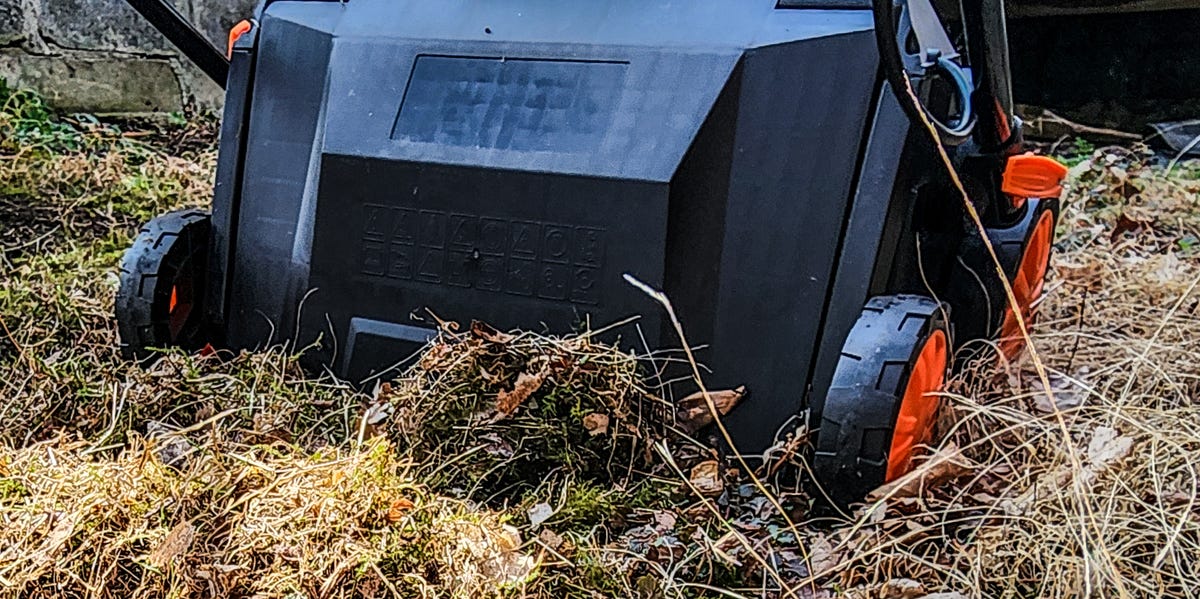
ProsPowerful enough to take on dense thatchComes with scarifying headEasy to push around ConsVery loudCollection bag isn’t very effectiveThe Wen DT1516 is a great dethatching solution for anyone looking for a motorized alternative to the backbreaking chore of manually dethatching a lawn with a rake. With its 16-inch-wide, 24-tine dethatching head, this corded motorized dethatcher is capable of handling dethatching duties for small to medium-sized yards.We were impressed with the Wen’s ability to remove a thick thatch layer with a single pass without bogging down or clogging. At about 34 pounds it’s also fairly easy to push around. We did wish more of those dethatched clippings actually made it into the collection bag. Most ended up collecting around the mouth of the discharge opening. That said, we have yet to test an electric dethatcher with an effective bagging design.Along with its dethatching head, the DT1516 also comes with an additional scarifying head. Making the switch from dethatching head to scarifying head is fairly easy and involves loosening a few bolts with a hex wrench. The scarifier head worked well, aggressively pulling out a dense moss section against the shady north-facing side of our tester’s house.While we like the 15 amps of thatch-ripping power the DT1516 delivers, we weren’t thrilled with how noisily it carried out its job. It was one of the loudest dethatchers we’ve tested, so you’ll want to wear hearing protection when operating this machine. Noisy operation aside, the WEN DT1516 performed its thatch removal duties exceptionally well, making it a great alternative to a manual dethatching rake.Full Wen 16-Inch Electric Dethatcher ReviewProsWide head removes more thatch with each pass Can adjust head angle Cushioned grip on handleConsMulti-piece handle not as stable as single piece handlePaying a lot of money for a piece of yard equipment you may only use once a year or every other year may not make sense, especially if you don't have a big yard. Walensee’s thatch rake is a more affordable alternative to those pricier rakes. Its 17-inch-wide head is broader than that of most dethatching rakes, so you can cover more ground with each pull, though you’ll need to exert more force to do it. As with other dethatching rakes, you can adjust the head to set how deeply it bites into the ground.The steel handle screws together, so you can also adjust its length. While that’s a nice feature, the multi-piece design isn’t quite as sturdy as some of the single-piece solid wooden handle thatch rakes we’ve seen. A soft rubber grip on the handle makes it more comfortable to use than rakes that lack such a feature.Read the Full Review HereAdvertisement - Continue Reading BelowProsAdjustable head for getting that just right angle for dethatchingHeavy duty hardwood handle and stainless steel headCan flip head and use the rake to cultivate soilConsThatch can get caught up on in the tinesIf you have a smaller yard and don’t mind a little physical labor, then True Temper’s manual dethatcher is a good option. Its curved steel tines bite nicely into the earth to pull up thick layers of thatch. Once we identified that just-right angle on the adjustable head, we were able to bring layers of dead grass up to the surface of the lawn while minimizing damage to healthy turf.After making another adjustment to set the blade at a more aggressive angle, we were able to scarify the lawn to remove patches of moss on a north-facing side of the house. We also liked the versatile design of this rake. The opposite side of the tines are flat, so you can flip the rake to cultivate soil.As with other True Temper yard tools we've tested, this one has a sturdy hardwood handle that inspires confidence that it won’t crack when pulling out denser clods of thatch. While True Temper describes this rake as self-cleaning, we still found ourselves having to shake the rake more than a few times to clear the tines. Removing thatch with any dethatching rake is physically demanding, but the design and build quality of True Temper’s dethatching rake makes it a more manageable job.ProsEnough runtime to cover average sized yard in a single chargeFive depth settings you can change on the flyComes with dethatcher and scarifier cylindersConsMore plastic parts than we’d likeIf you have a medium-sized yard that’s too large to rake but isn’t suitable for a corded electric model, consider this cordless dethatcher. It runs off two 24-volt 4.0 Ah batteries and features a 15-inch-wide, 24-tine blade that’s capable of pulling up large amounts of thatch. There are also five depth positions, so you can dial in that just-right height for taking out thatch.The Sun Joe gets about 45 minutes of runtime, which is enough to cover the average quarter-acre yard. It also comes with a collection bag and a 7-blade scarifying cylinder for taking out larger amounts of thatch or moss. Despite carrying two large-capacity batteries, it weighs a very manageable 36 pounds, making it easy to push it around the yard. While the Sun Joe cordless dethatcher has more plastic parts than we’d like, it’s built solid enough to handle the 1 to 2 times a year you’ll need to use it.Advertisement - Continue Reading BelowProsDouble set of tines remove a lot of thatch with each passCovers a broad area with its 4-foot widthSturdy steel construction and never flat wheelsConsLacks controls for adjusting depthIf you’ve got a lot of ground to cover and a riding mower to help you do it, then this Brinly dethatcher is your best option for removing thatch. With its 48-inch width, it can cover a lot of ground with each pass. We also like the fact that it has two rows of tines, so it will remove large bunches of thatch in a single pass. Plus, you can load up to 70 pounds of weight onto the tray, so the tines penetrate deeper into the soil to scarify. The Brinly is durably built with 14-gauge steel construction and two sturdy 8-inch never-flat wheels.With their triple-coiled construction, the tines dig deep into the earth for dethatching or scarifying. We only wish there were controls for adjusting the tine depth. That said, it's a well-built tow-behind dethatcher with the size to handle larger yards, making it a great choice if you have a tractor to tow it and room in the shed or garage to store it.Tony Carrick is a full-time freelance writer who specializes in technology, home improvement, DIY, home security, and outdoor recreation. He’s tested and written about everything from home security systems to power tools to gas grills. His product guides, how-to articles, and feature stories can be found in such publications as Bob Vila, Angi, U.S. News and World Report, Field & Stream, Futurism, and Switchful. When Tony isn’t writing, he can be found working on his latest home improvement effort at his home in North Carolina.Colin Aylesworth attended Binghamton University and is a Deputy Editor with the Gear team at Popular Mechanics and Runner’s World, where he has been since 2022. Prior to joining Hearst Magazines, he worked for 11 years at U.S. News and World Report on the autos team. His personal pursuits fit in well with the work he does for PM and RW. Aylesworth was on his college’s club rowing team and has maintained a routine running habit through most of his adult life as a means of getting exercise and spending time outdoors. Running creates a hearty appetite, which brings us to Popular Mechanics. That publication's expertise in the area of grilling is relatable to Aylesworth, who is an adherent to charcoal grilling. In fact, he’s been primarily using the same Weber charcoal kettle he bought on Craigslist in 2012. Aylesworth also has experience in the lawn mower industry. Not only has he been mowing his and neighbor’s lawns during adolescence, one of his more recent endeavors is a side gig of repairing and restoring gas lawn mowers given up by their previous owners. Since joining PM, he has gotten more involved with the publication’s mower testing efforts and especially enjoys testing out new electric and zero turn mowers.
The 5 Best Lawn Dethatchers Help You Breathe Life Into Your Lawn
Full Article
Original Source
Read the full article at Popularmechanics →KhanList aggregates and links to publicly available news content. We do not host full articles from third-party sources. Always verify important information with original sources.