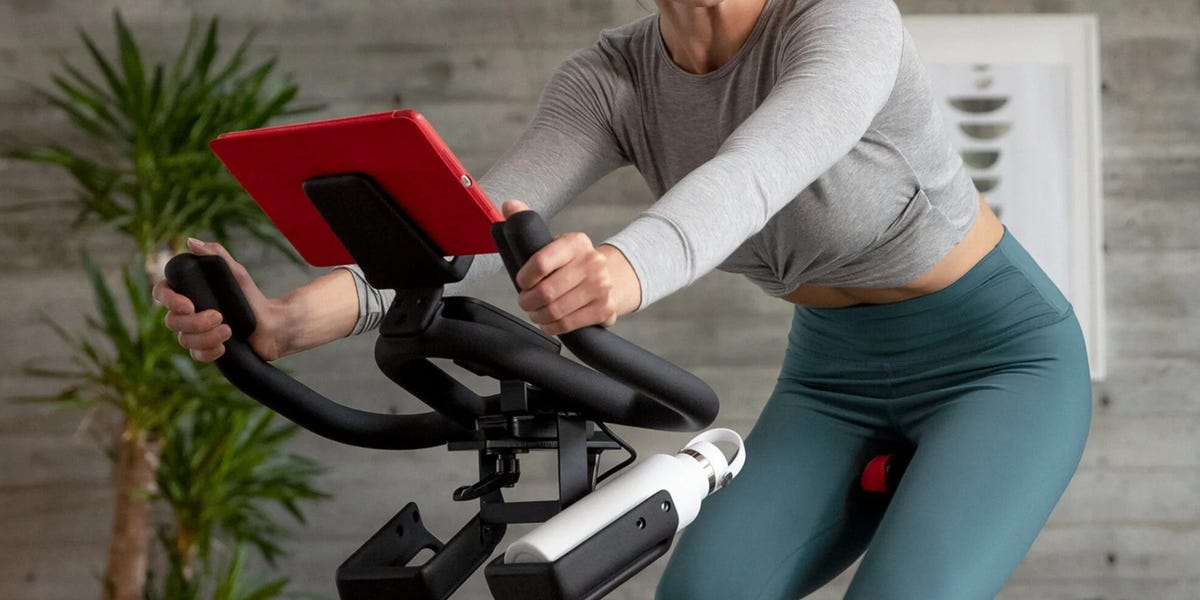
ProsCompatible with third-party appsComes with two-month membership trialConsNo longer has infinite resistance like last model didIn terms of consolidating your workout zone, Schwinn’s IC4 is tops thanks to its relatively small profile, double water bottle holders, and racks for included dumbbells. On top of that, it offers one of the most finely adjustable rides on this list with 100 unique resistance settings. Will you notice the difference between one and another? Maybe not immediately, but it does smooth the transition between speeds if you’re tapering to a different effort level.The bike’s LCD screen isn’t huge, but it nevertheless monitors resistance as well as heart rate, calories, and distance. No need to cycle through a frustrating number of pages to find data you need immediately.Schwinn bundles the IC4 with access to a two-month trial membership to JRNY classes on the house. The collection of workouts you get with these classes isn’t as elaborate at some other subscription services, but two months for free is two months for free—that’s twice as much time as you’ll get with a lot of other brands. Key SpecsResistance Levels100PedalsDual SPD; toe cages and clipsWeight Limit330 lb.Resistance TypeMagneticProsComfortable, adjustable, and sturdyEasy to assemble and maintainConsDisplay only shows one metric at a timeIf you’re looking for a no-frills exercise bike to keep your legs spinning during the off-season, this simple-but-effective Yosuda model offers fantastic value and keeps you churning out miles without a fuss.While this exercise bike lacks a screen, it does have a spacious tablet holder, so you can still follow along with online classes if you have some downloaded. It also has an LCD monitor to track your basic stats, like distance and time, and the seat and handlebar are adjustable.Key SpecsResistance Levels8PedalsAdjustable toe clipsWeight Limit300 lb.Resistance TypeMagneticAdvertisement - Continue Reading BelowProsGreat, comfy rideBright, easy screenGood built-in classesConsAdjustments aren’t as straightforward as they could beI’ve been consistently impressed with Merach for the past year. They are elevating value-priced sports and fitness equipment in a way that’s subverting the market. This bike is no different. It has all the bells and whistles of many of the pricier models, like the big, rotating screen, the streaming capabilities, and the adjustable pedals and seat, but for under $600. That’s a big deal.You won’t get everything a Peloton or NordicTrack will get you, but you’re getting scarily close. The only note I’d make is that I’d like the handlebar adjustment to be a bit less finicky, and for the adjustments to be a little more accessible to people with mobility issues. Other than that, it’s a great rideProsHuge screen that rotatesTop of the line customer serviceGreat instructors and class varietyConsThat price tag. OuchIt's a lot bigger than the originalIt’s pricey, but dang, is it fun. The new Peloton bike feels like a personal trainer, DJ, and motivator in one sleek machine. Its upgraded AI engine learns your habits, adjusting resistance and recommending workouts that suit your pace and goals—whether you’re into high-intensity rides, yoga, strength training, or recovery sessions with your fave trainer (Yo, Adrian!). The rotating HD screen makes it easy to pivot from cycling to floor workouts, blending cardio and strength and whatever else you feel like pulling up that day. You know all about the on-demand classes and live sessions led by trainers from around the world—hoping they’ll read out your name in class. The integration of smart stats and voice-guided coaching adds an intuitive layer that feels almost too human—Skynet what? Sure, it’s an investment, but with AI personalization, endless variety, and pure ride bliss, this Peloton turns your home gym into a high-tech fitness studio that actually keeps you coming back.Features at a GlanceResistance Levels100PedalsDelta-compatible aluminum clip-in pedalsWeight Limit297 lb.Resistance TypeMagneticAdvertisement - Continue Reading BelowProsEasy setupCompact and solidConsTruly a no-frills machineThe Sunny Health & Fitness Resistance Adjustable Bike offers a solid, no-frills workout experience that won’t break the bank. It delivers smooth, quiet rides thanks to a durable 49-pound flywheel and belt drive system. While this bike doesn’t have a screen or fancy smart features, it’s fully mechanical with a simple resistance dial that’s easy to use—even for beginners. Ideal for fans of classic spin-style workouts, it lets users focus on pedaling without distractions. The seat is quite firm and may require a cushion for longer sessions, but the bike’s solid build and stable frame make it feel sturdy and reliable. Overall, it’s a practical choice for those wanting a straightforward, budget-friendly indoor cycling experience.Features at a GlanceResistance Levels16PedalsToe cageWeight Limit300 poundsResistance TypeFelt pad frictionProsHigher bar position and shorter reach may feel more comfortableNot as laid-back as a recumbentConsNo handlebar height adjustabilityMost standard exercise bikes position riders with their torsos tilted forward, which can help engage rear leg muscles like the glutes and hamstrings. Unfortunately, this posture can also feel uncomfortable if you have an achy neck, back, or shoulder.If you don’t want to lean forward or all the way back into a recumbent-style machine, this exercise bike from Schwinn remedies that awkward positioning with a short reach, an elevated handlebar, and a wide seat that can comfortably hold a greater portion of your weight.Key SpecsResistance Levels25PedalsAdjustable toe clipsWeight Limit330 lb.Resistance TypeMagneticAdvertisement - Continue Reading BelowWhat to ConsiderExercise Bikes Versus Recumbent Bikes Versus TrainersYou’ve got a few solid options when it comes to indoor cycling setups. First up, the classic exercise bike. It puts you in that standard riding position—chest over hips, hands on handlebars, knees tucked. This is pretty much the gold standard for most folks, giving you a full range of motion in your legs and feeling a lot like riding a real bike.But hey, that position isn’t for everyone; it can be a real pain in the back. If you’re looking for some extra comfort and support, a recumbent bike might be more your speed. Think cushy seat with a backrest—and a few other subtle perks.Now, if you’re one of those people who loves hitting the road on your own bike when the weather’s nice, you don’t have to switch platforms just because you’re indoors. Grab a bike trainer. This handy little machine hooks right up to your bike’s wheels or drivetrain, letting you ride your trusty steed no matter what the forecast says. Sure, it might feel a little less stable than a dedicated stationary bike, but it’s perfect if you’re obsessed with the fit and feel of your road bike.ResistanceWhen it comes to exercise bikes, resistance is the name of the game, making your workouts tougher and more effective. You’ll primarily encounter two systems: fans and flywheels. Fan bikes are the straightforward choice. Just start pedaling, and the fan blades spin, creating resistance against the air. The catch? The moment you stop pedaling, you lose that momentum, forcing you to start from scratch again, which can feel like an uphill battle. Plus, watch out for anything getting caught in those spinning blades—that’s a potential hazard.For a ride that feels more like an actual bike, the flywheel system is your best bet. These bikes get their resistance from friction or magnets, and thanks to their hefty mass, they maintain momentum. A good flywheel is heavy, packed with inertia, and offers a smooth ride. While they tend to be pricier and might require a pro for repairs, they won’t add a chill to your workout space like fan bikes do by pushing air around.PedalsAside from standard flats, the two most prominent pedal options are toe clips, also known as foot straps, and clipless pedals, which require metal or plastic cleats (you’ll need to buy those separately) to hold your foot on the pedal. This is similar to how a ski boot is held in by its bindings—that’s actually where this tech originated.The name may sound counterintuitive, but clipless pedals were originally introduced as an alternative to toe clips—even though one colloquially “clips into” clipless pedals. Is it confusing? Absolutely. We don’t blame you if you’re scratching your head at that.Semantics aside, both of these pedal styles are superior to flats because they allow you to pull up on your pedals as well, rather than just pushing down or forward. This means you’re providing power through the full rotation on each pedal, which engages more leg muscles.Toe clips give you the freedom to do this in whatever shoes you’d like, whereas clipless pedals require cycling shoes that can fit the same cleat that your pedals require—the most common is a Shimano-style SPD. Many bikes have both fitments—one on each side of the pedal—but it’s worth checking before you buy if you don’t want to invest in cycling shoes.Another point on safety: If your feet are bound to your pedals, you may not be able to catch yourself as easily if your bike tips over. This is a rare occurrence, but one worth acknowledging as a possibility, especially if you want to knock out some intense efforts that include upper body workouts. If this is a concern for you, be sure to ride carefully at first and practice removing your feet quickly.Displays, Accessories, and Digital ContentIndoor workouts, especially for endurance-style sports like cycling, can feel like a drag if you don’t have a display. These can be as simple as a tiny screen that shows you distance, time, or calories burned, or as elaborate as a 22-inch touchscreen that plays videos to keep your experience as immersive as possible.Fancier displays often allow you to load up spin classes and follow-along virtual rides that keep you from focusing on the wall in front of you, but they’re also pricier—and not entirely necessary if you like to entertain yourself in other ways, such as reading a book or throwing something on a nearby TV.If watching a movie on your phone or tablet while you work out keeps you motivated, look for a bike with a large media holder or a display that can connect to streaming services. Think about other small bits of hardware that could benefit your workout in smaller ways, too—for example, if you are constantly sipping water, a bottle holder is a must.Also, consider smart features and compatibility with health apps if you like to sync your workout data with your phone. Several machines on this list come with a companion app that allows you to preset workouts and automatically adjust your resistance to coincide with your intervals. Many also come stocked with spin classes that can accompany you as you churn out some virtual miles.Likewise, some high-end exercise bikes include classes that take you off the bike and direct you through bodyweight, HIIT, yoga, and other low-equipment workouts while you stand nearby. These add-ons, while sometimes pricey, are worth considering if you want to expand your home workout repertoire without investing in a bunch of bulky equipment. Just make sure you have the space around your bike to perform these comfortably before you go all in on a fancy subscription plan.Adam Schram is an Assistant Editor of Commerce at Runner's World, though you might see his byline on Bicycling and Popular Mechanics, too. A lover of all things outdoors, Adam's writing career comes after six years as a bike mechanic in his hometown of State College, PA. His journalism experience is steeped in cycling and running gear reviews, and he's also a published creative nonfiction and satire author. When he's not writing, riding, or running, you can catch Adam at home mixing cocktails, watching Star Wars, or trying in vain to do the Sunday crossword. You can check out his latest work below.Cat Bowen, senior editor of commerce; reviews, is a seasoned runner with more than 20 years of distance running experience, including dozens of marathons, half marathons, and even a few ultra marathons. For over a decade, she has tested parenting, fitness, home, and running gear and written in-depth guides to help readers with their next purchase. Holding multiple advanced degrees and currently studying kinesiology, Cat Bowen brings research-backed insight to all of her guides. Passionate about women’s health and neurodivergent inclusion, she advocates for closing research gaps and helping others—especially AudHD people—find joy in running and fitness.Amanda Furrer, Editor, Running Reviews, studied journalism at NYU and writing at Emerson College. She has reviewed gear and covered other topics in the running space for almost 10 years. Since 2013, she has consecutively run the Boston Marathon. She also has a master’s degree in gastronomy from Boston University and was formerly a professional baker for two years before hanging up her apron.
The 5 Best Exercise Bikes for Low-Impact Workouts at Home
Full Article
Original Source
Read the full article at Runnersworld →KhanList aggregates and links to publicly available news content. We do not host full articles from third-party sources. Always verify important information with original sources.