
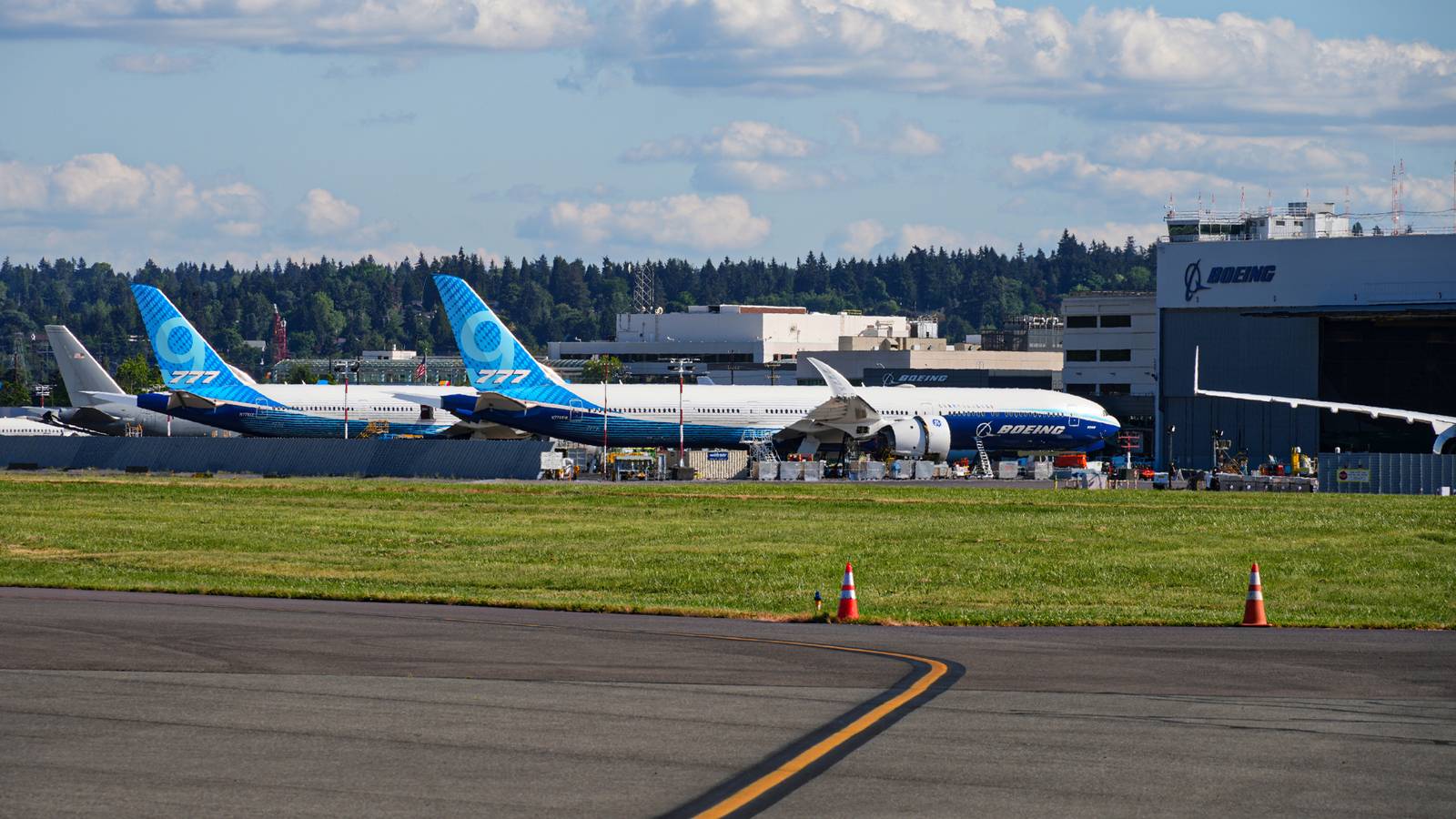
Credit: EQRoy | Shutterstock, Simple Flying Published Oct 5, 2026, 4:00 AM EDT Based in the UK, Josh is a keen writer with a degree in Military History. Having worked previously as a financial journalist, he has covered the aviation industry extensively, reporting on airlines' results and monthly passenger statistics in the aftermath of the pandemic, alongside the likes of regulation around sustainable fuels, and the prospects for hydrogen-powered commercial flight. He joins Simple Flying with a lifelong love of all things aviation. Sign in to your Simple Flying account Boeing has faced a lengthy and costly saga in attempting to roll out its latest widebody. Having launched the Boeing 777X program 13 years ago, the US manufacturer has suffered setback after setback. While certification now finally appears to be around the corner, efforts to mitigate the impact of delays and get the ball rolling on production ahead of time have left Boeing with another predicament. Because the aircraft is so long overdue, Boeing has been forced to mull over the viability of sending out models built before approval. Indeed, some of these are now several years old and so will need additional work before being handed to operators. In one case, the manufacturer has even deemed it necessary to scrap a pre-built airframe before it left its production site, let alone ever got the chance to serve passengers. The 777X And Boeing’s Latest Bid To Build A Widebody Boeing officially kicked off the 777X program in 2013 at the Dubai Airshow. Some 259 orders from four airlines made it the largest product launch in commercial jetliner history. Boeing noted at the time that the combined list value of the orders was $95 billion. All told, the 777X family would build on the success of the Boeing 777, aiming to take the crown as the largest and most efficient twin-engine jet in the world. The GE9X from GE Aerospace was picked as a result, itself the largest and most powerful commercial jet engine ever built. Alongside this, Boeing engineered a new composite wing with a raked, folding wingtip to boost span and, in turn, efficiency. The folding mechanism would also keep it operationally compatible with existing airport infrastructure worldwide, helping ensure the family remained a flexible choice for operators. Passenger variant Boeing 777X specifications, from Boeing: Specification/Variant Boeing 777-8 Boeing 777-9 Seats (two-class) 350-425 375-450 Maximum Takeoff Weight 805,000 lb (365,140 kg) 775,000 lb (351,530 kg) Range 9,500 nautical miles (17,590 km) 8,000 nautical miles (14,820 km) Length 232 feet, 6 inches (70.9 meters) 251 feet, 9 inches (76.7 meters) Wingspan Extended: 235 feet, 5 inches (71.8 meters) On ground: 212 feet, 9 inches (64.8 meters) Extended: 235 feet, 5 inches (71.8 meters) On ground: 212 feet, 9 inches (64.8 meters) Height 64 feet, 1 inch (19.5 meters) 64 feet, 1 inch (19.5 meters) Engine GE9X by GE Aerospace GE9X by GE Aerospace The result was the 777-8, capable of carrying 350 to 425 passengers across two classes for up to 9,500 nautical miles (17,590 km), and the 777-9, with a typical two-class capacity of 375 to 450 seats and a maximum range of 8,000 nautical miles (14,820 km). The 777-8F, a freighter variant, would then complete the family, with a 5,000 nautical mile range (9,260 km) at a 242,507 lb (121-US ton) payload. But Boeing, having aimed to kick off production in 2017 ahead of rolling out the 777X commercially in 2020, has yet to even secure certification for the program. 777X’s Certification Now Years Overdue As it stands, approval is anticipated in 2027. That means at least a seven-year delay between expecting and actually being handed the aircraft for the first airlines to have penned deals for variants of the 777X. Emirates, which was by far the biggest of the initial customers in terms of orders, had opted for a hefty 150 models at the time of the program’s launch in 2013, for instance. Qatar Airways, Etihad Airways, and Lufthansa placed orders for 50, 25, and 34, respectively, in the meantime, for context. Boeing’s own woes, along with a slow regulatory process, are both key to the delays. While the 777X program itself has faced a number of hiccups, Boeing has faced increasingly intense scrutiny, in particular after issues with its Boeing 737 MAX program resulted in two fatal crashes in 2018 and 2019, respectively. 777X orders by airline, from Boeing: Airline Number on order Air India 10 All Nippon Airways 20 British Airways 24 Cargolux Airlines 10 Cathay Pacific 35 China Airlines 23 China Southern Cargo 5 Emirates 321 Ethiopian Airlines 8 Etihad Airways 30 Korean Air 20 Lufthansa 27 Qatar Airways 124 Silk Way West Airlines 2 Singapore Airlines 31 Unspecified 40 Total 730 Meanwhile, Boeing has racked up an ever-growing number of orders for its latest widebody. With the initial deals dating back to 2013 calling for 259 jets, the order book for the family has ballooned to 730. It is no surprise, therefore, that the manufacturer has looked to get ahead on production before receiving approval as a way to manage deliveries promptly when it can start shipping the 777X. But 777X Production Quietly Got Underway Anyway Unfortunately for Boeing, it has faced a longer-than-usual timeframe between building these and handing them to airlines. Boeing has reportedly already built around 30 airframes. These, in turn, have been left sitting idle on the tarmac at its Washington, Everett production facility, awaiting the moment that they can eventually be given to operators. This process of jump-starting construction prior to certification is not unusual. However, it requires modifications to aircraft built before later developments in the approval process prompt design changes. Boeing dubs this “change incorporation,” having carried out similar work on examples of Boeing 767, original 777, and Boeing 787s, for instance, between building them and receiving certification. Of the 30 or so 777Xs that have already rolled off the production line, some date back to as early as 2019 and 2020. As a result, they will have to systematically be brought up to standard based on the potentially seven-plus years of testing and development since they were originally built. Naturally, that will be no mean feat. The work is so complex that Boeing has already opted to scrap rather than reconfigure one of its oldest 777Xs. One 777X Not Even Worth The Upgrade As Boeing chief executive Kelly Ortberg said on the company’s first-quarter earnings call this year, the work varies from airframe to airframe. “It depends on when the airplane was built,” he explained, “the older the airplane, the more change incorporation and the more structural-related changes that are needed, and they will take longer.” For one of the jets, known as WH007, the scope of this effort proved too much. The seventh 777-9 built, WH007's green airframe sat dormant at Everett for six years after rolling out in the summer of 2019. Weighted blocks sat where its engines were meant to go, and Emirates branding on the folding wingtips hinted at where the jet would end up. But by late summer last year, the company had dismantled the airframe before it had even left the ground, according to sources cited by the publication The Air Current. Boeing subsequently confirmed the “partially assembled” 777-9 had been scrapped. This had been accounted for in prior financial results reflecting charges taken on the 777X program, it noted. Shortly after WH007’s untimely scrapping, those costs hit $15 billion. 777X Delay Costs Surpass $15 billion With these charges, including efforts to incorporate changes, Boeing booked an additional $4.9 billion in its October third quarter 2025 financial results. At the same time, the company pushed back expectations for the first 777X delivery from this year to next, adding another setback to the program. The extra $4.9 billion meant that total charges relating to the 777X had topped $15 billion. That includes losses tied to prolonged testing, penalties paid to airlines for overdue deliveries, and costly retrofits to airframes already built, to name a few. Example 777X program setbacks: 2019 Fuselage structural failure Cargo door blew out during a high-pressure ground test. 2019–2020 Engine compressor issues Early development problems with the GE9X’s compressor delayed the aircraft’s first flight. 2020-2021 Uncommanded pitch events Nose moved up or down without pilot input during flight testing. 2021 Certification delayed The FAA declined to certify the aircraft one year after the originally planned delivery date given outstanding technical issues. 2022 Engine fault A new engine-related issue grounded the entire 777X test fleet. 2022 Midair door panel failure A door panel blew out midair during a separate stress test. 2024 Engine thrust link failures Cracks were discovered in the thrust link structure connecting GE9X engines to the wing, resulting in another grounding of the test fleet. 2026 GE9X engine seal durability issues Further durability concerns identified with GE9X engine seals. It's unclear when WH007 was specifically written off. Either way, Boeing's decision to scrap rather than spend the time, money, and effort retrofitting the particular jet offers a glimpse of the sheer scale of the work ahead for its pre-built 777X fleet. 777X Change Incorporation To Take Years Behind the scenes, a dedicated team within Boeing is said to already be at work exploring how much attention each of the pre-built models will require to bring them in line with what will be required by the US’ Federal Aviation Administration. As Ortberg clarified earlier this year: “That is what the team is doing right now, going through defining the statement of work.” As to how long this, and then actually carrying out the retrofits, will take, it is expected to be years. Per Ortberg, the aircraft will be stripped down to a common configuration level so the required changes can be incorporated. “We think that’s going to be the most efficient way,” he added, “this is not new. This is something we’ve always planned. It’s a part of the production process.”
The $4.9 Billion Problem That Made Boeing Dismantle A 777X Airframe Before Even Flying It
Full Article
Original Source
Read the full article at Simpleflying →KhanList aggregates and links to publicly available news content. We do not host full articles from third-party sources. Always verify important information with original sources.