
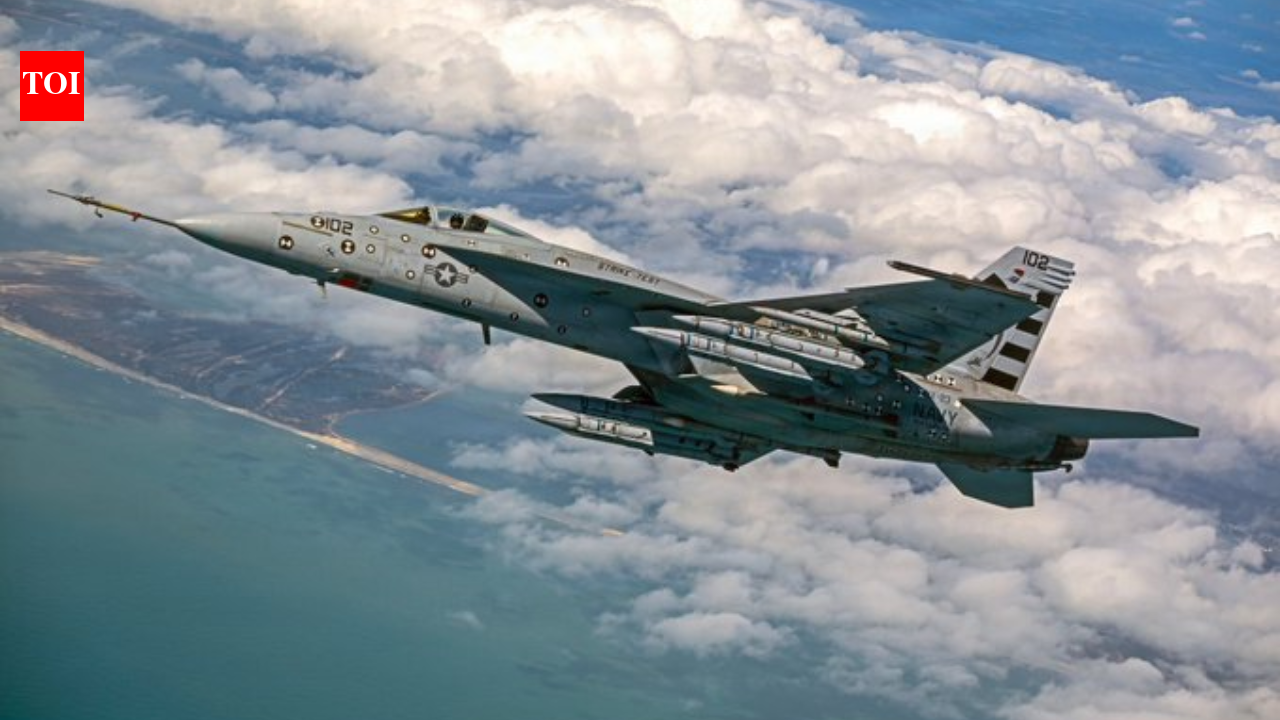
The US Navy has revealed the AIM-424 air-to-air missile, which has a range of over 450 KM. (Image credit: US Department of War)The United States Navy has unveiled its most ambitious air-to-air missile programme yet, one that could redraw the rules of aerial combat for decades to come. Announced at a naval aviation symposium, the AIM-424 Long Range Air-to-Air Missile (LRAAM), also referred to as Malice, is being developed by the Department of the Navy to ensure United States retains its edge in what defence planners call the first look, first shot, first kill engagements. The missile is designed to be fired from fourth, fifth and sixth-generation fighters alike. The ultra long range missile is expected to arm the F/A-18E/F Super Hornet, the F-35C and the still-under-development sixth-generation F/A-XX. The missile will give naval aviators a weapon designed for both today's air wing and tomorrow's.Manufactured by Raytheon, the missile stretches 13.5 feet in length, weighs around 680 kilograms, and is powered by a solid-propellant rocket motor, with a stated range exceeding 250 nautical miles, or roughly 463 kilometres. Its two-stage design is understood to be the key behind its extended reach and high terminal speed, placing it well ahead of the long-serving AIM-120 AMRAAM and the much newer AIM-260, both of which share a similar airframe mould. Where exactly Malice fits alongside the formidable AIM-174B, adapted from the Navy's ship-launched SM-6 interceptor, remains unclear for now. The Pentagon has made no secret of its ambition to eventually field air-to-air weapons capable of reaching out to nearly a thousand miles, a capability seen as essential to surviving an adversary's long-range anti-access systems and to winning the extended kill chains expected to define future aerial warfare, particularly as Washington races to stay ahead of China's own missile advances.Air-to-air missiles are becoming increasingly more potent. These missiles are now coming with increased ranges and greater lethality as technology advances. India, meanwhile, is charting a similar trajectory of its own with the Astra family of missiles. The indigenously developed Astra Mk-2 is expected to enter service either this year or in 2027, offering a range of 200 kilometres, with the Indian Air Force planning to induct as many as 700 units across its Sukhoi-30 and Tejas fleets. Work is simultaneously underway on the more ambitious Astra Mk-3, also called the Gandiva, which will extend the range further to 350 kilometres using Solid Fuel Ducted Ramjet propulsion, a technology comparable to that powering Europe's Meteor missile. Together, the Astra series is expected to progressively replace the Russian, French and European air-to-air missiles that currently equip Indian fighter squadrons, marking a significant step toward self-reliance in one of the most technologically demanding categories of modern weaponry.
The 450km kill shot: How AIM-424 Malice is pushing air combat into a new era
Full Article
Original Source
Read the full article at Timesofindia →KhanList aggregates and links to publicly available news content. We do not host full articles from third-party sources. Always verify important information with original sources.