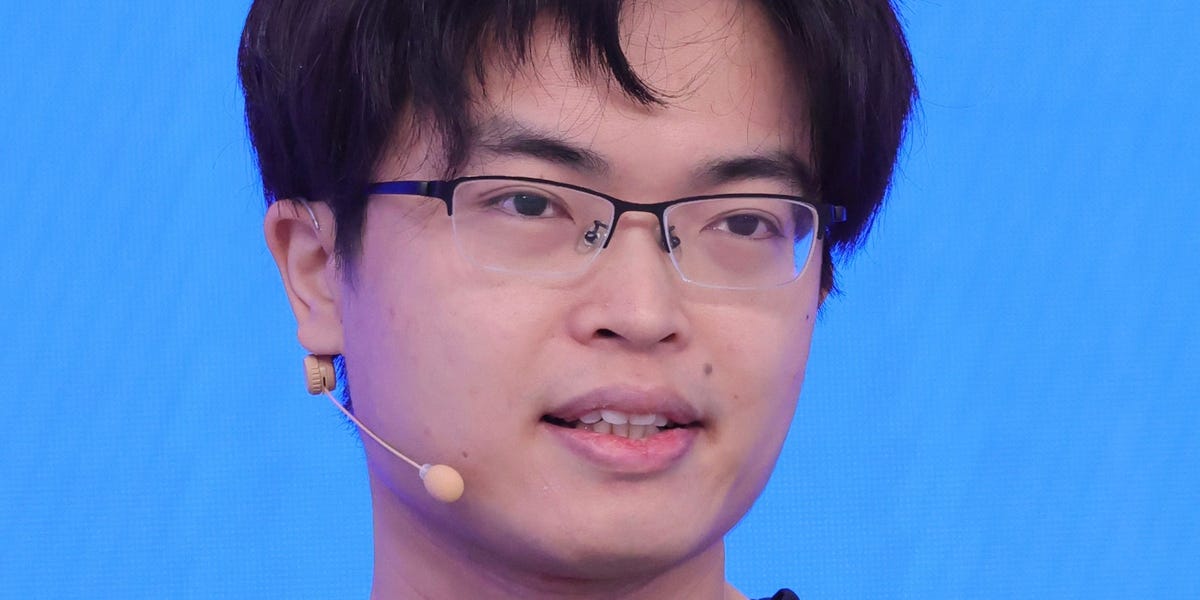
The 4 qualities that make the Moonshot AI founder so exceptional, according to his Ph.D. advisor Yang Zhilin, cofounder of Moonshot AI. VCG/VCG via Getty Images Yang Zhilin is having his moment in the sun right now.The 34-year-old cofounder of the Chinese firm Moonshot AI has been dubbed a "millennial genius" after the launch of his new Kimi K3 model this month, which sent shockwaves across the AI industry.But years before he cofounded Moonshot AI in 2023 in China, Yang studied in the US and was one of two dozen Ph.D. students in machine learning at Carnegie Mellon University.Business Insider spoke with Yang's former Ph.D. advisor, Ruslan Salakhutdinov, a computer science professor at Carnegie Mellon University, about the buzzy founder and the qualities that make him exceptional.The making of an AI founderSalakhutdinov said Yang possessed four qualities that set him apart even among one of the world's most competitive AI programs: unusual independence, original thinking, rare technical breadth, and the ambition to take risks.Salakhutdinov has a unique vantage point. Beyond supervising Yang, he has also taught or mentored researchers who have gone on to cofound AI startups, become professors at leading universities, and secure research roles at companies including OpenAI, Anthropic, Google DeepMind, Meta, Microsoft AI, and Tesla AI.He told Business Insider that the most successful AI researchers he's taught tend to share "extreme motivation," "extreme self-direction," and a strong work ethic, while also benefiting from highly competitive environments that push them to excel. Read more about Moonshot AI's viral Kimi K3 model Ruslan Salakhutdinov, computer science professor at Carnegie Mellon University and former Ph.D. supervisor of Moonshot AI CEO Yang Zhilin. Courtesy of Ruslan Salakhutdinov Some of those former students, he said, include xAI cofounder Jimmy Ba, Mistral founding member Devendra Chaplot, and Perceptual Machines cofounder Nitish Srivastava. Salakhutdinov has also taught at the University of Toronto.Yang, however, stood out even among that group.The professor said Yang joined Carnegie Mellon directly after his undergraduate degree and quickly developed into an unusually self-directed researcher."He started being very independent in terms of his research," Salakhutdinov said.He completed his Ph.D. in four years, from 2016 to 2019. During that time, he also helped develop an AI language model, XLNet.Salakhutdinov recalled being struck by Yang's willingness to challenge conventional thinking. Around 2019, three years before ChatGPT entered the mainstream, Yang said he believed it was possible that a single AI model, if scaled up enough, could perform many different tasks from simple natural-language prompts rather than requiring separate models for each task."I was like: 'What is this? This is never gonna work. This is a little bit crazy,'" Salakhutdinov recalled telling him.Yang's response stuck with him."He was like, 'No, I think if we scale these things should work.'"Yang developed those ideas while interning on Google's AI Brain team, where he coauthored two AI papers outlining new methods: Transformer-XL, which they proposed would help models understand longer text, and XLNet, which they said would improve how AI systems understand language.Salakhutdinov said Yang wasn't alone in thinking that scaling could unlock more general AI systems, particularly among researchers at Google, but that the belief was "not shared by many researchers" at the time.Yang didn't immediately respond to Business Insider's request for comments.From Ph.D. prodigy to AI starKimi K3 is an open-weight model that rivals leading systems from OpenAI and Anthropic on coding, reasoning, and knowledge tasks.Its release this month sparked debate across Silicon Valley about China's AI progress, while overwhelming demand forced Moonshot to temporarily pause new subscriptions.Moonshot's rapid rise has helped propel the three-year-old startup to a valuation of about $31.5 billion in its latest funding round. Bloomberg reported this week that the company is already preparing another financing round that could value it at as much as $50 billion ahead of a potential IPO.Salakhutdinov said Yang's independence, technical depth, original thinking, and entrepreneurial ambition help explain how he built one of China's fastest-rising AI companies.Another was Yang's unusual ability to combine deep research with low-level engineering."He has the ability to do research," Salakhutdinov said, but also "the remarkable ability to go and do low-level coding" and optimize GPUs for large-scale AI experiments.Salakhutdinov said the most accomplished AI Ph.D. students are often expected to become professors at top universities or join leading technology companies.But Yang was determined to start his own company, even after a brief stint as a professor in China."I was actually a little bit surprised, because it's risky," Salakhutdinov said. "You can go, you can try building a company, and if it doesn't go anywhere, then your career can suffer."Yang, however, had already made up his mind. "He basically told me: 'I have to try. If I don't try, then I'll be regretting it,'" Salakhutdinov said. Read next Thibault is a business reporter at Business Insider's London office.He covers the intersection of wealth, work, and technology — focusing on the global economy, AI’s impact on the workplace, job and cognitive skills, and how economic changes are affecting careers. Before moving to the trending team, Thibault covered international affairs, including the Russia-Ukraine war, tensions in the South China Sea, and Russia’s economy on the news desk.He has previously worked at the Daily Express and held internships at Agence France-Presse, Politico Europe, and Factal.Il parle français. Se habla español.Email Thibault at tspirlet@businessinsider.com, connect with him on LinkedIn @ThibaultSpirlet, or follow him on X @ThibaultSpirlet and BlueSky @thibaultspirlet.bsky.social.ExpertiseAI and the future of work Job and cognitive skills in the AI economyWorkforce trendsFirst-person, "as-told-to" business storiesPopular articlesAI isn't making us smarter — it's training us to think backward, an innovation theorist saysNetflix tried full pay transparency for senior staff — it ended up fueling petty rivalries, Reed Hastings saysDuolingo gives staff 2 weeks off over the holidays — and the CEO says it pays offA Nobel Prize-winning physicist explains how to use AI without letting it do your thinking for youAI is giving workers the illusion of expertise — and quietly making them worse at their jobsSatya Nadella says he spends his weekends studying startups as Microsoft's size has become a 'massive disadvantage''Think big': A 35-year finance veteran urges Gen Z to start their own businesses as entry-level jobs dry upAI is reshaping the teenage brain — and an Oxford study says it is making students faster, but shallower thinkersSwitching jobs used to mean higher pay raises. Not anymore.Canadians were urged to boycott travel to the US in response to tariffs — and numbers suggest they listened AI Artificial Intelligence
The 4 qualities that make the Moonshot AI founder so exceptional, according to his Ph.D. advisor
Full Article
Original Source
Read the full article at Businessinsider →KhanList aggregates and links to publicly available news content. We do not host full articles from third-party sources. Always verify important information with original sources.