
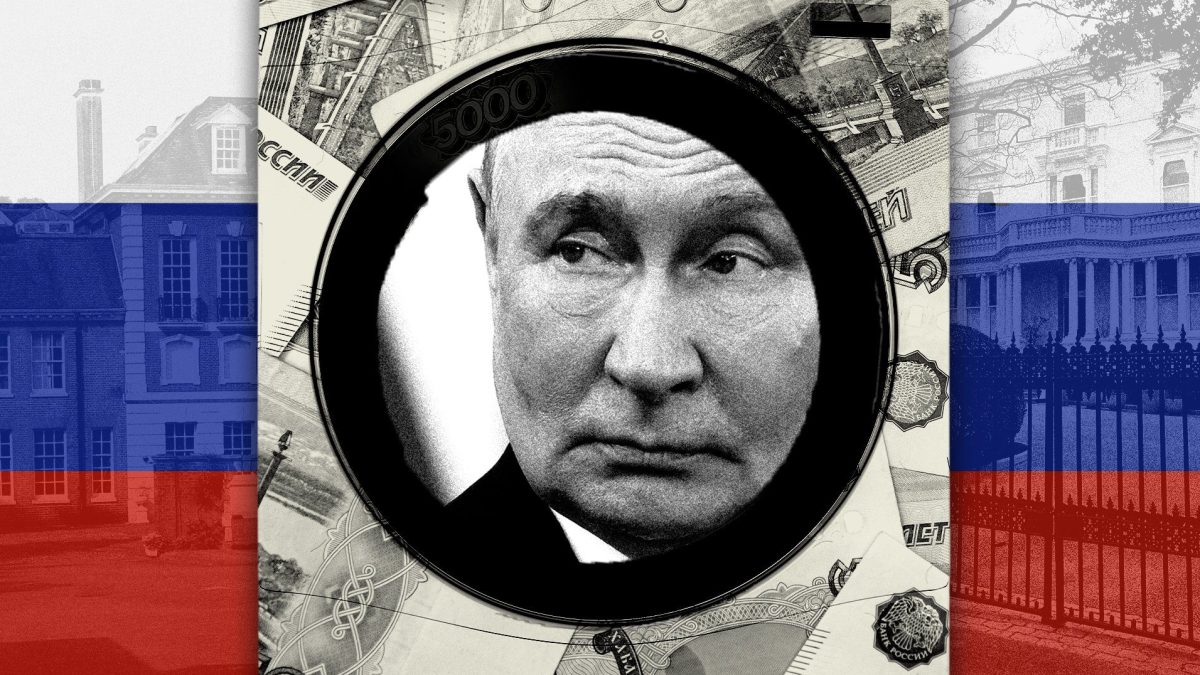
At first glance, Five Belgrave Square looks like a grand London mansion hastily abandoned by its aristocratic owner. Imposing white columns, paint peeling off them, line the entrance alongside a makeshift barrier of brown packing tape and imposing security doors. It is a ghostly symbol of old money, power and influence whose running costs exceeded its owner’s resources. Now worth £50m, it is owned by Oleg Deripaska, one of President Putin’s favourite Russian oligarchs who has benefited from huge state-backed contracts and is a regular visitor to the Kremlin, according to leaked diplomatic cables published by Wikileaks. Deripaska bought the house for £17m in 2003 using an offshore company registered in the British Virgin Islands. His ownership of this historic property – once home to Sir Henry “Chips” Channon (1897-1958), a Conservative MP with notoriously decadent tastes – is now frozen as part of the government’s sanctions against the oligarchs. It’s worth being precise about what “frozen” means in this context. Putin’s war in Ukraine triggered the sanctions – but sanctions restrict use, they don’t transfer ownership. Deripaska, like every oligarch named in this investigation, is still the legal owner of his London property. He cannot sell it or live in it while sanctions apply, but he has not lost it, and the day sanctions are lifted, he is free to walk back through his own front door. And that isn’t the full picture. The i Paper has identified 33 further Russian-linked properties across London and Surrey – worth £700m – that were never frozen at all. Their owners are sanctioned, but the houses themselves sit outside the government’s asset freeze entirely, meaning they could legally be sold, remortgaged or handed to a relative tomorrow, while the war continues. Inside, this Georgian townhouse looks frozen in time, its luxury interiors still intact: a grandiose staircase, chandeliers in all seven bedrooms, a Barbara Hepworth sculpture, a majestic glass table, a neoclassical reclining sofa, and a grand piano. The dining room, a Rococo fantasy in cascades of aquamarine and silver leaf, still dazzles the eye. From the outside, the London laundrette seems switched off – a washing machine stopped mid-cycle, lights left on in an empty house. For years, the capital’s property market was where oligarchs’ fortunes went to be cleaned: a mansion bought through an anonymous offshore company converted dirty money into a solid, defensible asset. A Belgravia address bought its owner respectability no amount of cash could on its own. Freezing a house like this switches off one machine. But it doesn’t tell the whole story. Russian-linked assets hiding in plain sight Because for every boarded-up Belgravia mansion, there are dozens of others hiding in plain sight – untouched by sanctions. To reach this figure, Transparency International examined Land Registry records, tracing each property back to the offshore company or trust that holds the title, and cross-checking those names against the UK’s sanctions list. The anti-corruption campaigners also checked leaked documents, notably the Panama Papers, which revealed ownership details of offshore companies. What they found was at least 33 Russian-linked houses, flats and offices in London and Surrey – worth £700m – that do not appear on the UK’s register of frozen Russian assets at all. Nothing stops these properties changing hands right now. They can be sold, remortgaged or quietly passed to a relative, while the war rages on. If Five Belgrave Square is the laundrette’s shopfront, boarded up for the cameras, this is the back room still turning the drum. And even where mansions have been frozen, freezing is not the same as confiscating. Every house mentioned in this article is still legally owned by the person who bought it. Sanctions restrict use and sale; they do not extinguish title. That distinction is the reason the Government has moved so cautiously – and where the story of the laundrette gets complicated. “Some of these properties are owned in the name of UK companies, notably [Roman] Abramovich,” a property broker told The i Paper. “If those UK companies are struck off by Companies House because of the sanctions, then ownership of the houses will belong to the Crown.” This means the Government will, in effect, be confiscating assets – a policy they have been trying to avoid at all costs, because of the implications for the rule of law. Five Belgrave Square, owned by the Russian billionaire Oleg Deripaska, was the focus of protests after the invasion of Ukraine in March 2022 (Photo: Bloomberg/Getty) Some anti-corruption campaigners are uneasy about confiscation as a step too far, even if the motive is to raise funds to rebuild Ukraine. “Confiscating assets without proof they are the proceeds of crime is akin to expropriation”, said Gretta Fenner, former head of the Basel Institute, an NGO that investigates oligarchs and financial crime. “This is done by dictators not democracies.” Deripaska’s properties are a case study in the short-term nature of sanctions. A former metals trader, he made his $7bn fortune from aluminium based partly on a close working relationship with the Kremlin. He was sanctioned when Russia invaded Ukraine in 2022. All his UK assets – Five Belgrave Square and a country house at St George’s Hill, Weybridge, Surrey, now worth £20m – were frozen. Initially, Deripaska said the house belonged to relatives, but a High Court judge had already ruled that he was the true owner. Today, the oligarch lives in Moscow, and his UK properties remain unoccupied. Like many sanctioned Russian billionaires, Deripaska cannot sell his house, now valued at £45m. But he still legally owns both properties, and when the war ends, he will be free to return and enjoy their benefits after sanctions are lifted. Desperate to keep ownership secret from courts, law enforcement and regulators, oligarchs often register their properties in the name of obscure, impenetrable offshore companies and trusts, or in other people’s names. This secrecy has allowed some oligarchs’ assets to escape identification and freezing altogether, according to Transparency International. One Government source told this newspaper the problem is the properties are owned by anonymous trusts and the Land Registry “has no power of investigation to identify the beneficial owner”. London’s biggest house after Buckingham Palace Take Witanhurst in Highgate – 90 rooms, six acres and, after Buckingham Palace, London’s largest house. Bought for £50m by fertiliser billionaire Andrey Guryev, sanctioned by the US and UK, through a Guernsey entity, Boradge Ltd, it’s now worth £300m following a reconstruction that has infuriated neighbours. This legal loophole of buying and registering prime property in offshore islands and tax havens has been exploited even by Putin’s own allies directly involved with the war. Igor Komarov sits on Russia’s National Security Council, the body that Putin chairs and fills with his most loyal officials. Komarov has been directly involved in the war and is sanctioned by both the UK and US. Witanhurst House in Highgate – pictured in 2007. (Photo: Suzanne Plunkett/Bloomberg via Getty) On paper, his multi-floor mansion on Herbert Crescent, around the corner from Harrods, belongs to an anonymous company in the British Virgin Islands called Wastom Holdings. But the Pandora Papers – a 2021 leak of millions of documents from offshore law firms, which exposed how the wealthy and powerful hide assets behind shell companies – named Komarov as the real owner. Despite that leak, the Knightsbridge house was never frozen. It’s one of 33 properties at the centre of this investigation. Using a company closer to home, in the Isle of Man, the Kremlin favourite Alisher Usmanov, sanctioned by the UK, EU and US, former majority shareholder of Arsenal, paid £48m for Beechwood House, a Regency mansion on Hampstead Lane set on 11 acres overlooking the heath, whose former owners include a King of Saudi Arabia and an Emir of Qatar. In 2011 Abramovich paid £92m for 16 Kensington Palace Gardens, opposite Kensington Palace itself: the former Soviet diplomatic mission, used by KGB spies during the Cold War, now held through a Cyprus-based company, A Corp Trustee, whose registered address is Stamford Bridge, Chelsea, and now being renovated with plans for an underground pool. Reclusive, unassuming and secretive, Abramovich is nonetheless the most powerful oligarch, and while owner of Chelsea football club built a property portfolio worth £175m. Beyond Kensington Palace Gardens, he owns luxury flats on Lowndes Square in Knightsbridge, near Harvey Nichols, worth £50m and registered under LS Investments, a Seychelles company. Unusually, he has also bought in his own name: two houses on Chester Square, Belgravia, for £19m, and a flat on Eaton Square – known as “Red Square” – for £13m. Flats on Chelsea Manor Street and Manresa Road are kept for Russian guests. It is no secret Abramovich sits inside President Putin’s inner circle. “I had, and continue to have, a good working relationship with President Putin,” he told the High Court in 2012, when sued by the oligarch Boris Berezovsky. It was this relationship that made him a natural, discreet intermediary in early peace talks between Presidents Zelensky and Putin within weeks of the Russian invasion of Ukraine. Russian money in London has the ‘taint of illegitimate origin’ It has taken a long time for the UK Government to take the danger seriously – London’s property market offers sanctioned money a route back to respectability, letting frozen wealth sit untouched, while unfrozen wealth keeps moving unchecked. In 2016 the National Security Council was tasked with reviewing oligarchs’ ownership of UK assets. No action was taken. The reason was disclosed in a leaked memo, written by a civil servant shortly after Russia’s annexation of Crimea in 2014: “HMG should not close London’s financial centre for Russians,” the official wrote. It took a full-scale war, not an annexation, to finally move the Government to act. The gated entrance to the private street of Kensington Palace Gardens, where sanctioned Russian Roman Abramovich owns a property (Photo: Jason Alden/Bloomberg/Getty) London property prices have been artificially driven up by oligarchs buying flats and houses. But there is a darker side too: ownership hidden behind anonymous shell companies in secretive jurisdictions, while a London address launders reputation as well as cash. Transparency International estimates Russians account for £729m of the £4.4bn acquired in UK property via what it regards as “suspicious wealth”. As Berezovsky himself once told me, Russian money in London carried a heavy taint of illegitimate origin. Campaigners remain mystified about why and how such properties escape freezing when their owners are sanctioned. “These assets may be held by sanctioned individuals’ relatives, allowing restrictions to be circumvented,” a Transparency International spokesperson said. “In theory, the UK Government can examine the origins of assets, but in practice such tools are largely absent. It is increasingly hard to explain why measures have not yet been applied to these people.” So is the laundrette really dead? Not quite – think of it as more on pause. The freeze doesn’t touch the oligarchs’ fortunes themselves: Deripaska’s aluminium interests, Guryev’s fertiliser empire and Usmanov’s tech holdings all sit largely outside UK jurisdiction, untouched by sanctions. What’s frozen is the London base, not the wealth that built it. Five Belgrave Square, Witanhurst, Beechwood – these were always the visible, decorative fraction of what these men are worth, which is exactly why freezing them makes a strong headline and a comparatively modest dent. And freezing is not confiscating. Every house in this article is still legally owned by the oligarch who bought it. Deripaska cannot sell Five Belgrave Square, but he has not lost it and if, or when, sanctions are lifted, he walks back through his own front door, past pillars which, by then, might finally have been repainted. The danger of London property being owned by Russian oligarchs and Putin state officials is not just that it artificially inflates house prices for homeowners. These 33 unfrozen properties also send a message to all plutocrats and tycoons that the UK provides a soft and secret haven for hiding their ill-gotten gains. They are the part of the laundrette that never stopped running – proof the dirty money didn’t disappear so much as it learnt to keep the lights off.
The 33 properties that show London is still a haven for Putin’s dirty money
Full Article
Original Source
Read the full article at Inews →KhanList aggregates and links to publicly available news content. We do not host full articles from third-party sources. Always verify important information with original sources.