
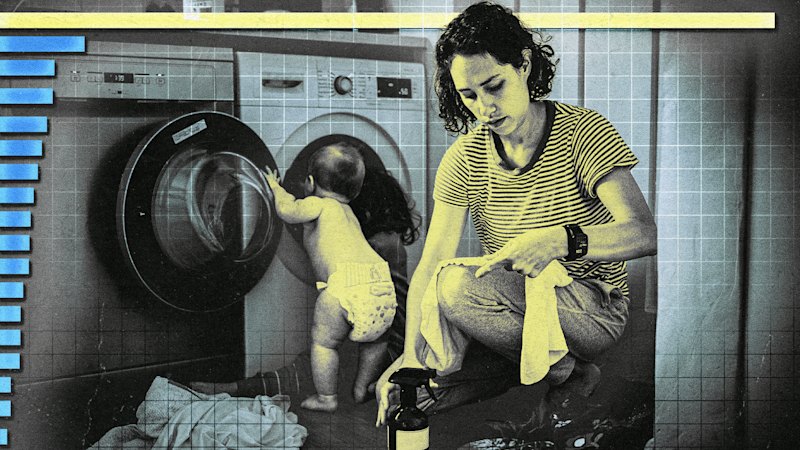
September 7, 2026 — 5:00amAustralians spend more time each year doing unpaid work such as cooking and cleaning, and caring for children, than the combined paid hours of work in every industry.New analysis reveals about 31 billion hours of unpaid labour are performed annually, nine times more than in healthcare and social assistance, Australia’s largest sector for paid hours. Australians do 14 times more unpaid work than in the construction sector, the country’s second-largest industry for paid hours.Australians spend more time on unpaid labour than on all paid work combined.GettyWomen do 8.2 hours of unpaid work more than men each week – equivalent to more than a full-time work day – although the gender gap has closed a little over the past two decades.Gianni La Cava, an economist at the e61 Institute who did the analysis, said the huge scale of Australia’s unpaid workload was not well understood despite the fundamental role it played in daily life.“Australia’s biggest industry has no payroll,” he said.La Cava estimates time spent on household production is 1.3 times more than the hours worked across every paid industry put together.A separate study by consulting firm Mandala, commissioned by online delivery platform DoorDash, found Australian adults spent a similar amount of time each week on paid and unpaid work – both 26 hours on average.Nearly three-quarters of unpaid work was spent doing domestic activities, especially meal preparation (25 per cent), housework (21 per cent) and shopping (8 per cent). Childcare accounted for 20 per cent of unpaid labour and adult care 4 per cent. Volunteering comprised about 3 per cent.Mandala’s report found long hours of unpaid household labour, particularly intensive care duties, are “associated with reduced mental wellbeing” including depression and anxiety.Research published recently by Queensland University of Technology economist Dr Leonora Risse found the value of unpaid work in Australia was $688 billion, about one-third of gross domestic product, although other studies put the share above 50 per cent. These estimates vary depending on the assumed wages and the method used for the calculation.She estimates Australian women do the equivalent of $40,092 in unpaid labour a year compared with $25,636 for men.Risse says unpaid work is taken for granted.“It is the invisible scaffolding that holds up the rest of the economy,” she said. “It is underappreciated, under-recognised and undervalued.”The latest Australian Bureau of Statistics figures show women did an average of 31 hours of unpaid work per week in 2024 while men did 22 hours a week, up from 19 hours in 2002.The biggest gender discrepancy was in time spent doing housework, where women do 3.5 hours more each week than men on average.La Cava said the time use data shows women in paid employment “do more unpaid work on average than men not in paid work”.Unpaid labour rises sharply when people have children.La Cava found that in the year that a first child is born, mothers’ unpaid work rises by about 53 hours a week and fathers’ by about 15 hours. Mothers take on close to four-fifths of the additional workload. At the same time, mothers’ paid work falls by about 18 hours a week, while fathers’ paid work rises by about two hours.“Most of the initial increase is childcare, but ordinary housework and errands also become less equal,” the e61 Institute report said.“In the birth year, mothers add about nine hours a week of housework, errands and outdoor tasks; fathers add about one. Four years later, the gap in those tasks has widened to around 11 hours.”La Cava said simply counting hours missed a crucial aspect of unpaid labour, as women took on a disproportionate share of the “mental load” required to keep households running.“Who’s doing the work of predicting when the kids need new school clothes and where they need to be on the weekend for sporting commitments? That stuff is often done by mothers,” he said.La Cava believes gender differences in the way unpaid work is managed in households underscores the need for fathers to take parental leave after the birth of a child.“Leave does more than change who is at home because it affects who learns the routines, who becomes the childcare centre’s first call, and who is expected to stay home when a child is sick,” he said. “And those roles are often established early.”Mandala managing partner Amit Singh said better, more frequent data on unpaid work was required for Australia to address inequalities.“Technology has incredible potential to alleviate the pressure of unpaid labour, but it will only work if it’s supported by government with actual visibility of the problem,” he said.Start the day with a summary of the day’s most important and interesting stories, analysis and insights. Sign up for our Morning Edition newsletter.Matt Wade is a senior economics writer at The Sydney Morning Herald.Connect via X or email.From our partners
The 31 billion hours we don’t get paid for: Australia’s giant workload revealed
Full Article
Original Source
Read the full article at Smh →KhanList aggregates and links to publicly available news content. We do not host full articles from third-party sources. Always verify important information with original sources.