
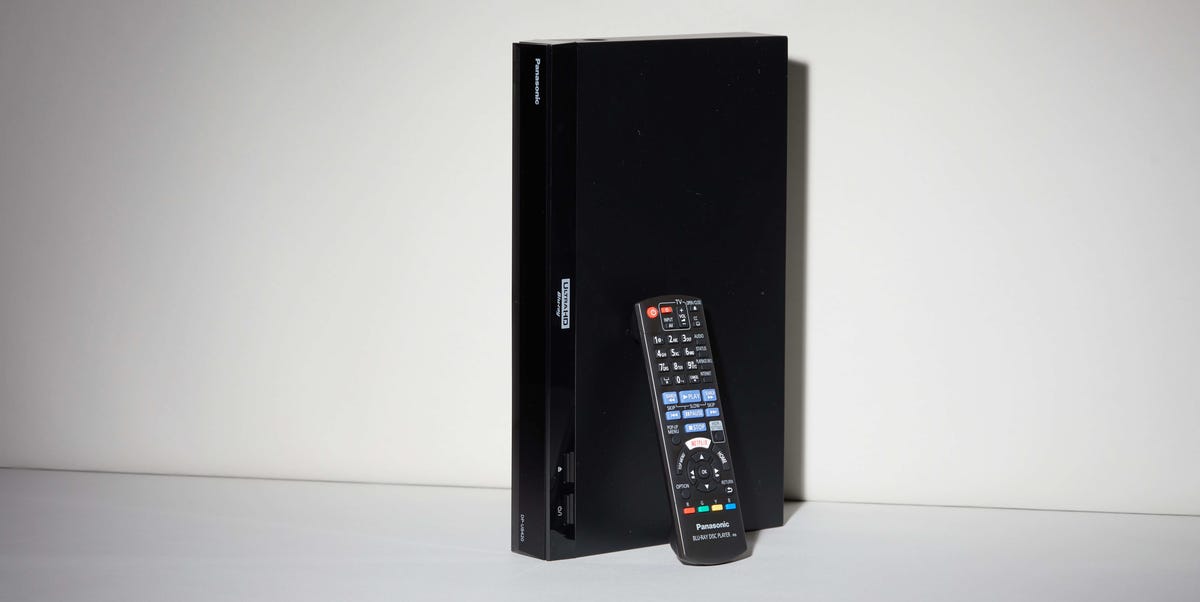
Every product was carefully curated by an Esquire editor. We may earn a commission from these links. Here’s how we test products and why you should trust us.Credit: Eli SchmidtProsPerfect for Blu Rays and old DVDsLightweightHDMI Cable includedConsWon't play 4K discsNo internet capabilitiesIf you don’t own any 4K discs and don’t care to, this is the Blu-ray player to start with. It will play Blu-rays as well as standard-def DVDs. With Netflix now charging more for its 4K tier and many services following suit, most folks aren’t watching their content in 4K anyway because a) it’s an expensive upcharge and b) they don’t see the difference.Point is, if you don't care about resolution and just want a regular ol' Blu-ray/DVD player, they do in fact still make and sell those. Shocking, I know. This one even has the technology to upscale your DVDs to what Sony calls near-HD. As a tech guy and hardcore cinephile, am I a fan of the way this tech makes movies look? Definitely not, but I’m not most people. Chances are if this is the Blu-ray player you're buying, you’ll be perfectly happy with the results, or more likely you’ll be happy not even knowing the feature exists.In appearance, the box is small and nondescript. In function, it gets the job done. Perfect for a new HD Blu-ray release or some shitty horror movie you rented (can you still rent movies?) from your local dine-in movie-theater chain that still does DVD rentals for some reason (complimentary).ProsPlays 4K, Blu-ray, and DVD discsNative 4K and direct chroma upscaling High-res sound to match the vivid imageBuilt-in WiFi and streaming apps ConsRemote control is smallThis is the pick for the already converted. The upgrade, if you will. If you're already really into the home theater thing, a Blu-ray player that supports both native 4K and UHD upscaling is essential to getting the best “cinema at home” experience possible. Can you get an 8K player in today's day and age? Sure, go for it, but it's straight up a waste of money.This Panasonic 4K Blu-ray player does everything you need, with 4K playback and the option to upscale your 1080p Blu-rays and lower-resolution DVDs. This tech digitally doubles the resolution to 4K, giving you the most precise cinema-style viewing experience. Is it the way the movie was meant to be viewed? Not really, but for the casual (or impaired, elderly, etc.) viewer it can be pretty useful. It doesn't quite compare with what you'll get from a movie meant to be viewed in 4K, though.Technically, this isn't a completely anti-streaming device. It does indeed have the ability to connect to the Internet, and when you boot it up, certain apps will be preinstalled. It's a modern DVD player, even if it helps you reject modernity to some degree. If you have a nice pair of speakers in your movie room of choice, this player will pump high-resolution audio in if hooked up. It's an added value to an already great deal.Advertisement - Continue Reading BelowProsCan play Blu-rays and DVDs from all regionsIncludes cable and remoteDVD upscalingConsNot compatible with 4KsPretty much every Blu-ray disc (and DVD for that matter) is region coded, meaning you can only watch it using a player made in the same region. If you own an American Blu-ray player, you can’t watch “region-locked” discs from other parts of the world. Unless, of course, you get one of these region free players.Technically, this is a modified Sony Blu-ray player sold through a verified third party on Amazon. It can play Blu-rays from regions A, B, and C, and DVDs from regions zero through eight. Beyond that, it’s a typical Sony player—lightweight, slim, and dependable.FAQsCan Blu-ray and 4K players play regular DVDs?Yes. All Blu-ray and 4K players are capable of playback from a standard-definition DVD. Additionally, all 4K players are able to play a Blu-ray disc.What's the difference between 4K and UHD?4K and UHD are shorthands for a 3840x2160 resolution. That's a measure of the pixels in a given display. 4K and UHD (Ultra High Definition) are interchangeable ways of referring to the same resolution.What's the difference between native 4K and upscaled 4K?When we talk about native 4K and Blu-ray players, we are referring to the ability to play 4K/UHD discs. Upscaling, on the other hand, is a hardware-based way of converting lower resolutions automatically to higher ones. No matter what you upscale, there will always be some loss of quality in the process. That's why native is always preferred. If you have a huge Blu-ray collection, though, the ability to watch all those 1080p movies in upscaled 4K could be a deal-maker when it comes to which one of these players you choose. Some devices can also upscale your old standard-def DVDs to Blu-ray-quality 1080p.What is a Region Free Blu-ray Player?Like I said, pretty much every Blu-ray disc is region locked to one of three regions: A, B, or C, each corresponding to different parts of the world. This means you typically need a corresponding device made in the same region. For example, I can’t watch a Blu-ray (or DVD) from Japan on my American bought Blu-ray player. Region Free players are modified units that can play any disc, regardless of manufacturing origin.For what it’s worth, 99 percent of all 4K discs are region free. In the first place, the only reason you’d need one of these if you’re a collector.
The 3 Best Blu-ray Players to Buy in 2026
Full Article
Original Source
Read the full article at Esquire →KhanList aggregates and links to publicly available news content. We do not host full articles from third-party sources. Always verify important information with original sources.