
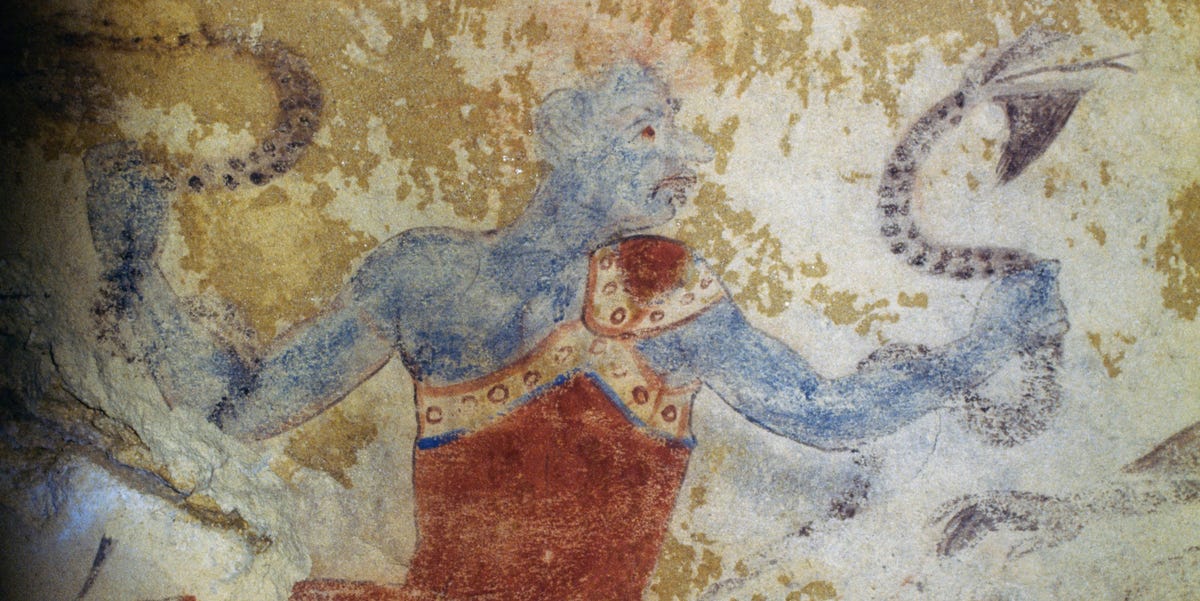
5 min readHere’s what you’ll learn when you read this story:Etruscan tombs were engineered to trick the senses, using sight and sound to conjure scenes from the underworld.An AI algorithm reconstructed what ancient visitors saw and heard, revealing how each tomb’s architecture amplified those effects.One tomb creates an orderly descent into the afterlife, while the other feels like a terrifying plunge beyond the world of the living.Transitioning from the world of the living to the underworld was a tangible experience for ancient Etruscans who entered the shadows of their family tombs. These tombs were not only intended to be chambers for the dead; as visitors ventured deeper into the darkness, lit only by candle flame, vision and sound became distorted. Dancers and musicians painted on the walls seemed to come alive, and so did a menacing demon waiting to ambush and swallow its next victim.Etruscan funerary rituals are already known to have pushed mourners to the edge of consciousness. For the Etruscans, death unfolded in three phases. First the soul separated from the body, then it journeyed to the other side, where finally it rejoined its ancestors. To help the dead along, mourners put themselves into hypnotic states. This often involved dancing to ecstatic extremes and even erotic acts that reached the transcendent moment of orgasm. Tombs were also designed to engage and alter the senses, creating an immersive experience that was as close as possible to the spirit realm that Etruscans envisioned. Researchers have now recreated that experience through the eye of an AI algorithm trained to interpret sensory events without the bias that might come from recreating rituals.“Through contrasting sensory strategies, each tomb, as presented here, shapes in different ways how bodies move, visual focus, and interestingly, how sound is structurally experienced,” said researchers Maurizio Forte of Duke University and Jacqueline Ortoleva of the University of Oxford, who coauthored a study recently published in Journal of Archaeological Method and Theory. “Both of the studied tombs functioned as sonic, visual, and spatial environments.”Tombs naturally convey a certain feeling of dread. The Etruscans engineered theirs to deepen it. The tombs Forte and Ortoleva studied in the Monterozzi necropolis in Tarquinia, Italy, just northwest of Rome, are known as the Tomba del Gallo and the Tomba dei Demoni Azzurri, or “Tomb of the Blue Demons.” Walking down the entrance passageway, or dromos, visitors would feel the walls narrowing as they descended deep into the earth toward the chamber where the body was interred. Torches produced too much smoke for visitors to have carried them far beyond the mouth of the dromos. Instead, Etruscans likely used beeswax or tallow candles to light the way, while incense was burned in the main chamber. The flickering of candlelight probably conjured the illusion that the wall paintings were moving.Both the Tomba del Gallo and the Tomba de Demoni Azzurri were constructed during the 5th century B.C.E., in pre-Roman times. Each offers a vastly different experience that was relived through sensory elements. These experiences were simulated by AI devices placed at certain locations in the tombs. Tomba del Gallo was carved from limestone sometime between 450 and 400 B.C.E. The steep stairs of its dromos lead to a small burial chamber that had been robbed of its grave goods in antiquity. Its walls are plastered over and painted with scenes of banqueting and revelry, with musicians playing double pipes among masked dancers. Plaster, unlike bare limestone, reflects sound rather than absorbing it, and the chamber’s coated walls stretch reverberations well beyond what its size would suggest. The dromos narrows at its end, concentrating those echoes in the corridor instead of letting them dissipate.Sound and sight likely amplified each other, with echoes registering as louder to anyone watching murals shift in candlelight. The architecture compounds this effect. Just as the tomb’s shape traps sound, the ceiling drops and the walls tighten at the entrance to the burial chamber, forcing visitors to slow down and sharpen their attention. Here the chamber’s curved walls rise to meet overhead, signaling separation from the world of the living. Stepping through, mourners would have felt absorbed into the painted banquet. Any rituals were probably performed in this space, where the murals made the afterlife feel like somewhere a person could stand. Tomba del Gallo insists on continuity between life and death. Tomba dei Demoni Azzurri insists on rupture.Built between 450 and 420 B.C.E., the tomb filled with painted blue demons was designed to feel more like being suddenly thrust into the underworld, rather than a gradual descent. Archaeologists recovered animal bones from the dromos, several of which were charred or fully calcined, evidence of cult rituals that probably included blood sacrifice. Human remains and most of the grave goods initially brought down to the burial chamber have long since vanished into the hands of looters. Larger than Tomba del Gallo, the Tomba dei Demoni Azzurri has dimensions that produce long reverberations like those that echo in Gothic cathedrals. Reverberations lasted the longest in parts of the chamber meant for rituals. AI determined that they were longer near a banquet mural, but shorter near a wall of painted demons.The most imposing demon of the Tomba dei Demoni Azzurri is a blue-skinned, red-eyed creature swathed in red and gold, clutching what appear to be the tentacles of an even more nightmarish monster. Its clawed hands seize attention as it transfixes the viewer. Surrounded by the already trancelike visual and auditory atmosphere of the tomb, and with darkness and proximity to death heightening awareness and fear, those who encountered this entity in ancient times may have been convinced that they’d fallen under its spell. This is a stark contrast from the visual order and more limited acoustics of Tomba del Gallo. While rituals there probably centered on memory and recognition, with controlled emotion, the demons of Tomba dei Demoni Azzurri trigger what Ortoleva and Forte call “emotional rupture.”“The two tombs examined here not only represent stylistic variants within a shared funerary tradition but rather fundamentally different theories of how death should be experienced by the living, hence those who were involved in the final deposition of the dead,” they said. “These represent divergent but equally sophisticated ritual philosophies, both of which depend on the orchestration of sensory experience.”Elizabeth Rayne is a creature who writes. Her work has appeared in Popular Mechanics, Ars Technica, SYFY WIRE, Space.com, Live Science, Den of Geek, Forbidden Futures and Collective Tales. She lurks right outside New York City with her parrot, Lestat. When not writing, she can be found drawing, playing the piano or shapeshifting.
The 2,500-Year-Old Mystery of the Tomb of the Blue Demons Has Stumped Archaeologists. Until Now.
Full Article
Original Source
Read the full article at Popularmechanics →KhanList aggregates and links to publicly available news content. We do not host full articles from third-party sources. Always verify important information with original sources.