
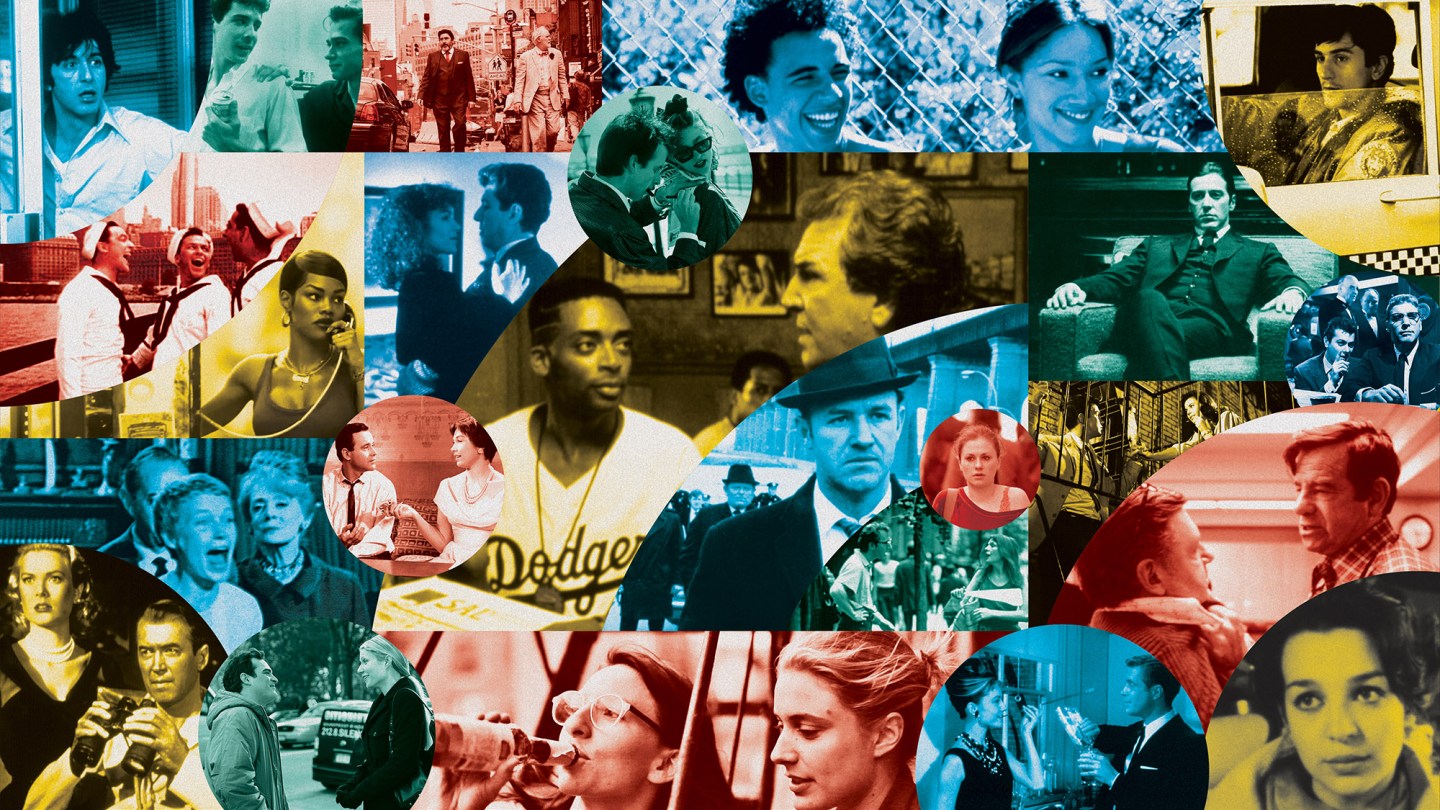
Courtesy Everett Collection In honor of three true-blooded New York features currently in theaters, THR film critics — two of them born-and-raised NYC natives — pick their all-time favorites from a subgenre as rich and varied as the city itself. Hollywood has always been synonymous with the movies, but film history buffs know that American cinema really started in New York — or, if you want to get picky, just across the Hudson River at Thomas Edison’s lab in New Jersey, where the Kinetoscope was invented. One of the first narrative motion pictures, Edwin S. Porter’s The Great Train Robbery (1903), was shot partly at Edison’s studios in Manhattan. The earliest works of D.W. Griffith were also made in Manhattan, until Biograph built a bigger stage in the Bronx. “King of Comedy” Mack Sennett, who launched Charlie Chaplin’s career, started off at Biograph as well. In other words, New York was Hollywood before Hollywood was Hollywood, and even if the studios soon moved west (although Netflix is now headed back east with its ginormous new facility in Jersey), the city has remained an ideal backdrop for some of the greatest films ever made, many directed by native New Yorkers. Martin Scorsese, Francis Ford Coppola, Spike Lee, Woody Allen, Sidney Lumet and John Cassavetes were all either born or grew up in one of the five boroughs. They shot some of their best work there, eschewing L.A. sunshine for the vibrance and grit of the Big Apple, which has no equal anywhere on earth. To celebrate the release of three true-blooded NYC movies — Club Kid, The Only Living Pickpocket in New York and Queens boy James Gray’s latest crime drama, Paper Tiger (in addition to fabulous doc Once Upon a Time in Harlem) — THR critics have compiled and ranked a list of the 25 best films taking place in the city. To say there were more options than we had room for is an understatement; we started with a “shortlist” of around 100 titles we love or like, then debated and whittled down from there. We’d like to think you can trust us — two of us are NYC-born-and-raised, one from Manhattan, one from Queens; one of us is a longtime transplant (25 years in Chelsea and counting); and one of us is a Californian with deep family roots in Brooklyn. Our list could have consisted exclusively of works by the directors name-checked three paragraphs above, so we decided to limit the count to one film per filmmaker. We excluded documentaries (Welfare, On the Bowery and Paris Is Burning would have staked strong claims). And while we adore the classics that have stood the test of time, we also wanted to make room for some more recent films that are plugged in to the city’s ever-evolving set of joys and challenges. There are countless beloved mainstream hits featuring NYC in significant ways — Tootsie, Kramer vs. Kramer, Ghost, Splash, Big, When Harry Met Sally, Ghostbusters, Moonstruck, Home Alone 2: Lost in New York, Working Girl, The Devil Wears Prada … we could go on. Those aren’t on our list, not because we don’t have affection for them (we do!), but because there were other titles we found more interesting, more distinctive in their use of the city as a setting and, in many cases, really a character in and of itself. Some of our selections exude sheer energy. Others are marked by solitude and despair, chaos and murder, because New York is a town that has broken many a soul. Brooklyn-born Jay-Z may have said it best in “Empire State of Mind,” undoubtedly the NYC anthem of our time: “Eight million stories out there in the naked city; it’s a pity half of y’all won’t make it.”That lyric references Jules Dassin’s 1948 noir The Naked City, one of 10 honorable mentions — films that could have made the list if we had finalized it another day. The others: All That Jazz, Escape From New York, Girlfriends, It Should Happen to You, Klute, Marty Supreme, Midnight Cowboy, Saturday Night Fever and Tiny Furniture. And here are our 25 favorites. ‘A Thousand and One’ (2023) Image Credit: Focus Features/Courtesy Everett Collection Set against the background of rapidly gentrifying 1990s New York — Brooklyn and Harlem in particular — debuting director A.V. Rockwell’s atmospherically charged Sundance winner gives Teyana Taylor a powerhouse showcase as Inez, a hair stylist and single mother fresh from a stint at Rikers and determined to get her 6-year-old boy out of the foster care system by whatever means necessary. Tracing a decade-plus in the marginalized lives of the mother and son, this moving character study watches Inez evolve from youthful bravado to hard-won self-possession. It also acutely observes painful rips in the fabric of New York City life for the economically disadvantaged and racial minorities, under the aggressive policies of Rudy Giuliani’s mayoral administration and on through the rampant development and discriminatory policing of the Bloomberg years. ‘Two Lovers’ (2008) Image Credit: Magnolia Pictures/Courtesy Everett Collection Queens native James Gray made a trio of dark and eloquent outer-borough thrillers (Little Odessa, The Yards, We Own the Night) before switching gears with this romantic drama set in Brighton Beach — about as far as you can get from Manhattan without officially leaving New York City. The neighborhood’s windswept boardwalks and beaches are a perfect backdrop for a searing study of desire, in which a 30-something homebody (Joaquin Phoenix) is caught between two women: the nice local Jewish girl (Vinessa Shaw) that his parents want him to marry and the bewitching blond shiksa (Gwyneth Paltrow) that he spies on, Rear Window-style, from across the courtyard of their apartment building. With a mastery of tone and an eye for authentic detail, Gray turns the setup for a zany rom-com into an arrestingly intimate tale of longing anchored by three great performances. Set to the swooning arias of Puccini and Mascagni, the film takes on the emotional proportions of a small-scale Brooklyn opera by the final act. ‘Raising Victor Vargas’ (2002) Image Credit: Samuel Goldwyn/Courtesy Everett Collection Peter Sollett’s film is not only a radiant and delicate indie rom-com/coming-of-ager, in which a 16-year-old self-styled lothario (Victor Rasuk) learns to be worthy of his guarded, regally dignified crush (Judy Marte). It’s also an indelible portrait of the Lower East Side’s Dominican community that vividly captures the romantic glow and sweaty, sensual restlessness of summer in the city. From the cacophony of a public pool on a scorching day, to the cramped apartment where the protagonist spars with his siblings and grandma, to tender close-ups of the teenage characters seducing, rebuffing, confronting and then tentatively yielding to each other, it’s a modest movie that nonetheless brims with authentic New York swagger and soul. ‘Love Is Strange’ (2014) Image Credit: Sony Pictures Classics/Courtesy Everett Collection Revolving around a longtime gay couple (John Lithgow and Alfred Molina at their rumpled best) forced to sell their West Village apartment — and make less-than-ideal sleeping arrangements — when one of them is fired from his job, Ira Sachs’ understated heartbreaker is also an ode to the glories, aggravations and absurdities of life in the city. Lovingly shot and precisely observed, the film is imbued with a weary affection for a metropolis that’s changed in cruel ways but retains its inexorable pull on the eccentric, creative people who call it home — and go to often logic-defying lengths to do so. This is a movie that grasps the socioeconomic and logistical challenges of 21st century New York City (from daunting subsidized housing applications to the awkwardness of hosting guests in small apartments), folding them into an achingly wise story about loss, legacy and the imperfect ways we love one another, in life and beyond. ‘The Taking of Pelham One Two Three’ (1974) Image Credit: Courtesy Everett Collection Made in an era when hijacking planes was a frequent occurrence, Joseph Sargent’s raw and riveting adaptation of a novel by John Godey (real name Morton Freedgood) revolves around an almost ridiculous premise: Bad guys hijack a subway car and threaten to kill one passenger per minute if the city doesn’t cough up $1 million in used bills within an hour. But the bad guys weren’t counting on the perspicacity of Transit Police Lieutenant Zachary Garber (Walter Matthau at his most deliciously Matthau-ian), among others. The dialogue’s abundant racism hasn’t aged well, and the command center’s walls of blinking Christmas light bulbs look absurdly quaint. But there’s real, palpable New York City grit in the movie — literally so, in the grimy tunnels used as locations standing in for the 28th Street station, where the titular 6 train stops while negotiations proceed over walkie-talkies between Matthau’s officer and the lead hijacker (a silken Robert Shaw). Watch and marvel at how fast the cops get across lower Manhattan traffic in order to hit the deadline. ‘Crossing Delancey’ (1988) Image Credit: Warner Bros./Courtesy Everett Collection Before the Lower East Side became an overpriced haven for hipsters, fashionistas and finance bros, its streets were lined with modest mom-and-pop businesses, many of them run by Jewish New Yorkers whose families had settled there at the turn of the 19th century. The last remnants of that Manhattan shtetl are lovingly portrayed in Joan Micklin Silver’s charming rom-com, which follows a bookshop employee (Amy Irving) and a pickle vendor (Peter Riegert) who can’t manage to hook up despite the pair of matchmaking bubbes trying to get them together. Adapted by Susan Sandler from her own play, the film captures a vibrant pre-Giuliani-era LES, in which working- and middle-class 30-somethings could still afford to pay the rent and, perhaps, fall in love. (Micklin Silver’s memorable debut, Hester Street, depicts the very same neighborhood back in 1896, when Jewish immigrants were first building a community that has all but disappeared by now.) ‘Frances Ha’ (2012) Image Credit: IFC Films/Courtesy Everett Collection The fact that Noah Baumbach’s sharp, affectionate portrait of a very modern millennial woman (Greta Gerwig, also co-writer) is filmed in knowingly retro black-and-white is just one of its many charming contradictions, along with the way its sketch-comedy randomness builds to a perfect, cohesive ending. The monochrome palette also signifies that this is a particular kind of New York movie, harking back to screwball comedies and vintage Woody Allen. The city is a playground for the not-quite-grown-up heroine, and Baumbach and Gerwig punctuate Frances’ odyssey through it with title cards noting each address she comes to rest at — from the Prospect Park digs she starts out sharing with her bestie (Mickey Sumner) to the room in a Chinatown walk-up that she rents from more moneyed hipsters (Adam Driver, Michael Zegen) and beyond. Frances, a disorganized dancer struggling to find her footing in the performance world, literally prances and pirouettes through city streets in immaculately edited montages cut to pop classics like David Bowie’s “Modern Love.” You can’t help but fall in love with her at least a bit, as well as seeing how clearly Frances’ journey augurs Gerwig’s own eventual transition from ingenue to confident writer-director. ‘Margaret’ (2011) Image Credit: Myles Aronowitz/Fox Searchlight/Courtesy Everett Collection While Spike Lee’s The 25th Hour captured the rage and chaos of post-9/11 New York, the film that best channeled that period’s deep-seated malaise was Kenneth Lonergan’s maligned, underseen, then critically resurrected coming-of-age drama Margaret. For this epically intimate story of a teenage girl (played by a remarkable Anna Paquin) whose life is upended after she witnesses a fatal bus accident, Bronx-born Lonergan chose to stage the action on the Upper West Side, populating his film with well-educated, upper-middle-class Manhattanites facing the consequences of a gruesome death that could have perhaps been avoided. Shot in 2005 but then mired in legal and editing-room disputes for years, the film only hit theatres in 2011, by which time many New Yorkers had tried to put Sept. 11 behind them. More than a decade later, Margaret remains a rich and unsettling portrait of a time when the city suddenly lost its mojo — a sentiment echoed by the film’s 17-year-old heroine, who can’t shake off her sense of guilt, or the feeling that the world has suddenly fallen to pieces. ‘On the Town’ (1949) Image Credit: Courtesy Everett Collection This exhilarating post-World War II MGM classic musical is packed with top-name talents both in front of and behind the camera. Co-star Gene Kelly choreographed it and co-directed with Stanley Donen, the first of many fruitful collabs between the two. Meanwhile, Kelly is one of a trio of male leads, alongside Frank Sinatra and Broadway star Jules Munshin, who play three sailors maximizing their fun on a 24-hour shore leave. The lads link up via a series of very New York encounters with three women (or “goyles”): a horny cab driver (Betty Garrett), an anthropologist (super-hoofer Ann Miller) and an aspiring model-dancer (Vera-Ellen). Kelly and Donen insisted that they film on location at least a little bit, which means the cityscape of 1949 Columbus Circle is on full display, as are other locales. The city’s eternally changing nature forms a key component of the plot, toasted in songs like “New York, New York” and “Come Up to My Place,” wherein Sinatra’s character keeps asking to visit long-gone tourist attractions. Now the then-modish spots they do visit seem just as antiquated and historical as the Hippodrome. ‘Desperately Seeking Susan’ (1985) Image Credit: Orion/Courtesy Everett Collection A good chunk of Susan Seidelman’s delightful screwball mistaken-identity comedy unfolds in bougie Fort Lee, New Jersey. But the movie’s punk heart beats loudest in downtown New York, where Roberta, a bored housewife played by Rosanna Arquette, gets a bump on the head in Battery Park and becomes convinced she’s Susan, a bohemian scenester played by Madonna in her first and best major screen role. Still in her ascendance when the film was shot, the pop star’s signature sense of style informed the character and became influential in ’80s fashion. Locations featured include the former cult East Village vintage clothing store Love Saves the Day, the Bleecker Street Cinema and hot night spot Danceteria, while Washington Heights’ Audubon Ballroom stood in for fictional dive Magic Club (John Turturro plays the emcee). And Seidelman peppered the cast with downtown artists including Rockets Redglare, Annie Golden, John Lurie, Ann Magnuson and Shirley Stoler, and included a cameo from the adult triplets whose astonishing history was recounted in 2018 doc Three Identical Strangers. The Village Voice personal ads play a significant role, but MVP is Laurie Metcalf, in sublimely acerbic form as Roberta’s judgy sister-in-law. ‘Parting Glances’ (1986) Image Credit: Cinecom Pictures/Courtesy Everett Collection This funny and achingly felt film is an artifact of the times, as one of the first to engage with AIDS and its impact (writer-director Bill Sherwood himself died of the disease four years after this, his only feature-length work, was released). But it’s also an admirably expansive work that takes a snapshot of New York life on a broader scale. At the center, there’s a love triangle of sorts, between couple Michael (Richard Ganoung) and Robert (John Bloger) and Michael’s rock-musician ex Nick (an inconceivably young Steve Buscemi), who is HIV positive. The night before Michael leaves for a six-month work assignment in Africa, he and Robert attend a dinner party thrown by a married man and woman with their own sexual secrets and then another soiree downtown hosted by their artist friend (Kathy Kinney). Sherwood and his cast limn these different milieus with the lightest of brushstrokes, bringing in a galaxy of vividly realized characters to populate the overlapping realms. This is a scruffy New York on the back foot in the era of Mayor Ed Koch, seething with anger and creativity that’s not yet been priced out by Wall Street money. ‘The Apartment’ (1960) Image Credit: Courtesy Everett Collection A razor-sharp depiction of the kind of soul-crushing corporate culture and patriarchal entitlement that decades later would become the language of Mad Men, Billy Wilder’s evergreen 1960 romantic comedy is shot through with an expressive vein of melancholy. Jack Lemmon stars as Baxter, an insurance clerk who mistakenly believes career advancement will be his reward for handing over the key to his Upper West Side apartment multiple nights a week to married company executives in need of a place to carouse with their mistresses. Among them is Fred MacMurray’s head of personnel, whose affair with elevator operator Fran Kubelik — one of Shirley MacLaine’s most cherished performances — hits a bump when she attempts suicide with an overdose of sleeping pills in Baxter’s apartment. While much of the shoot took place on a Hollywood studio lot, this is a quintessential NYC movie, from its portrayal of the midcentury workplace grind to its tender insights into urban solitude, notably in Baxter’s line from the exquisite closing scene: “I used to live like Robinson Crusoe. I mean shipwrecked among 8 million people.” ‘Shadows’ (1959) Image Credit: Courtesy Everett Collection What Jean-Luc Godard’s first feature, Breathless, was to New Wave-era Paris, John Cassavetes’ jazzy and downbeat Shadows was to Beat-era New York City. Both were made in the late ’50s and both broke directing norms, helping launch movements — the Nouvelle Vague in France, independent filmmaking in the U.S. — that changed the face of cinema. But whereas Godard’s film was a tongue-in-cheek homage to film noir and Hollywood, Cassavetes’ hip, deeply felt drama tackled tensions in a city divided along racial lines, even if it wasn’t technically segregated. The project stemmed from theater workshops the actor-director conducted with aspiring young talents in Manhattan, and that improvised approach lent it a striking realism compared to most American films of the time. Shadows still resonates powerfully through its honest portrait of three Black siblings — two of them light-skinned — trying to make it as musicians and writers in New York, which also means trying to overcome biases that were prevalent back then and haven’t yet been definitively erased. ‘The French Connection’ (1971) Image Credit: 20th Century Fox Film Corp./Courtesy Everett Collection Big Apple realtors like to claim “location is everything” while selling overpriced, closet-sized apartments to folks dying to live in one of the city’s coveted ZIP codes. Such a tagline could also be applied to William Friedkin’s heart-pounding NYC cop thriller, which set a standard for action flicks that has rarely been equaled ever since the film triumphed at the box office and Oscars more than 50 years ago. Friedkin broke lots of rules — as well as several laws — during the shoot, sending stunt drivers down pedestrian-lined Brooklyn streets or bribing an MTA official for a mind-boggling subway chase toward the end of the movie. The result was a sustained game of cat and mouse that literally hits the ground running and never lets up until the credits roll. By then, we’ve raced through three out of five boroughs in a pursuit that feels both visceral and existential, making us question whether the movie’s obsessive pair of NYPD detectives (a never-better Gene Hackman and Roy Scheider) have been chasing phantoms the entire time. ‘The Godfather Part II’ (1974) Image Credit: Courtesy Everett Collection Of the many qualities that contributed to the immense success of The Godfather, the authenticity of its setting is seldom mentioned. And yet unlike most mob movies before it, Francis Ford Coppola’s crime classic was shot entirely on location in New York City (except for sequences set in L.A. and Sicily), lending it a verisimilitude that made the travails of the Corleone clan feel both real and Shakespearean. Working with twice the budget and the full blessing of Paramount, Coppola went bigger and broader for the film’s brilliant sequel, hopping across several continents and time periods for a three-plus-hour epic set simultaneously in the 1950s and the 1920s. For the latter part, which traces the rise of Vito Corleone (Robert De Niro) from Sicilian immigrant to all-powerful Don, the director — along with DP Gordon Willis and production designer Dean Tavoularis — took several streets on Manhattan’s East Village through a time warp. The result was a stunning re-creation of classic Little Italy, as well as one of cinema’s great murder scenes. ‘All About Eve’ (1950) Image Credit: 20th Century Fox Film Corp/Courtesy Everett Collection One of the all-time great movies about New York City as the nation’s vibrant theater hub, Joseph L. Mankiewicz’s delectably witty 1950 backstage drama left such a mark that calling someone “an Eve Harrington” — after the rapacious title character played by Anne Baxter — remains widely understood code for the kind of ruthlessly ambitious upstart who would step over your corpse to climb the ladder. Insinuating herself into the life of Broadway legend Margo Channing, one of Bette Davis’ defining roles, Eve poses as the meekest, most devoted of fans while plotting each maneuver that gets her closer to becoming a grand leading lady of the stage. She’s the ultimate protégée as predator. In the bright lights of Broadway, the stage-door alleys, sophisticated cocktail parties and self-congratulatory awards ceremonies, the film captures a moment when New York theater was considered the epicenter of American culture. For those of us who chose a career as critics, it also has the magnificent George Sanders as Addison DeWitt, a viper-tongued drama critic with make-or-break influence, whose perceptiveness allows him to see through Eve and exert control over her, even as he helps clear her path to stardom. ‘Sweet Smell of Success’ (1957) Image Credit: John Springer Collection/CORBIS/Corbis via Getty Images No movie nails the boozy, sophisticated and sinister ambiance of post-war midtown Manhattan like Alexander Mackendrick’s scathing New York noir. Inspired by the antics of legendary gossip columnist Walter Winchell and publicist Irving Hoffman (who wrote regularly for The Hollywood Reporter), this sharp-tongued look at journalism, celebrity, cutthroat competition and backstabbing New Yawkas features a murderers’ row of talent both in front of and behind the camera: stars Tony Curtis and Burt Lancaster; writers Clifford Odets and Ernest Lehman; a score by Elmer Bernstein; and cinematography by the great James Wong Howe, who captures the city — mostly Times Square and its surroundings — in vibrant chiaroscuro black-and-white. Famous for its machine gun one-liners, delivered like disses in a rap battle a few decades before New York would invent hip-hop, the film is best summed up by what Lancaster’s J.J. Hunsecker says before he climbs into a cab after another night of making and breaking people with the stroke of his pen: “I love this dirty town.” ‘Breakfast at Tiffany’s’ (1961) Image Credit: Courtesy Everett Collection Is there a more iconic New York movie moment than Audrey Hepburn’s Holly Golightly, resplendent in a black Givenchy evening gown, stepping out of a yellow cab onto Fifth Avenue in the early morning hours, sipping takeout coffee and nibbling on a Danish while gazing at the window displays of the famed jewelry emporium? Blake Edwards’ 1961 film of the Truman Capote novel shows its age in Mickey Rooney’s cartoonish ethnic stereotype as Holly’s Japanese photographer neighbor Mr. Yunioshi. But it nonetheless remains an enchanting portrait — both cynically transactional and romantic — of the city as a sanctuary for a self-invented social butterfly living off wealthy men and a handsome young aspiring writer reliant on the “patronage” of a well-heeled woman (all hail Patricia Neal). The boozy party in Holly’s East 71st Street brownstone is one for the ages, eventually shut down by cops, but not before willowy model Mag Wildwood crashes drunkenly to the floor like a felled tree. ‘Taxi Driver’ (1976) Image Credit: Courtesy Everett Collection Beyond Woody Allen, there’s perhaps no director more synonymous with the Big Apple than Martin Scorsese, who was born in Queens and grew up in Little Italy — a neighborhood that would shape him as an artist and serve as a backdrop for his earliest features. Several Scorsese flicks (Mean Streets, Raging Bull, After Hours, Goodfellas, The Age of Innocence) could easily have made our list, but the one that feels the most indelibly New York-y of them all is Taxi Driver. This may be because the movie nearly plays like a documentary, bringing to deeply unsettling life the grimy, horny, crime-ridden streets of Times Square, Hell’s Kitchen and other Manhattan enclaves during the dog days of the 1970s — when the Daily News famously quipped that President Gerald Ford had told the city to “drop dead.” But Taxi Driver is as much a N.Y. of the mind as it is of the eye, channeling the inner solitude of its antihero, Travis Bickle, a perennial outsider who lives by night in a town that never sleeps, viewing it as either fantasy or hellscape from the safety of his cab. ‘Rear Window’ (1954) Image Credit: Courtesy Everett Collection Anyone who has lived in a Manhattan courtyard apartment block or has a clear view into homes across the street knows the unplanned voyeuristic pleasures of catching neighbors doing weird shit. In the case of Alfred Hitchcock’s riveting murder mystery — among the filmmaker’s very best — James Stewart’s Jeff is the observer, a photojournalist immobilized by a busted leg who becomes convinced that a lugubrious-looking traveling salesman in the building opposite his Greenwich Village home has killed his bedridden wife. Unable to convince his detective pal of foul play, Jeff enlists his wisecracking home nurse, Stella (peak Thelma Ritter), and glamorous model girlfriend, Lisa (Grace Kelly, dripping couture), in his amateur sleuthing. Shot almost entirely inside and through the windows of Jeff’s apartment, the movie makes masterful use of subjective camera. It also vividly evokes the kind of sweltering heat wave — without air-conditioning — that might make any New Yorker contemplate murder. ‘Dog Day Afternoon’ (1975) Image Credit: Courtesy Everett Collection With the Godfather trilogy, The Panic in Needle Park, Serpico, Cruising and Carlito’s Way, among others, Al Pacino almost merits his own personal NYC movie ranking. Unforgettably paired here with John Cazale — one of just five features in the brief but blazing career of the great character actor, who died at 42 — they play Sonny and Sal, inexperienced crooks attempting in 1972 to rob the First Brooklyn Savings Bank, in part to pay for the gender-affirming surgery of Sonny’s lover, Leon. Sidney Lumet’s gritty thriller is steeped in the kind of unbearably tense, restless pressure-cooker atmosphere that’s typical of a sweltering New York City summer. Based on a real-life heist-and-hostage situation, the film unfolds with both irreverent humor and searing compassion as the naïve would-be robbers watch the situation spiral out of control over the course of eight sweaty hours, becoming a media circus that builds to preordained tragedy at Kennedy airport. Standouts among the deep bench of outstanding supporting players are Charles Durning as the cops’ empathetic primary negotiator, Susan Peretz as Sonny’s emotionally volatile wife and Chris Sarandon as Leon, his eyes brimming with raw pain and exhaustion through a semi-improvised farewell phone call. ‘Rosemary’s Baby’ (1968) Image Credit: Courtesy Everett Collection Many of us would love a spacious two-bedroom Upper West Side apartment — but maybe not the one where Mia Farrow’s title character, an expectant mother, lives with her husband, a theater actor struggling to get a foothold on Broadway (played with an incremental drip of subtle menace by John Cassavetes). Then there’s the neighbor (the inimitable Ruth Gordon), a seemingly benign eccentric who’s a tad too solicitous to be genuine. While the exteriors of Roman Polanski’s ageless psychological chiller were filmed at the famed Dakota Apartments facing Central Park, interiors were shot on Paramount soundstages in Los Angeles. But this enthrallingly insidious tale of women’s bodily autonomy, paranoia, lapsed-Catholic hysteria and Satanism lives and breathes residential Manhattan — namely, the unsettling side of apartment-building living, in close proximity to complete strangers. The film includes a nail-biting scene in which pregnant Rosemary wanders through oncoming midtown traffic in a daze, captured by Polanski himself with a handheld camera since no crewmembers were willing to risk their lives on a busy street not closed off for shooting. ‘West Side Story’ (1961) Image Credit: Courtesy Everett Collection Robert Wise and Jerome Robbins’ outstanding, canonical movie musical — a grafting of Romeo and Juliet onto a pre-gentrification Upper West Side — improves on the 1957 Broadway hit right off the bat: The exhilaratingly staged “Prologue” and “Jet Song” use aerial footage of 1961 New York, coming down to land just north of the San Juan Hill (now Lincoln Square) area, where the Sharks and Jets express their enmity with finger clicks and elegant jetés through eerily empty streets. The romantic tragedy at the film’s center is timeless, but this West Side Story also bottles up a stylized version of the period’s working-class New York culture and ethnic strife (Puerto Rican immigrants versus mainland-born whites) with warmth, emotion and wit — the latter expressed particularly well through Stephen Sondheim’s droll lyrics for numbers like “Gee, Officer Krupke” (“I’m depraved on account I’m deprived!”). Even the soundstage sets evoke the stark lines and scruffy textures of that midcentury concrete landscape. ‘Annie Hall’ (1977) Image Credit: Courtesy Everett Collection Does the still-contested cancellation of Woody Allen mean we can’t still love Annie Hall? Of all his movies, losing this one would hurt the most. Manhattan, as the name suggests, might be his most echt New York film, but the Allen character’s deeply icky romance with Mariel Hemingway’s high schooler is a punch-bowl turd you can’t ignore. Annie Hall, in which Allen’s Alvy Singer is in love with a woman nearly his own age — an indelible, never-more-charming Diane Keaton — is every bit as much a mash note to the city as it is to the characters’ relationship, which Alvy likens to a shark that must keep moving lest it die. The metropolis we see here, full of real residents’ favorite spots, is never at risk of ceasing its perpetual motion, its constant churn of characters and kookiness becoming part of the film’s laugh-laced, bittersweet momentum. Where else could you pull Marshall McLuhan out of nowhere to solve an argument in a line to buy movie tickets? Sure, it’s a gag, but it’s rooted in a deeper truth — that that sort of thing could only happen in New York. The film’s cruelest jabs are reserved not for a person, but for the entire city of Los Angeles, a place whose only redeeming feature, to paraphrase Alvy, is that you can make a right turn on a red light. ‘Do the Right Thing’ (1989) Image Credit: Courtesy Everett Collection There are many reasons Spike Lee’s third feature tops our list of the greatest New York movies, but the main one may simply be that it hasn’t aged one iota since it was shot in Brooklyn nearly 40 years ago. Part of this comes from the tragic reality that the film’s climactic event — the killing of Radio Raheem (Bill Nunn), who is choked to death by the NYPD — has been echoed many times over since the movie first came out, whether it was Eric Garner in Staten Island, Freddie Gray in Baltimore or George Floyd in Minneapolis. Racial friction and police brutality are at the heart of Do the Right Thing, whose story depicts one long and languid NYC summer day during which tensions simmer, boil over and eventually ignite, tearing the diverse working-class neighborhood of Bedford-Stuyvesant apart. As a native Brooklynite, Lee knew some of these tensions firsthand, turning several actual incidents that rocked the Big Apple into a brilliant, hip-hop-infused ensemble piece (aside from Lee, the stacked cast includes Danny Aiello, Rosie Perez, John Turturro, Samuel L. Jackson, Giancarlo Esposito, Ossie Davis and Ruby Dee) that gradually takes on the force of a Greek tragedy. But what really makes the movie still crackle decades later is how Lee counterbalances all the conflict and chaos with lots of streetwise humor and brotherly love, highlighting the resilience that New Yorkers can show in the face of a crisis. His film is a love letter to the town he grew up in, even if it’s one dipped in blood, sweat and broken glass. It’s New York as melting pot, salad bowl, powder keg and barrel of laughs. New York as America. THR Newsletters Sign up for THR news straight to your inbox every day Subscribe Sign Up
The 25 Best New York Movies of All Time, Ranked
Full Article
Original Source
Read the full article at Hollywoodreporter →KhanList aggregates and links to publicly available news content. We do not host full articles from third-party sources. Always verify important information with original sources.