
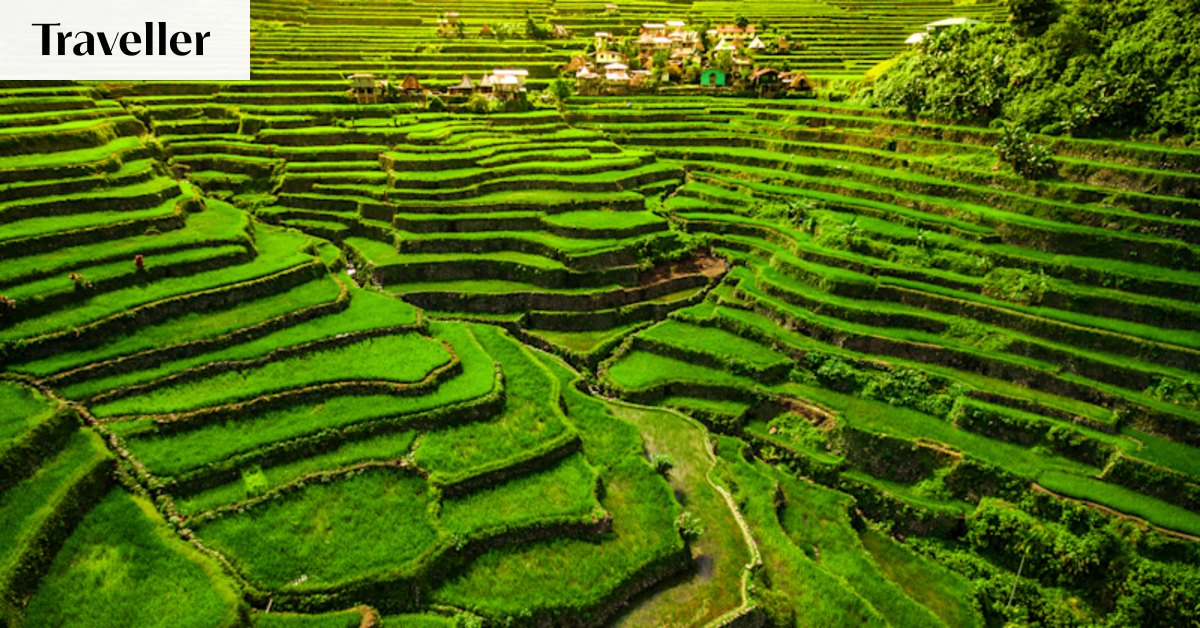
We inherited quite a few good ideas from the ancient Greeks: democracy, theatre, the Olympic Games. One idea that tends to get overlooked is, in effect, the travel bucket list. Hellenic writers created the original list of the wonders of the world, a selection of see-them-before-you-die monuments.From the Hanging Gardens of Babylon and the lighthouse of Alexandria to the 33-metre statue known as the Colossus of Rhodes, most of these ancient marvels have disappeared.But in the intervening millennia, humans have created plenty of other awesome attractions, from which we have drawn a must-see list of our own.In compiling this list, we had to keep it manageable, we had to exclude whole categories – museums, for instance, which, generally, tend to be more compelling for their collections than their construction.The ornate interior of Istanbul’s Blue Mosque, one of the world’s greatest man-made attractions.iStockThe Renzo Piano-designed Jean-Marie Tjibaou Cultural Centre in New Caledonia opened in 1998.iStockSign up for the Traveller Deals newsletterGet exclusive travel deals delivered straight to your inbox. Sign up now.We have ranged freely across the globe and also across the centuries. Some of our picks are ancient, while the newest is just a few decades old, but all of them are worth seeing at least once.25 Ifugao Rice Terraces, Luzon, the PhilippinesThe Ifugao rice terraces in northern Luzon, Philippines are 2000 years old.iStockContoured to follow the rise and fall of the mountains, the terraced rice paddies of Ifugao Province on the Philippine island of Luzon, are an arresting sight. Dating back 2000 years, these terraces were built using mud and stone walls which have been carefully maintained over generations by farmers who harvest water from the high mountain forests to keep their crops alive. Examples can be found throughout the province, but the rice terraces at Banaue are the most famous. See philippinetourism.co24 Wieliczka Salt Mine, PolandSt Kinga’s chapel forms part of Poland’s Wieliczka Salt Mine, one of the oldest of its type in the world.iStockTwenty years after they stopped mining salt at Wieliczka, near Krakow, thousands of people a day descend into the depths – not to work, but for sightseeing. Across 700 years, miners excavated 240 kilometres of tunnels and chambers, creating some stunning set pieces along the way. There is a chapel with a bas-relief of The Last Supper chiselled into the wall, and chambers decorated with statues and chandeliers, all carved out of salt. You don’t need to take our word for it – licking the walls is encouraged. See wieliczka-saltmine.com23 The Flatiron Building, New York, USNew York’s Flatiron Building, built in 1902, was the world’s first steel-frame skyscraper.iStockThe Empire State Building is taller. The Chrysler Building is prettier. But when you walk the streets of Manhattan, it is the Flatiron Building that arrests your eye. One of the world’s earliest steel-frame skyscrapers was groundbreaking when it was built in 1902, towering a record 22 storeys above the street, but even to this day the Flatiron Building’s wedge shape is distinctive. See nyctourism.com22 Fushimi Inari-taisha shrine, Kyoto, JapanFushimi Inari-taisha features thousands of orange torii gates.iStockIn a city like Kyoto, with 1600 Buddhist temples and more than 400 Shinto shrines, it takes a lot to stand out, so the fact that Fushimi Inari-taisha has become Kyoto’s most famous sight is saying something.Its thousands of orange torii gates form virtual tunnels leading up the mountain – each of the gates is donated by an individual or business hoping for success or wealth. The best time to marvel at this heavily visited attraction is early morning, before 7am, or in the evening after 6pm. See kyoto.travel21 Tjibau Cultural Centre, Noumea, New CaledoniaTjibaou Cultural Centre, just outside Noumea, was designed by the Italian “starchitect”, Renzo Piano.iStockIt is not often that political conflict leads to an architectural masterpiece, but that is what unfolded in New Caledonia in the 1990s. During peace talks following violent conflict between the local Kanaks and the French colonial rulers, the French agreed to build a cultural centre celebrating Kanak culture. Architect Renzo Piano was inspired by the traditional form of Kanak chieftains’ huts in creating the Tjibaou Cultural Centre’s 10 soaring arrowhead towers, which are about 12 kilometres from the centre of Noumea, the capital of New Caledonia. See centretjibaou.nc20 Chichen Itza, Yucatan Peninsula, MexicoThe Temple of Kukulcan dominates the Chichen Itza archaeological site in Yucatan. iStockChichen Itza, one of the largest cities in the Mayan world, thrived for almost 1000 years, and even today its soaring structures are imposing. These ruins on Mexico’s Yucatan Peninsula also demonstrate the ingenuity and know-how of the Mayan culture, from the remarkable acoustics to the arresting spectacle that takes place on the equinox, when the shadow of the sun on the mighty Temple of Kukulkan resembles a slithering serpent. See visitmexico.com; smartraveller.gov.au19 Borobudur, Java, IndonesiaBorobudur temple with the Merapi, Merbabu and Arjuno mountains as a backdrop.iStockIt may be the world’s largest Buddhist temple, built over six decades by the Sailendra dynasty of central Java, but its size isn’t the most impressive thing about Borobudur. What really draws you in is the rings of Buddha statues on the temple’s top tiers, as well as the intricate narrative panels chiselled along the monument’s six terraces. They bring Buddhist texts to life with vivid depictions of dancing girls and musicians, kings and warriors, and plenty of elephants. See indonesia.travel18 Chhatrapati Shivaji Maharaj Terminus, Mumbai, IndiaMumbai’s Chhatrapati Shivaji Maharaj rail terminus has UNESCO World Heritage status. iStockThere are plenty of grand railway stations around the world, but Mumbai’s Chhatrapati Shivaji Maharaj Terminus – better known by its old name, Victoria Terminus – may be the only one with a dedicated viewing platform to keep snap-happy visitors safe from the traffic. The building’s extraordinary architecture blends Gothic features – gargoyles, arches and flying buttresses – and traditional Indian designs. Avoid sightseeing at peak hour, as 3 million commuters pass through this station daily. See incredibleindia.gov.in17 Sagrada Familia, Barcelona, SpainBarcelona’s Sagrada Família is a must-visit for its eye-catching exterior and organically-inspired interioriStockNo, it’s still not finished. Structural work on this Barcelona church may have recently been completed – a century after the death of Antoni Gaudi, the architect who conceived this extraordinary building – but work on the interior continues. Even so, Sagrada Familia remains a must-see, not only for its eye-catching exterior but for the organically inspired interior that makes you feel like you are wandering through a stone forest. See sagradafamilia.org/en16 Blue Mosque, Istanbul, TurkeyThe Blue Mosque, or Sultan Ahmed Mosque, ranks as one of Istanbul’s three most-visited attractions.iStockThe six minarets flanking its domes make its silhouette instantly identifiable on the Istanbul skyline, but it isn’t until you step inside the Blue Mosque that you understand why this 17th-century building is so famous. Light pours in through more than 200 stained-glass windows and falls onto the gleaming tiles – more than 20,000 of them – decorated with designs featuring tulips, roses and lilies. It all gives the Blue Mosque a sense of serenity, despite its vast size. See goturkiye.com15 Lalibela churches, EthiopiaEthiopia is home to no fewer than 10 UNESCO World Heritage sites including the Simien Mountains, the ancient ruins at Aksum and the fortified town of Harar Jugol. But the rock-hewn churches of Lalibela are definitely the star attraction. Instead of building these 11 churches from the ground upwards, the 12th-century King Gebre Meskel Lalibela had them carved out of the mountains like statues, with workers chipping away until the building form was revealed. The church of Bet Giyorgis (Church of St George), with its distinctive cruciform shape, is the standout. Bet Maryam, with its vividly coloured decorations, is also a highlight. Note that at the time of writing the federal government’s Smartraveller travel advisory site has a “reconsider your need to travel warning” for Ethiopia. See visitethiopia.et; smartraveller.gov.au14 Catedral Metropolitana, Brasilia, BrazilThe true showpiece of Brasília is the Oscar Niemeyer-designed Catedral Metropolitana.iStockDue respect to Walter Burley Griffin and Marion Mahony Griffin, the visionary designers of Australia’s bush capital, Canberra, but if you were tasked with creating a national capital from nothing, Brasilia is the city that might most inspire you. Built in just three years in the 1950s, with three shifts of workers labouring 24 hours a day, modernist architect Oscar Niemeyer’s designs were not just unexpected but also occasionally surreal – check out the parliament building in the shape of a giant saucer. The true showpiece, however, is the Catedral Metropolitana, which rejected geometric lines and standard building materials in favour of huge glass panels set between sweeping concrete columns. Passing from the dark entry tunnel into the light-filled interior is a breathtaking experience. See visitbrasil.com13 Alhambra, Granada, SpainFrom the 13th century, Spain’s Alhambra served as a military fort, a royal residence and even as a small city.iStockThe Alhambra in Granada may just be the ultimate slow travel destination. A power centre for six centuries under Muslim and then Christian rulers, this southern Spanish site has layers of history woven through it. Starting in the 13th century, it has served as a military fort, a royal residence and even a small city, and exploring it properly takes several hours. Don’t rush as you work your way through the essential sights, which include the Nasrid palaces, the cooling water features and the terraced orchards. The power of this place lies in the beauty of its details, so take time to drink in the carved stucco walls, honeycombed ceilings and glazed tiles, especially in the show-stopping Hall of the Ambassadors. See tickets.alhambra-patronato.es12 St Mark’s Basilica, Venice, ItalyYou could argue that the entire city of Venice is a monument, a triumph of engineering – all those wooden pylons beneath the waves keeping the palazzos aloft – as well as aesthetics. But if you have to choose just one building to highlight, it is always going to be St Mark’s Cathedral, standing watch over the city’s main square. Its design reflects Venice’s historical role as intermediary between East and West, piling together Greek columns, Roman arches, Gothic pinnacles and Islamic domes in a way that shouldn’t work, yet does. And that is just the exterior. The inside is just as astonishing, with marble inlaid floors, a dazzling altarpiece studded with emeralds, rubies and pearls, and golden mosaics inside each dome. See basilicasanmarco.it11 Sydney Opera House, AustraliaThe Sydney Opera House is one of the most recognisable buildings in the world.Travel the world long enough, and you will soon notice something peculiar: more often than not, locals are a little dismissive of the landmarks that intrigue international visitors. The Sydney Opera House is an exception. Sydneysiders love it, whether they jog past it, drink cocktails alongside it, admire it from a passing ferry or step inside to catch a concert, a play or an opera. This remarkably sculptural building sits perfectly in its surroundings – on breezy days, the massive shells echo the shape of the billowing sails on the yachts racing past – and the way it appears different from every angle, means you never tire of looking at it. It more than deserves its position as the country’s most famous building. See sydneyoperahouse.com 10 Colosseum, Rome, ItalyThe Colosseum connects visitors with ancient Rome in a way that old temples and palaces don’t.iStockYou never forget your first sight of the Colosseum. A ruined building so vast, it makes the traffic circling it look insignificant, this ancient relic refuses to be cowed by the modern city that has sprung up around it. Even in a place as packed with monuments as Rome, the Colosseum impresses, even if you never set foot inside. And if you do step inside, the Colosseum puts you in touch with ancient Rome in a way that all those old temples and palaces don’t. The Colosseum is about the sweaty masses upon whose backs Rome was built, the crowds that lived for gladiatorial combat and vicious fights between wild animals. Walking through the arena – past trapdoors and animal cages and the seats, where 50,000 spectators crammed in – is a visceral form of time travel. See ticketing.colosseo.it9 Eiffel Tower, Paris, FranceInscriptions on the Eiffel Tower detail the 72 scientists, engineers and mathematicians who contributed to its construction. iStockThere is something paradoxical about the Eiffel Tower. It is Paris’ most inescapable building, one that almost seems to follow you around town playing hide and seek, yet 7 million visitors a year pay an entry fee to get even closer to it. Its total weight is nearly 10,000 tonnes, yet its latticed form appears lightweight, almost fragile. It has become a timeless symbol of Paris yet when it was built in 1889, it was steeped in controversy. The tallest structure in the world for four decades, it was a triumph of both engineering and physics, its distinctive curved form designed to resist wind shear. It was also the building that transformed iron from a mere structural support to an aesthetic element in its own right. Originally decried as an eyesore, it is now synonymous with Paris. Not bad for a building that was only supposed to stand for 20 years. See toureiffel.paris8 Machu Picchu, PeruWhat did the rulers of the now-vanished Incan empire have in common with real estate agents? They knew a good location when they saw one. There are many reasons why the Incan citadel of Machu Picchu has become South America’s most famous attraction, but its spectacular location – on a remote, mist-draped mountain ridge – is definitely one of them. The journey there, whether you opt for the scenic train ride or the challenging multi-day hike, is part of the adventure. Ultimately, it is Machu Picchu’s ruined royal palaces, sacred temples and agricultural terracing that are the real draw. The advanced building techniques are impressive – working without mortar, the Incas fitted the granite blocks together so seamlessly that not even a piece of paper can slip between them – while the carved ritual stone called Intihuatana reveals the Incan understanding of astronomy. See machupicchu.gob.pe7 Taj Mahal, Agra, IndiaAmong the many masterpieces of Mughal architecture, Agra’s Taj Mahal is considered the high point.iStockAll the world loves a lover, and countless visitors have been swept away by the romance of the Taj Mahal’s backstory: Mughal emperor Shah Jahan, bereft at the death of his favourite wife, Mumtaz Mahal, vowed to commemorate her with a stunning monument. He delivered on that promise: among the many masterpieces of Mughal architecture, the Taj Mahal is considered the high point, distinguished by its sense of harmony and symmetry, and the way its white walls change with the hours, blushing a soft pink at dawn and glittering in the moonlight. Not that Shah Jahan had much time to enjoy it. Even as the Taj Mahal was under construction, the emperor was also building a brand-new capital, today known as Old Delhi, where he spent the rest of his reign until he was overthrown by his son. See tajmahal.gov.in6 Petra, JordanHarrison Ford must take some of the blame. Almost 40 years ago, Indiana Jones and the Last Crusade hit the cinemas and suddenly, everyone wanted to visit the ancient Nabataean city of Petra, riding through the narrow Siq gorge that opens out dramatically to reveal the 2000-year-old city carved into the sandstone cliffs. These days Petra in peak season is overcrowded and exhausting, but choose your travel time well and this remarkable desert city is still mesmerising. Stay for a couple of days to explore beyond the famous buildings along the main street: Petra covers more than 260 square kilometres, with more than 800 registered sites. A guide can take you along less-visited trails such as the walk to the High Place of Sacrifice, passing a number of eye-catching tombs. Note that at the time of writing the federal government’s Smartraveller travel advisory site has a “reconsider your need to travel warning” for Jordan. See visitpetra.jo/en; smartraveller.gov.au5 Shah-i-Zinda, UzbekistanThe Timurids knew a thing or two about warfare. Timur, the founder of the Central Asian dynasty, was one of history’s most bloodthirsty warlords, a nomadic conqueror who built an empire that stretched as far as Afghanistan and Iran. His successors were equally ruthless but the Timurids weren’t just about death and destruction – they also loved art and learning, and developed a unique style of Islamic art. Their unlikely showpiece is the Shah-i-Zinda necropolis in Samarkand, an avenue lined with eye-catching mausoleums built between the 11th and the 15th centuries. Every building is covered with tiles glazed in astonishing shades of blue, from azure to cobalt, cerulean to turquoise. Embellished with accents of yellow, green and white, with dizzying patterns that are variously geometric, floral and even calligraphic, the entire thing shimmers in the sunlight like a precious jewel. See uzbekistan.travel4 Angkor temples, Siem Reap, CambodiaThe design of Cambodia’s flag unusually features Angkor Wat, the nation’s signature sight.iStockIt is just not something most countries do. The US flag doesn’t feature the White House, the Greek flag doesn’t feature the Parthenon. But look at Cambodia’s flag and there, against a background of blue and red stripes, you will see Angkor Wat, the most famous of a collection of temples that have become Cambodia’s signature sight. That tells you something about the esteem in which the Cambodian people hold these temples, erected by the Khmer Empire over 700 years, right until its fall in the 15th century. Aside from Angkor Wat, the best-known are Bayon, where more than 200 stone faces gaze down on you serenely, and Ta Prohm, where centuries-old strangler figs appear to grip the ancient stones. Just a little further afield are largely ignored sites such as Banteay Srei, built of pink and yellow sandstone blocks, and Koh Ker, with its seven-tiered step pyramid. See ctb.gov.kh3 The Great Wall, ChinaWhen visiting the Great Wall, head for one of the more rugged, less-visited sections such as Jinshanling. iStockCan we all agree that, when visiting China’s Great Wall, a toboggan ride is a little unnecessary? The most-visited sections of this historic fortification, places such as Badaling and Mutianyu near Beijing, have become something akin to theme parks, packed with crowd-pleasing activities that really don’t belong at one of the world’s greatest monuments. To properly appreciate the incredible effort, extending back more than 2000 years, that went into this defensive barrier, head for one of the more rugged, less-visited sections such as Simatai or Jinshanling, where you can trace the wall’s sinuous path over ridge lines and down into valleys, all the way to the horizon. If you love to get active, the unrestored section starting at Jiankou makes for a memorable hike. See cnto.org.au2 The pyramids of Giza, EgyptEgypt’s Pyramids of Giza are so old even the ancient Romans were impressed by their antiquity.iStockNowhere can match Egypt’s collection of ancient monuments, and the pyramids of Giza justly get top billing. It’s not just about size, although the Great Pyramid of Khufu – the sole survivor of the Greeks’ wonders of the world – was the tallest man-made structure in the world for more than 3800 years. They are so old even the ancient Romans were impressed by their antiquity: when Augustus visited in 30 BC, before he became emperor, they were already about 2500 years old. How these monuments were constructed was for many years a mystery. It is only recently that researchers determined that a workforce of between 20,000 and 30,000 people hauled the immense blocks of stone up ramps using sledges. A new visitor centre and the opening of the nearby Grand Egyptian Museum have made this an even more compelling experience. See egymonuments.com1 The statues of Easter Island/Rapa Nui, ChileThe first surprise when visiting Rapa Nui is just how many of its giant statues remain.iStockRapa Nui is not a large place. Also known as Easter Island, this scrap of land is just 24 kilometres long, and five hours’ flight away from the nearest land mass, South America. Yet the people who lived here created some of the most distinctive statues ever created, the impressive moai that never cease to astonish visitors. The first surprise is how many of these giant statues there are – more than 800. Some are incomplete and never made it out of Rano Raraku, the volcanic crater used as a quarry. Others stand tall, such as the 15 moai on a platform at Ahu Tongariki, their backs to the sea, gazing protectively across the land. And when we say tall, we are not exaggerating – some of these stand up to 14 metres and weigh up to 60 tonnes. Perhaps the most surprising thing about Rapa Nui’s moai is that, just like snowflakes, no two are alike. All of them feature prominent ears and noses but beyond that, their expressions vary. Some look disdainful, others calm, and some even seem about to crack a cheerful smile. See rapanuinationalpark.comAgree? Disagree? Post a comment or write to us via the box below.
The 25 astonishing man-made attractions every traveller should see
Full Article
Original Source
Read the full article at Smh →KhanList aggregates and links to publicly available news content. We do not host full articles from third-party sources. Always verify important information with original sources.