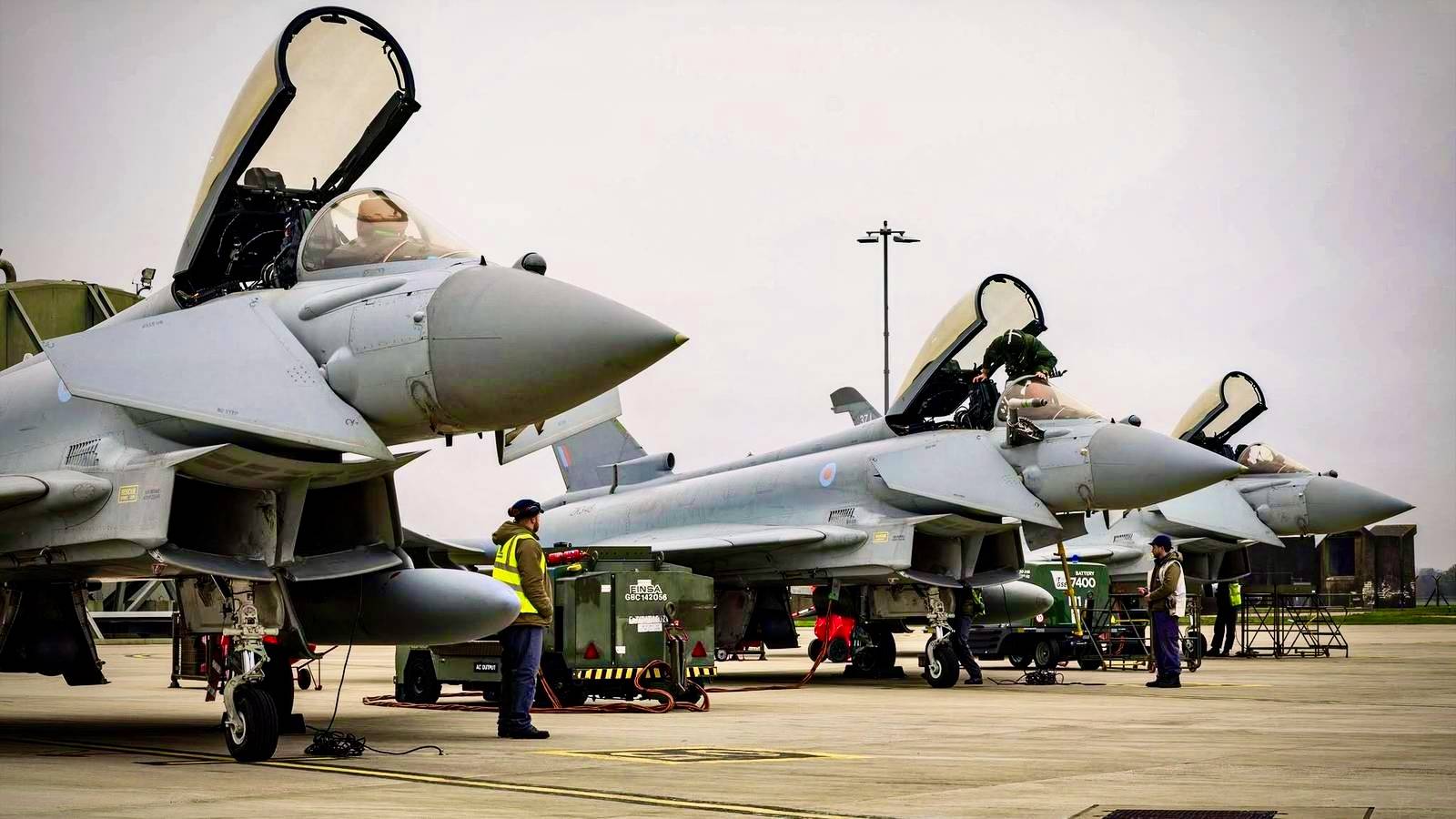
Published Aug 19, 2026, 1:00 PM EDT Luke Diaz is a freelance military writer with experience with active duty experience in the US Navy as well as defense and industrial engineering. He is a former Naval Flight Officer who performed tactical air control on the carrier-based E-2 Hawkeye. While the skies of the United Kingdom are peaceful almost every single day of the year, that doesn't mean that the Royal Air Force is resting on its laurels. Quick Reaction Alert fighter jets have only scrambled a handful of times in the past year to defend the UK's airspace, but the operational tempo is very different for the RAF Eurofighter Typhoons deployed to Romania. The past year for these QRA fighters saw them scramble dozens of times and fly combat patrols over Poland as well as shoot down a drone over Latvia. The long-standing joint NATO air policing mission escalated significantly in September 2025 after 19 Russian drones violated Polish airspace. Since then, the RAF has contributed fighters in rotating deployments to coalition forces across NATO's Eastern flank. The Baltic air policing mission was created in 2004 to fill a capability gap for three states with no fighter jets of their own. Today, there is a composite force at air bases in Estonia, Latvia, and Romania managed by the NATO integrated air and missile defense system. The RAF's fighter jets represent a critical component of the largest concentration of NATO Combat Air over the Eastern flank since the start of the full-scale Invasion of Ukraine. The Watch That Never Stops Credit: RAF With the ongoing war in Ukraine, the Baltic flank has increasingly become a crossfire zone. The QRA force is continuously scrambled to intercept, identify, and escort Russian military aircraft flying between mainland Russia and the Kaliningrad exclave. These planes routinely engage in provocative behaviors that threaten civilian aviation. At the same time, remote-pilot aircraft are an ongoing threat. Just recently, in the Spring of 2026, it struck an Estonian power station chimney and a Latvian oil storage facility. The illegal airspace penetration over Poland by Russian drones was the largest in scale to occur since the Russian military initiated open hostilities against Ukraine, but is far from the only incident. On June 8, a French Dassault Rafale fighter intercepted and shot down a drone roughly 20 miles from the border. NATO Command determined Russian electronic warfare had 'spoofed' the drone, which appeared to be of Ukrainian origin. Despite the United States slowly drawing down its force concentration, NATO has continued to maintain and reinforce its collective defense posture in the Baltic. Deployed units include the RAF's Typhoons as well as Eurofighters from Spain and Germany, and a mix of other fighter jets from Denmark, France, and Italy. The air policing operations flown by the RAF and other allied air forces are crucial to defend the Easternmost members of the coalition from a wide range of airborne threats. QRA jets primarily defend against unidentified Russian military aircraft that routinely violate international aviation safety rules and approach or breach NATO airspace. Even if there is not a threat from drones or missiles, Russian military aircraft often do not file a flight plan, refuse to communicate with a regional air traffic control, or fly with transponders turned off. So, even when they do not represent a direct military threat, the danger to other air traffic is real. Credit: RAF The Latest RAF Detachment of Typhoons and Romania touched down on March 31 under Operation Biloxi and was relieved just days ago on August 1. The 121 Expeditionary Air Wing conducted a handover ceremony at Borcea Air Base as the Spanish Air and Space Force assumed its Watch to defend Europeans along the embattled border. 121 Wing Commander Wicks-Randy gave these remarks on the occasion: "This deployment is a testament to the Dedication, Professionalism and Resilience of every member of the Detachment. Our personnel have delivered outstanding results whilst representing the Royal Air Force and NATO with distinction. The Typhoon may be the visible symbol of our operation, but it is the people behind the aircraft who make delivering NATO Air Policing possible." The latest tour of duty marked the sixth deployment of RAF Typhoons to Romania since 2014. These scheduled four-month rotations have always been designed to protect NATO airspace over the Black Sea, monitor Russian military movements, and prevent drone incursions. The conflict in Ukraine has raised the threat level, but defense analysts warn the Typhoon Force is being asked to do more with a shrinking and increasingly strained fleet. A parliamentary defense committee inquiry has probed the retirement of 30 Tranche 1 Typhoon Aircraft in 2025, questioning why sorely needed airplanes were decommissioned with years of service life left on their airframes. This left a heavily reduced frontline strength of just 107 active-service Typhoons to handle all home defense and NATO deployments. RAF Fighter Command: An Overstretched Force Credit: RAF The RAF's mission in Eastern Europe has significantly intensified since 2022, and that tempo has not slackened since. Operation Azotize to Estonia in 2023 conducted 21 interceptions of 56 Russian aircraft over four months. That tour included one day in June, when Typhoons were launched twice to intercept three Russian aircraft in a single day. Then, in June 2025, RAF Typhoons deployed to Poland intercepted 15 Russian aircraft in just six days. The RAF Typhoons flew alongside Swedish JAS-39 Gripens and, in between intercepts, German Airbus A400M tankers provided aerial refueling to the fighter jets. One pilot later commented: “This was an extremely busy scramble. Over the past few weeks, we have become accustomed to intercepting one aircraft and then being re-tasked to intercept a second. But intercepting a third aircraft in the same sortie is a first for me.” The intensity of these operations starkly contrasts with the complex fleet crisis and recruiting shortage for the RAF at home. While these developments remain strategically non-negotiable, maintaining them has severely overstrained the RAF's frontline resources. The RAF is pivoting away from procuring the American-made Lockheed Martin F-35 Joint Strike Fighters, but no timeline has been clearly established for a replacement. Simultaneously, the number of fully trained aircrew is critically low. Efforts are being made to improve the situation, but the RAF still has a critical deficit of frontline fast-jet pilots, heavily restricting its ability to sustain back-to-back rotations without burning out personnel. Attrition is most noticeable in mid-level career combat pilots, where recent numbers show a 30% shortfall. Bolstering The Home Front Credit: RAF Even before the Eastern Sentry missions began, the Typhoon fleet has been the first military tool committed to new crises by successive governments for the best part of a decade, according to the Royal United Services Institute for Defense and Security Studies. Regular operational flying over Iraq and Syria alongside Baltic air policing rotations, Falkland Islands duties, and Eastern-flank vigilance patrols has resulted in a force that is overstretched and worn out, showing declining aircraft availability. In parallel, the core driver of the RAF fast-jet pilot shortage is a systemic, multi-year failure of the UK Military Flying Training System. A fast-jet training process that is supposed to take two to three years frequently drags on for up to seven or eight years. While a highly publicized 2022 hiring policy made headlines, an investigation by the National Audit Office confirmed that the pipeline was failing to meet its targets long before that point. Once a pilot finally makes it through the eight-year training pipeline, the RAF struggles to keep them. Experienced Typhoon pilots who should ideally transition into instructor roles at RAF Valley are instead being retained by frontline squadrons to cover ongoing operational commitments like NATO air policing. The instructor deficit became so severe that the UK was forced to sign agreements to embed flying instructors from international partners, such as the Indian Air Force. You cannot train fast-jet pilots without operational training jets, and the RAF’s primary advanced trainer, the BAE Systems Hawk T2, is an antiquated airframe that is both a burden on the maintenance team and a poor instrument for training 4.5 and fifth-generation fighter pilots. These systemic issues have been assessed by the RAF's own analysts as producing a force running without the depth of spares or personnel. Supporting The Fighter Jockeys Credit: RAF Until the gap between aircraft and aircrew closes, every additional Baltic or Black Sea deployment is being flown, quite literally, on borrowed airframe hours. Driven heavily by the mandates of the recent Strategic Defense Review, the UK Government and Ministry of Defense have initiated a multi-billion-pound overhaul aimed at fixing pilot recruitment and retention as well as updating the frontline fleet. The Prime Minister's commitment to raise defense spending to 2.5% of GDP was cited directly alongside the RAF's first Operation Chessman Scramble in Poland in April 2025. The MOD has since signed a £205 million contract extension for technical and engineering support intended to keep the Typhoon fleet mission-ready. The pilots and ground crew of the RAF have risen to the challenges. Undaunted by the indefinite rotating commitment to the Eastern Sentry on top of an unchanged 24/7 home QRA posture, they continue to fulfill the mission with excellence. Now the race is on to support the frontline through policy and defense industrial reinvestment. Keeping the Typhoons combat-capable at all times is critical, with the Global Combat Air Program's Tempest successor not due to enter service until the mid-2030s.
The 24/7 RAF Mission That Protects NATO's Eastern Border
Full Article
Original Source
Read the full article at Simpleflying →KhanList aggregates and links to publicly available news content. We do not host full articles from third-party sources. Always verify important information with original sources.