
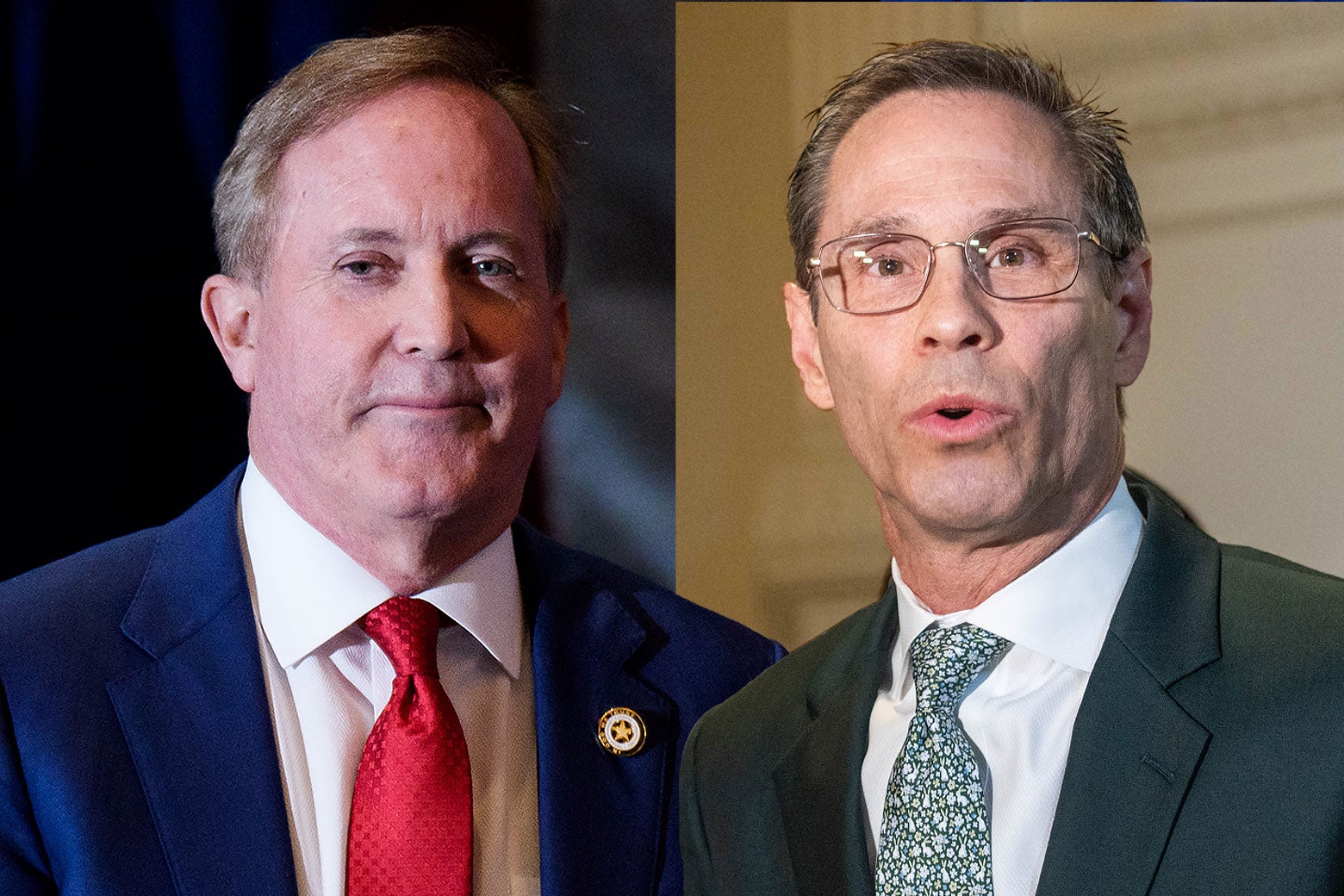
Jurisprudence The outgoing and incoming Texas AG. Photo illustration by Slate. Photos by Adam Gray/Getty Images and Mikala Compton/Austin American-Statesman via Getty Images. Sign up for the Slatest to get the most insightful analysis, criticism, and advice out there, delivered to your inbox daily. Amid all the coverage of the 2026 midterm elections, there’s one statewide result with big national implications that has gone mostly under the radar: Nathan Johnson’s victory in the race for Texas attorney general. That development is likely to have significant ramifications, both in the near term and for a future president’s ability to govern. Most significantly, it means that it will be harder for the conservative legal movement to direct its cases to handpicked judges in Texas. Let’s back up. Under Ken Paxton, the Texas attorney general’s office spent 12 years focused on litigating conservative causes célèbres against everyone from the Biden administration to local Texas officials and doctors across the country. At the same time, it outsourced the typical work of a state AG—enforcing the law—to expensive, politically connected law firms. The office in recent decades has also served as an influential incubator for conservative talent, counting former Texas Solicitor General and current Sen. Ted Cruz, multiple federal judges, and senior officials in Donald Trump’s Department of Justice among its alumni. No more. Attorney General–elect Johnson reportedly plans a major overhaul of the office, reorienting it away from serving as “MAGA’s own private law firm” to focus on issues that actually affect people in Texas. Although the office will no longer serve as a “headline-producing lawsuit machine,” Johnson has said, he will take action “if the federal government is breaking the law.” He has also indicated that he will take a close look at whether state officials let taxpayer dollars flow to Elon Musk without proper oversight or entered into improper contracts with politically connected law firms. These are welcome developments, and they may only be the start. Johnson’s term will run through January 2031. This means that if the next president is a Democrat, they will not have to contend with a Texas AG steering challenges to their policies to handpicked judges for at least the first two years of their term. Over the four years of the Biden administration, Paxton filed over 100 lawsuits against the federal government—four times as many as the next-most-litigious state, and more than any other single litigant—seeking to block progressive priorities on issues as wide-ranging as the rights of students in schools, privacy safeguards for those seeking reproductive care, protections for immigrant communities, and efforts to slow climate change. He wasn’t the only conservative AG, to be sure, but the size and reputation of the Texas AG’s office gave it an outsize role. The Texas AG’s office also had an advantage no other conservative AG had: the ability to funnel lawsuits directly to Texas’ conservative federal district courts, with review by the conservative U.S. Court of Appeals for the 5th Circuit. It could even pick specific judges by filing in the multiple Texas divisions that have only a single judge. Many went to infamous Chief District Judge Reed O’Connor in Wichita Falls—someone known for, among other things, attempting to strike down the Affordable Care Act and entering collusive immigration agreements between Texas and the Trump DOJ. Of Paxton’s lawsuits in Texas, 90 percent were guaranteed to go to either O’Connor, who was appointed by President George W. Bush, or a Trump appointee. Armed with favorable 5th Circuit judges above them, those district judges ruled against the Biden administration again and again—often with consequences for the entire country. The statistics tell the story: 37.1 percent of challenges to major Biden regulations were filed in the 5th Circuit. (Challenges to the rules that drew the most public attention landed in Texas a striking 62 percent of the time.) Challengers won roughly 80 percent of those cases—which is the sort of win rate you can put up only when you get to pick the referees. Now that the Texas AG’s office is out of play, other conservative AGs won’t have it so easy. Under the federal venue statute, a plaintiff against a federal agency can generally file suit only in a judicial district where the agency resides, where a substantial part of the events or omissions giving rise to the claim occurred, or where the plaintiff resides. Because most agencies are based in and conduct their business in the District of Columbia, a plaintiff can pick another venue only if that’s where they or a co-plaintiff happens to be located. Without Texas to anchor the coalition, other conservative AGs won’t be able to just waltz into Texas courts and seek injunctions on demand. Instead, they’ll be left to litigate in the federal courts of their own states. Don’t take my word for it; no less a conservative stalwart than Judge Matthew Kacsmaryk, another Paxton judge-shopping favorite, reached the same conclusion last year. After the Supreme Court overruled Kacsmaryk and held that the Alliance for Hippocratic Medicine lacked standing to challenge the availability of mifepristone (one of the two drugs commonly used in medication abortion), the states of Missouri, Idaho, and Kansas intervened to try to keep the case alive. Kacsmaryk acknowledged that “Missouri, Idaho, and Kansas do not reside in the Northern District of Texas,” and so transferred the case to the Eastern District of Missouri (a tactical choice in its own right, given that it landed before another Trump appointee). He even noted that venue “would have easily been satisfied” in Texas had the Texas AG’s office become involved sooner. But no Texas ties, no Texas courts. The importance of these obscure venue rules should be neither understated nor overstated. Whoever wins the presidency in 2028, the conservative litigation coalition will remain formidable. But that army will be lacking one of its main lieutenants and automatic access to its preferred battleground. Conservative state AGs are no doubt starting to think about work-arounds, like litigating side by side with conservative business interests (including the local affiliates of the Chamber of Commerce) and organizations that can manufacture residency in Texas. But those potential plaintiffs might face the same problem that doomed the Alliance for Hippocratic Medicine: standing to sue, which can be easier for states to establish in certain cases. Finding private entities that have both a concrete case for standing and an authentic connection to Texas may be harder than it looks. To the extent that litigants invoke doctrines like associational standing, which allows them to bring suit on behalf of their members, they should be required to identify specific members who operate in and are injured in Texas. Conservative state AGs will also continue filing cases in their own conservative judicial districts and circuits—expect to hear more about the 6th (Tennessee), 8th (Missouri), and 11th circuits (Alabama and Florida). Louisiana and Mississippi, meanwhile, still have the 5th Circuit—and favorable divisions of their own. The Supreme Court still looms over all. But Texas was first in its class for a reason, and this midterms’ ripples didn’t stop in Texas—AG offices appear to have flipped in Georgia, Iowa, Kansas, and Ohio, all of which were previously proud members of the conservative multistate coalition. Of course, flipping state AG offices alone won’t stop hostile judges dead set on preventing a future president from governing. If anything, this story should demonstrate how wild it is that a single state official can leverage handpicked judges to set national policy. Ending that sort of judge-shopping—by, for example, eliminating single-judge divisions or directing to a single court cases challenging nationwide policies—should be a core priority, alongside broader, more fundamental efforts at court reform. But in the meantime, you can pour a toast to the end of MAGA’s favorite personal law firm. Donald Trump Joe Biden Jurisprudence Supreme Court Texas Judiciary 2026 Midterms
The 2026 Midterms Removed the Biggest Thorn in Any Democratic President’s Side
Full Article
Original Source
Read the full article at Slate →KhanList aggregates and links to publicly available news content. We do not host full articles from third-party sources. Always verify important information with original sources.