
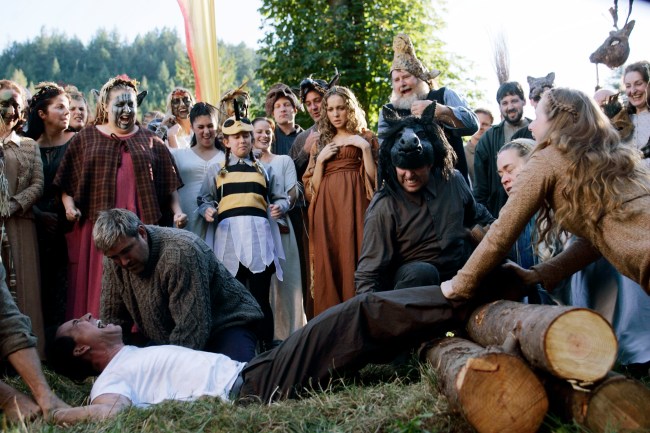
Reader, you have been lied to! Film history is littered with unfairly maligned classics, whether critics were too eager to review the making of rather than the finished product, or they suffered from underwhelming ad campaigns or general disinterest. Let’s revise our takes on some of these films from wrongheaded to the correct opinion. When filmmaker Neil LaBute signed on to write and direct a remake of the 1973 horror film “The Wicker Man” in 2006, both his fans and his detractors were surprised. Not that LaBute would be making a horror movie — after all, “In the Company of Men,” “Your Friends and Neighbors,” and “The Shape of Things” were all horror movies in a sense, disturbing pageants of trauma and sadism where the (human) monsters always won. The surprise came in the type and scale of horror movie LaBute was making: a big-budget Hollywood movie with a big star (Nicolas Cage) derived from preexisting IP. Coming from a fiercely personal writer/director whose only previous studio assignment had been the handsomely mounted literary adaptation “Possession,” “The Wicker Man” seemed like an odd career choice. Was LaBute just broke, or did he inject his own preoccupations into Anthony Shaffer’s tale of a policeman whose missing-person investigation on a remote island leads to his doom? I don’t know if he needed the payday, but I do know that the answer to the second half of the question was a resounding “yes.” Not only is “The Wicker Man” pure LaBute through and through, but it’s also, like Brian De Palma’s “Scarface,” John Carpenter’s “The Thing,” or David Cronenberg’s “The Fly,” a rare remake of a classic that’s actually superior to its source. Not that people thought so at the time. LaBute’s movie failed to make its money back at the box office and drew almost universal scorn from critics, most of whom compared it unfavorably with the original (conveniently forgetting that the original itself met with mixed reviews upon release). LaBute was nominated for a Golden Raspberry Award for Worst Screenplay, which in and of itself should be a marker of the film’s quality given the Razzies’ consistent knack for being on the wrong side of history. (Other nominees in that category over the years have included Blake Edwards, Oliver Stone, Elaine May, Norman Mailer, and Lawrence Kasdan.) As is so often the case, one of the very things that makes “The Wicker Man” great — its wild mix of tones — is also what made it misunderstood. The general consensus among those who didn’t get the movie was that it was silly and histrionic, that Nicolas Cage’s performance was over the top, and that scenes like the one where he infiltrates a cultish ceremony wearing a bear suit were ridiculous. Cage is over the top in the film, and the bear suit is funny. But why does this mean the movie is doing something wrong? To the contrary, LaBute and Cage clearly know exactly what they’re doing, and the movie’s power comes from the collision between a sense of genuine horror and a layer of playful black comedy — the same combo that characterized LaBute’s acclaimed debut, “In the Company of Men.” That’s also a movie where laughs come in inappropriate places, but Labute got the benefit of the doubt as an unknown with no corporate support. For some reason, when he does the same thing in a major studio movie, people view the idiosyncrasies as “mistakes.” ‘The Wicker Man’©Warner Bros/Courtesy Everett Collection The fact is that there’s as direct a line from a “pure” LaBute movie like “The Shape of Things” to “The Wicker Man” as there was from “In the Company of Men” to “Your Friends and Neighbors.” LaBute doesn’t just recreate the 1973 film; he reinvents it in ways that make it both more personal and more complex and resonant. The key alteration is that Cage’s cop character travels to an island dominated by a society of women. It’s a simple change, but it lets Labute extend and develop the inquiry into shifting power dynamics in heterosexual relationships that began with his first film and pervades nearly every film and play he ever wrote. The persistent charges of misogyny that have followed LaBute since the beginning are so poorly argued they’re barely worth dignifying. They largely seem to stem from the idea that because men are mean to women in LaBute’s work, the work itself must be misogynistic. The quickest way to counter the argument is to simply watch “In the Company of Men” and “Your Friends and Neighbors” and ask one simple question: Who comes off most badly in these movies? Spoiler: It’s not the women. While “The Shape of Things” does feature a woman who’s almost supernatural in her icy cruelty, taken in context alongside LaBute’s other work, I’d argue that if anything he’s a misanthrope and a cynic, not a misogynist. I’d also argue that given the Rachel Weisz character’s status as a kind of artist, “The Shape of Things” is as much a lacerating self-portrait as it is a statement about women — the movie is LaBute’s most potent examination of the ways in which artists justify the exploitation of their personal lives and their loved ones for the sake of their work. “The Wicker Man” is admittedly the director’s most challenging film when it comes to defending him against the accusations of misogyny, but the view of women as manipulative and self-interested is counterbalanced by the movie’s often hilarious take on male superiority and anxiety. Like the detective in the original film, Cage arrives on the island puffed up with the authority his gender and position have given him, and LaBute takes undeniable pleasure in spending the rest of the movie stripping Cage of his power, security, and sanity. ‘The Wicker Man’©Warner Bros/Courtesy Everett Collection This connects to another of LaBute’s big changes from the 1973 film: making Cage a troubled, compromised soul from the start. In the original movie, Edward Woodward plays the cop as a religious family man whose self-righteousness seems more or less justified. While this creates a starker contrast as the island residents taunt and torment him, it also makes for a less nuanced, interesting movie. Cage is already a mess when he gets to the island — the women just exploit what is already lying in wait beneath the phony masculine confidence on the surface. LaBute’s shifts in emphasis make his “Wicker Man” more complex and rewarding than the 1973 film, effective as it is. Then there’s the question of filmmaking prowess. By virtually any standard, the 2006 “Wicker Man” is simply a far more aesthetically rich movie than director Robin Hardy’s unsettling but somewhat plain original, exquisitely lit and composed. (Among the movie’s few accolades was an award for DP Paul Sarossy from the Canadian Society of Cinematographers.) LaBute has never really gotten his due as a stylist, possibly because his debut feature, “In the Company of Men,” had grain the size of basketballs and so little camera movement it made a routine episode of “Two and a Half Men” look like “Boogie Nights.” First impressions stick, and the impression “In the Company of Men” left behind was that of a great writer whose directorial style was basically just aiming the camera in the general direction of the actors to record them delivering his dialogue. But LaBute was just getting warmed up. Shot on a production budget of $25,000, “In the Company of Men” was a film whose ambitions far outstripped its resources, and its director would never make a movie as technically ramshackle again. His follow-up, “Your Friends & Neighbors,” was modestly budgeted at $5 million but enabled LaBute to shoot in ‘scope and with precise care when it came to color, blocking, and rhythm. A professed admirer of Godard’s “Contempt,” LaBute would go on to rival that film’s formal elegance in virtually everything he made afterward. That’s certainly true of “The Wicker Man,” a movie that fully utilizes its studio resources to create one expertly orchestrated frame after another. In the end, though, what gives the film its power is less its visual and aural flair than the deep sense of betrayal at its core. The cop’s ultimate fate in the original is motivated purely by economic necessity — he’s a human sacrifice the island needs for its crops to flourish. This is true of the remake as well, but LaBute’s changes to Cage’s character, and his addition of a personal connection to the island, add a chilling dimension the original lacks. The movie’s final moments carry the same authentic sense of horror found in the betrayals that climax “In the Company of Men” and “The Shape of Things,” and the reversal is perhaps even more powerful coming in the form of an ostensibly commercial, mainstream movie. Like Martin Scorsese’s “Cape Fear” or Spike Lee’s “Inside Man,” “The Wicker Man” is a genre movie given added potency by its filmmaker’s uncompromising sense of personal commitment. It also hints at what was to come in LaBute’s career, as he would ultimately lean into his knack for genre filmmaking — in recent years, all his movies have been thrillers or horror pictures, albeit with far fewer resources than “The Wicker Man.” “The Wicker Man” remains an artistic, if not commercial or critical, high point. Now that it just turned 20, maybe it’s time people finally acknowledged its virtues.
The 1973 ‘The Wicker Man’ Is a Classic, but Neil LaBute’s Loathed 2006 Remake Is Even Better
Full Article
Original Source
Read the full article at Indiewire →KhanList aggregates and links to publicly available news content. We do not host full articles from third-party sources. Always verify important information with original sources.