
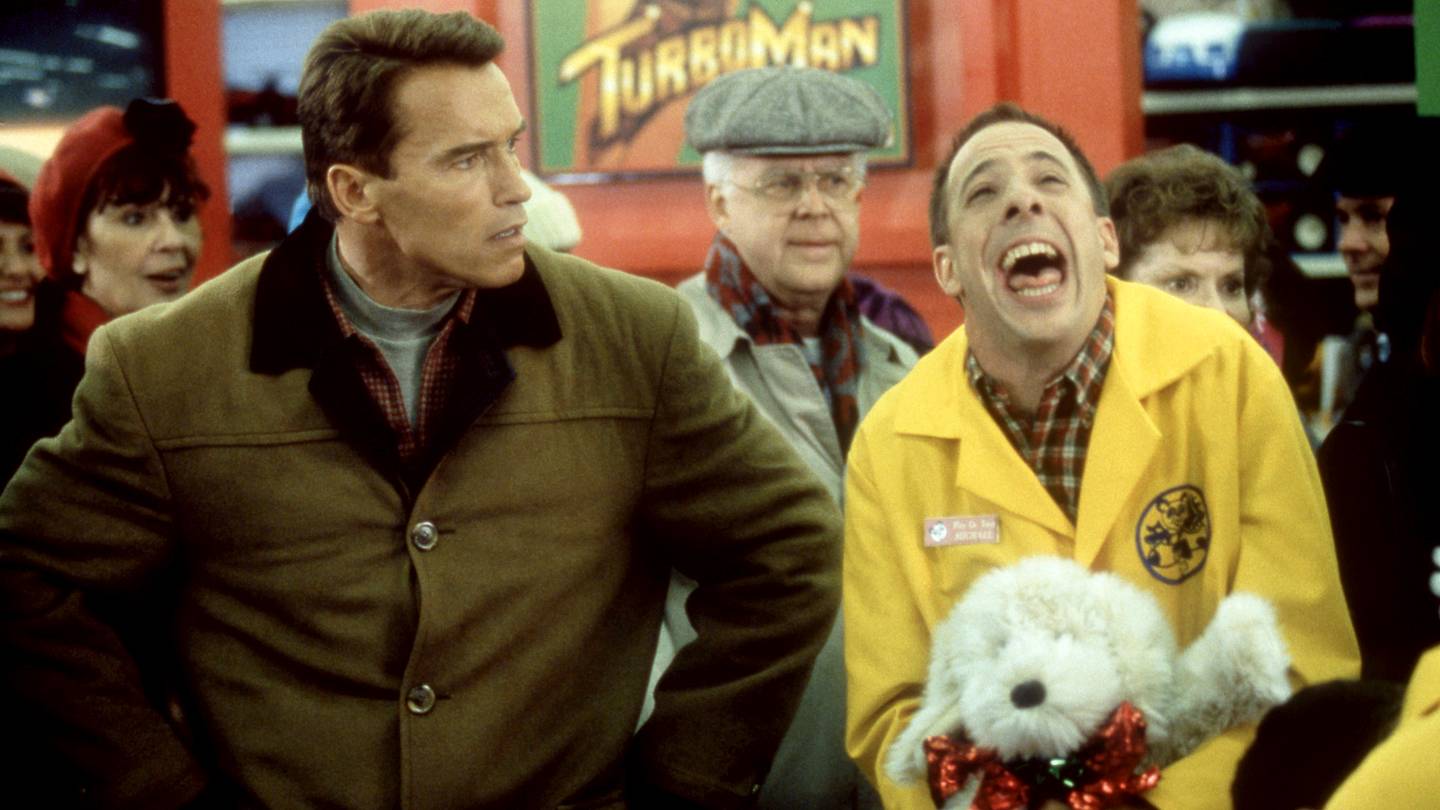
Jingle All the Way turns 30 on November 22, and the movie’s behind-the-scenes trivia includes a short entry on the plagiarism suit it drew. The full story runs more than six years, through a $19 million jury verdict and a Fox script reader who, according to the court, read both screenplays at the center of the case within a few months of each other.Two Dads and Two Action FiguresBrian Webster, a Detroit school teacher and aspiring screenwriter, got his idea in 1988, when he struggled to find a Golden Batman for his son, according to the Sixth Circuit’s 2004 opinion. His script went through three titles, from Action Man: The Toy to So This Is Christmas to Could This Be Christmas?, and told the story of a broke single mother who fights a wealthy real estate businesswoman over an Action Man figure.Randy Kornfield, a Fox script reader who freelanced as a screenwriter, had his own toy-store ordeal in 1993, when he tried to buy a Mighty Morphin Power Ranger for his son’s birthday. On January 11, 1994, he registered a six-page treatment called A Christmas Hunt with the Writers Guild of America. Less than a month later, Webster optioned his script to Murray Hill Publications, which sent it to Fox’s family film division that June. On July 9, a Fox reader named Rudy Romero summarized it, and the court noted that Romero, a friend of Kornfield’s, did the same job on Kornfield’s screenplay a few months later. Fox passed on Webster’s script on August 1, while Kornfield’s became the Arnold Schwarzenegger movie that, as of December 2000, had earned $183 million.Bob Riha Jr/GettyImages36 CoincidencesMurray Hill’s president, Robert Laurel, read about the movie in Daily Variety in early 1996, and the company sued Fox in federal court in Michigan in December 1997. “They both were about an African-American parent and a caucasian trying to find a toy for a son. And the toy in our script was Action Man, and in their script was Turbo Man,” Murray Hill attorney Mayer Morganroth told the BBC.During the six-week trial, a retired University of Michigan film professor testified that he’d found 36 points of overlap between the two scripts. “You can’t have 36 coincidences in an independently created work,” Laurel told the Associated Press when the jury sided with Murray Hill on March 6, 2001. A Fox spokeswoman countered that “Fox copied nothing, infringed nothing, and in no way violated any of the plaintiff’s rights,” and said the studio would appeal.The award added up to $19 million, and most of it was money the movie hadn’t made yet: jurors found Fox hadn’t turned a profit on Jingle All the Way, then estimated its future profits at $15 million and gave Murray Hill all of it. The rest covered lost producer’s and writer’s fees, lost goodwill, and $500,000 in soundtrack and toy merchandising. Judge Marianne Battani threw out everything but the producer’s and writer’s fees, which shrank the award to $1.5 million.Murray Close/GettyImagesSix Out of 24Both sides appealed, and on March 19, 2004, a three-judge panel of the Sixth Circuit took the rest of it away. Murray Hill’s case rested on an expert’s list of 24 similarities, and the court found that 18 of them were already in the treatment, written before anyone at Fox could be shown to have seen Webster’s script. The six left over were a child’s drawing, unhelpful toy store clerks, a nosy neighbor, and three details of a parent stealing the toy. “Each of these similarities is tenuous,” the court wrote, and a defendant who already had the same elements in its own earlier work had no reason, “beyond the illicit thrill of copyright infringement, to copy wrongfully from another what he could legally copy from himself.”It was the first time the Sixth Circuit had ruled that elements a defendant created before seeing the plaintiff’s work get filtered out of the comparison, the same way unprotectable elements are. The panel reversed and ordered judgment for Fox, with no new trial, and the court’s summary of the record includes one last detail about Webster’s script: after Fox turned it down in 1994, Murray Hill never tried to sell it again.Read More:
The $19 Million Verdict That Said Fox Stole 'Jingle All the Way'
Full Article
Original Source
Read the full article at Mentalfloss →KhanList aggregates and links to publicly available news content. We do not host full articles from third-party sources. Always verify important information with original sources.