
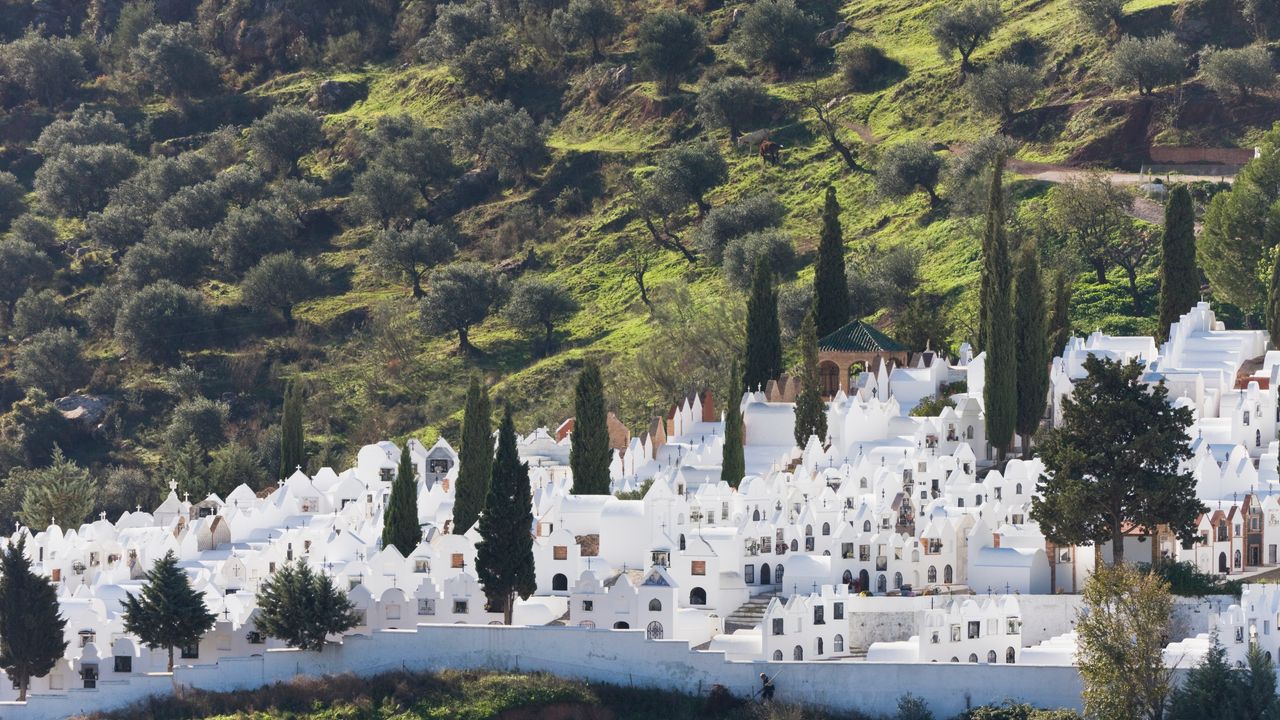
These breathtaking grave sites are to die forIn Casabermeja, a town in Málaga, Spain, the local cemetery appears more like a village than a graveyard.Photo: Education Images/Getty ImagesStrolling through a graveyard might seem like a macabre pastime, but choose the right one and you’ll get a whole different perspective on burial grounds. Beautiful cemeteries can captivate with their artistic and architectural elegance, entice with lessons in local history, and tantalize the senses with botanical delights. Take Málaga’s Monumental Cemetery of San Sebastian, in Spain, which overlooks the typical picturesque Andalusian countryside populated with olive groves. Or, join the bird-watchers who enjoy the Mount Auburn Cemetery in Massachusetts, which sits on the Atlantic Flyway, a major thoroughfare for fall (and spring) bird migration. This is just the beginning of these hauntingly stunning sites. Perfectly timed for Halloween, we’ve put together an array of beautiful cemeteries around the world that are sure to hold your interest, whether you simply want to meditate mindfully on the human condition or you’re an art, history, or nature enthusiast.Photo: Getty ImagesMirogoj Cemetery (Zagreb, Croatia)Likened to an open-air art gallery, Mirogoj is most noted for its grand neo-Renaissance, copper-domed arcades that give this burial ground a fortress-like appearance from the outside. Designed by architect Hermann Bollé, the site dates to 1876 and is currently undergoing restoration following a major earthquake in 2020. Art lovers roaming the tree-lined avenues will also notice the elaborate funereal monuments of respected sculptors, such as Antun Augustincic’s creation: the bronze bust depicting Zlatko Balokovic, an eminent violinist.Photo: Getty ImagesHietaniemi Cemetery (Helsinki, Finland)Set on a peninsula extending into the Baltic Sea, this wooded graveyard—mere steps from a popular sandy beach—offers a window into Finnish history and culture. Many dignitaries, including almost all of the country’s former presidents, are permanent residents, as are soldiers who fell during WWII and other conflicts. The tombs clustered on Artists’ Hill are a veritable who’s who of Finland’s illustrious creatives, from poets to actors to composers. Here, visitors will also find the grave of influential Finnish architect Alvar Aalto. His includes half of an ionic capital on it, likely reflecting his lifelong love of Italy.Photo: Getty ImagesMount Auburn Cemetery (Cambridge, Massachusetts, USA)Mount Auburn, which dates to 1831, is the first cemetery in the US to inter the deceased in a serene, rural, natural landscape, giving rise to the garden cemetery movement, which created parklike burials instead of those in churchyards. Stunning sepulchral works carved by notable American artists meld with this bucolic landscape that retains its natural geological contours formed during the last Ice Age. Sculptor Thomas Crawford’s marble memorial to physician-naturalist Amos Binney is a notable highlight. Depicting carved drapery, a soul ascending into Heaven, and a mourning figure, it’s the only piece at the site designated an “American Treasure” by the National Trust for Historic Preservation.Photo: Education Images/Getty ImagesMonumental Cemetery of San Sebastian (Casabermeja, Málaga, Spain)Perched on a hillside stands a whitewashed “village” of sorts with decidedly quieter inhabitants compared to Andalusia’s typical villages. Slim, pebble-paved lanes and stepped sidewalks follow the undulating slope as they weave past rows of cream, above-ground burial vaults that resemble petite houses complete with doorways, windows, and roofs. On the lowest level of these resting places is the coffin, followed by the tombstone, sometimes protected by a grill or glass, on the second level. The exterior is finished with a wrought-iron cross.Photo: Krista Rossow/Getty ImagesOakland Cemetery (Atlanta, Georgia, USA)The paths winding through this Victorian-era garden cemetery allow visitors to not only soak up the history of Atlanta but also become enthralled with the variety of foliage and landscape design, as well as funerary art and architecture. Among the more elaborate mausoleums is one decorated with Tiffany stained-glass windows and another displaying bat-winged, gargoyle-like creatures. This 48-acre property is a well-loved public arboretum, dense with oaks and magnolias. The fall is an especially colorful time to visit when the native sourwoods display their brilliant red leaves, and dogwoods as well as azaleas and mums are in bloom.Photo: Martin Bernetti/Getty ImagesPunta Arenas Cemetery (Punta Arenas, Chile)Officially known as the Sara Braun Municipal Cemetery, to acknowledge part of the legacy of this prominent philanthropist, this sprawling necropolis appeals to history buffs and nature lovers alike. Hundreds of tall, precisely pruned cypress trees flank the paths lacing the manicured grounds that are peppered with disparate styles of grave markers. The medley of funerary structures mirrors the diversity of social classes, from the austere headstones of laborers and merchants who migrated to the city, to the opulent mausoleums and Gothic-style detailing of prominent aristocrats.Photo: Hugh ThompsonHighgate Cemetery (London, UK)Highgate cemetery is the final home for a number of famous residents, including singer-songwriter George Michael, who passed away in 2016, and philosopher Karl Marx. But there are many other reasons to visit. Guided tours of the West Cemetery take you to mausoleums and the Terrace Catacombs (thought to comprise England’s earliest surviving asphalted building). Talks by authors about history, art, and Victorian topics are hosted often and published on the cemetery’s website.Photo: Courtesy of the Unitarian Church in CharlestonUnitarian Church in Charleston (Charleston, South Carolina, USA)Behind an unassuming iron gate off of King Street, this churchyard—with wildflowers, Spanish moss, camellias, and crepe myrtles—is connected to the Unitarian Church in Charleston, whose English Perpendicular Gothic Revival structure dates back to 1787 and is a National Historic Landmark. Volunteer docents lead tours of the sanctuary (featuring a fan-vaulted ceiling and hand-painted glass windows) between September and mid-June on Saturdays and Sundays.Photo: Page Light Studios/Getty ImagesSt. Louis No. 1 (New Orleans, Louisiana, USA)New Orleans is known for its cemeteries filled with ornate tombs and wall vaults. The oldest of these landmarks is St. Louis No. 1, which was founded in the late 1700s and is the burial site of many prominent New Orleans families (and the future resting place of Nicolas Cage, who already built a pyramid mausoleum for himself). The maze of vaults was featured in the movies The Cincinnati Kid and Easy Rider.Photo: Alamy Stock PhotoPère Lachaise (Paris, France)The establishment of Paris’s largest, and now most visited, cemetery in 1804 determined what a fashionable burial would look like for the better part of the next century. The sprawling grounds and contemplative paths drew the attention of curious and pioneering spirits, but it was the transfer of the remains of the tragic romantic figures Héloïse and Abélard that solidified Père Lachaise Cemetery and its daring garden-like design as the blueprint for a new urban staple—the public cemetery. Rock ballads and witticisms can sometimes be heard echoing through the tombs today as guests pay their respects to two of the cemetery’s most visited permanent residents: Jim Morrison and Oscar Wilde.Photo: Alamy Stock PhotoPanteón Antiguo (Santa Cruz Xoxocotlán, Mexico)Every year on October 31, the haphazard byways of the 17th-century cemetery become one of the busiest neighborhoods in Mexico’s Oaxaca region. Surrounded by the crumbling churchyard walls, the families and friends of the deceased begin preparations to break bread with the spirits of their forebearers. For the residents of Santa Cruz Xoxocotlán, walking among the dead is not a novelty but a tradition.Photo: Getty Images/Lonely Planet ImagesSouth Park Street Cemetery (Kolkata, India)On Kolkata’s South Park Street in the Indian state of West Bengal, the lush South Asian flora twines around Ionic columns and domed roofs in an unexpected juxtaposition. The largely Gothic architecture peppered with Indo-Saracenic motifs is a quiet reminder of some of the country’s earliest European colonizers, who established the cemetery in the late 18th century. Foremost among the challenges that the British faced in India were tropical disease and the ensuing necessity for hygienic burials. Though simple stone tombs may have sufficed, the colonizers opted for more elaborate structures.Photo: Alamy Stock PhotoLa Paz Cemetery (La Paz, Bolivia)In this town, which was established in the 16th century, burial is not the final farewell. Instead, the dead book a date with their living relatives 10 years into their interment, at which point their remains are exhumed, cremated, and put on display behind glass panels in the cemetery’s walls. Families commission plaques and flowers to decorate these niches for their loved ones and, of course, to be sure that their ancestors are not outdone by their neighbors.Photo: Alamy Stock PhotoOkunoin Cemetery (Koyasan, Japan)Kōbō-Daishi, the founder of Shingon Buddhism, is believed to lie in eternal meditation at the heart of this UNESCO World Heritage Site, which is said to have been established in the 9th century. The cemetery is best visited at night, when the stone lanterns and looming cedar trunks flanking the pathway make the site feel like another realm. Small statues of the the Jizo Bodhisattva are said to bring protection and guidance for loved ones crossing over.
The 17 Most Beautiful Cemeteries Around the World That Are Spellbindingly Stunning—Including 4 in the US
Full Article
Original Source
Read the full article at Architecturaldigest →KhanList aggregates and links to publicly available news content. We do not host full articles from third-party sources. Always verify important information with original sources.