
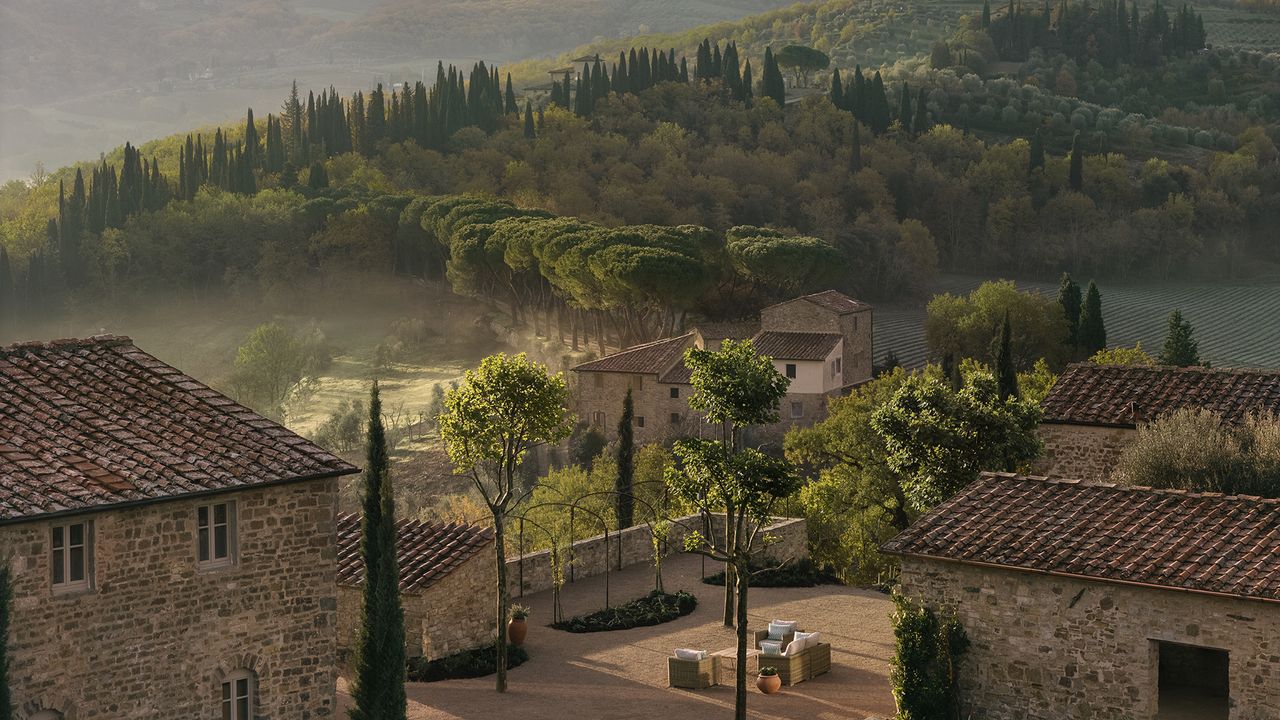
From villages transformed into resort hotels to small boutique boltholes nestled in hilltop towns.Tobias Kaser PhotographyItaly isn't short on beautiful places to stay, and some of the best hotels in Tuscany are also some of the best in the country. Not long ago, a trip to rural Tuscany meant you were either renting a villa or staying in a drafty castle that had been turned into a “luxury hotel” with Medieval plumbing. How different things are now.Since its first cautious steps in the 1990s, the new Tuscan hotel scene has grown by leaps and bounds. Some of those who have opened stylish places to stay amidst the region’s cypress-studded hills are wine producers; some come from the world of fashion, while others arrived here from far-flung lands and simply fell in love with the place. The result is a varied offering that stretches from whole rural villages transformed into resort hotels to small boutique offerings within the walls of charming hilltop towns. Here, we harvest some of the best hotels in rural Tuscany and Umbria.Our top picksMore editor-recommended hotels in TuscanyFrequently asked questionsMore Tuscany recommendationsOur top picks:Best for couples: Villa San Michele, A Belmond Hotel, FlorenceBest for families: Rosewood Castiglion del Bosco, MontelcinoBest for a boutique stay: Lupaia, SienaCastelfalfiLocation: MontaioneBeauty, comfort, and a vibe of breezy ease are axiomatic at Castelfalfi. Ditto flattering lighting and delectable food. At the whole-village resort, which sprawls over 2,700 acres and has 146 rooms, one main cobblestoned street leads down from the castle to a 13th-century church, a row of boutiques, gelaterias, and pizzerias, and the two hotel buildings. The older of the two—a repurposed 19th-century tobacco warehouse—sits opposite the 1980s-built low-slung main building, which has sublime valley views. This houses the Bar Ecrù & Lounge, one of four restaurants, as well as the indoor pool and spa.Along with outdoor pools and a Montessori kids club, there’s a woodland adventure center, a wine and olive oil tasting setup, and isolated farmhouses operating as villas and apartments with pools. A key attraction is the activity program that offers over 40 experiences, including archery, beekeeping, truffle hunting, falconry, cooking, Pilates, and yoga. Transformed by the Milan design company Caberon Caroppi, rooms are fragrant and understated, with a mix of textures—velvet, leather, marble—and a muted earthy palette, silky bed linens, and sculptural Paolo Castelli furnishings. Executive chef Davide De Simone ensures the partially farm-to-table menus include ingredients grown on the resort’s farms. —Adrianne PielouRead Full ReviewHotel Il PellicanoLocation: Porto ErcoleFor more than 60 years, Il Pellicano has been an icon of Italian hospitality. Opened on the wild slopes of Monte Argentario in 1965 by English-American couple Michael and Patsy Graham, it was purchased in 1979 by Roberto Sciò, who had been in love with the place ever since he first frequented it alongside the jet set of the time. The guest list has always been a strong point, but with the arrival of Roberto’s daughter, Marie-Louise Sciò, as new leadership, the hotel’s image has been refreshed, thanks in large part to the book Hotel Il Pellicano, which contains photos by Juergen Teller (in addition to earlier ones by Slim Aarons). The volume has helped to attract a new generation of bohemians from all over the world.This corner of Tuscany is far from Positano; here, there are no designer boutiques. Instead, those who travel here do so because of its slightly magical atmosphere paired with impeccable service, meticulous design, a Michelin-starred restaurant, a new boat, and a boutique that wonderfully expresses the style of the hotel and, more broadly, a certain vision of an Italian holiday. —Sara MagroRead Full ReviewVilla San Michele, A Belmond HotelLocation: FiesoleLocated in the hills outside of Florence, Villa San Michele is one of Tuscany's many fairy-tale-like properties, this time in the form of a 15th-century monastery turned villa. Everything about it feels like a dream, from the drive to the property to standing on its grounds and admiring the architecture. Rooms are monastery chic: understated luxury with beautiful architecture. There are vaulted ceilings, beautiful glass window panes, and period furniture. Less is absolutely more here. Bathrooms are beautiful marble with separate showers and large sunken tubs. The view is the wow factor, though, along with the superb staff. There is a lovely pool where you can get a massage, a 24/7 gym kitted out with TechnoGym machines, and cooking classes are also on offer. You'll want for nothing here. —Nicky SwallowRead Full ReviewLupaiaLocation: Torrita di SienaThis is an idyllic location for focusing on wellness and connecting with the people and land around you—especially as a pit stop in between the hustle and bustle of other lively Italian cities. Each of the four rooms and eight suites is as unique and unforgettable as the last, with scenic views; a balanced mix of vintage materials, including oak beams, rustic stones, and antique mirrors; and modern elements, from restored wood furniture to Tuscan tiles, locally sourced lighting, and ceramics. It's a destination in and of itself with everything you could need on site: private cooking classes, wine and olive oil tastings, picnics in the olive grove, truffle hunting, e-bike tours, honeybee exploration, and more. Should you want to venture off the property, the towns of Montepulciano and Pienza are a 15-minute drive by car and offer rich Italian history and some of the area's best Pecorino cheese. —Taylor MeadRead Full ReviewLa Darbia ChiantiLocation: Greve in ChiantiPerched on a hilltop in the heart of Tuscany, La Darbia occupies an idyllic sweep of land that spans 37 acres of olive groves, woodland, wildflower meadows, and undulating lavender fields. Scattered throughout are 17 suites unfolding across the hillside in clusters of ancient stone farmhouses. No two rooms are alike, their proportions and personalities dictated by the quirks of the original buildings, but all claim equally lovely views. Some occupy the farmhouses on the lower slope, overlooking the cobbled courtyard and Mediterranean herb gardens, while others are slightly further up and offer panoramic views of the Panzano valley. Ambling down to breakfast from my hilltop suite, past fragrant herbs and wildflowers, I felt like I was staying in a little Tuscan village rather than a hotel or retreat. Meals are served at the terrace restaurant, with views stretching towards the hilltop bastion of Panzano. Executive chef Sebastiano Pagliaro oversees an ever-changing menu that draws on Chianti's rich agricultural heritage and the nearby Tuscan coast, showcasing regional cheeses, local meats, and freshly caught fish from Livorno. If your preferred vacation pace involves doing very little, this is an excellent place for it. La Darbia is as much about being immersed in the landscape as it is any organized activity, and most guests seem content to simply spend time outdoors. —Laura KettlewellRead Full ReviewCastiglion del Bosco, A Rosewood HotelLocation: MontalcinoAt Castiglion del Bosco, suites and villas are authentically ancient from the outside, and sensuous, modern, and smart on the inside. Here, red wine is globally renowned among oenophiles and crafted at the working vineyard. The food—specifically the wild boar and truffle pasta—is last meal worthy. Among the guests you’ll find a mix of Italians, Europeans, and Americans dripping with good taste— including, at one point, former president Barack Obama. Such a crowd, blended with the fantastically attractive surroundings, immediately inspires connotations of cult tragi-drama White Lotus, minus the simmering tension and murder mystery.17th- and 18th-century villas have been restored to feel like an understated yet ravishing home rather than a hotel. Little touches ensure this: mismatched sun hats for guests, framed photos and artworks, and some surprisingly bold kitchen tiles, combined with marbles, antiques, and fabrics that reflect the warm colors of the rolling Tuscan hills outside (best marveled at from each villa’s private heated pool). The 42 suites have towering ceilings, wooden beams, tastefully pared-back four-poster beds, and roomy terraces to spread out on. The majority of staff, both on-site and in the spa, are local, and while such a prestigious location could be intimidating, instead, the team ensures you feel constantly welcomed and cared for. —Becky LucasRead Full ReviewBorgo Santo PietroLocation: ChiusdinoAn Edenic combination of escapism and reconnection can be found at Borgo Santo Pietro. Unlike at some resorts, visitors here don’t block out the destination once they check in. The 300-acre estate is in Chiusdino, on the more rugged side of Tuscany, and feels like a microcosm of the region itself. The ricotta at dinner comes from the sheep you’ve spied on long walks through farms and forests; the fields of lavender and marigold provide ingredients for the face oils at the spa. None of this is to say that Borgo Santo Pietro isn’t sharp. Everything is done with a very Italian elegance: the manicured gardens and landscaped pool; the staff who appear with a spritz and silver tray of truffled chips simply because they thought you needed it; the Trattoria sull’Albero, with its thick oak tree rising in the middle. During the harvest season, guests can pluck and stomp grapes at Borgo’s tumble of vineyards. There’s a six-foot-deep swimming hole in the middle of a rushing stream. It’s on the property but open to use by the 30 or so locals from a nearby village. Closer to the guest villas is a tall canopied wall beside the vegetable gardens, along which pilgrims in the Middle Ages trekked to the nearby Abbey of San Galgano. My stay was an opportunity to explore a pocket of wild southern Tuscany, thrillingly alone and free, without ever needing to backtrack through the great wide entrance gates. —Erin FlorioRead Full ReviewIl SalviatinoLocation: FiesoleIl Salviatino is the expression of the creative spirit of the eclectic Alessandra Rovati Vitali, who bought this 15th-century villa on the slopes of Fiesole, Italy, and transformed it into a workshop for her vision of beauty, elegance, style, and hospitality. Every corner of this aristocratic country residence is unique, filled with fine fabrics, artwork, and design pieces selected with a hostess’s touch. Meals are served with views of Brunelleschi’s dome, framed by the Italian garden and the 30 acres of private parkland. Six suites are nestled in former greenhouses: With retro portraits, bohemian sofas, and powder-pink terra-cotta floors, they bask in the natural light that animates every surface. The marble and wooden spa is bookable for two. Small but complete, it’s a haven of peace. Though located in Florence, Il Salviatino feels worlds away. —S.M.Read Full ReviewLa RoqqaLocation: Porto ErcoleIt’s been eons since a new hotel graced Porto Ercole, a chic but discreet village on the Monte Argentario peninsula that’s home to Caravaggio’s tomb. La Roqqa, a cliffside retreat whose distinctive coral-orange façade and secluded views of the Tyrrhenian Sea created ripples upon opening in 2023, has provided a forward-looking alternative to Hotel Il Pellicano (which you'll see below), the area’s sine qua non grande dame since 1965.In the 55 rooms and suites, floor-to-ceiling windows let sunshine flood onto walls of sage green or Terra di Siena orange, which pop against crisp white bed linens. Designers Palomba Serafini, Milanese masters of uncluttered contemporary chic, have mixed midcentury pieces and Gaetano Pesce’s iconic Up chairs with ultramodern features, including an eye-catching white central staircase spiraling from the entrance. On the alfresco rooftop, Ferragamo-clad locals sip Negronis gilded by sunset rays in view of the 16th-century Forte Stella and harbor yachts below.Aperitivo hour turns into dinner at the outdoor Scirocco restaurant, where chef Francesco Ferretti knocks up fresh sea bass and other local seafood capped with Venetian grappa. Days spent lounging at the hotel’s smart Isolotto Beach Club are broken up by lunches of avocado and tuna salads paired with a local white. Or you can ask friendly staff to book you a Vespa tour along the rugged coast. It’s la dolce vita reimagined for the next generation. —E.F.Read Full ReviewBorgo dei Conti ResortLocation: Boschetto VecchioLocated on a modest Umbrian backroad halfway between Perugia and Città della Pieve, Borgo dei Conti Resort can finally take its place among Italy’s great country hotels now that a head-to-toe redesign has made its pleasant but modest previous incarnation a distant memory. Unveiled in July 2024, the reboot draws inspiration from the deep, intense color palette of two Renaissance painters with an Umbrian connection, Perugino and Raphael. Original details, including frescoed wall friezes, are complemented by fabrics and fittings that draw on Umbria’s still vibrant artisanal manufacturing traditions, among them smoky terra-cotta bathroom tiles and headboards made from textiles woven on handlooms in Perugia. In the summer heat, the capacious outdoor infinity pool comes into its own, but the resort’s forest walking trails, two restaurants, and a spa that seems to go on forever make it a perfect long weekend destination even at the cooler extremes of its April to November seasonal opening.Read Full ReviewHotel Castello di ReschioLocation: Lisciano NicconeHotel Castello di Reschio, an 11th-century castle on a hilltop on the Tuscany-Umbria border, comprises 3,700 quite outrageously beautiful acres of rolling hills, olive groves, vineyards, forest, farm buildings, and, looming darkly over it all, a curtain-walled 11th-century castle. The most radical of the many changes Castello di Reschio has undergone in its long history is the most recent: its transformation from a place designed to keep people out to one redesigned to welcome them in. After a thousand or so years as a fortress, the castle opened in 2021 as a 36-room hotel. The success of its reinvention has to do entirely with its owner-proprietors, Count Benedikt Bolza, an architect and designer, and his wife, Donna Nencia Corsini, an artist and environmentalist.The hotel is a lucid expression in three dimensions—in wood and stone and bronze, in silk and velvet and linen, in wildflowers and works of art and kooky knickknacks—of the couple’s shared enthusiasms, their style, their outlook on life. Castello di Reschio works brilliantly as a hotel and does all the things that a top hotel must do. (Is there a chicer palm-court bar, a more astonishing spa, or a lovelier swimming pool in rural Italy? Or anywhere?) More than that, the castle-hotel is just one part of the much larger Reschio story, the point of entry into what has often—predictably, though not without reason—been characterized as a modern-day fairy tale. –Steve KingRead Full ReviewCastello di VicarelloLocation: Poggi del SassoThis go-slow country retreat might just be the most romantic hotel in Italy. The Baccheschi Berti family bought it in 1980 after growing tired of their gallivanting life in Milan, going on to restore the sprawling 12th-century castle into an under-the-radar escape. Each of the eight suites is gorgeous; some with rustic spiral staircases, others with enormous freestanding tubs beneath wood-beamed ceilings, gorgeous velvet upholstered armchairs, and endless little corners for reading and gazing at the enduringly bucolic views. This is, after all, the family’s home, and old photographs are displayed among curios gathered from their travels: little taxidermy birds and well-thumbed volumes of Architectural Digest on antique wooden tables.The airy flagstone kitchen isn’t a restaurant; rather, it’s a place for guests to gather around long wooden tables. Instead of menus, the day’s freshest farm-to-fork ingredients sourced from the estate are cooked up: wild boar, eggs scooped from the chicken coop, and freshly baked cakes made of windfall apples from the trees outside. Everyone is encouraged to poke their head in for an impromptu cooking lesson throughout the day—or perhaps mix a blood-orange Negroni from the honesty bar. The land around here is made for exploring, with gentle hiking trails, streams, and two pools tucked into the hillside; one carved from cooling marble, the other beside the spa gazebo overlooking stands of olive trees. Among all the big castle renovations and hamlet reimaginings on the Tuscan hotel scene, this is a smaller, completely personal, utterly spoiling alternative. –Sophie GoodwinRead Full ReviewVocabolo MoscatelliLocation: CalzolaroRelaxed luxury is the name of the game at this intimate member of Design Hotels in a restored monastery in Umbria. The hotel is set on a two-and-a-half-acre estate planted with a vegetable garden and replete with manicured lawns where dogs can play. A hub for the local community, this hotel draws Italians and ex-pats from the neighboring towns, who come to sip creative cocktails at the bar, enjoy Sunday lunch at the restaurant, or attend events hosted by the owners.There are just 12 rooms, which juxtapose the ancient monastery’s stone walls with sleek contemporary art and design. The beds, for example, are each bespoke creations in minimalist silhouettes and bold colors made by fourth-generation ironsmith Emanuele Lispi. In the afternoon and evening, the on-site restaurant transforms into a showcase for the chef, who brings Middle Eastern and Asian flavors to this very traditional part of Italy. Start with a cocktail or glass of wine in the lounge, which feels more like a living room than a hotel bar, and then settle in for a culinary voyage in the restaurant, where you might start with ramen in Umbrian beef broth with smoked duck breast and end with bread pudding with ricotta, pistachios, and vanilla cream perfumed with rose water. —Laura ItzkowitzRead Full ReviewBelmond Castello di CasoleLocation: Casole d'ElsaThis imposing, buff-colored castle in Casole d'Elsa may date back more than 1,000 years, but its heyday wasn't until the 1960s, when it was bought by Edoardo Visconti di Modrone Erba—the brother of Italian film director Luchino Visconti—who hosted parties for Hollywood stars and the Euro elite. Today, after a full restoration and an acquisition by Belmond in 2018, the castle and its 3,200-acre estate are run impeccably as a hotel.Despite the shiny, branded management, there's a sensitivity to the design and an attempt at a Tuscan style that prevents it from feeling too overtly plush or featureless. 16 of the 39 bedrooms are in the historic main building, all traditionally furnished with ornately carved wooden beds, exposed honeyed-brick walls, and Carrara marble bathrooms. The rest of the rooms—the Limonaia suites, previously housing lemon trees in the winter, and the nine Etruria suites, which were constructed by Italian designer Alessandro Mendini—have been converted and are more contemporary. In the terrific Essere Spa, there are hot-stone massages and deep-cleansing facials beneath barrel-vaulted ceilings.Read Full ReviewBorgo San FeliceLocation: Castelnuovo BerardengaWhen is a hotel not just a hotel? When it’s a village. Here, at harvest time, grapes are still offloaded in the main piazza. A cute 19th-century chapel hosts regular art shows. And the kitchen gardens just below what was once a rural hamlet—gardens that supply the hotel’s Michelin-starred Poggio Rosso restaurant and more informal Osteria del Grigio—are still abuzz with life thanks to a horticultural project that pairs young local people with cognitive disabilities and retired agricultural workers.When it opened in 1990, Borgo San Felice was a pioneering Italian “albergo diffuso” (the term refers to a hotel spread out across a pre-existing community, often a depopulated village). It’s kept an edge today thanks to a major three-year renovation, wrapped in 2021, which added 11 guest rooms and suites and brought studio ArchFlorence in to give the whole place a country-chic makeover. The persuasive result feels like it’s the house of that art-collecting, polo-playing Tuscan uncle you never knew you had.Read Full ReviewFAQ:How many days do you need in Tuscany?Planning a trip to Tuscany can be overwhelming. Beyond the postcard picture of Tuscany’s Val d’Orcia, with its cypress trees and rolling hills, the dreamy Italian region is also home to emerald-colored waters, secluded bays, dreamy islands and delicious food alongside stony villages steeped in history and exquisite culinary joints to visit.We recommend booking a seven-day trip so that you can experience all that Tuscany has to offer. You'll want to enjoy your Tuscan country hotel, but leave plenty of time to explore Cortona and Siena, with stops at the legendary vineyards of Chianti and Montepulciano. For more inspiration, see our edit of the best things to do in Tuscany.What is the best month to visit Tuscany?We'd recommend visiting in spring (April to May) or early fall (September) as the weather tends to be at its mildest during these months. June is also lovely if you want to see the sunflower blooms, with temperatures averaging 81˚F. Tuscany is always beautiful but the summer months (July-August) see increasing temperatures with the daily average maximum sitting at 86˚C.How we choose the best hotels in Tuscany:Every hotel on this list has been selected independently by our editors and written by a Condé Nast Traveler journalist who knows the destination and has stayed at that property. When choosing hotels, our editors consider both luxury properties and boutique and lesser-known properties that offer an authentic and insider experience of a destination. We’re always looking for beautiful design, a great location, and warm service—as well as serious sustainability credentials. We update this list regularly as new hotels open and existing ones evolve.More Tuscany recommendations:The Best Vineyards to Stay at in TuscanyThe Best Family-Friendly Hotels in TuscanyThe Best Villas in TuscanyThe Best Airbnbs in TuscanyThe Best Hotels in FlorenceThe Best Affordable Hotels in FlorenceThe Best Airbnbs in Florence A portion of this story originally appeared on Condé Nast Traveller UK. It has been updated with new information since its original publish date. Additional reporting by Alex Erdekian.More hotels nearbyItaly, Grosseto, Terme di SaturniaItalians from across the country flock to the famously magical Saturnian waters.Powered By: Terme di Saturnia$$$ | Italy, Florence, Lungarno degli Acciaiuoli, 4An elegant boutique hotel steps from the Ponte Vecchio, with an atmosphere that will have you feeling like a chic 1950s starlet on a secret vacation.$$$ | Italy, Florence, Borgo San JacopoThe Hotel Lungarno is set on prime real estate right on the south bank of the River Arno and steps from the Ponte Vecchio, yet it still makes you feel you've escaped the hectic life of the city.Four Seasons Hotel Firenze$$$ | Italy, Florence, Borgo Pinti, 99Channel your inner Tuscan aristocrat.
The 15 Best Hotels in Tuscany Where the Rooms Are as Great as the Wine
Full Article
Original Source
Read the full article at Cntraveler →KhanList aggregates and links to publicly available news content. We do not host full articles from third-party sources. Always verify important information with original sources.