
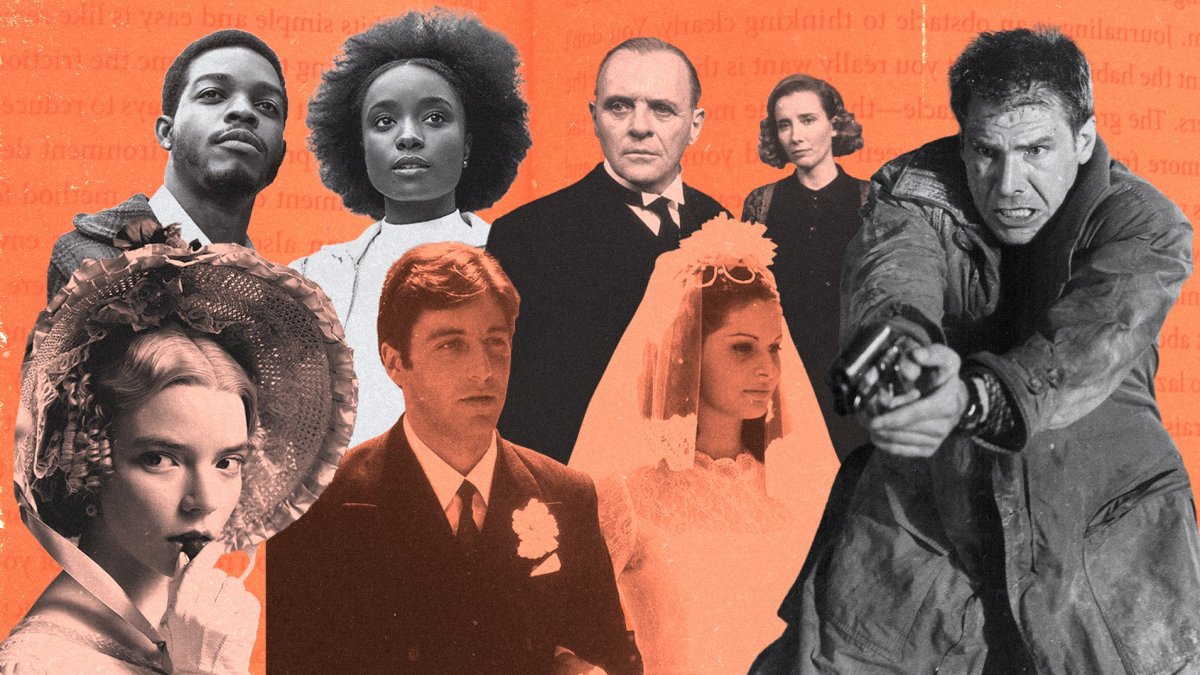
What makes a good page-to-screen adaptation? Faithfulness to the text? Reinvention? It can be almost impossible for filmmakers to satisfy readers, with casting, altered plots and varying tone all opening up the possibility of outcry over a butchered vision. But when it’s done right, seeing your favourite books on the big screen is one of life’s great pleasures. From memoirs to romantic comedies, and changed endings to doggedly faithful adpatations, here are some of the best. Dangerous Liaisons (1988) Stephen Frears’s film is a wonderful adaptation of the wickedly funny and tragic 1782 novel by Pierre Choderlos de Laclos Stephen Frears directed this wonderful adaptation of the wickedly funny and tragic 1782 epistolary novel by Pierre Choderlos de Laclos fresh off the success of Christopher Hampton’s multi-award-winning stage adaptation. It’s a story of sex and betrayal, of gender politics in pre-Revolutionary France, social mores and power, but it’s also a story about love in unlikely places. Glenn Close plays the malevolent Marquise de Merteuil, who plots with former lover, the Vicomte de Valmont (John Malkovich, reptilian rather than straightforwardly seductive), to seduce and destroy other aristocrats. It’s all fun and games until one of them actually falls in love. The film, also written by Hampton, retains a strong sense of theatricality, and the final scene is a brilliantly cinematic pivot from the book’s original ending. Twelve Years a Slave (2013) ‘Twelve Years a Slave’, starring Chiwetel Ejiofor, is based on Solomon Northup’s 1853 memoir (Photo: Jaap Buitendijk)This devastating film, with its unforgettable performance by Chiwetel Ejiofor, should have won Best Actor Oscars and didn’t, but did still walk away with three including Best Picture. Ejiofor plays Solomon Northup, who wrote a memoir in 1853 about his experience of being kidnapped from Washington as a free man and being sold into slavery in the American South. The film sticks closely to real events and horrifying moments, amplified by Steve McQueen’s extraordinary visuals – for example, the long take of a lynching, Northup’s toes dangling an inch off the ground, as regular plantation life carries on all around. The Godfather ‘The Godfather’ is a devastating indictment of the American Dream – and superior to the bestselling book it’s based on (Photo: Silver Screen Collection/ Getty) Less pulpy than its bestselling source material, here’s one where the film is better than the book. Featuring two of the most mesmerising performances ever committed to screen – Al Pacino as the initially reluctant heir to a Mafia legacy, Michael, and Marlon Brando as his merciless, husky-voiced father, Don Corleone – it is a devastating indictment of the American dream and a tragedy about the corruption of a young man’s soul (I’d say Part 1, released in 1972, is the best of the trilogy for this reason). The book’s author Mario Puzo co-wrote the screenplay with director Francis Ford Coppola, but stripped it of some more tangential plotlines. Together they created the definitive Mafia film, a complex, psychological drama that has influenced countless others. The Remains of the Day (1993) Anthony Hopkins (above, with Emma Thompson) expressively renders the book’s unreliable narrator on screen (Photo: Columbia Pictures /IMDb) Kazuo Ishiguro’s Booker Prize-winning novel centres on repressed butler Stevens – and the Merchant Ivory adaptation is perhaps the greatest example of rendering an unreliable narrator such as him on screen. As Stevens recounts his time serving Lord Darlington, it is always clear to the reader how desperately in love with the housekeeper Miss Kenton he is, however hard he insists he had no feelings beyond his professional duties. On screen, we inevitably lose the power of that internally discordant account, but Anthony Hopkins’s tightly controlled, multilayered expressions, hiding behind clipped politeness and silence as he repeatedly tries to keep Emma Thompson’s formidable Miss Kenton at a distance, tell us everything we need to know. Emma (2020) Gorgeous visuals and Anya Taylor-Joy’s spoilt, cocksure Emma make this one of the best Jane Austen adaptations (Photo: Focus Features) There’s always another Jane Austen adaptation to slate or adore (the new Netflix Pride and Prejudice is out soon), but this Emma, directed with absolutely gorgeous visuals by photographer Autumn de Wilde and written by the Booker Prize-winning author Eleanor Catton, is my favourite. Anya Taylor-Joy’s eponymous heroine is far more cocksure and unlikeable than previous iterations. She’s spoilt and remains painfully oblivious to the power her wealth and social position give her over Harriet and Miss Bates. And yet Knightley is also far more hot for her here too; the chemistry with Johnny Flynn is off the charts. An extremely funny and clever adaptation. The Virgin Suicides (1999) ‘The Virgin Suicides’ was the film that launched director Sofia Coppola’s career (Photo: Paramount Classics/AP) The film that launched Sofia Coppola as a filmmaker and reinvented child star Kirsten Dunst as an adult screen success is a beautiful floaty nightmare, a shocking examination of girls coming of age under the male gaze that somehow also became a sort of cult teenage girl film. Coppola’s highly sensory work in her debut film has the quality of a washed-out photo, half-forgotten images bathed in 1970s sunlight and cigarette smoke, bored girls adored by but never understood by adolescent boys. It’s an incredibly clever and cinematic evocation of Jeffrey Eugenides’s wistful prose. Bladerunner (1982) Ridley Scott takes the premise of Philip K Dick’s ‘Do Androids Dream of Electric Sheep?’ and adds his own extraordinary vision (Photo: Warner Bros/Archive Photos/Getty) Bladerunner is the most unfaithful to the source material of this bunch, but far from the least successful. Ridley Scott takes the premise of Philip K Dick’s 1968 novel, Do Androids Dream of Electric Sheep? – an android-killing bounty hunter in a dystopian future city – gets rid of most of the rest, and introduces us to his own extraordinary vision. And that vision is a retro-futuristic, neon, film-noir Los Angeles, with emotionally alive replicants and hard-hearted humans. Harrison Ford’s exhausted, frightened Deckard gives us an entirely new science fiction hero too, an existentially weary man who is almost the complete opposite of the kind of Star Wars hero audiences were previously used to. Rebecca (1940) Alfred Hitchcock’s adaptation of Daphne du Maurier’s novel is a gothic triumph (Photo: Hulton Archive/Getty) Alfred Hitchcock’s first American movie is a gothic triumph, translating Daphne du Maurier’s obsessive prose about a jealous and insecure second wife into a film full of haunting physical objects: cushions monogrammed with R, Rebecca’s stationery, the preserved West Wing. Rebecca’s presence is everywhere in his Manderley. Laurence Olivier imbues widower Maxim de Winter with indecipherable intensity and Joan Fontaine is painfully awkward as his shy second wife. Both were Oscar-nominated. The whole thing nearly got shut down until Hitchcock came up with an alternative ending – Hollywood’s strict Production Code at the time couldn’t abide du Maurier’s incendiary original conclusion. The Innocents (1961) Truman Capote wrote the brilliantly equivocal screenplay for a film based on Henry James’s ‘The Turn of the Screw’ (Photo: British Film Institute) In this adaptation of Henry James’s The Turn of the Screw, a governess, Miss Giddens, (Deborah Kerr) goes to a large country estate to take care of two neglected orphans, but she gradually becomes convinced that Flora and Miles are being possessed and corrupted by the ghosts of two former employees. Are they? Or is Miss Giddens projecting her own fears and fantasies onto two poor young kids? The brilliantly equivocal screenplay, co-written by Truman Capote, keeps us guessing to the end. It’s the ultimate horror movie. Breakfast at Tiffany’s (1961) Audrey Hepburn’s Holly Golightly in ‘Breakfast At Tiffany’s’ became a cinematic icon (Photo Paramount Pictures) And now here is an adaptation Truman Capote was himself unhappy with. Capote wrote the novella, and George Axelrod wrote the screenplay, which diverges wildly from the source material. Capote hated the new ending, and he hated the casting of Audrey Hepburn as the lead (he had envisaged Marilyn Monroe). Regardless, Hepburn’s Holly Golightly became a cinematic icon, an intrinsically elegant, spontaneous, tragicomic figure who embodies New York. A Clockwork Orange (1971) The adaptation of Anthony Burgess’s novel makes protagonist Alex as charming and fun to watch as he is repellent (Photo: LMPC/Getty) In this adaptation, wildly controversial on release, Stanley Kubrick takes Anthony Burgess’s troubled protagonist Alex and makes him as charming and fun to watch as he is repellent. Malcolm McDowell’s Alex is a witty, physically graceful reprobate who commits shocking violence for fun until the state tries to force the urge out of him. Both film and book ask: how important is free will? Whatever you make of the morals, like most of Kubrick’s work, it’s a very aesthetically original and, yes, fun film, turning pop art into pornography and Beethoven into a grotesque score. The Droogs’ white uniform – braces, codpieces, bowler hats – is iconic. If Beale Street Could Talk (2018) Like James Baldwin’s novel, the flm is a furious, lyrical, deeply humanising look at love and institutional racism (Photo: Tatum Mangus/ Annapurna Pictures/AP) Writer and director Barry Jenkins keeps James Baldwin’s nonlinear structure here, telling the tale of the thwarted lovers Tish and Fonny as if love itself is a refuge. Fonny (Stephan James) sits in prison, where he is awaiting trial for a rape he didn’t commit, while his partner Tish (KiKi Layne) looks back over their relationship. Jenkins repeatedly lets us into what it feels like to be one of these characters with near-fourth-wall-breaking close-ups, actors who look almost directly at the camera. Like Baldwin’s prose, it’s a furious, lyrical, deeply humanising look at love and institutional racism. The Princess Bride (1987) This meta-fairy tale directed by the late Rob Reiner preserves the playful tone of William Goldman’s book “As you wish.” “My name is Inigo Montoya, you killed my father, prepare to die.” “Inconceivable!” This meta-fairy tale, directed by the late Rob Reiner, must be one of the most quotable films ever made. It remains enormously enjoyable because it knows the silliness and the constraints of the genre and loves it all anyway, preserving the playful tone of the book. Adapted from William Goldman’s (equally meta-narrated) novel, it tells the story of a man reading a story about a fictional land of unhappy princesses, rodents of unusual size, battles, torture and true love. As the slightly knowing Westley and relentlessly earnest Princess Buttercup, Cary Elwes and Robin Wright are simply perfect.
The 13 best film adaptations of classic novels
Full Article
Original Source
Read the full article at Inews →KhanList aggregates and links to publicly available news content. We do not host full articles from third-party sources. Always verify important information with original sources.