
We all know a movie star when we see one. But how can you tell which stars shine the brightest? Measuring the greatness of a movie star can be like catching lightning in a bottle. It’s a process that requires chemistry and finesse, as well as a search for the perfect mix — that fusion of artistry and popularity, history and currency that adds up to the incandescent ideal of stardom. Not every movie star is a great actor; not every great actor is a movie star. Many of the choices on our list reflect that. Yet there’s a magic zone where talent and luminescence fuse. And there’s another overlap that might be even more important: the one between the way these people pop onscreen and the way they dance in our dreams. To choose the 100 Greatest Movie Stars, we had to use our heads, our hearts, our guts, our fantasy lives. We were looking for the stars who magnetize us, the ones who awe and overpower us and make us swoon. The ones we wish we were, and the ones who inspire the ultimate movie-star thought: “That’s who I am.” Henry Fonda Image Credit: Courtesy Everett Collection His signature film was, by its very narrative design, an encapsulation of his virtues as a performer: In a room of 12 angry men, you could count on him to be the calmer, quieter one, a bastion of sense and reason. Upstanding integrity may not be be the sexiest thing to be known for as a movie star, but Fonda was never stodgy with it. It’s fitting that Abraham Lincoln was one of his breakout roles, but it’s the urgently striving all-American masculinity of his Tom Joad in “The Grapes of Wrath” that really defined the Fonda aura, at least until his stubbornly humane Juror #8 came along. And the occasional, disorienting effect of his playing against type — bewildered doofus in “The Lady Eve,” ruthless villain in “Once Upon a Time in the West” — proved the strength of that type in the first place. — G.L. MUST SEE: “12 Angry Men” Sylvester Stallone In half a century of stardom, Sylvester Stallone has had two just roles that connected with audiences on the mythological level out of which movie stardom is sculpted. But that turned out to be just enough. The first role was, of course, Rocky Balboa, who Stallone played with hooded eyes and a voice of muffled molasses and a groggy valor that came to life. The beauty of “Rocky” is that it connected the glory of Frank Capra to the grittiness of the New Hollywood. And what made it work was the shabby majesty of Stallone’s presence, the way he believed in the character — the way he made Rocky, in his tattered dreams, an echo of us all. The second role was John Rambo, a character who critics loved in his first movie and hated in his second. Yet if “Rambo: First Blood Part II” had problematic politics, Stallone’s smoldering fury — combined with an action flair so rooted in endurance it was nearly sadomasochistic — made the character into a galvanizingly stylized pop hero. Consider “Rocky” and “Rambo” the yin and yang of a star with old movies in his (first) blood. — O.G. MUST SEE: “Rocky” Zendaya Image Credit: ©MGM/Courtesy Everett Collectio You probably think that we think she became a movie star in “Dune.” Nope. It was well before that. She’s scintillating in the “Dune” films, where her stoic warrior Chani does a dance of fury around Paul Atriedes’ shifting sympathies. But the Zendaya moment that gave us that first star tingle came in a musical that never got the love or respect it deserved: “The Greatest Showman.” As she sings “Rewrite the Stars,” hanging from a hoop trapeze, her face lights up with the pleasure of knowing that a forbidden love might be stronger than prejudice. And at that moment, her joy becomes ours. Zendaya took a leap into the acting stratosphere in “Challengers,” as a tennis champ who becomes the vertex angle — now seductive, now demanding, now who’s she going to choose? — of an isosceles love triangle. She smoldered onscreen, and in “The Drama” she shored up that smolder as a vibrant bride with the darkest of secrets. Keep watching her; she’s rewriting stardom. — O.G. MUST SEE: “Challengers” Alain Delon Image Credit: Courtesy Everett Collection Delon was, at his peak, almost too beautiful to be a functioning movie star: unapproachably, almost icily perfect, with a flinty gaze that either conveyed tortured depths or no soul whatsoever. Yet his beauty was never merely decorative — he was fortunate to be at his most ravishing in a testy, challenging era of European cinema that knew what to do with difficult beauty. Rather than playing straightforward heroes or objects of desire, he was happy to be the statuesque psycho: a lethally yearning Tom Ripley in “Purple Noon,” a hit man whose unnerving silence is a loaded weapon in “Le Samouraï.” Even when the men he played were slightly less tortured, his unlined, fine-cut face was an ideal vessel for the ambiguities that were the stock-in-trade of filmmakers like Visconti and Antonioni. He could make action of stillness, and a character trait of mystique. — G.L. MUST SEE: “Le Samouraï” Eddie Murphy Image Credit: ©Universal/Courtesy Everett Col From the start, he’s led with his delirious effrontery. It’s there in his great characters from “Saturday Night Live” (Buckwheat, Mr. Robinson), to the point that he was practically a movie star then. When he took the literal leap in “48 Hrs.,” he became a movie star the moment you saw him singing “Roxanne” with his Walkman on. From then on for Eddie Murphy, it was “Party All the Time.” Yet from his scene-stealing role as Donkey in the “Shrek” films to the serious acclaim he earned for “Dreamgirls,” Murphy made it impossible for the entertainment industry to define him as just one thing. In the ’80s, he was the Hollywood comedy star, triumphantly irreverent in “Beverly Hills Cop” and “Coming to America,” winning the capital to make his own films his way, with all-Black casts. And starting with “The Nutty Professor,” those casts would often include Murphy in half a dozen roles, a seeming stunt that he elevated into uproarious artistry, with one guiding rule: In an Eddie Murphy movie, the more of him the better. — A.T. MUST SEE: “The Nutty Professor” Philip Seymour Hoffman Image Credit: Courtesy of Sony Pictures Classics It might not be as iconic as “You talkin’ to me?” or “I coulda been a contender,” but the scene that made Philip Seymour Hoffman a movie star is every bit as potent and defining. It comes in the first half of “Boogie Nights,” when Scotty J., the awkward, closeted boom operator, sits in his car after making a failed pass and says, “I’m a fuckin’ idiot!” over and over again, letting you touch the nerve of his self-hatred — and cuing you to the fact that every person watching this movie has known that feeling. That’s movie-star poetry, and Hoffman brought it to every role. He was a virtuoso chameleon who could play pathologically shy (“Happiness”) or blissfully arrogant (“The Talented Mr. Ripley”). He could be a sap (“Before the Devil Knows You’re Dead”), a manipulator (“The Master”) or a tragic head case (“Owning Mahowny”). Or he could be every one of those things at once (“Capote”). — O.G. MUST SEE: “Capote” Emma Stone Image Credit: Courtesy of Lionsgate In “La La Land,” the movie that solidified her place as one of the stars of our time, Emma Stone plays a struggling actress who becomes a movie star. A common enough scenario to encounter at the movies. Only in this case, you feel the chemical evolution: how Stone’s Mia starts as a pragmatic striver, only to look like she’s failed until she sings “Audition (The Fools Who Dream),” at which point her very being is suffused with stardom. Stone never looked back from that incandescent moment. In a career of dizzying and daring choices, she can play vintage heroic (“Battle of the Sexes”), saintly or scheming or both at once (“The Favourite”), a cawing lascivious Frankenstein monster (“Poor Things”), a ruthless corporate sociopath you start to root for (“Bugonia”), or she can turn a kids’ movie into a thrilling ride for adults (“Cruella”). Here’s to the ones — like Emma Stone — who dream. — O.G. MUST SEE: “La La Land” Joaquin Phoenix Image Credit: Niko Tavernise Remember “I’m Still Here,” Casey Affleck’s 2010 mockumentary in which Joaquin Phoenix played “Joaquin Phoenix,” the very picture of a self-congratulatory tortured actor, seemingly blowing up his career to pursue rapping instead? It was the kind of dumb stunt that could indeed have tanked a lesser talent; for Phoenix, coming at what turned out to be only the halfway mark of a consistently adventurous, exploratory career, the film seems both a blip and a telling reflection of what a reluctant and system-averse star he is. Phoenix has made a career of being a misfit — whether playing Johnny Cash in his pomp or the addled seeker of “The Master” — though his most defining outcast role, as the grimmest, most unwell incarnation of DC’s Joker yet put onscreen, became an Oscar-winning, billion-dollar-grossing pop icon. Such are his contradictions. — G.L. MUST SEE: “Joker” Shah Rukh Khan Image Credit: Eros International Now in his sixties, Bollywood cinema titan Shah Rukh Khan has held Indian audiences in thrall through more than 90 films across four decades — showing daunting staying power in one of the world’s most restlessly churning film industries. His secret? An unabashed flair for peacocking showmanship and drama writ large, allied to a self-aware comic intelligence, a combination that served him through multiple phases of stardom. He broke out in 1993 as a rakish villain in “Baazigar” and “Darr,” before his megawatt charisma and leonine good looks vaulted him to romantic-lead status, putting audiences on full swoon alert in the likes of “Dilwale Dulhania Le Jayenge” and the global hit “Devdas.” Restless diversions into comedy and character acting have followed; recently, he’s made himself over as a venerable action star. Named “King Khan” by local fans, he remains comfortable in his throne. — G.L. MUST SEE: “Devdas” Kristen Stewart Image Credit: Courtesy Movie-star energy tends to burst outward. But Kristen Stewart has a different energy — doleful and pensive, in a way that recalls the young Jane Fonda, who also brandished a fraught inward gaze. In movies like “Adventureland,” Stewart established herself as a new kind of actor, with a captivating too-cool-for-school millennial glamour. But then the “Twilight” films elevated her into a teen idol, even though the franchise came with a special challenge: She was tasked with carrying Bella Swan’s tormented romantic doubts through half a dozen movies, and she brought it off, finding endless variation in her push-pull attraction to Robert Pattinson’s vampire bad boy. And when the series ended, Stewart sprung herself into adult roles, notably channeling Princess Diana in a performance of rippling depths in “Spencer,” acting with a fervor that continues to display her onscreen paradox: the movie star hiding under the reluctant movie star. — O.G. MUST SEE: “Spencer” Lauren Bacall Image Credit: Courtesy Everett Collection Bacall was just 19 when she made her indelible screen debut in “To Have and Have Not,” projecting a self-possessed sexuality far beyond her years — and thus bridging the age gap with her 44-year-old leading man (and soon-to-be husband), Humphrey Bogart. (It was, shall we say, a different time.) “You know how to whistle, don’t you? You just put your lips together and blow,” she famously said — absurd innuendo that, in her delivery, sounded coolly in command. She was a woman in control at all stages of her career, whether as the smoky, precocious femme fatale of the Bogey-and-Bacall years or as the more imperious grande dame that she shifted into in middle age and beyond. Her senior years yielded some of her best, most challenging work in art films like Jonathan Glazer’s “Birth” and Lars von Trier’s “Dogville,” but she could just as easily wield her brittle authority to imposing effect in instant coffee commercials. — G.L. MUST SEE: “To Have and Have Not” Nicolas Cage Image Credit: ©United Artists/Courtesy Everet You might say there are two Nicolas Cages. As one of the most compelling actors of his generation, he has a hangdog sincerity he wore on his sleeve from his first hit, “Valley Girl,” through his crowd-pleasing turns in “Moonstruck” and “Raising Arizona” and on to the film in which he gives his greatest performance: the funny, tragic, delicately baroque drama of love and alcohol, “Leaving Las Vegas.” But then there’s the other Nicolas Cage — the self-consciously over-the-top stylized junk-movie clown, who first appeared, full on, in “Vampire’s Kiss” and “Con Air,” and who went on to carve out an identity as the Man of 1,000 Paycheck Gigs. In our view, both versions of Cage are integral to the singularity of his stardom. Few actors hold the camera the way he does — but in his dozens of bad movies, he never phoned in his flamboyance. He made the degradation of his stardom the point, in a way that only a quintessential star could do. — O.G. MUST SEE: “Leaving Las Vegas” Lillian Gish Image Credit: Courtesy Image At a time when the stars of silent cinema were largely stage-schooled, Gish was perhaps the first intrinsically cinematic Great Actor of the era, her vast expressive range and quivering physicality both minimized and magnified for the camera, relative to the theatrical gestures of many of her peers. Her pioneering innovations are inseparably braided with those of filmmaker D.W. Griffith, whose epic experiments were frequently anchored by her extraordinary, ecstatic, anguished features. The ugly presence of “The Birth of a Nation” in their joint filmography can’t be ignored, but it shouldn’t cancel out the technical and thespian achievements of “Intolerance” or “Broken Blossoms,” with its haunting “closet scene,” a master class in confined emotional torment. Sound didn’t end Gish’s career — eventually delivering her an Oscar nod for “Duel in the Sun” and an all-time classic in “The Night of the Hunter” — but hers remains a legacy defined by silence. — G.L. MUST SEE: “Broken Blossoms” Whoopi Goldberg Image Credit: ©Paramount/Courtesy Everett Colllection She melted our hearts as Celie, the heroine of “The Color Purple,” who emerges from a life of deprivation and abuse with a soul intact enough to lunge for freedom and joy. But that defining performance in Steven Spielberg’s 1985 film was just the tip of the iceberg of Goldberg’s movie-star mojo. She spent the next few years lurching around in ill-defined action comedies, but then, in what turned out to be one of the genius casting coups of the ’90s, she showed up as Oda Mae Brown, the huckster psychic in “Ghost” who only thinks she’s a charlatan. Outrageously brash and uproariously full of fury, she seems to be channeling Groucho Marx, Richard Pryor and Medea. And from that moment on she went Full Goldberg, hiding out in a convent and dressing down her fellow nuns in the delectably irreverent “Sister Act” and hunting down a Hollywood killer in Robert Altman’s “The Player.” What makes her not just a funny but enchanted presence is the way she elevates flippant forthrightness into a kind of delirious cathartic truth-telling. — O.G. MUST SEE: “Ghost” Timothée Chalamet Image Credit: Courtesy of A24 At 30, Chalamet is one of the youngest stars on this list, yet his career already feels storied enough to justify his inclusion. The bright, beseeching teenager of “Interstellar” and “Call Me by Your Name” grew into a fresh-faced but confident matinee idol in the likes of “Dune” and “Little Women.” Yet as Chalamet heads into his 30s, the more intriguingly perverse instincts of a character actor seem to be guiding his choices: Playing men as disparate as Willy Wonka and Bob Dylan, he seems drawn to their mystery and peculiarity. His recent turn in “Marty Supreme” represented a boldly big swing: an agitated, eccentric inhabitation of a genuine asshole that he carried to a $192 million gross. No one else of his generation can lead such a vast audience to a character so hard to love, and that courage and clout bodes well for his next chapter. — G.L. MUST SEE: “Marty Supreme” Burt Reynolds Image Credit: Courtesy Everett Collection Imagine that Marlon Brando had a country-boy cousin who was less interested in Method acting than in his own advanced methods for charming the ladies. That would be Burt Reynolds. At times, he can be a hell of an actor, notably in “Deliverance,” where he faces down his hillbilly adversaries with a cutthroat resolve that smolders. Yet what made Reynolds just about the biggest movie star of the 1970s was his mixture of macho bluster and teasing self-mockery. He was perhaps the first hunk of Hollywood beefcake who refused to take himself seriously (a quality he honed on the late-night talk-show circuit) — and that lends his performances in everything from “The Longest Yard” to the chicken-fried drive-in juggernaut of “Smokey and the Bandit” a quality of insolent swagger marked by his irresistible wink at his own magnetism. — O.G. MUST SEE: “Smokey and the Bandit” Kate Winslet Image Credit: Courtesy of 20th Century Studios Winslet fought hard for the lead role in “Titanic,” but today it’s difficult to imagine any other actress having taken Rose DeWitt Bukater’s spot on the ship of dreams. Rose, an heiress fallen on hard times who insists on pursuing love over security, etched into box office history what Winslet does as well as anyone: She shows us a woman who understands the rules of society and then attempts, fiercely, to claw through the veneer of propriety. Whether Winslet, onscreen, is blowing up her marriage (“Little Children”) or her career (“Steve Jobs”) or her entire existence (“Eternal Sunshine of the Spotless Mind”), she seems always to be making decisions utterly in the moment — and surprising even herself. Little wonder that with “Titanic,” Winslet became the onscreen avatar for untold millions of teen girls. Perhaps no other actress might have so perfectly merged earthy realism with, just a millimeter beneath, a dreamer’s sense of possibility. — D.D. MUST SEE: “Titanic” Robert Pattinson Image Credit: ©Warner Bros No one becomes a movie star without trying to. But after fashioning himself into the moody pinup heartthrob of a generation in the “Twilight” films, Robert Pattinson made a radical left turn. He’d become a star, but he almost seemed to leave stardom at the altar when he took on a series of edgelord roles in defiantly niche art films (“Good Time,” “The Childhood of a Leader,” “The Lost City of Z”), spending the better part of a decade doing the character-actor-in-a-leading-man’s-body thing. We don’t mean to make light of it; he was honing his chops, showing the world the kind of star he wanted to be. And when he was cast in “The Batman,” the best of both worlds finally came together: Behind the gruff voice, Pattinson created a Batman who was more complexly dynamic and riveting than any who had come before him. As his daring performances in “Primetime” and “The Drama” attest, he’s a new kind of movie star: hushed and saturnine, plugged into the dark side of his time. Will that be reflected in his upcoming role as James Bond? We’re betting that Pattinson leaves us as shaken as we are stirred. — O.G. MUST SEE: “The Batman” Morgan Freeman Image Credit: Courtesy of Columbia Pictures It’s no accident that he became the voice of God. Though if you chart his career path, that was hardly his destiny. In the midst of a thriving New York theater career, Freeman became a regular on the ’70s children’s TV series “The Electric Company.” But he didn’t explode into the spotlight until he was nearly 50, when he starred in “Street Smart” (1987), giving the most authentic performance as a wily, vicious street operator that the movies had ever seen. As he quickly proved, though, he could play deep-grained benevolence as complexly as he did ferocity. He became a humanistic everyman, as embodied by his memorable performance in “The Shawshank Redemption.” For this immense orator, the leap to voicing the Almighty came all too naturally, since that voice emerged from his inner quality — a higher wisdom that envelops you in its warmth. — A.T. MUST SEE: “The Shawshank Redemption” Liv Ullmann Image Credit: Courtesy Everett Collection The actresses in Ingmar Bergman’s films weren’t just accomplished artists. Like Bergman himself, they were groundbreakers, expressing sides of women’s experience that had never been seen onscreen before, and doing it with a lacerating intimacy that took on an almost confessional quality. But even within that gallery of acting genius, Ullmann stands apart. In “Persona,” the movie that introduced her to the world, she gave a nearly silent performance as a theater actor so traumatized she had decided to stop speaking. Yet Ullmann spoke volumes with her face — the gaze that could be furious or beatific or full of fear. And as she became Bergman’s most complex and impassioned surrogate, what you saw in her was the charisma of unbridled expression, culminating in her virtuosic performance in “Scenes From a Marriage,” which she turned into nothing less than “A Doll’s House” for the postwar age. What’s a movie star? Someone who makes the truth shine as brightly as Liv Ullmann did. — O.G. MUST SEE: “Scenes from a Marriage” Sean Penn Image Credit: ©GramercyPictures You knew he was a movie star the moment he charmed the world into a collective giggle fit in “Fast Times at Ridgemont High,” playing the stoner surf dude Jeff Spicoli with a blitzed bravado that made every line sound like a stupido catchphrase. But even in that lighthearted career launch, he was sneakily authentic. And that became Penn’s calling card — that whatever the role, he was going to whittle it down to the bone of reality. From the moment he played a juvenile con in “Bad Boys,” you knew you were seeing the next-generation De Niro, and he knew it too. That’s why he was drawn, compulsively, to playing criminals, losers, lowlifes, renegades and ugly-mustache freaks. Yet in every case, he found the character’s underlying humanity. And that’s his glory as a star: the way he will always go to that place other actors won’t, daring to excavate the hidden reality of a lost soul. — O.G. MUST SEE: “Dead Man Walking” Divine Image Credit: "Pink Flamingos" The shaved head that’s like an angry egg, topped by a wave of synthetic hair. The giant dagger eyebrows and mouth that curls into an evil leer. The body that makes her look like Jayne Mansfield crossed with Godzilla. It would be hard to think of an image in movie history as magnetic, scary, hilarious and flat-out insane as Divine in “Pink Flamingos.” In that 1972 midnight classic, she plays “the filthiest person alive,” who is also a homicidal demon-clown maniac with the personality of the Wicked Witch of the West on PCP. It’s a performance that’s pure drag Dada, but as Divine proved in every movie she made with director John Waters (the von Sternberg to her deranged Dietrich), she was no one-trick pony. Whether playing a psycho rebel (“Female Trouble”) or a fuddy-duddy mom (“Hairspray”), Divine owned the screen with a delirious punked-out effervescence unlike any star who came before or after. — O.G. MUST SEE: “Pink Flamingos” Gregory Peck Image Credit: Courtesy of Universal Pictures He’ll always be Atticus Finch because of how large he made that character loom in the American imagination. It all started, of course, with Harper Lee’s great novel, but in the 1962 film adaptation of “To Kill a Mockingbird,” Peck turned Atticus into such an intractable yet homespun figure of relatable valor that it’s almost as if he was playing Abe Lincoln. The performance earned him an Oscar while spotlighting America’s racial discord and racial criminality at a time when the issue of race was starting to rip the country apart. Peck tended to play thoughtful and rather reserved characters, notably opposite Audrey Hepburn in “Roman Holiday,” but that made him the perfect actor to step into Alfred Hitchcock’s psychologically twisted “Spellbound,” which seemed to be stress-testing the limits of his charmed rationality. — A.T. MUST SEE: “To Kill a Mockingbird” Ryan Gosling Image Credit: Courtesy of Film District It’s easy to forget that Gosling began his career on Disney Channel’s “All New Mickey Mouse Club” in the ’90s — before becoming one of the rare child stars to rise above the chaos of the industry to become an acclaimed actor in his own right. While the hit tearjerker “The Notebook” catapulted Gosling to superstardom in 2004, it was his performance as a drug-addicted teacher in “Half Nelson” two years later that showed his range and landed him the first of three Oscar nominations. A millennial dreamboat with a singing voice to match, he has thrived in everything from indies like “Lars and the Real Girl” to genre blockbusters like “Blade Runner 2049” to the glittery showbiz epiphany that was “La La Land,” playing everyone from Neil Armstrong to, well, just Ken. — A.T. MUST SEE: “Drive” Burt Lancaster Image Credit: Courtesy Everett Collection Few stars have hit the jackpot with their film debut in quite the way Lancaster did: with a leading role in a hell of a movie — Robert Siodmak’s icily hardboiled 1946 noir “The Killers” — that also just happened to encapsulate his whole deal as an actor. As an ex-boxer embroiled in an underworld scheme, ultimately undone by obsessive love, Lancaster’s character is a bruiser with a soul. It’s a tender-tough archetype that served the actor well in such films as “The Birdman of Alcatraz,” “Atlantic City” and, of course, “From Here to Eternity.” The enduring cultural memory of the latter is of him rolling around in the surf with Deborah Kerr, his brawny physique made barely decent with a tight swimsuit, but that scene rather obscures the portrait he etched in the film of military alpha masculinity with a stout liberal conscience. In Lancaster, Hollywood got itself a man who could do both. — G.L. MUST SEE: “From Here to Eternity” Pam Grier Image Credit: Courtesy Everett Collection The action star was a phenomenon that rose up in the 1970s, and it took years for the concept of the “female action star” to seem anything more than a counterintuitive anomaly. But that shouldn’t have been the case, since the female action star was born, full-blown and electrifying, in the person of Pam Grier. She was fast and furious and decades ahead of her time, but she came up in the world of blaxploitation films, which were highly successful and influential movies that were marginalized as an “underground” happening. The reality, however, is that they were cultural bombshells, and Grier was nothing less than a revolutionary movie star. In the raw funk revenge thriller “Coffy,” she’s sly-eyed and insolent, proudly sexual, rivetingly spontaneous in her violence (she wields a sawed-off shotgun like James Bond in an Afro), with a ruthlessness that feels rooted in experience. This was a whole new kind of star: a badass with soul. — O.G. MUST SEE: “Coffy” Robert Downey Jr. Image Credit: Photo Credit: Zade Rosenthal Even in the ’80s, when he was just an overgrown kid, Robert Downey Jr. never stopped talking. As the title lothario of “The Pick-up Artist,” or the spiraling druggie of “Less Than Zero,” he talked circles around his co-stars, cajoling, hustling, pleading, bargaining. For a while, that was Downey’s comic eccentricity (it’s telling that when he finally made an awards-bait movie, he had to put a cork in it to play Charlie Chaplin). But in “Natural Born Killers,” where he gave a brilliant performance as the hell-bent tabloid-TV chatterbox Wayne Gale, it finally began to look as though Downey’s motormouth might be the stuff of movie stardom. And in “Iron Man,” something fantastically ironic happened. He was starring in a comic book movie — a genre that tends to swallow up stars, even when the movies are hits. But Downey’s Tony Stark gave the new superhero culture just the buzzy, chewy center it needed. He humanized this most corporate of genres … and in a funny way, it humanized him. — O.G. MUST SEE: “Iron Man” Barbara Stanwyck Image Credit: Courtesy Everett Collection The hottest tickets at the most recent edition of Il Cinema Ritrovato, the classic film festival in Bologna, Italy, were for the Stanwyck retrospective. That 20-something cinephiles were queueing in rush lines even for relative obscurities like “Ladies of Leisure” and “Night Nurse” was a testament to the enduring modernity of Stanwyck as a star. Exuding cool, controlled reserve in romantic comedy and film noir alike, with a distinctively husky tone and a pragmatic, forthright demeanor that tolerated only the bare minimum of studio glamour, she was an independent woman decades ahead of a feminist revolution that, as a staunch Hollywood Republican, she likely wouldn’t have had much time for anyway. That slightly forbidding no-bullshit attitude gave her the air of a character actor in a leading lady’s body, as spiritually aligned with the likes of Cagney and Bogart as any of her female peers. — G.L. MUST SEE: “Double Indemnity” Nicole Kidman Image Credit: ©20thCentFox Back in 2017, when Film Twitter was a happier place, I launched the Kidman World Cup: a bracket tournament of polls to determine Kidman’s best performance that went semi-viral, with Barry Jenkins and Melanie Lynskey among those lobbying for their picks. “To Die For” wound up beating “Birth” by a hair, but what the exercise mainly proved was that there’s little consensus on the best version of Kidman: the oldschool multiplex goddess (“Moulin Rouge!”); the art-house boundary pusher (“Dogville”); the raw, turbulent emoter (“The Hours”); the untouchable ice queen (“Stoker”); or the anything-goes adventurer (“The Paperboy”). And all that was before she shored up her queenly reputation not just with typically gutsy, wide-ranging performances in the likes of “Babygirl” and “Destroyer,” but as the official spokeswoman for cinema itself in her immediately iconic AMC spots. Heartbreak does indeed feel good when Kidman is the breaker, or the broken. — G.L. MUST SEE: “Moulin Rouge!” Matt Damon Image Credit: ©Miramax It was Matt Damon’s fate to be a golden boy who came along just at the moment when the world was starting to look askance at golden boys. But it’s the measure of his stardom that he took that twist of karma and owned it. Having used his brain to melt our hearts with “Good Will Hunting,” Damon took the most daring of left turns, portraying the murderous protagonist of “The Talented Mr. Ripley” as a silky but vulnerable psychopath, haunted by what he can’t have. His great performance in that film was no one-shot. It opened the door to the real Matt Damon — a golden boy who never shined brighter than when he was showing us his dark side. He turned the “Bourne” films into riveting downbeat action psychodramas, and he was brilliantly duplicitous in “The Good Shepherd.” Yet he found his way back to wounded nobility, carrying the ancient world on his shoulders in “The Odyssey,” a movie that proves he’s the star we can always count on to take us home. — O.G. MUST SEE: “The Talented Mr. Ripley” Jack Lemmon Image Credit: Courtesy Everett Collection We have never had enough everyman movie stars like Jack Lemmon, but least of all today: At a time when studio cinema is less interested than ever in films about regular people, actors who look very much like regular people tend to be sidelined. But Lemmon’s faintly schlubby ordinariness was his extraordinary secret weapon. He could catch you off guard either with a virtuoso comic transformation — as in “Some Like It Hot,” where his burlesque of feminine allure stood in hilarious contrast to Marilyn Monroe herself — or by turning inside out the hidden neuroses and insecurities of the common man, with results either farcical (“The Apartment”) or deeply, achingly tragic (“Glengarry Glen Ross”). You never knew quite what to expect from that nice, unremarkable face, which stood in for those of a million typical men while becoming, over time, unmistakably his own. — G.L. MUST SEE: “The Apartment” Dorothy Dandridge Image Credit: ©20thCentFox Dandridge is arguably more known as a historical trailblazer — the first person of color nominated for a leading-role Oscar — than as an actress, which is not the way it should be: Her career was kneecapped by systemic racism even before it was cut short, when she was 42, by an accidental antidepressant overdose. But in the films she made, you can see the supernova she might have been if everything around her had been different: Her Oscar-nominated turn as the sultry, operatic seductress in “Carmen Jones” is all the more electrifying for the actorly hunger you see behind the character’s wayward determination — a palpable awareness that she may never have a shot like this again, and a full-body push to give it everything she’s got. — G.L. MUST SEE: “Carmen Jones” Daniel Day-Lewis Image Credit: ©Paramount Never a minimalist onscreen, Daniel Day-Lewis has nonetheless cultivated a lofty kind of stardom by making himself very scarce. He’s made fewer than 20 films since his 1985 breakout in “My Beautiful Laundrette,” working at an ever-decreasing rate as his reputation has risen. But then a good part of the Day-Lewis mystique is tangled up in the seemingly exhausting immersiveness of his process: Performances as physically transformative as his Christy Brown in “My Left Foot” or as psychologically unfettered as his Daniel Plainview in “There Will Be Blood” do feel like they would require some recovery time. We arguably haven’t seen enough of Day-Lewis underplaying, which he showed he could do to supremely disconcerting effect in “Phantom Thread”; he briefly paused his retirement spell last year for his son Ronan’s modest directorial debut, “Anemone,” but if he ever deigns to stage a proper comeback, he has plenty left to show us. — G.L. MUST SEE: “There Will Be Blood” Robert Mitchum Image Credit: Everett Collection Today, film noir might be the most popular genre of classic Hollywood, because it’s the one that seems the most “modern.” Yet it might also be the most misunderstood. “Out of the Past,” the movie that gave Robert Mitchum his greatest role, is a tangled tale of crime and fate and femme fatale treachery, yet at its heart is the portrayal of a troubled relationship that is very much a twisted kind of love. Mitchum uses his sleepy eyes and sleek cheekbones to suggest an inexorable longing and the things it will drive a man to do. A real-life renegade, Mitchum always worked the edge, and that’s what made him so captivating: the freedom with which his characters commune with the dark side. In “The Night of the Hunter,” he’s an evil preacher pursuing two children (to find the money they’re hiding) in a way that’s so sinister, the film feels almost Lynchian. And in “Cape Fear,” his Max Cady is an aging greaser of singular menace, one who will get his vengeance the old-fashioned way: by figuring out what hurts you the most. — O.G. MUST SEE: “Out of the Past” Will Smith Image Credit: ©Columbia Pictures He never meant to start acting. In fact, the former Fresh Prince of Bel-Air became a screen star by happenstance. After stepping onto the set of the NBC sitcom as a baby-faced rapper, the Philadelphia native realized that his talent extended beyond music. The show made Smith a household name, but it was the highbrow stage-to-film adaptation of “Six Degrees of Separation” that proved he had serious chops — before movies like “Independence Day” and “Men in Black” made him a blockbuster phenomenon. Putting on Muhammad Ali’s boxing gloves got him his first Oscar nomination; switching to tennis shorts in “King Richard” 20 years later got him the win. In Hollywood, Smith has long been more than just a kid from Philly. — A.T. MUST SEE: “Men in Black” Michael Caine Image Credit: Courtesy Everett Collection Americans born outside England’s rigid class system may not fully appreciate the significance of Caine keeping his Cockney accent throughout his storied career. But it means quite a lot that one of the defining British movie stars, with roles from “Alfie” to Alfred in Christopher Nolan’s “Batman” trilogy, didn’t graduate from one of the U.K.’s many prestigious acting schools, nor grow up among the country’s upper crust. You feel the lumpen power of Caine’s hooded gleam in “Get Carter,” the uncompromising 1971 gangster movie in which he plays a professional killer on a ruthless odyssey of revenge. But throughout his career — from the time he was a bespectacled icon of mod-era London cool to when he satirized the same in “Austin Powers in Goldmember” — Caine helped define an archetype that he never allowed himself to be defined by. — A.H. MUST SEE: “Get Carter” Russell Crowe Image Credit: ©DreamWorks When you’re talking about movie stars, it’s easy to have nostalgia for those of the studio system, because they were so direct in their appeal. But when you watch Russell Crowe in “Gladiator,” he’s exactly that. The drive for payback that fuels Maximus, a Roman general forced into slavery following the murder of his family, is so primal and consuming that it becomes his life-or-death religion: He will kill, and then he will die. Playing this man of higher vengeance, Crowe gives what may be the purest movie-star performance of his time. His Maximus turns the viciousness of justice into a calling, and that’s the quality Crowe has imparted to all his great characters: the tormented whistleblower of “The Insider,” the schizophrenic mathematician of “A Beautiful Mind.” When Crowe is onscreen, a movie glows — burns — with the fervor of his mission. — O.G. MUST SEE: “Gladiator” Faye Dunaway Image Credit: Courtesy Everett Collection The first time you see Faye Dunaway in “Bonnie and Clyde,” she’s in a bedroom by herself, but we can already taste Bonnie Parker’s hunger for something more. She’s sensual, ferocious, voracious. She hooks up with Clyde Barrow because he promises thrills, and that’s going to be Bonnie’s drug. Dunaway gave a brilliant and controlled performance in that game-changing movie, but as her career went on, the operatic quality of her emotion became less contained; it just about spilled out of her. And that’s her glory as a movie star. Is she an over-the-top satire of corporate ruthlessness in “Network”? Yes, and dazzlingly so. Is her performance as the seething Joan Crawford of “Mommie Dearest” a piece of baroque camp? Yes, if camp is understood to be the expression of a truth that less polite acting won’t allow. Yet in “Chinatown,” she was as tragic — and lyric — as any Tennessee Williams heroine. The dramatic excitement Dunaway creates is often inseparable from excess. That’s why she’s indelible. — O.G. MUST SEE: “Bonnie and Clyde” Orson Welles Image Credit: Courtesy Everett Collection We debated, in compiling this list, whether Welles carries too much of a filmmaker’s aura to qualify as one of Hollywood’s greatest movie stars: “Citizen Kane” may continue to top “Greatest Film of All Time” lists, but it’s Welles’ technically pathbreaking direction of the film that gets all the glory there, rather than his very fine, subtly evolving performance at its center. But Welles’ onscreen presence was too distinctive and imposing to ignore, beginning with that resonant, stentorian voice and extending to his forceful, sometimes raging physicality: He tested his acting range most daringly in his own work (veering between classical grandeur in “Othello” and gruff modernism in “Touch of Evil”). But his unforgettable entrance as Harry Lime in Carol Reed’s “The Third Man” was proof that his star power acted independently of his direction. — G.L. MUST SEE: “Citizen Kane” Elvis Presley Image Credit: Everett Collection With the exception of the Beatles, he was the most seismic pop star of the 20th century. But when you put the words “Elvis” and “Hollywood” next to each other, it tends to provoke a cliché reaction, something along the lines of “God, his movies were terrible!” A lot of them were (the worst: “Harum Scarum” and “Clambake”). A handful were just meh, and a few are actually good, like “King Creole” and “Viva Las Vegas.” But the real point about Elvis and Hollywood is that though he never got respect as an actor, he became just about the biggest movie star of the ’60s, and that’s because he owned those movies through the sheer power of his swaggering, twinkly-eyed, apple-cheeked, devil-in-disguise presence. There’s a lightness to Elvis as a movie star that’s actually irresistible. Even in his junkiest vehicles he radiates pure pleasure, and sometimes you’re plugged back into that jittery crooning energy that changed everything. — O.G. MUST SEE: “Jailhouse Rock” Sophia Loren Image Credit: Courtesy Everett Collection Usually, it’s European stardom that launches an actor into the Hollywood spotlight, but in Loren’s unusual case, she only really became an icon after both those chapters. In the 1950s, a run of unremarkable Italian films gave way to a run of unmemorable American crossover vehicles that coasted off her beauty, essentially trying to mold her into a less intense, more approachable Anna Magnani. It was only when she returned to Italy in the early 1960s, shedding the glamour treatment for “Two Women,” Vittorio De Sica’s stark portrait of working-class womanhood in wartime, that Loren’s magic was finally unlocked: A history-making Oscar ensured her Hollywood royalty status, even if Hollywood never figured out how to use her. Ultimately, it was her native cinema, in films like “Yesterday, Today and Tomorrow,” “Marriage Italian Style,” “Sunflower” and, most exquisitely, “A Special Day,” that let her be both earthy and ordinary, against all appearances to the contrary. — G.L. MUST SEE: “Two Women” Arnold Schwarzenegger Image Credit: ©Orion Pictures Corp Arnold Schwarzenegger was such a multiplex fixture in the ’80s and ’90s that one could almost forget what a very strange movie star he was: We just took it as a given that this steel-eyed, thickly accented man built like an armoire was the quintessence of Hollywood masculinity, and that was that. But what made Schwarzenegger special — and we all know it wasn’t his acting, which was never more than mechanically suited to the material at hand — was his own good-humored awareness of that absurdity, which eventually led him from po-faced action-man vehicles to a nifty line in comedy, the best films of which required no greater exertions of him than the sheer, hilarious fact of his physical presence. Meanwhile, the action films that figured out how to use that deadpan gift — none more so than the first two “Terminator” movies — stand tallest today. — G.L. MUST SEE: “The Terminator” Gene Kelly Image Credit: Courtesy Everett Collection Gene Kelly was, undeniably, an artist of the highest caliber, but he might recoil at the idea that dancing on film was high art. A trained dancer and gifted choreographer, Kelly took as his career-long project making dance legible and accessible to the masses. Post-World War II audiences seeking a lift swooned for the “dream ballet” Kelly danced with Leslie Caron in “An American in Paris.” And in the title dance sequence of “Singin’ in the Rain,” Kelly’s own kinetic movement speaks more eloquently than do the song’s lyrics; leaping on lampposts and tapping through puddles, Kelly may be the standard-bearer for the surprisingly challenging feat of conveying joy on film. Hollywood wouldn’t be Hollywood without musicals, and Hollywood musicals wouldn’t be Hollywood musicals without the actor and choreographer who knew how to leverage classic technique toward the noble goal of making audiences smile. — D.D. MUST SEE: “Singin’ in the Rain” Jodie Foster Image Credit: ©Orion Pictures Corp She didn’t choose acting — she was pressed into the business as a child by her manager mother — but Jodie Foster happened to possess a true gift for it. Indeed, her early work, like her guileless kid sex worker in “Taxi Driver,” was so natural as to seem effortless. In adulthood, though, Foster has been defined by the challenges she poses herself. In “The Silence of the Lambs,” could this performer who radiates intellect play an FBI agent who must learn to trust her instincts instead? In “Panic Room” and “Flightplan,” could she redefine herself as a wily, resourceful action-movie star? Could she direct films? Act in French? Mentor younger stars? One of the great pleasures of watching Foster is observing a fundamentally cerebral person throw rationalization aside to see what new dimensions of her talent she can show us, and herself. — D.D. MUST SEE: “The Silence of the Lambs” John Travolta Image Credit: ©Paramount On paper, it seemed the ultimate cynical package from the new corporate Hollywood: a movie to cash in on the disco craze. One engineered to synergize with a hit record. Starring the hot sitcom actor of the moment. Yet onscreen, “Saturday Night Fever” was something no one could have anticipated: one of the most electrifying music films in Hollywood history. And Travolta strutted through it like James Dean touched with boogie fever in a white polyester suit. His street bravado was mesmerizing, his dance-floor moves were jive poetry and his hurtin’-on-the-inside sensitivity turned the movie into a gritty and indelible teenage daydream. A year later, he made “Grease,” and that put him on top of the world. But Travolta turned out to be a tricky actor to cast, and it wasn’t until Tarantino tapped him for “Pulp Fiction,” inviting him to showcase a disheveled version of the charisma that had hypnotized us in “Saturday Night Fever,” that we gazed once again at his star and thought: How deep is our love. — O.G. MUST SEE: “Saturday Night Fever” The Marx Brothers Image Credit: Courtesy Everett Collection They came out of vaudeville, a word that now sounds quaint and ancient. But let’s be clear about what Groucho, Chico and Harpo brought to Hollywood — and into the world at large. The Marx Brothers weren’t just “madcap.” Their comedy was insane, a pageant of delirious anarchy, where each of them presided over a kingdom of mishegas: Groucho with his stylized walk and leer and jabbering verbal acrobatics, Chico with his proletarian “commonsense” lunacy and Harpo with his mime-on-drugs-of-the-future harlequin surrealism. In the world according to the Marx Brothers, there was joy in every topsy-turvy act of destruction, madness was the only constant and the target was nothing less than Western civilization, which they laid waste to with a hilarity that paved the way for everyone from Mel Brooks to Monty Python to Jim Carrey. — O.G. MUST SEE: “Duck Soup” Robert De Niro Image Credit: Everett Collection He’s Johnny Boy, a scruffy deranged gangster punk stumbling through the neon bars of “Mean Streets.” He’s Travis Bickle, the solitary cabbie whose journeys through the tantalizing hellscape of Manhattan drive him deeper into his own head, until he blasts his way out the other side of it. He’s Jake LaMotta, the boxer as grandly jealous as Othello, and he’s the young Vito Corleone, a man of dashing ruthlessness who convinces you that crime could start out as honor. When De Niro came to the fore as the greatest American actor since Brando, what made him special was the quality of identification he invited. Watching him, you were Johnny Boy. You were Travis Bickle, looking into a mirror to say, “You talkin’ to me?” Yet part of De Niro’s majesty is that he’s a great artist who is also a sublime entertainer. He’s brilliant at comedy, whether playing a Focker or Rupert Pupkin. In “The Untouchables” and “Cape Fear,” he lends his very menace a touch of disturbed lightness. He’s a star because whatever he does, he’s talkin’ to you. — O.G. MUST SEE: “Taxi Driver” Bruce Lee Image Credit: Courtesy Everett Collection By now, it’s become something of a cliché to compare hand-to-hand action fighting to dance. But 50 years ago, when Lee became the most electrifying action figure the cinema had ever seen or ever would see, the fact that he moved like a lethal ballet dancer created an unprecedented spectacle of heightened aggression. The poised heat of his stance (that stoic glare of his was pure Jeet Kune Do rock ’n’ roll), the lightning quickness of his kicks and jabs, the switchblade elegance of his twirling, leaping, flying command — he was the Nureyev of hell-bent combat. The fact that he made just four films in two years, before dying of a cerebral edema in 1973, has only sealed the image the world has of him: as an action god in his prime, a born movie star who uses his fists of fury to achieve transcendence. — O.G. MUST SEE: “Enter the Dragon” Joan Crawford Image Credit: Courtesy Everett Collection The comeback queen who transitioned seamlessly from silent films to talkies, Crawford was initially known for her sensational dance moves and her power shoulders. Beginning her career as a traveling dancer in a chorus line, she climbed the ladder to become one of Hollywood’s highest-paid actresses — only to be booted by MGM when she acquired the dreaded “box office poison” label. Switching to Warner Bros., she made a triumphant, Oscar-winning return to the top in “Mildred Pierce.” In 1962, with “Whatever Happened to Baby Jane?,” she reinvented herself as a queen of the horror genre. A defiant megastar at a time when women were often relegated to the sidelines, Crawford defined stardom on her own terms. — A.T. MUST SEE: “Mildred Pierce” Kirk Douglas Image Credit: Courtesy Everett Collection Douglas’ hardened, invulnerable physicality onscreen made him a natural, battle-worn hero — either as a conscientious leader in “Paths of Glory” or a lone underdog in “Champion” — but in his career’s most counterintuitive moments, it could convey sleek, silky cruelty or even bruised delicacy. He was never better than as a cynical reporter in “Ace in the Hole” or a toxic Hollywood producer in “The Bad and the Beautiful”; he was never more imaginatively cast than as the shattered Vincent van Gogh in “Lust for Life.” But he was never more wholly, galvanizingly Kirk Douglas than as the eponymous warrior in “Spartacus” — the man who inspired hordes of others to identify as him too. “I am Kirk Douglas” is a cry that comes less naturally, though many a guy would have loved to say it. — G.L. MUST SEE: “Spartacus” Diane Keaton Image Credit: Everett Collection Once, this critic was lucky enough to spot Keaton in public, recognizing her from clear across a restaurant because she was dressed exactly like herself: bowler hat, glasses, black-and-white outfit and all. If that isn’t a movie star, what is? Whether Keaton was playing the title character of “Annie Hall” or the Hamptons-dwelling heroine in “Something’s Gotta Give,” her klutzy, warm, chatty persona transcended individual projects and even the screen. Keaton had charisma in spades, of course, but also an everywoman quality that allowed audiences to root for her as a spurned member of “The First Wives Club” or even a disapproving would-be mother-in-law in holiday cult classic “The Family Stone.” To go back and watch Keaton in early roles like Kay in the “Godfather” films (“Our marriage is an abortion!”) is to see someone whose talent is self-evident but who hasn’t yet channeled that skill into a more defined and repeated set of tics. There’s Diane Keaton, and then there’s Diane Keaton. The one who will live on. — A.H. MUST SEE: “Annie Hall” Marcello Mastroianni Image Credit: Courtesy Everett Collection In 2014, the Cannes Film Festival used as its poster that famous still of Mastroianni in Fellini’s “8 1/2” — his head tilted down, his hair perfectly swooshed, pushing his chicly narrow shades up his nose as he peers quizzically over them. I bought and framed the poster, so I’ve spent a lot of time with that image, which captures everything that was at once breezily cool and unknowably reserved about Mastroianni, a star who became internationally famous as the very picture ofla dolce vita in the film of the same title: all suave, shiny swagger, but with an unspoken undercurrent of restless, inchoate yearning. Mastroianni’s gentlemanly elegance could also be played for caddish comedy — as in the very wicked “Divorce Italian Style,” which netted him the first of three Oscar nominations — but it was most effective when mined for quiet heartbreak: As a gay man persecuted under Mussolini’s fascist regime in “A Special Day,” he makes a fragile shell of his signature debonair charm. — G.L. MUST SEE: “La Dolce Vita” Warren Beatty Image Credit: Courtesy Everett Collection His reputation as the lothario with the highest body count in Hollywood is essential to his general star aura — who else in the business can draw a line from Joan Collins to Diane Keaton to Madonna? But it did perhaps lead the industry to undervalue Warren Beatty as a talent, to the point that even his sister, Shirley MacLaine, roasted him onstage at the Oscars. “Just think what you could accomplish if you tried celibacy,” she quipped. To be fair, he accomplished more than most as a horndog: When you take his impressive record as a producer and director out of the equation and just focus on him as a star, his oeuvre adds up to a magnetic study in American masculinity at its most violently dysfunctional (“Bonnie and Clyde,” “Bugsy”) or sensually overstimulated (“Shampoo,” “Splendor in the Grass”). — G.L. MUST SEE: “Shampoo” Shirley Temple Image Credit: Courtesy Everett Collection Child stars aren’t usually stars in the truest sense of the term. Many are talented and appealing, but the list of non-adult actors who have been able to actually open a movie is a short one. And it’s still topped by Shirley Temple, an all-out Hollywood instrument of mass persuasion — a child whose cherubic curls and smiles barely masked the determined showmanship and timing of a veteran vaudevillian. Between 1934 and 1938, she became America’s biggest box office attraction, her unflappably sunny, tap-dancing demeanor a corrective to the anxieties of the Great Depression, a signal to worn-down adult viewers that maybe the future really was going to be OK. That’s a burdensome star persona to carry; small wonder that the grown-up Temple opted out of acting entirely, reinventing herself as a diplomat and public servant. — G.L. MUST SEE: “Little Miss Marker” Robin Williams Image Credit: Courtesy Everett Collection Williams’ rubber face and rat-a-tat rhythm served him well in stand-up comedy, but they made him an absolute supernova at the multiplex, where the tight focus of a camera rendered him even larger than life. (Though as “Aladdin” proved, his voice alone had more personality than most full human beings.) Everyone has their personal favorite Robin Williams routine; this writer’s happens to be Armand’s dance number in “The Birdcage,” a manic tour de force. Williams set the precedent for many fellow comedians going serious and getting rewarded for it with his roles in “Good Morning, Vietnam,” “Good Will Hunting” and “Dead Poets Society.” But more than a decade after his death, he doesn’t need such prestige plays to have a sterling legacy. “Popeye,” “Jumanji,” “Flubber” and the like didn’t win awards; they did spread joy, and that’s what made Williams special. — A.H. MUST SEE: “Dead Poets Society” Steve McQueen Image Credit: Courtesy Everett Collection To jaded contempo eyes, he might almost come off as a gentler Daniel Craig. But in the 1960s, Steve McQueen was the King of Cool. The impassive squint of his blue-steel eyes, the refusal to get ruffled by anything, and even the haircut, which he wore like a dirty-blond crown — whether playing a renegade prisoner (“The Great Escape”), a card sharp (“The Cincinnati Kid”) or a thief (“The Thomas Crown Affair”), McQueen reigned over the decade like a new kind of ruggedly hip straight arrow, culminating in his performance in “Bullitt” (1968), which marked the apotheosis of his ability to coast through a movie on sheer aura. As a cop investigating a crime-syndicate murder, zooming around in his forest-green Mustang (in which he led the still-fabled first modern movie car chase), he’s the law enforcer as stylishly implacable master of indifference. As Quentin Tarantino put it, “He practically does nothing. But nobody in the history of movies did nothing like Steve McQueen.” — O.G. MUST SEE: “Bullitt” Julie Andrews Image Credit: ©20thCentFox/Courtesy Everett C The hills are alive with the sound of her soaring majesty. She’s acted on the big screen for decades, but her status as one of the immortal movie stars rests on just two performances, given back-to-back: In 1964, she played the title character of “Mary Poppins,” a no-nonsense governess with a heart of purest gold; a year later, in “The Sound of Music,” she played a scampish-nun-turned-governess with a heart of purest gold. Can you sense a theme here? Yet the glory of Julie Andrews is that she turns goodness into something magnetic. As Maria, she’s not a cloying Goody Two-shoes but a saddened romantic who makes the Von Trapp children bloom — and brings herself to life. Without her beatific élan, “The Sound of Music” might have collapsed; instead, it’s one of the most moving films ever made. How do you solve a problem like a musical that’s this G-rated? Thanks to Julie Andrews, we don’t have to. — O.G. MUST SEE: “The Sound of Music” Marlene Dietrich Image Credit: Courtesy Everett Collection The lyrics to “Falling in Love Again,” her signature song from “The Blue Angel,” encapsulated Dietrich’s louche, languid onscreen allure: “Falling in love again / Never wanted to / What am I to do / Can’t help it.” The German star’s great trick was to be an immaculate object of desire while seeming ever so slightly above the act of desire herself. Her sex appeal was presented very much on her terms, from that smoky voice to that insolent, heavy-lidded gaze to her sharp, sometimes pointedly androgynous tailoring. Her collaboration with Josef von Sternberg produced some of Hollywood’s most charged exercises in erotic power, but she wasn’t just an exquisite arrangement of lighting and cheekbones — her striking independence extended off-camera to her outspoken anti-fascist convictions. — G.L. MUST SEE: “Shanghai Express” Dustin Hoffman Image Credit: ©Columbia Pictures Diminutive and retiring and just a little funny-looking, Dustin Hoffman seemed nothing like a movie star when he burst onto the scene in “The Graduate” — which, of course, became the very definition of his star quality. His Benjamin Braddock planted a modest but insistent flag for antiheroism: He was awkward, intractable, self-sabotaging, sexually bewildered and altogether more real than the vast majority of taller, studlier Hollywood leading men of the era. Hoffman made a career of turning apparent liabilities into strengths: In “Midnight Cowboy,” “Kramer vs. Kramer” and “Tootsie,” his characters’ incapabilities and insecurities were in full view, though he would worry away at them until we fell in love with that very imperfection. Failing that, as in “Tootsie,” he could simply become someone else entirely. For someone whose star persona is so distinctly his own, Hoffman can be quite the shape-shifter when the mood strikes him. — G.L. MUST SEE: “Tootsie” Fred Astaire and Ginger Rogers Image Credit: Courtesy Image Paired as dancers by RKO, Astaire and Rogers made nine films together. Today, those films are a reminder of the artistry of the studio era (to say nothing of the surprising sex appeal that managed to make it into movies despite the Hays Code). But in their moment, as America staggered through the Great Depression, Astaire and Rogers were something more. They projected not merely athleticism but glamour and class — an escapist tonic for a dark historical moment. Together, the pair were fluid and joyful, eschewing the grandeur-for-grandeur’s-sake spectacles of Busby Berkeley musicals in favor of the simple elegance of two bodies moving in complement. Both performers had triumphs on their own (he in films from “Funny Face” to “The Towering Inferno,” she in her Oscar-winning role in “Kitty Foyle”), but it was their ability, together, to tell stories through movement that we remember today. — D.D. MUST SEE: “Top Hat” Jane Fonda Image Credit: Courtesy Everett Collection Between her activism, her workouts, her marriages and her famous family, one could certainly argue that Jane Fonda’s renown comes largely from outside acting. But she’s a two-time Oscar winner (and seven-time nominee), and Fonda’s magnetic screen presence speaks for itself. She can elevate sci-fi schlock like “Barbarella,” dial up the tension in a textbook paranoia thriller like “Klute” and, devastatingly, remind us all that beauty and humor are not mutually exclusive in comedies like “9 to 5.” The same steeliness that’s led Fonda to take principled stands in her actual life is always evident in her characters. Fonda may be funny, vulnerable or sad, but there’s never any doubt that she’s fully in possession of herself. — A.H. MUST SEE: “Klute” Rudolph Valentino Image Credit: Courtesy Everett Collection That the Italian-born Valentino was dubbed Hollywood’s “Latin Lover” in the silent era is an indication of the imprecise, catch-all exoticism he embodied for audiences at the time — and also of the way his very legend created an enduring vocabulary of stardom. In films such as “The Sheik,” “Blood and Sand” and “The Four Horsemen of the Apocalypse,” he invented a kind of screen choreography for seduction with his languorous body language and willowy but sinewy form. His appeal unsettled contemporary ideals of manhood, drawing both worship and ridicule. But he was a real actor too, capable of plunging depths of melodramatic feeling, all conveyed in precise, balletic gesture. His untimely death, at 31, sealed the myth. — G.L. MUST SEE: “Blood and Sand” Leonardo DiCaprio Image Credit: ©20thCentFox If there’s an ostensible heartthrob who’s as game to repeatedly debase himself (or as good at doing so) as DiCaprio, it’s hard to think of one. The romantic lead who once updated Shakespeare’s Romeo for a new generation of disaffected teens and cast himself into the icy Atlantic Ocean to save Kate Winslet’s Rose is now a happy fool. Dragging himself across a frozen tundra to finally win an Oscar in “The Revenant”; drunkenly sobbing as the insecure actor Rick Dalton in “Once Upon a Time in Hollywood”; haplessly running after his missing daughter while perpetually stoned in “One Battle After Another” — ever since melting down on Quaaludes in “The Wolf of Wall Street,” DiCaprio seems to have acquired a taste for the pathetic. But he never loses our sympathy, a combination wielded to masterful effect in “Killers of the Flower Moon.” DiCaprio’s Ernest is a loathsome coward, but also deeply in love with the wife he’s helping murder in slow motion. Only the greatest of stars could walk that tightrope. — A.H. MUST SEE: “Titanic” Catherine Deneuve Image Credit: Courtesy Everett Collection Deneuve broke out as the ingenue to end all ingenues: In “The Umbrellas of Cherbourg,” Jacques Demy’s radiant musical of first love and disillusionment, she’s such a blond beacon of bright, hopeful youth that your heart breaks a little for her even before romantic disappointment strikes. In “Repulsion,” Roman Polanski used that girlish vulnerability to terrifying ends. But that was a short era. The Deneuve that endures in most viewers’ imaginations is more worldly, more self-possessed, more frankly sexy. In Luis Buñuel’s “Belle de Jour,” she made bourgeois repression look like an invitation to mischief; in “The Last Metro,” she brought womanly resolve to romantic glamour. And her screen image has remained consistent to this day: She still works frequently and curiously, her unvarying mane and watchful, kohl-lined gaze reassuring marks of very French quality. — G.L. MUST SEE: “Belle de Jour” James Cagney Image Credit: Courtesy Everett Collection He could do it all. He remains most famous, of course, for playing seething, snarling gangsters, and the violent antisocial electricity that coursed through his performances in “White Heat” (“Top of the world!”), “Angels With Dirty Faces” and “The Public Enemy” — where he famously smooshed a grapefruit into Mae Clarke’s face — amounted to an insurrection larger than any crime film. He was acting out a license to misbehave that changed the culture. But Cagney, who started out as a vaudeville hoofer, was every bit as enthralling to watch in song-and-dance mode (behold the awesomeness of his energy in “Yankee Doodle Dandy,” the movie that won him an Oscar). No less than Orson Welles hailed him as “maybe the greatest actor who ever appeared in front of a camera.” What Welles meant is that whether Cagney was playing tough or tender, he made it rivetingy real. — O.G. MUST SEE: “White Heat” Vivien Leigh Image Credit: Courtesy Everett Collection Her place in the Hollywood firmament would have been permanently assured even if she’d made nothing after “Gone With the Wind.” Before the film was even shot, the casting process for Scarlett O’Hara was the stuff of industry legend; she was introduced to American audiences with the pomp of a pageant winner. But star-making machines aren’t usually programmed to deliver performances of such vicious brilliance: Leigh attacks Scarlett in all her maddening contradictions, playing her by turns as naive belle, scheming seductress, self-made woman and smarting victim, never courting easy sympathy or uncomplicated loathing. And then she did it all over again, somehow, to more poignantly ruined effect as Blanche DuBois in “A Streetcar Named Desire” a little over a decade later. Her other films were neither great nor great in number, but most actors would trade a career’s worth of roles for just one of those two peaks. — G.L. MUST SEE: “Gone With the Wind” Spencer Tracy Image Credit: Courtesy Everett Collection Early in the Academy’s life, Tracy earned his spot in history twice over, becoming the first actor to win two trophies consecutively. But that was near the start of his career, for 1937’s “Captains Courageous” and 1938’s “Boys Town”; his greatest success, and the work that made his name, would come as he grew into himself as a performer seemingly born to be middle-aged. Tracy had the ability to project fair-minded virtue: He’s fighting on the side of the angels in the courtroom dramas “Inherit the Wind” and “Judgment at Nuremberg,” and his approval of a then-controversial interracial relationship provides the heart-swelling conclusion to “Guess Who’s Coming to Dinner.” In that film, as in so many others, Tracy played opposite Katharine Hepburn — and her high-spirited, fast-talking heroines in comedies like “Desk Set” and “Adam’s Rib” needed the ballast and grounding Tracy provided. — D.D. MUST SEE: “Woman of the Year” Judy Garland Image Credit: Everett Collection The stardom of Judy Garland is inseparable from the tragedy of Judy Garland. Once you learn what she went through under the auspices of the studio system, it’s hard to see the trembling vulnerability that she exudes in her best roles entirely as performance. Yet even that knowledge can’t diminish the sheer, exhilarating intensity of her artistry. As a musical performer, she would deliver even a number as buoyantly frothy as “Get Happy” with a near-frenzied commitment to showmanship; as an actor, she made a line as ostensibly hackneyed as “There’s no place like home” sound like a bone-deep personal mantra. That extraordinary voice, by turns playfully girlish and bruised with womanly knowing, was practically prepared from birth to carry her all the way from Hollywood ingenue to industry casualty to immortal legend. — G.L. MUST SEE: “The Wizard of Oz” Al Pacino Image Credit: Courtesy Everett Collection It’s astonishing to recall how quiet he was in “The Godfather.” As Michael Corleone, the WWII hero and son of an underworld kingpin who says to his girlfriend, “That’s my family, Kay. It’s not me,” Pacino traces one of the most extraordinary arcs in movie history — from grave innocent to devoted scion who commits a Mob hit out of loyalty, only to get in touch with his inner coldhearted Mafia don. And he did it all — holding us rapt — without raising his voice. That would come later. “The Godfather Part II” extended Pacino’s svelte menace into obsidian-dark tragedy, but in “Dog Day Afternoon,” you saw the volatile Pacino — antic and feverish, as unstable as a firecracker — alongside the haunted Pacino. And from that point on, whether he was playing the live-wire sociopath of “Scarface,” the muckraker of “The Insider” or the blind wreck of “Scent of a Woman,” he remained an actor who could electrify any scene. Just when you think he’s as still as the night, he erupts and pulls you back in. — O.G. MUST SEE: “Dog Day Afternoon” Paul Newman Image Credit: 20th Century Fox Film Corp. Some younger people know Paul Newman only as a face on a salad dressing bottle, and that’s a little sad — for them, mostly, since they’ve missed out on a lot of good stuff — but one suspects the man himself would have been okay with it. For a person who looked like a marble statue, Newman always wore his stardom lightly, even a bit reluctantly, as if he knew there were more important things to life: philanthropy, when one mood took him; auto racing, when another did. Perhaps it’s because acting didn’t mean everything to him that he was so effortlessly good at it. From the guarded, damaged masculinity of “The Hustler” and “Hud” to the insouciant rebellion of “Butch Cassidy and the Sundance Kid,” his charisma was always easy, close to accidental. You got the sense that beneath all that beauty lurked the most regular of guys. — G.L. MUST SEE: “The Hustler” Grace Kelly Image Credit: Everett Collection Grace Kelly ended her acting career at 26 — shockingly young for how much work she’d done in Hollywood — to marry Monaco’s Prince Rainier III, but the title of “princess” seemed only to ratify what the public already knew: She was royalty even before she had a crown. In films from “High Noon” to “High Society,” and especially in her three collaborations with Alfred Hitchcock, Kelly carried herself with preternatural elegance. In “Rear Window,” she can seem less a mere actress than a visiting dignitary, blessing a gritty thriller with luminous yet self-effacing beneficence. It’s a struggle to write about Kelly without succumbing to the no-pun-intended use of her first name, as “grace” is what she personified. Her exit from the industry for a different kind of public life, and her tragic death at 52, have burnished the sense of Kelly as ethereal — a star whose soft glow warmed each of her films. — D.D. MUST SEE: “To Catch a Thief” Brad Pitt Image Credit: 20th Century Fox The first time Brad Pitt caught the eye of general audiences was in “Thelma & Louise,” as easy-breezy drifter JD. He saunters into the film for just a few minutes, gets Geena Davis’ Thelma in a tizzy over his perfect denim-clad butt and his frankly absurd abs and makes off with all her money — despite having warned her that he’s a convicted armed robber. That breakout role distilled Pitt’s grinning, slightly reckless all-American charm in a nutshell; the next year, when Robert Redford cast him in a very Redford-esque role, the map for his career appeared to be drawn. But Pitt, it turns out, wasn’t content just to play the charmer. The more darkly he tested his limits — as in “Fight Club,” playing many a straight man’s corrupt alter ego — the more interesting he got, at little cost to his commercial viability. — G.L. MUST SEE: “Fight Club” James Stewart Image Credit: Courtesy Everett Collection He was the stammering nice guy, the sweetly noble neighbor, the one who seemed “Aw, shucks” bashful about everything, including his own handsomeness. In the love triangle of “The Philadelphia Story,” you knew he’d be outfoxed by the wily sharpness of Cary Grant. Yet Stewart was also an acting genius who revealed a more dramatic emotional range than just about any star of the classic Hollywood era. He first did it in Frank Capra’s “Mr. Smith Goes to Washington,” then in Capra’s “It’s a Wonderful Life,” where he gives one of the greatest performances in film history. His George Bailey is the most universal of ordinary men: a struggling cornball human brought, by circumstance, to the cusp of despair — and then brought back by his faith in the goodness of the life around him. And in the movies he made with Alfred Hitchcock, most spectacularly “Vertigo,” Stewart showed that lurking under the polite manners is a dark side as profound as the abyss of romantic mystery he feels compelled to plunge into. — O.G. MUST SEE: “It’s a Wonderful Life” Meryl Streep Image Credit: Universal We know what makes her one of the great actors. It starts with her chameleonic quality — her ability to morph into any role with definitive conviction, be it the tormented Holocaust survivor of “Sophie’s Choice” or the divorcing mother of “Kramer vs. Kramer” or the free-spirited whistleblower of “Silkwood,” the stoic adventurer of “Out of Africa” or the acid-tongued actress addict of “Postcards From the Edge” or the blowsy songbird of “Mamma Mia!,” the romantic wallflower of “The Bridges of Madison County” or the haughty editrix of “The Devil Wears Prada” or Julia Child or Katharine Graham or Margaret Thatcher. (Pause for breath!) What makes Streep one of the great stars is that every performance is undergirded by the ardor of her transformation, as if she were performing a trick and wearing it on her sleeve. Here’s the trick: Most chameleonic actors work from the outside in, but Streep, for all her vocal and behavioral virtuosity, works from the inside out, injecting everyone she plays with an underlying dose of Meryl, so that each character, no matter how flawed or vulnerable, remains the mistress of her own domain. — O.G. MUST SEE: “Sophie’s Choice” Audrey Hepburn Image Credit: Paramount Pictures Even to viewers who have never seen a frame of her film work — or perhaps, more specifically, viewers who have seen precisely one frame of her film work — Hepburn endures as an emblem of feminine grace and glamour; her appearance in “Breakfast at Tiffany’s,” complete with cigarette holder and costume pearls, has been stamped on everything from coffee mugs to birthday cards. Hepburn deserves better than being reduced to a collection of symbols and accessories; she may have captivated audiences as a winsome, Euro-accented princess in “Roman Holiday,” but her most interesting acting was often showcased in less likely roles: as a searching bride of Christ in “The Nun’s Story” or as a harrowed blind woman in “Wait Until Dark.” Perhaps Hollywood never tested her as much as it might have, but she became a seemingly eternal icon anyway. — G.L. MUST SEE: “Roman Holiday” Harrison Ford Image Credit: Paramount Pictures “I love you.” “I know.” With just two words, Harrison Ford cemented himself as an avatar of jaded cool, all while fronting what was soon to be the most mainstream franchise of all time. Such is the paradox of Ford’s storied career: He has always maintained the air of being above or at least separate from it all, even as he’s the ubiquitous face of Han Solo and Indiana Jones. (Even Rick Deckard earned a sequel, if several decades later.) Maybe it’s the deep, steady voice; maybe it’s the irrepressible irascibility that comes through even as Ford guides us on yet another thrill ride. But as so many younger, lesser actors have been overshadowed by the blockbuster machines that surround them, Ford’s ability to have it both ways has only grown more exceptional with time. — A.H. MUST SEE: “Raiders of the Lost Ark” Elizabeth Taylor Image Credit: Courtesy Everett Collection So much of what we think of as contemporary stardom was effectively invented by Elizabeth Taylor. The pairing of celebrity with charitable work? Taylor was an early, dogged advocate for AIDS research, lending a globally known name to the cause. The concept of an actress going “deglam” for the right part? She of the violet eyes and breathless voice transformed herself for first-time film director Mike Nichols — and “Who’s Afraid of Virginia Woolf?” remains a landmark of film acting. And the idea of a celebrity as someone who is, in her glamour, beauty and appetites, simply grander than us mortals? Taylor’s films attest to her gifts, but her tabloid legend was forged on the turbulent set of “Cleopatra” and on the beaches of Portofino and at the altar (eight times). Still, Taylor treated her stardom with wit and self-deprecation, even as she dramatized her way through a very public life. — D.D. MUST SEE: “Who’s Afraid of Virginia Woolf?” Sean Connery Image Credit: Courtesy Everett Collection He’d be on this list even if James Bond was his only role. For Connery played Bond as if the character were a movie star, so sleek was his image (the jet-black pompadour and matching eyebrows), so insolent was the Scottish-coffee burr of his voice, so panther-like were his reflexes, so commanding was his now-amorous, now-lethal gaze. What no other Bond will ever match is the way Connery’s stood at the cusp of the sexual revolution, announcing it in the brusque sexiness of his being. Yet the superman of espionage chafed at the role, turning out to be a more serious actor than anyone might have guessed — in a neo-traditional adventure like “The Man Who Would Be King,” in a jolting police thriller like “The Offence” and, in his twilight years, in movies like “The Untouchables” and “The Rock,” where he wore his ageless gleam of macho bravado like a man who was cocksure he would only live twice. — O.G. MUST SEE: “Goldfinger” Greta Garbo Image Credit: Courtesy Everett Collection It’s somewhat hard, in this day and age, to imagine a time of movie stardom when an actor’s basic tools of expression were heralded as cultural events. But so it was for the enigmatic Swede: “Garbo talks!” bragged the marketing for 1930’s “Anna Christie,” her first sound film; “Garbo laughs!” was declared the unique selling point of “Ninotchka” nine years later. But the truth is that this kind of breathless awe didn’t feel altogether inappropriate for Garbo, who cultivated a kind of otherworldly presence — one of unreachable glamour onscreen and heavily veiled mystery off it. It’s telling that the line most associated with her — “I want to be alone,” said as the haughty ballerina Grusinskaya in “Grand Hotel” — is commonly misremembered as being a personal statement by the star herself. We never altogether got to know Garbo, which somehow draws us closer to her. — G.L. MUST SEE: “Ninotchka” Robert Redford Image Credit: ©20thCentFox Not every movie star looks like the winner of the Most Handsome Man in the Universe contest. And coming along when Robert Redford did, in the late ’60s and ’70s, his outlandishly sleek copper-blond beauty elevated his stardom, though it was also something he had to push back against to be taken seriously. He coasted through “Butch Cassidy and the Sundance Kid” on sexy mustached charisma. But with his terse and cunning deadpan cool, it took a while for audiences to catch on to what a terrific actor he was, even though that finesse was inseparable from his stardom. In “The Candidate,” he used his demigod-haunted-by-doubt quality to capture the fallen idealism of our liberal politics (in 1972!); in “All the President’s Men,” he used it to capture the furrowed-brow investigative Zen of news reporting; and in “The Way We Were,” he played a lovelorn WASP dreamboat as if he were deconstructing his own image. His offscreen career as a movie producer and founder of the Sundance Film Festival revealed how much he cared about the art and survival of motion pictures — but that, in its way, was always linked to his onscreen image: the way he radiated moral urgency, turning it into guarded passion. — O.G. MUST SEE: “Butch Cassidy and the Sundance Kid” Denzel Washington Image Credit: ©Warner Bros That two of his defining early roles were as real-life freedom fighters — the anti-apartheid activist Steve Biko in “Cry Freedom” and the eponymous Civil Rights leader of “Malcolm X” — was indicative of his inherently noble and formidable stature as an actor: Denzel Washington can play righteous heroism like nobody else, which is the foundation of the longest leading-man career any Black actor has sustained in Hollywood. He’s most fascinating as a performer, however, when he leans into conflict or steers against type altogether: He electrified as an outright villain in “Training Day,” found contemporary colors in “The Tragedy of Macbeth,” essayed flawed patriarchy in agonized detail in “Fences” and, in one of my favorite and most underrated turns, played the gentle, sensual lover in “Mississippi Masala.” But that’s not to deny the ample pleasures of Washington giving maximum Washington: His force is never without grace. — G.L. MUST SEE: “Malcolm X” John Wayne Image Credit: Courtesy Everett Collection He is the Old West. Not the real West, of course, but the West of our dreams, the one that Hollywood was built on. His very presence — the sideways swagger and etched-in-granite drawl — was the heroic cornerstone on which the Western genre was perched, and that genre, more than any other, became the foundation of movies as a mythic medium. Wayne was our Odysseus in a Stetson and spurs, the frontier cowboy who staked a claim to a home on the range, and whose chivalry and sharpshooting were the law. His presence remains so iconic that a lot of people grew up seeing him parodied before they ever saw the real thing. But the real thing is richer than you think, with unspoken shades of valor and grief, and a moral complexity you can trace in the arc from John Ford’s “Stagecoach” to Ford’s “The Searchers,” a great movie that became a touchstone for a generation of directors who have never stopped remaking its questing dark spirit. — O.G. MUST SEE: “The Searchers” Ingrid Bergman Image Credit: Everett Collection She wasn’t just radiant — she was luminous. Whatever the Hollywood lighting — be it the back-lot rosiness of “Casablanca” or the nightmare gloom of “Gaslight” — Ingrid Bergman had a glow. Born and raised in Sweden, she was touched by a worldly European romanticism that lent her beauty a warmth that could melt you. That presence became the measure of her devotion — to love, and to a higher calling — in “Casablanca,” even as she ravished Cary Grant with the longest kiss in screen history in her greatest movie, “Notorious.” The ultimate drama of Bergman’s career would be when her affair with director Roberto Rossellini, with whom she made five films, scandalized audiences in the U.S. But this just marked the trailblazing quality of her stardom, as she went her own way, always lit from within. — O.G. MUST SEE: “Notorious” Tom Hanks Image Credit: © PARAMOUNT PICTURES He has often been called the latter-day James Stewart, because that’s how relatable his appeal is. And just as Stewart had a hidden edge, the secret of Hanks’ stardom is that he’s a prickly pear with an honest heart. He started out as a comedy actor who could brandish a whiplash comeback. But from the moment he fell in love with a mermaid in “Splash,” Hanks expanded his acerbic take on the world into something stubbornly humane. “Big” remains one of his great films, because his character — a 13-year-old in a man’s body — called up the American innocence that is always lingering in him. It’s that quality that made him a peerless romantic (“Sleepless in Seattle”), a heartbreaking victim of illness and prejudice (“Philadelphia”), a singular bumpkin-saint (“Forrest Gump”) and the most captivating animated hero of the digital age (the “Toy Story” films), not to mention a soldier of ordinary — and therefore extraordinary — valor (“Saving Private Ryan”). — O.G. MUST SEE: “Forrest Gump” Bette Davis Image Credit: ©20thCentFox Hollywood has traditionally not been kind to so-called difficult women: The studios, in particular, tended to like their leading ladies gamine and compliant and uncomplicatedly alluring. But Davis — much like her nemesis Joan Crawford, though she’d have hated the comparison — was a brilliantly thorny exception. Defiant and recalcitrant in person, she extended those qualities to many of the characters she played onscreen, often embracing the kind of brittle, unsympathetic types that many of her peers would shy from: Audiences thrilled to her elegant bitchery in “All About Eve,” but at an earlier point in her career, playing a cruel slattern in “Of Human Bondage” was genuinely courageous, and ultimately name-making. For all that, however, she could play the melodramatic victim as well as anyone in the business: Watch her in “Now, Voyager” and literally weep. — G.L. MUST SEE: “All About Eve” Clark Gable Image Credit: Courtesy Everett Collection The “King of Hollywood” isn’t an imaginative nickname for a star, but it is an authoritative one, and Gable held it for an awfully long time in a golden age of cinema when there were any number of plausible challengers to that throne. He kept it on the basis of blatant, untrammeled machismo, in tandem with gentlemanly polish: He was burly but not a brute, suave but not a sissy, handsome (particularly once he found his signature mustache, which set off his jug-eared face just so) but not pretty. “Gone With the Wind” rather crudely stressed the point by casting as his nominal love rival the foppish, faintly wilted Leslie Howard: Gable played Rhett Butler as more than a bit of a cad, but at the same time, there wasn’t a whisper of a competition. And if the star’s career faded slightly after that lofty commercial peak, it was in part because he took a few years off to join the Air Force and fight in WWII. Of course. — G.L. MUST SEE: “Gone With the Wind” James Dean Image Credit: Courtesy Everett Collection I have a friend with a large, detailed and rather spectacular tattoo of Dean’s face on his upper arm — he tells me that he hadn’t actually seen any of Dean’s movies when he got the ink done in his early 20s, but he has done so since and stands by his choice. Dean is a potent enough symbol of rebellion, modernity and wasted youth that his image carries enduring cultural meaning quite separate from his film career — but the movies, when you get to them, only deepen and enrich those associations. Dead at 24, Dean has the shortest filmography of anyone on this list, but those three indelible lead roles — playing wayward boyhood in “Rebel Without a Cause,” edging into more maturely troubled masculinity in “East of Eden,” before the epic timeline of “Giant” made the heftiest demands on him as an actor — make one yearn to see what kind of legend he’d have grown into. — G.L. MUST SEE: “East of Eden” Julia Roberts Image Credit: Buena Vista Pictures The title of “Pretty Woman” turned out to be more movie-star perfect than anyone could have known. It certainly describes Julia Roberts — though in her case a more fitting title might have been “Gorgeous Woman” or “Woman With the Trillion-Dollar Smile.” When you think about it, though, the phrase “pretty woman” encapsulates 100 years of movie stardom. Before anything else, that’s why we go to the movies — to see beauty light up the screen. And Roberts lights up the screen in a way you’d have to go back to the glory days of the studio system to compare it to. Here was a goddess for the age of sex-positive feminism (a spirit “Pretty Woman” was instrumental in launching into orbit), as well as a fantastic actress, as she proved in her sly and pensive performances in movies from “Erin Brockovich” to “Ocean’s Eleven” to “My Best Friend’s Wedding” (the great romantic comedy of its time). Through it all, her spark remained undimmed. As Roy Orbison sang, “I don’t believe you, you’re not the truth. No one could look as good as you.” — O.G. MUST SEE: “Pretty Woman” Cary Grant Image Credit: ©Columbia Pictures Cary Grant’s name endures as shorthand for a kind of relaxed, debonair charm that is widely seen as lacking from the modern gentleman’s playbook — women in romantic comedies still hold him up as a platonic ideal of manhood, just soft enough and just tough enough, while online menswear influencers still post his pictures as the bar to be met in suit-wearing. And sure, Grant wore a suit very well. But it’s easy to underestimate just how much nuance and precision and range there was to his sleek persona, which could run hot and cool. He never played an out-and-out villain (he was supposed to be one in Hitchcock’s “Suspicion,” but studio brass insisted the character be modified), but there’s a world between the urbane briskness of Grant in “Suspicion” and the bumbling earnestness he plays in “Bringing Up Baby” — killer comic timing being yet another of his lightly wielded gifts. — G.L. MUST SEE: “His Girl Friday” Clint Eastwood Image Credit: United Artists To say he started out as the Man With No Name is to understate the dramatic minimalism of it all. In the Sergio Leone spaghetti Westerns that turned him into an international superstar, Clint Eastwood had no name, hardly any dialogue and not a whole lot of facial expressions. He had an impassive gaze, a mean glower and an occasional raised eyebrow. Yet brandishing all that (along with a cigarillo and a poncho), he became as iconic a Western hero as John Wayne, and that was all due to the inner hum of Eastwood’s magnetism. He would continue to act in Westerns — and his most defining role, as the rules-are-for-chumps renegade cop of the right-wing thriller “Dirty Harry,” was in an urban Western. Yet as he took the directorial reins of his own career, Eastwood deepened that mean gaze into something rich and humane, cementing his status as the last of the stone macho movie gods. — O.G. MUST SEE: “The Good, The Bad and the Ugly” Barbra Streisand Image Credit: Courtesy Everett Collection There will always be those detractors who deem Barbra Streisand “too much,” as if there’s a plausibly restrained or retiring way to be Barbra Streisand. She’s a lifelong overachiever whose Oscar-winning film debut in “Funny Girl” effectively announced her as someone who quite literally lives to perform, or performs to live. (The here-I-am proclamations of “Don’t Rain on My Parade” aren’t just a musical showstopper but a career manifesto.) Streisand’s screen stardom has sometimes been overshadowed by her prodigious recording career and her various restless extracurricular celebrity duties: She hasn’t made as many movies as someone so naturally born to the spotlight should have done. But to watch “Funny Girl” or “The Way We Were” or even something as disposable as “The Guilt Trip” is to see someone seize the camera with uniquely ferocious determination. — G.L. MUST SEE: “Funny Girl” Toshiro Mifune Image Credit: Courtesy Everett Collection Some great actors command a room; Mifune, in “Seven Samurai,” appeared to command an entire landscape. With his simmering physicality and razor-cut features, he could play either the feral warrior or the quiet sophisticate; in Akira Kurosawa, he found just the stylistically roving auteur to exploit his full range. Together, they produced a remarkable run of 16 films, from the Shakespearean thunder of “Throne of Blood” to the sly black comedy of “Yojimbo.” (And that collaboration represents just the cream of an astonishingly prolific career that spanned more than 170 features.) Beneath his swagger was a delicate tenderness, a sharp capacity for farce or a burden of melancholy, any of which could be brought to the fore with the slightest shift in expression or stance. — G.L. MUST SEE: “Seven Samurai” Tom Cruise Image Credit: AccuSoft Inc. Whoever chose his stage name knew just what they were doing. In the 1980s, the former Thomas Cruise Mapother IV truly seemed to cruise — through his movies and his life. He seemed to exist without the friction of inner conflict. And the thing is, that made him a magical presence. Brash and ebullient, cocksure and ingratiating, touched with a bit of that old-time rock ’n’ roll, he was as compelling to watch in a piece of kitsch like “Cocktail” as he was in a pop-zeitgeist paramilitary music-video rouser like “Top Gun.” But then his career took a turn as unexpected as it was enthralling. He began to team up with the most adventurous filmmakers around (Scorsese, Levinson, Stone, Kubrick, Anderson), still drawing on his bedazzled-jock persona but deepening and transcending it. In “Top Gun,” he’s the movie star of the post-counterculture age. But in “Rain Man” and “Jerry Maguire” and “Magnolia,” he’s an actor for the ages whose expressions of tenderness and dismay grow right out of his skating-on-air charisma. — O.G. MUST SEE: “Top Gun” Marlon Brando Image Credit: The Kobal Collection So many actors win Oscars for the wrong roles; Brando, unusually, won two that perfectly define the two halves of his career, a world apart in spirit and physicality. In “On the Waterfront,” Brando the raw, beautiful young realist was at his most impassioned and romantic; in “The Godfather,” Brando the ruined patriarch was at his most grizzled and melancholic, but still with a vital undercurrent of danger. Forever resistant to the system, Brando seemed determined almost to torpedo his own stardom, whether sending a proxy to turn down his Oscar in the name of Native American rights or testing his audience with challenging provocations like “Last Tango in Paris.” But his prickly rebellions and eccentricities became part and parcel of his legend — none of which would have been sustained if he hadn’t been such an electrifying, pathbreaking actor in the first place. — G.L. MUST SEE: “On the Waterfront” Sidney Poitier Image Credit: MIRISCH/UNITED ARTISTS He has a presence that can’t be denied: lyrical and intense, spontaneous yet majestically aware. And as the first larger-than-life Black movie star, the trailblazer who always felt (by his own admission) that it was his obligation to represent, he altered the chemistry of movies with the very fact of that presence. Yet it was the ferocity and containment of it — the twinkling Bahamian-bred charisma and haunted depths — that made Sidney Poitier’s landmark status so much more than the word “first” implied. At times, there was a perception that Poitier, due to the groundbreaking nature of his stardom, played characters who were rigorously (and perhaps overly) idealized, walking role models who may have been a bit too perfect for their own good. Yet if you drink in his performances, what you see is an actor of radiant moods and magnetism, one who changed the movies by changing what Black people could imagine themselves being, and in doing so changed the world. — O.G. MUST SEE: “In the Heat of the Night” Katharine Hepburn Image Credit: Courtesy Everett Collection Hepburn’s regal bearing, headstrong personality and ripe Mid-Atlantic diction make her easy and enjoyable to parody — Cate Blanchett won an Oscar for more or less doing just that in “The Aviator” — but her stardom was more complex and versatile than any such party trick might suggest. Many still think of Hepburn as the screen’s premier Great American Thespian, and she had the record-breaking four Oscars to prove it. (She also had an unmatched Mary Tyrone in the film version of Eugene O’Neill’s “Long Day’s Journey Into Night.”) But she was also a spry and mischievous comedian — her sweetest side brought out in her collaborations with life partner Spencer Tracy, her snappiest by onscreen soulmate Cary Grant — and, when she allowed herself to be, a delicate minimalist: See “Summertime,” one of her loveliest and most disarmingly ordinary portraits. — G.L. MUST SEE: “The Philadelphia Story” Jack Nicholson Image Credit: Courtesy Everett Collection The killer grin. The knitted eyebrows. The low dry singsong voice that’s like a threat turned into a seduction. The 1970s was an era of singular screen actors, but as a movie star Jack Nicholson towers over them all. Whoever he’s playing, he has a quality of cocky joy, with an anger just beneath, that turned him into something epic: the Last of the Rebels. You can trace that quality through all his performances, whether he’s rebelling against a bullying mental-ward nurse in “One Flew Over the Cuckoo’s Nest” or the waitress who won’t give him his toast in “Five Easy Pieces” or the corruption of L.A. in “Chinatown” or his own family in “The Shining.” At heart, Nicholson is rebelling against a world that no longer has use for rebellion, and that’s what makes him so liberating. He speaks to the Last Rebel in us all. — O.G. MUST SEE: “One Flew Over the Cuckoo’s Nest” Charlie Chaplin Image Credit: Courtesy Everett Collection The early 20th century was the dawn of the media age, and Chaplin towered over it in a way that’s almost hard to imagine now. For sheer iconic global popularity, he was like … well, think Cleopatra meets the Beatles meets Santa Claus. A major aspect of his celebrity is that Chaplin created himself as a storybook character: the Little Tramp, the silent-hobo-as-everyman, with his boxy mustache and bowler hat and penguin walk and gleam of innocence. He moved with the stylized wit of an angelic acrobat. Chaplin was a singular genius of physical comedy that was miraculous in its execution yet expressed a common humanity. And audiences, for the first time, saw what a movie star could be — an enchanted projection of their inner selves — as Chaplin showcased his virtuosity in a series of movies that remain touching and hilarious snapshots of the magic that launched cinema as an art form. — O.G. MUST SEE: “The Gold Rush” Humphrey Bogart Image Credit: Courtesy Everett Collection With his modest stature and craggy features, Bogart wasn’t the very picture of a movie star. Indeed, he was initially resigned to thuggish supporting parts, not getting to prove otherwise until he was in his 40s. But even in early vehicles like “The Petrified Forest,” he wielded a focus-pulling intensity. And once studios figured out that his gruff, retiring quality could be as quietly heroic as it was villainous, Hollywood’s most fascinatingly distinctive leading man was born: macho, wounded, surly, soulful. Perhaps his wait for A-list status accounted, in part, for the wary renegade air that was so essential to his appeal: Whether playing good guys (“Casablanca”), bad guys (“High Sierra”) or guys in the shadowy moral margins (“The Maltese Falcon”), Bogart always felt like the outsider. Which is what made him one of us. — G.L. MUST SEE: “Casablanca” Marilyn Monroe Image Credit: 20th Century Fox The words “movie star” make you think of someone who’s ageless and timeless. Yet even some of the greatest stars of Old Hollywood are very much of their time. Two or three decades ago, we might have said the same thing of Marilyn Monroe. Her luscious cuddlebug sensuality was undeniable, yet it was all too easy to view her through the lens of her era: the 1950s, a period that was more than a bit peekaboo about sex. But then a funny thing happened. Somewhere in the middle of our own highly sexed, flagrantly explicit, seen-it-all era, the mystique of Marilyn began to grow. Rather than being trapped in her time, she started to seem more timeless than ever, as if she were the herald of our own romantic-erotic dreams. With her singular glow, her bedazzling beauty and teasing theatricality, and the incandescent enigma that runs through her performances in films from “The Seven Year Itch” to “Some Like It Hot” (the enigma: Is she a “dumb blonde,” or a smart girl doing what it takes to get by?), Marilyn had a liquid identity that pours itself into our own day and age with surprising power. As it turns out, she wasn’t trapped in her time. She was miles ahead of it. When you watch her in “Gentlemen Prefer Blondes” or “The Misfits,” you see that Marilyn is a far greater actress than she’s often given credit for. Yet one reason her acting chops are routinely underrated is that the mythic character she created — the persona of Marilyn — was itself a sublime performance. When she’s onscreen, whatever the role, there is something magical in the luminosity of her presence. You can’t tear your eyes (or your heart) away from her. Watching a Marilyn movie, you don’t just look at Marilyn Monroe; you melt with her. And that’s the quintessence of movie stardom. — O.G. MUST SEE: “Gentlemen Prefer Blondes”
The 100 Greatest Movie Stars of All Time
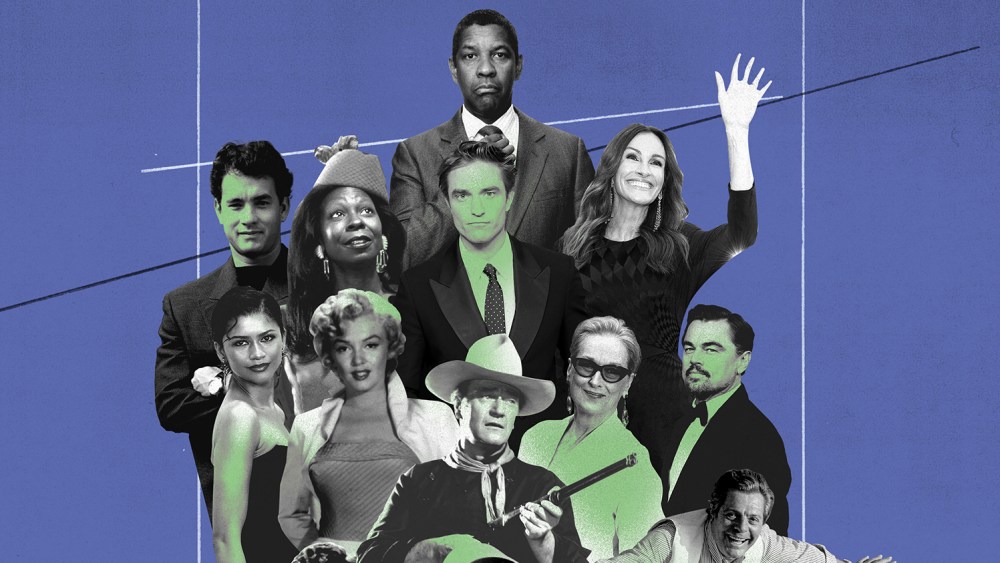
Full Article
Original Source
Read the full article at Variety →KhanList aggregates and links to publicly available news content. We do not host full articles from third-party sources. Always verify important information with original sources.