
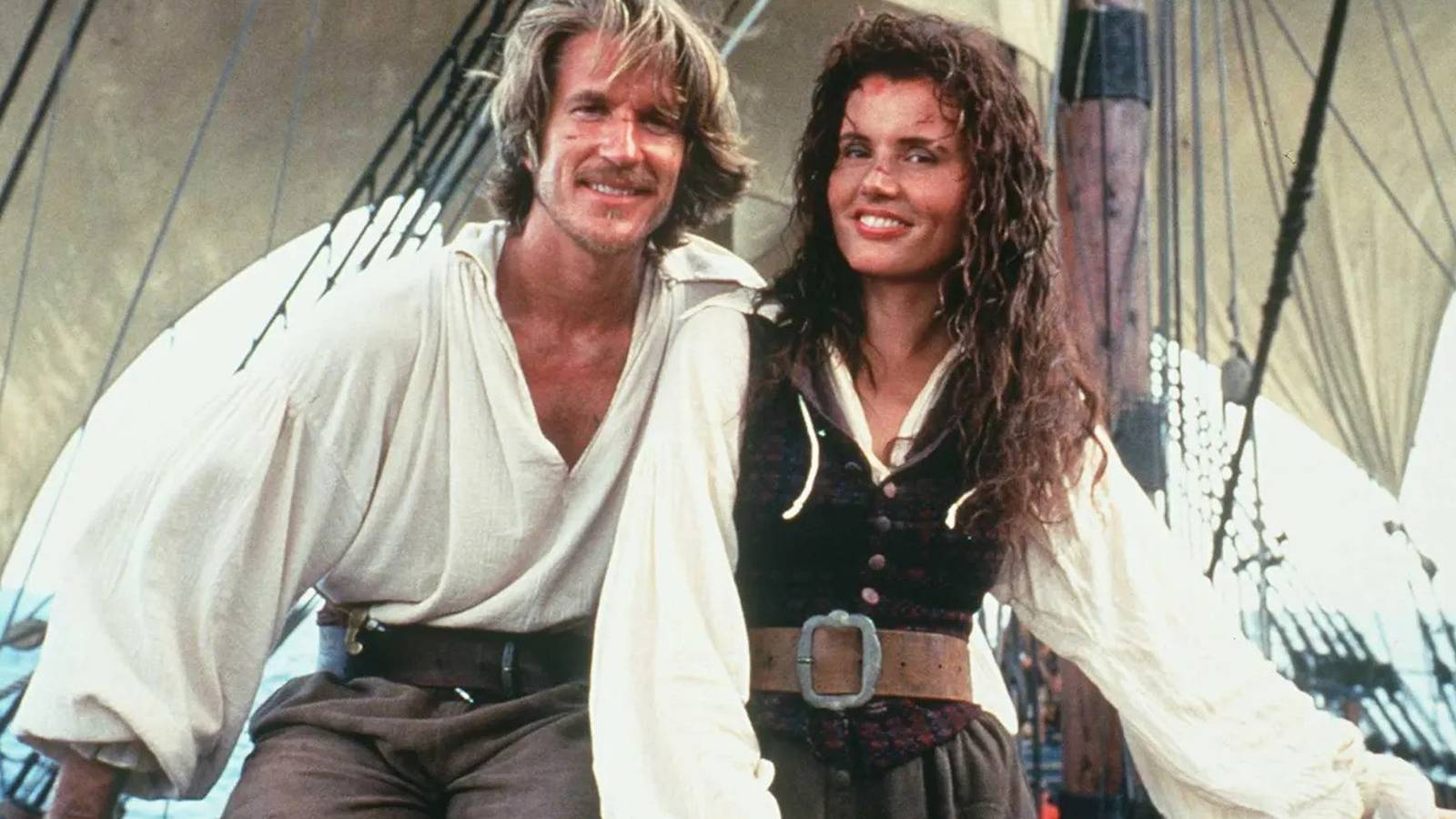
Image via MGM Published Nov 28, 2026, 5:15 PM EST Michael Block is a 14 time GLAM Award nominated writer, producer, and host of the podcast Block Talk. Throughout his time in the entertainment industry, he has worked on and off Broadway as a stage manager, written several produced plays, critiqued hundreds of theatrical performances, drag and cabaret shows, and has produced events randing from drag competitoons to variety concerts! On Block Talk, he interviews nightlife personalities, covers the wide world of entertainment through features, ranking episodes, and recaps ALL of Drag Race, as well as Dragula and Survivor. He has interviewed hundreds of RuGirls that span the globe at DragCon NYC, DragCon LA, and DragCon UK. In his free time, he makes one-of-a-kind jewelry and gift baskets with his mom. He is a proud member of the LGBTQ+ community. Sign in to your Collider account We love a good period piece because it transports us back to a time rooted in nostalgia or to somewhere we could never experience. These movies tend to be filled with extraordinarily accurate sets, pitch-perfect costumes, and dialogue reminiscent of a time not of our present. But just because the spectacle is present doesn’t mean it’s done well. In fact, the worst period films can be sensationally cringe. We’re here to discuss ten of those disasters. From brutally offensive depictions to excruciatingly poor creative decisions, these ten films made the genre look atrocious. While they may have one or two redeeming qualities, overall, it’s not enough to warrant any semblance of passing. Maybe it’s actors ill-equipped at wrapping their mouths around period dialogue or changing facts for entertaining fiction; these ten films are period pitiful. 10 'The Patriot' (2000) Image via Sony Pictures Releasing Hollywood has produced a plethora of Revolutionary War films, but The Patriot is by far the worst. Directed by Roland Emmerich, the epic historical war drama follows Benjamin Martin (Mel Gibson), a widowed French and Indian War veteran who tries to stay neutral to protect his seven children. When ruthless British Colonel William Tavington (Jason Isaacs) burns his home, captures his eldest son, Corporal Gabriel Edward Martin (Heath Ledger), and murders one of his younger sons, Thomas (Gregory Smith), Martin joins the fight and leads a colonial militia in a brutal guerrilla campaign against the British Army. Despite three Oscar nominations, historians have frequently criticized The Patriot for major historical distortions, melodrama, and plot contrivances that prioritize action and entertainment over accuracy. A deservedly knocked film, The Patriot took so many liberties that it garnered the story almost unrecognizable. The most notorious criticism is the scene where Colonel William Tavington, a distorted take on Banastre Tarleton, locks townspeople in a church and burns them alive. Historians point out that no such massacre happened during the American Revolution, as it was closer to a 1944 Nazi SS atrocity at Oradour-sur-Glane in France. The film then essentially whitewashed slavery, as Martin is portrayed as a free farmer in South Carolina who doesn't own enslaved people, and enslaved characters appear largely as willing allies or free laborers. Martin blends traits of several real commanders, including Francis Marion, Thomas Sumter, and Daniel Morgan, while the climactic battle mashes together details from different engagements like Cowpens and Guilford Courthouse. The story is more about revenge than ideology, turning a complex revolution into a standard action thriller. Even nitpickers pointed out details like anachronistic props, such as rocking chairs, uniform mix-ups, and one-man-army skirmishes that stretch believability. 9 'The Private Life of Henry VIII' (1933) Image via United Artists Henry VIII has been a source of inspiration for film and television, but easily the worst version came from Alexander Korda’s drama The Private Life of Henry VIII. In the almost comic take, the film chronicles the tumultuous later marriages of England's King Henry VIII (Charles Laughton), starting with the 1536 execution of his second wife, Anne Boleyn (Merle Oberon). It chronicles his rapid succession of subsequent unions—from the tragic childbirth death of Jane Seymour (Wendy Barrie) and an awkward annulment with Anne of Cleves (Elsa Lanchester) to the fatal infidelity of Katherine Howard (Binnie Barnes), before he finally settles into old age with his caretaker wife, Catherine Parr (Everly Gregg). Despite Oscar love, including Best Picture and Best Actor nominations, The Private Life of Henry VIII is the antithesis of fact. If you judge it as a serious historical drama, it has plenty of flaws that rub people the wrong way. The Private Life of Henry VIII is a tonal mess. It jumps between tragic executions, broad slapstick, and a fourth-wall-breaking punchline at the end. Several wives and court figures are played as caricatures, from a ditzy Jane Seymour to a nagging Katherine Parr, which makes the drama feel thin. It’s a frustration for history buffs for how it truncates the timeline and invents moments simply for entertainment purposes. It ignores Henry's break with Rome, the Protestant Reformation, and big political moves in favor of domestic squabbles. Henry and Jane Seymour don't marry the same day Anne Boleyn is executed, and Anne of Cleves doesn't win her annulment over a card game. With an overtly stagey feel, the script is hokey and sacrifices weight for something frothy. Fortunately, many creatives have rectified Henry VIII’s story, with some giving the wives more focus and respect. Needless to say, this is no Six! 8 'Pompeii' (2014) Few natural disasters are as tragic as what happened in Pompeii with Mount Vesuvius. So when the film Pompeii was made, they decided to make a disaster film rather than a movie about a disaster. Deemed a romantic historical disaster movie, the Paul W. S. Anderson-directed epic follows Milo (Kit Harington), a Celtic slave-turned-gladiator who seeks revenge against the corrupt Roman Senator Quintus Attius Corvus (Kiefer Sutherland) for massacring his tribe. As Mount Vesuvius erupts and destroys the city with earthquakes, ash, and a tsunami, Milo must fight his way out of the arena to rescue his true love, Cassia (Emily Browning), who has been unwillingly betrothed to Corvus. A genuine letdown of a film that could have launched Harington to big-screen stardom during his Game of Thrones days, Pompeii features weak characters, a thin script, and an unnecessary romance that hoped to replicate the magic of Titanic. Pompeii is categorically a cinematic disaster. Formulaic, cliché storytelling and historical loose ends that were never even considered create a complete misfire. The filmmakers took big swings that were so historically inaccurate that it was evident very little research, if any, went into making the movie. With stiff costumes, questionable character choices, and Sutherland’s abysmal attempt at whatever accent that came out of his mouth, the film was completely uneven. Even when the disaster elements kick in, green-screen seams and uneven effects make the film nearly unwatchable. The conceit of dramatizing the Pompeii disaster was a noble idea, but it was handled so poorly that the film has become almost forgettable, as it’s been erased from our collective memories. Between this and Eternals, Harington is cinema poison. Poor Jon Snow! 7 'The Scarlet Letter' (1995) Image via Buena Vista Pictures Turning classic literature into blockbusters isn’t necessarily the issue. It’s how it’s executed. That was the problem with The Scarlet Letter. The Nathaniel Hawthorne novel was never intended to be a romantic melodrama, but that’s what director Roland Joffé did with it. In 1667 Massachusetts Bay Colony, Hester Prynne (Demi Moore) has an affair with Reverend Arthur Dimmesdale (Gary Oldman) while believing her husband is dead, resulting in her pregnancy and a public sentence to wear a scarlet letter "A" for adultery. When her estranged husband Roger (Robert Duvall) secretly returns under a false identity to seek revenge, his ruthless scheming sparks a violent conflict with the local Algonquian tribe before Dimmesdale confesses, and the lovers flee to Carolina. A widely panned film, The Scarlet Letter replaces Hawthorne’s psychological study of guilt and Puritan hypocrisy with over-the-top drama, steamy romance, and jarring action tropes. Oh, and an abysmal performance from Moore. As the page prescribes, Hawthorne writes about shame, secret guilt, and moral reckoning. Those core themes are abandoned. Reverend Dimmesdale is softened into a more sympathetic figure in order to craft a conventional romance instead of a somber period drama. Instead of the novel’s tragic confession and lingering weight of sin, the movie ends with Hester and Dimmesdale escaping to the Carolinas with a happy ending after she tosses the scarlet "A" aside. I mean, what? That’s a very bold and wrong choice. The Scarlet Letter feels disjointed due to over-the-top erotic scenes and sudden shifts into period action. It’s shoehorned skirmishes with Native tribes, witch-hunt chaos, and flaming arrows turn the final act into an uncharacteristic battlefield. At least its legacy is tied to the Razzies! 6 'The Last Legion' (2007) Image via Momentum Pictures. In Doug Lefler’s historical action-adventure thriller The Last Legion, after Gothic invaders overthrow Rome and imprison the young emperor Romulus Augustus (Thomas Brodie-Sangster) on the island of Capri, his loyal commander Aurelius (Colin Firth), his mystic tutor Ambrosinus (Ben Kingsley), and the skilled warrior Mira (Aishwarya Rai) rescue him. Carrying the legendary sword of Julius Caesar, the group flees to Britannia to rally the fabled Ninth Legion against a tyrannical warlord, forging the origins of the King Arthur (Rory Finn) legend. The Last Legion featured a terrible mix of historical liberties and a bumpy tone, balanced by some campier cult appeal for all the wrong reasons. While it brought escapist curiosity, The Last Legion didn’t achieve its mission. The origins of the Arthurian myth through this lens are alluring, but with a clunky, mismanaged script, The Last Legion was doomed to fail. The text features stilted dialogue, cliché plotting, and characters that lean on star power rather than real growth, leaving young Romulus Augustus mostly on the sidelines. The movie swings between serious fall-of-Rome drama, swashbuckling adventure, and a sudden pivot into Arthurian legend, complete with a magical sword and a wizard-like mentor, which felt clashing rather than gelled. The film is littered with historical inaccuracies. From treating Rome rather than Ravenna as the imperial capital in 476 AD to dressing late-era soldiers in outdated armor and reviving a Ninth Legion that had long vanished from Roman records, it was a hot mess of misfires. The film felt more like a TV movie than the blockbuster it was meant to be. With disjointed villains and quick, bloodless action cuts that undercut the grit expected in an epic sword-and-sandal film, The Last Legion was a colossal flop. 5 'The Scorpion King' (2002) Image via Universal Pictures We must give credit that The Scorpion King team fixed the uncanny valley CGI found in The Mummy Returns, but it still didn’t save the film overall. Directed by Chuck Russell, the action-adventure film follows a skilled Akkadian assassin named Mathayus (Dwayne Johnson), hired by nomadic tribes to kill the clairvoyant sorceress aiding the ruthless conqueror Memnon (Steven Brand). After capturing the sorceress instead of executing her, Mathayus unites a ragtag group of allies to overthrow Memnon's empire and claim his destiny as a legendary ruler. After back-to-back hits in the franchise, The Scorpion King stalled the momentum to deliver a movie with a formulaic plot, choppy editing, thin character work, and B-movie pacing. The Scorpion King suffered from being rushed to capitalize on its monetary success. The revenge quest and sword-and-sandal beats follow familiar templates with little originality, except for a wrestling icon at the center. At roughly an hour and a half, the story feels rushed and disjointed, jumping between locations and set pieces without care. Villains like Memnon and side characters meant for comic relief often come across as one-dimensional rather than layered, as the script reads like a depthless cash grab. Because it sought a larger audience, making it a PG-13 film created limits. What could have been a daring R-rated spinoff, The Scorpion King lacked the grit that the genre tends to require. The Scorpion King was an undercooked, underwhelming film. That said, it was the perfect launchpad for Johnson as a leading action star. 4 'The Last Samurai' (2003) Image via Warner Bros. Pictures There’s absolutely zero reason for Tom Cruise to be in a film like this, but after being the go-to action hero, do you blame director Edward Zwick? In 1870s Japan, disillusioned American Civil War veteran Captain Nathan Algren (Cruise) is hired to train the Emperor's modern conscript army to suppress a traditional samurai rebellion led by Lord Moritsugu Katsumoto (Ken Watanabe). After being captured in battle and living among his captors, Algren embraces the samurai code of honor and ultimately fights alongside them against the forces of rapid Westernization. Filled with historical shortcuts, creative liberties, and big flaws that knock it down a peg, The Last Samurai won at the box office while alienating history buffs seeking any semblance of authenticity. With so much attention on a disillusioned outsider, The Last Samurai leaned into the tired white-savior trope while pushing Katsumoto to the side. The Last Samurai is an example of when a film should have been a series. Though arriving well before the streaming era, it makes sense why it took a blockbuster swing. The film features a completely compressed timeline. The movie blends conflicts and eras rather than strictly tracking the 1877 Satsuma Rebellion, merging the Boshin and Seinan Wars into one. With Cruise as a box-office magnet, the filmmakers invented his character for narrative purposes. History buffs often compare him to real-life French officer Jules Brunet, who fought on the shogunate's side, while noting Americans weren't really driving this part of the conflict. The film leans into traditional swords, bows, and older-looking armor to heighten the clash with modern guns. In reality, samurai had used firearms for centuries and by the 1870s often used modern weapons and Western-style uniforms or gear. The Last Samurai is an example of heavy Hollywood license. 3 'Alexander' (2004) Image via Warner Bros. Pictures Not everyone looks good as a blonde, and yet Colin Farrell’s wig isn’t the worst thing about Alexander. Directed by Oliver Stone, the film chronicles the turbulent life of Alexander the Great (Farrell) as he rises from a fractured Macedonian royal family to become a legendary military commander who conquers most of the known world across Persia, Egypt, and India. Framed through the aging reflections of his general Ptolemy (Anthony Hopkins), the epic drama explores how Alexander's relentless ambition, intense personal bonds, and bitter betrayals ultimately lead to his downfall and early death in Babylon. Alexander features fragmented, non-linear storytelling, heavy exposition, and over-the-top melodrama that bogs down a massive 175-minute theatrical runtime. Framed by an elderly Ptolemy's narration, the movie jumps back and forth across timelines rather than telling a clean story. Instead of crisp historical drama, Alexander the text is overly talky and leans heavily into soapy silliness, especially around Alexander’s tangled relationship with his mother, Olympias (Angelina Jolie). Coming on the heels of "sword-and-sandal" epics, the film was rushed to release, leaving little time to properly shape such a sprawling epic. At the same time, studio pushback over scenes depicting Alexander's bisexuality further muddled the theatrical release. But that shouldn’t have shocked anyone at the time. Even with two re-cuts, Alexander is still a poorly presented project. 2 'Cutthroat Island' (1995) Image via MGM If there’s one thing that’s true about Cutthroat Island, it was a complete bomb with no treasure to be found. Directed by Renny Harlin and set in 1668, the swashbuckling adventure film follows fierce pirate Captain Morgan Adams (Geena Davis) as she inherits her late father's ship and one-third of a map leading to a hidden fortune. Teaming up with a Latin-speaking con man, William Shaw (Matthew Modine), she races to gather the remaining pieces while battling a mutinous crew, British authorities, and her murderous uncle Dawg Brown (Frank Langella). With a troubled shoot and a devastating box-office return, Cutthroat Island is '90s adventure cheese at its worst. COLLIDERInteractive Ballot sealed Movies/Academy Awards/Best Picture Collider · Best Picture Which Oscar Best PictureIs Your Perfect Movie? Five winners · ten questions · one envelope Five Oscar Best Picture winners. Five completely different visions of what cinema can be and what it can do to you. One of them is the film made for the way your mind works, and ten questions will work out which. The nominees 2020Parasite 2023Everything Everywhere All at Once 2024Oppenheimer 2015Birdman 2008No Country for Old Men Open the envelope Question 01 of 10TONE 01 What kind of film experience are you really after? The best movies do not just entertain. They leave something behind. ASomething that pulls the rug out, that makes me think I am watching one kind of film and then reveals I am watching another entirely. BSomething overwhelming: funny, sad, absurd and genuinely moving, all at once. CSomething grand and weighty, a film that makes me feel the full scale of what I am watching. DSomething formally daring, a film that pushes what cinema can even do. ESomething lean and relentless, pure tension with no wasted frame. ← Back Keys 1 to 5 or A to E · Enter to advance Next Question 02 of 10THEME 02 Which idea grabs you most in a film? Great films are driven by a central obsession. What is yours? AClass, inequality, and what people are willing to do when desperation meets opportunity. BIdentity, family, and the chaos of holding your life together while everything falls apart. CGenius, moral responsibility, and the catastrophic weight of a decision you can never take back. DEgo, legacy, and the terror of becoming irrelevant while you are still alive to watch it happen. EEvil, chance, and whether moral order exists at all or we just tell ourselves it does. ← Back Keys 1 to 5 or A to E · Enter to advance Next Question 03 of 10STRUCTURE 03 How do you like your story told? Form is content. The way a story is shaped changes what it means. AGenre-twisting. I want it to start in one lane and migrate into something completely different. BMaximalist and genre-blending: comedy, action, drama and sci-fi in one ride. CEpic and non-linear, cutting between timelines to build a mosaic of cause and consequence. DA single unbroken flow. I want to feel like I am living it in real time with no cuts to safety. ESpare and precise, every scene doing exactly what it needs to do and nothing more. ← Back Keys 1 to 5 or A to E · Enter to advance Next Question 04 of 10VILLAIN 04 What makes a truly great antagonist? The opposition defines the protagonist. What kind of opposition fascinates you? AA system: invisible, structural, and almost impossible to fight because it has no single face. BThe self, and the ways we sabotage, abandon and fail the people we love most. CHistory, and the unstoppable momentum of events no single person can stop or redirect. DThe industry, the machinery of culture that chews up talent and spits out irrelevance. EPure, implacable evil, a force so certain of itself it becomes almost philosophical. ← Back Keys 1 to 5 or A to E · Enter to advance Next Question 05 of 10ENDING 05 What do you want from a film's ending? The final note is the one that lingers. What do you want it to sound like? AShock and inevitability, a conclusion that recontextualizes everything before it. BEarned emotion. I want to cry, laugh and feel hopeful, even if the world is a mess. CDevastation and grandeur, an ending that leaves me sitting in silence for a few minutes. DAmbiguity, something open enough that I am still turning it over days later. EBleakness, an honest refusal to pretend the world is tidier than it is. ← Back Keys 1 to 5 or A to E · Enter to advance Next Question 06 of 10WORLD 06 Which setting pulls you in most? Where a film takes place shapes everything: mood, stakes, what is even possible. AA gleaming modern city with a hidden underside, beauty masking rot and wealth masking desperation. BA collapsing suburban life that opens onto something infinite, the multiverse inside one ordinary person. CThe corridors of power and science at a world-historical turning point, where decisions echo for decades. DThe grimy, alive chaos of New York and Hollywood, fame as both destination and trap. EVast, indifferent landscape, desert and highway where violence arrives without warning or reason. ← Back Keys 1 to 5 or A to E · Enter to advance Next Question 07 of 10CRAFT 07 What cinematic craft impresses you most? Every great film has a signature, the element that makes it unmistakable. AProduction design and mise-en-scène, every frame composed to carry meaning beneath the surface. BEditing and tonal control, the ability to move between registers without losing the audience. CScore and sound design, music that becomes inseparable from the dread and awe of what you see. DCinematography as performance, the camera not recording events but taking part in them. ESilence and restraint, what is left unsaid doing more work than any dialogue could. ← Back Keys 1 to 5 or A to E · Enter to advance Next Question 08 of 10PROTAGONIST 08 What kind of main character do you root for? The protagonist is the lens. Who you follow says something about you. ASomeone smart and resourceful who makes increasingly dangerous decisions under pressure. BSomeone overwhelmed and ordinary who turns out to be capable of something extraordinary. CA brilliant, tortured figure whose gifts and flaws cannot be separated from each other. DA self-destructive artist whose ego is both their superpower and their undoing. EA quiet, principled person trying to make sense of a world that has stopped making sense. ← Back Keys 1 to 5 or A to E · Enter to advance Next Question 09 of 10PACE 09 How do you feel about a film that takes its time? Pace is a choice. Some films sprint. Others let tension accumulate slowly, deliberately. AI love a slow build when the payoff is going to be seismic. Patience for a devastating reveal. BGive me relentless momentum. I want to feel breathless and emotionally spent by the end. CEpic runtime does not scare me. If the material demands three hours, give me three hours. DI want it propulsive even when nothing is technically happening, restless energy throughout. EDeliberate and unhurried. I want dread to accumulate in the spaces between the action. ← Back Keys 1 to 5 or A to E · Enter to advance Next Question 10 of 10AFTERMATH 10 What do you want to feel walking out of the cinema? The best films leave a mark. What kind of mark do you want? AUnsettled, like I have just seen something I cannot fully explain and cannot stop thinking about. BMoved and energized, like the film reminded me what matters and gave me something to hold onto. CHumbled, like I have been in the presence of something important and overwhelming. DExhilarated, like I have just watched cinema do something it has never quite done before. EHaunted, like a cold, quiet dread that stays with me for days. ← Back Keys 1 to 5 or A to E · Enter to advance Reveal my film The envelope, pleaseAnd the Oscar goes to ★ Best Picture, 2020 Parasite Bong Joon-ho, 2019 A film that hides its true intentions until the moment it is ready to reveal them. You are drawn to films that operate on several levels at once, that begin in one genre and quietly, brilliantly migrate into another. Bong Joon-ho's Parasite is a film about class, desire and the architecture of inequality that manages to be darkly funny, deeply suspenseful and genuinely shocking across a single extraordinary running time. Your instinct is for cinema that rewards close attention and punishes assumptions, right up to its devastating final image. From the Collider file The first film not in the English language to win Best Picture, in the Academy's 92-year history to that point. It took four Oscars in one night: Picture, Director, Original Screenplay and International Feature. It won the Palme d'Or at Cannes in 2019 by a unanimous jury vote, the first Korean film to do so. The Park family's modernist house was not a location. It was built from scratch on an outdoor lot. Reads between the lines Loves a reveal Attention to detail ★ Best Picture, 2023 Everything Everywhere All at Once Daniel Kwan and Daniel Scheinert, 2022 A film that refuses to choose between being entertaining and being meaningful. You want it all, and this one gives you all of it. The Daniels' Everything Everywhere All at Once is among the most maximalist films ever made: action comedy, multiverse science fiction, family drama, existential crisis, and an emotional core that sneaks up on you in the middle of the chaos. You respond to ambition. Being overwhelmed is the design, not the side effect, because the feeling of being crushed by infinite possibility is exactly what the film is about. From the Collider file Seven Oscars, including three acting wins for Michelle Yeoh, Ke Huy Quan and Jamie Lee Curtis. Michelle Yeoh became the first Asian woman to win Best Actress. The visual effects were handled by a team of fewer than ten people, most of them self-taught. Ke Huy Quan had all but left acting for two decades before this role brought him back. Wants everything Big swings Soft center ★ Best Picture, 2024 Oppenheimer Christopher Nolan, 2023 A film about the gap between what we can do and what we should do. You are drawn to cinema on a grand scale, films that treat history not as a backdrop but as a force, then place their characters inside that force and watch what happens. Christopher Nolan's Oppenheimer sits inside one of the most consequential moments in human history and refuses to look away from it. You want your films to feel important without being self-important, earning their ambition through craft and the gravity of the subject. This one is enormous, complicated, and offers no easy comfort. From the Collider file Seven Oscars, including Nolan's first wins for directing and for Best Picture. Cillian Murphy and Robert Downey Jr. both took their first Academy Awards for it. Kodak engineered a black-and-white 65mm stock that did not previously exist so Nolan could shoot those sequences on IMAX. A three-hour, R-rated drama about theoretical physics that passed 950 million dollars worldwide. Thinks in decades Scale and weight No easy comfort ★ Best Picture, 2015 Birdman Alejandro G. Iñárritu, 2014 A film doing something that probably should not be possible. You are drawn to films that foreground their own construction, where the how of the filmmaking becomes part of the what it is about. Alejandro G. Iñárritu's Birdman, stitched to appear as one continuous take, is cinema examining itself through the cracked mirror of a fading actor's ego. You respond to formal daring. Michael Keaton's performance and Emmanuel Lubezki's restless camera make something unlike anything else: a film about creativity, relevance, self-destruction and never quite knowing whether your work means anything at all. From the Collider file Four Oscars, among them Best Picture and Best Director for Iñárritu. Emmanuel Lubezki's win here was the middle of three consecutive cinematography Oscars, after Gravity and before The Revenant. Antonio Sánchez's improvised drum score was ruled ineligible for the score category, which caused a minor uproar. The long-take illusion was built from a handful of extended shots joined by hidden cuts. Formally daring Camera as character Ego and art ★ Best Picture, 2008 No Country for Old Men Joel and Ethan Coen, 2007 A film that treats dread as a form of meaning. You are drawn to cinema that trusts silence, refuses to explain itself, and lets unease do the talking. The Coen Brothers' No Country for Old Men is about the arrival of a new kind of evil: implacable, arbitrary, and indifferent to the moral frameworks we use to make sense of things. It is one of the most tightly controlled films ever made, and that control is the source of the terror. You want your films to haunt you rather than comfort you, and you have no interest in a resolution that would be a lie. From the Collider file Four Oscars: Picture, Director, Adapted Screenplay, and Supporting Actor for Javier Bardem. Adapted from Cormac McCarthy's 2005 novel, with much of his dialogue carried over intact. Carter Burwell's score runs about sixteen minutes and is nearly inaudible by design. Roger Deakins was nominated twice that year, for this and The Assassination of Jesse James, and won for neither. Trusts silence Dread over answers No tidy endings Ballot tally · your top three 1 2 3 ↻ Retake the quiz Copied to your clipboard Ballot counted byCOLLIDERCollider.com · The Awards Desk The film was cursed quite early on. Starting around a $60 million budget and ballooning to roughly $92–$121 million across production, marketing, and distribution, it earned back only a tiny fraction. Filming in Malta, Thailand, and England, it faced extensive and constant rewrites, set tear-downs and rebuilds, crew walkouts, stunt injuries, and rough water-tank conditions. Unfortunately, the product wasn’t worth the headaches. With clunky dialogue, mismatched performances, obvious blue-screen shots, and ill-timed explosions, Cutthroat Island became a campy film in all the wrong ways. Swashbuckling pirate movies were a tough sell in 1995, and opening over Christmas meant going head-to-head with big family hits; it was a losing battle. While it scratched an itch for adventure seekers, it didn’t pan out as expected. It made history in the wrong direction. If only they thought of Captain Jack Sparrow first. 1 'The Conqueror' (1956) Image via RKO Radio Pictures It’s unfortunate to say, there are simply no redeeming qualities to the epic disaster known as The Conqueror. Directed by Dick Powell, the historical adventure film set in the 12th century tells the story of Mongol chieftain Temujin (John Wayne), who abducts Bortai (Susan Hayward), the fiery daughter of a rival Tartar leader, and attempts to win her heart amidst escalating tribal warfare. As he navigates palace treachery, shifting alliances, and bloody battles against his enemies, Temujin gradually earns Bortai's love and unites the Mongol clans to become Genghis Khan. Earning a reputation as the worst period film ever made, The Conqueror is overtly racist with absurd miscasting, stilted dialogue, loose historical accuracy, and a notoriously dangerous production. Wayne is a Western legend, but here he inappropriately plays the Mongol leader. Though some will excuse it as a product of its time, Wayne took on the role with heavy makeup and a Fu Manchu mustache, delivering stiff, faux-archaic lines in his unmistakable Western drawl. But the yellow face didn’t stop there. The entire ensemble, from supporting actors to the extras, was thrust into similar attire and imagery. By the time you reach the text, rather than capturing Genghis Khan's complex rise and military campaigns, the plot leans into heavy-handed Hollywood romance and poorly executed action. The locale looked nothing like the historic terrain. Producer Howard Hughes filmed on location near St. George, Utah, downwind of atmospheric nuclear weapons tests. Over the following decades, high numbers of cast and crew developed and died of cancer. The film was so ill-received that Hughes reportedly bought up prints of the film to keep it out of circulation for years. Unfortunately, its terrible legacy will live on as a cautionary tale of what never to do again. The Conqueror Release Date March 28, 1956 Runtime 111 Minutes Cast Susan Hayward later Genghis Khan
The 10 Worst Period Movies in Film History, Ranked
Full Article
Original Source
Read the full article at Collider →KhanList aggregates and links to publicly available news content. We do not host full articles from third-party sources. Always verify important information with original sources.