
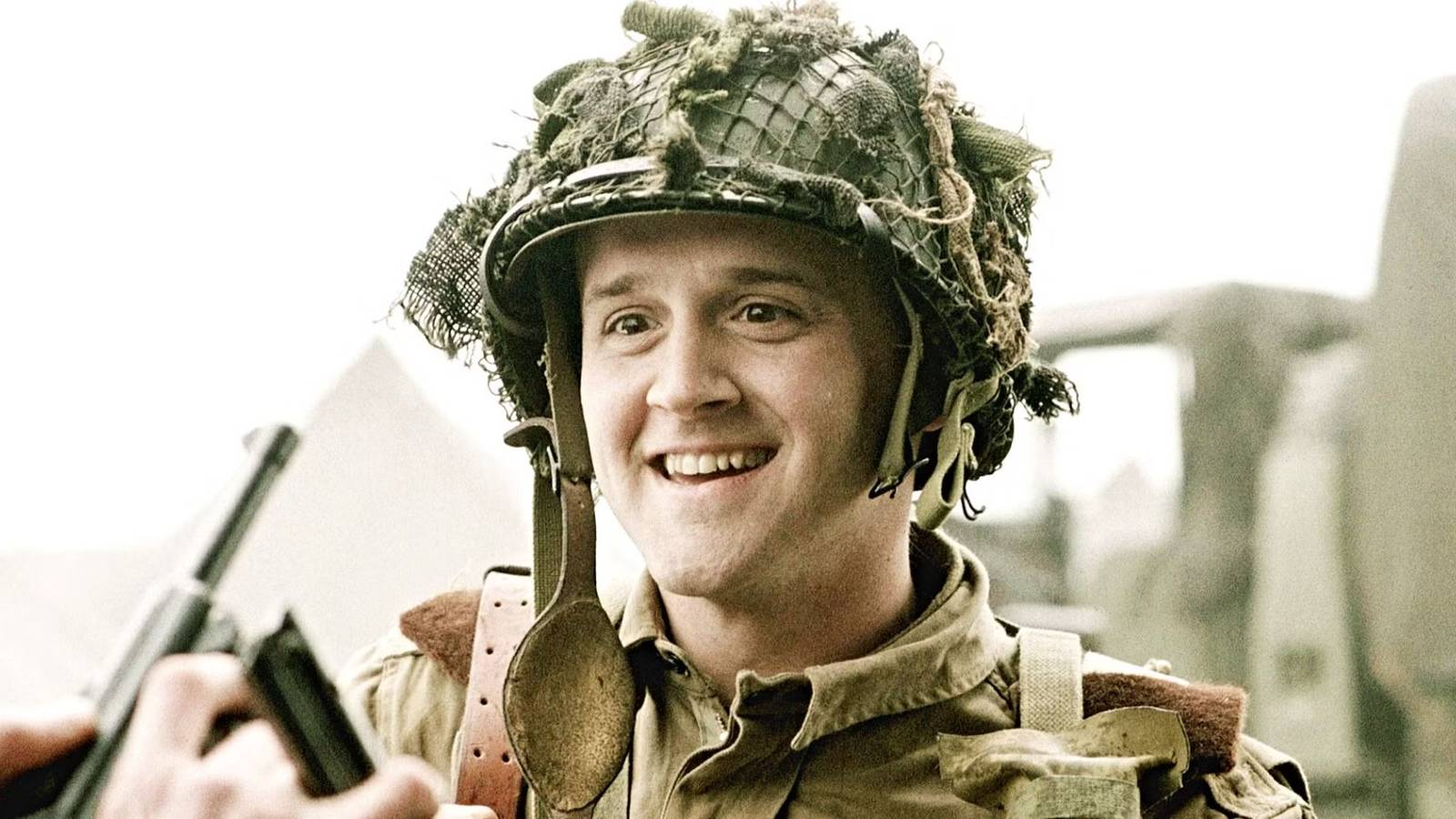
Image via HBO Published Nov 9, 2026, 7:56 AM EST Sign in to your Collider account I'm terrible company during war shows. I celebrate when somebody finds clean socks. I worry whenever a soldier mentions home. And if two men who've survived something awful start laughing together, I immediately become suspicious of whatever the writers have planned next. That's what happens when television gives you enough time to become attached to people whose lives are constantly in danger. You begin praying for the smallest things on their behalf. The greatest war stories also make it difficult to enjoy the fighting without confronting its consequences. With that said, these are the 10 greatest war show masterpieces of all time. 10 'Catch-22' (2019) Image via Hulu John Yossarian (Christopher Abbott) has a perfectly reasonable ambition. He wants to survive World War II. Unfortunately, he's an American bombardier stationed in Italy, and his commanders keep increasing the number of missions he must complete before being sent home. Catch-22 adapts Joseph Heller's novel into a wonderfully vicious satire where military bureaucracy has become an enemy almost as dangerous as the people shooting at Yossarian's aircraft. I find Abbott magnificent because Yossarian's growing desperation never feels like cowardice. He's surrounded by men who accept increasingly absurd orders, and his apparent madness comes from recognizing how insane the entire situation has become. Colonel Cathcart (Kyle Chandler) keeps moving the finish line while the airmen pay the price. The comedy can be gloriously ridiculous, but the losses gradually make laughing uncomfortable. That's the brilliance of this adaptation. Every bureaucratic absurdity becomes uglier when you remember that somebody might actually die because of it. 9 'Masters of the Air' (2024) Image via Apple TV At 25,000 feet, there's nowhere to hide. German fighters attack from every direction, flak bursts around the aircraft, and a damaged B-17 might suddenly become an enormous metal coffin. Masters of the Air follows the American 100th Bomb Group through its devastating bombing campaign over Nazi-occupied Europe, particularly pilots Gale “Buck” Cleven (Austin Butler) and John “Bucky” Egan (Callum Turner), alongside navigator Harry Crosby (Anthony Boyle). The Münster mission absolutely broke me. Robert “Rosie” Rosenthal (Nate Mann) manages to bring his damaged aircraft home, only to discover that he is the sole returning bomber from the group's thirteen aircraft that continued toward the target. Imagine surviving something unimaginable and finding practically nobody there to celebrate with you. The enormous aerial battles are technically magnificent, but that terrible absence gives them meaning. This was produced by Steven Spielberg and Tom Hanks. 8 'The Winds of War' (1983) Image via ABC American naval officer Victor “Pug” Henry (Robert Mitchum) arrives in Berlin in 1939, where his responsibilities place him uncomfortably close to the political developments leading toward World War II. Meanwhile, his family becomes scattered across an increasingly dangerous world, including his son Byron (Jan-Michael Vincent), whose relationship with Natalie Jastrow (Ali MacGraw) places him near the escalating persecution of Europe's Jewish population. The Winds of War transforms Herman Wouk's enormous novel into a sweeping account of the years preceding America's entry into the conflict. Mitchum is such an inspired choice. Pug isn't a man who enjoys explaining his emotions, and watching him quietly absorb the implications of what he's witnessing is fascinating. Dan Curtis directed the miniseries with an ambition that still impresses me. He moved between military strategy, political conversations, and relationships threatened by events nobody can control. The most painful moments involve people trying to maintain ordinary lives while history makes those lives increasingly impossible. We know what's approaching. They keep hoping there's still time to prevent it. 7 'Generation War' (2013) Image via ZDF Five young friends gather in Berlin in 1941, expecting that the war will soon end and they'll be reunited. Brothers Wilhelm (Volker Bruch) and Friedhelm (Tom Schilling) head toward the Eastern Front, Charlotte (Miriam Stein) becomes a nurse, Greta (Katharina Schüttler) pursues a singing career, and Viktor (Ludwig Trepte), who is Jewish, faces the escalating danger of Nazi persecution. Generation War follows their increasingly different experiences as their youthful confidence collapses. Friedhelm's transformation is especially disturbing. He initially questions the war's purpose, but prolonged exposure to violence gradually erodes his resistance to participating in it. The contrast with Wilhelm's exhaustion makes their relationship painful to watch. Philipp Kadelbach directed this three-part German drama. 6 'War and Remembrance' (1988–1989) Image Courtesy of ABC Natalie Jastrow (Jane Seymour) is trapped in Nazi-controlled Europe with her young son and uncle Aaron (John Gielgud), while her husband Byron Henry (Hart Bochner) serves in the American Navy. Their desperate attempts to escape persecution form one of the most harrowing storylines in War and Remembrance, the continuation of The Winds of War. Robert Mitchum returns as Victor Henry, whose military career carries him through the widening conflict in the Pacific. I find the story of Aaron and Natalie almost unbearably upsetting. They keep searching for another official who might help, another document that might grant safety, another opportunity to leave. Instead, the machinery of persecution keeps tightening around them. Dan Curtis, who directed this adaptation of Herman Wouk's novel, filmed portions at Auschwitz, bringing a profoundly disturbing historical reality into the production. The enormous naval battles and political developments are impressive, but I remember the family's desperation most vividly. A war fought across continents becomes a woman trying to protect her child from people determined to destroy them. 5 'MAS*H' (1972–1983) Image via CBS The surgeons of the 4077th Mobile Army Surgical Hospital spend the Korean War operating on wounded soldiers and finding increasingly ridiculous ways to preserve their sanity. Captain Benjamin Franklin “Hawkeye” Pierce (Alan Alda) leads much of the mischief, alongside an ensemble of doctors, nurses, and military personnel whose friendships make their exhausting work bearable. M*A*S*H somehow turns an army hospital into the setting for one of America's greatest television comedies. But then Radar (Gary Burghoff) enters the operating room with news that Lieutenant Colonel Henry Blake's plane has been shot down. Henry (McLean Stevenson) was finally going home. Everyone had celebrated his departure. Now the surgeons must absorb the news while continuing to operate. I genuinely cannot think of many sitcom moments that have hurt me more. That was the show's extraordinary courage. It could spend twenty minutes being outrageously funny, then remind viewers that wounded soldiers were arriving because actual people were killing one another. Hawkeye's jokes become more affecting when you understand how desperately he needs them. 4 'The Pacific' (2010) Image via HBO Forget the clean uniforms and reassuring speeches. The Marines fighting across the Pacific encounter suffocating heat, disease, relentless bombardment, and enemies who frequently refuse surrender. The Pacific follows several real servicemen, including Robert Leckie (James Badge Dale), John Basilone (Jon Seda), and Eugene Sledge (Joseph Mazzello), through the brutal campaign against Imperial Japan during World War II. There's a moment on Okinawa when Sledge encounters a dying Japanese woman who wants him to kill her. He's seen enough horror to understand her desperation, but instead of shooting, he lowers his weapon and holds her while she dies. It absolutely destroys me. Throughout the series, Sledge has been changing into somebody increasingly hardened by what he's witnessed. That small act of compassion becomes enormously important because we can see how difficult compassion has become. The performances are extraordinary, particularly Rami Malek as the disturbing yet oddly affectionate Snafu. These men don't leave the battlefield simply because the fighting has stopped. The war follows them into everything that comes afterward. COLLIDERInteractive Ballot sealed Movies/Academy Awards/Best Picture Collider · Best Picture Which Oscar Best PictureIs Your Perfect Movie? Five winners · ten questions · one envelope Five Oscar Best Picture winners. Five completely different visions of what cinema can be and what it can do to you. One of them is the film made for the way your mind works, and ten questions will work out which. The nominees 2020Parasite 2023Everything Everywhere All at Once 2024Oppenheimer 2015Birdman 2008No Country for Old Men Open the envelope Question 01 of 10TONE 01 What kind of film experience are you really after? The best movies do not just entertain. They leave something behind. ASomething that pulls the rug out, that makes me think I am watching one kind of film and then reveals I am watching another entirely. BSomething overwhelming: funny, sad, absurd and genuinely moving, all at once. CSomething grand and weighty, a film that makes me feel the full scale of what I am watching. DSomething formally daring, a film that pushes what cinema can even do. ESomething lean and relentless, pure tension with no wasted frame. ← Back Keys 1 to 5 or A to E · Enter to advance Next Question 02 of 10THEME 02 Which idea grabs you most in a film? Great films are driven by a central obsession. What is yours? AClass, inequality, and what people are willing to do when desperation meets opportunity. BIdentity, family, and the chaos of holding your life together while everything falls apart. CGenius, moral responsibility, and the catastrophic weight of a decision you can never take back. DEgo, legacy, and the terror of becoming irrelevant while you are still alive to watch it happen. EEvil, chance, and whether moral order exists at all or we just tell ourselves it does. ← Back Keys 1 to 5 or A to E · Enter to advance Next Question 03 of 10STRUCTURE 03 How do you like your story told? Form is content. The way a story is shaped changes what it means. AGenre-twisting. I want it to start in one lane and migrate into something completely different. BMaximalist and genre-blending: comedy, action, drama and sci-fi in one ride. CEpic and non-linear, cutting between timelines to build a mosaic of cause and consequence. DA single unbroken flow. I want to feel like I am living it in real time with no cuts to safety. ESpare and precise, every scene doing exactly what it needs to do and nothing more. ← Back Keys 1 to 5 or A to E · Enter to advance Next Question 04 of 10VILLAIN 04 What makes a truly great antagonist? The opposition defines the protagonist. What kind of opposition fascinates you? AA system: invisible, structural, and almost impossible to fight because it has no single face. BThe self, and the ways we sabotage, abandon and fail the people we love most. CHistory, and the unstoppable momentum of events no single person can stop or redirect. DThe industry, the machinery of culture that chews up talent and spits out irrelevance. EPure, implacable evil, a force so certain of itself it becomes almost philosophical. ← Back Keys 1 to 5 or A to E · Enter to advance Next Question 05 of 10ENDING 05 What do you want from a film's ending? The final note is the one that lingers. What do you want it to sound like? AShock and inevitability, a conclusion that recontextualizes everything before it. BEarned emotion. I want to cry, laugh and feel hopeful, even if the world is a mess. CDevastation and grandeur, an ending that leaves me sitting in silence for a few minutes. DAmbiguity, something open enough that I am still turning it over days later. EBleakness, an honest refusal to pretend the world is tidier than it is. ← Back Keys 1 to 5 or A to E · Enter to advance Next Question 06 of 10WORLD 06 Which setting pulls you in most? Where a film takes place shapes everything: mood, stakes, what is even possible. AA gleaming modern city with a hidden underside, beauty masking rot and wealth masking desperation. BA collapsing suburban life that opens onto something infinite, the multiverse inside one ordinary person. CThe corridors of power and science at a world-historical turning point, where decisions echo for decades. DThe grimy, alive chaos of New York and Hollywood, fame as both destination and trap. EVast, indifferent landscape, desert and highway where violence arrives without warning or reason. ← Back Keys 1 to 5 or A to E · Enter to advance Next Question 07 of 10CRAFT 07 What cinematic craft impresses you most? Every great film has a signature, the element that makes it unmistakable. AProduction design and mise-en-scène, every frame composed to carry meaning beneath the surface. BEditing and tonal control, the ability to move between registers without losing the audience. CScore and sound design, music that becomes inseparable from the dread and awe of what you see. DCinematography as performance, the camera not recording events but taking part in them. ESilence and restraint, what is left unsaid doing more work than any dialogue could. ← Back Keys 1 to 5 or A to E · Enter to advance Next Question 08 of 10PROTAGONIST 08 What kind of main character do you root for? The protagonist is the lens. Who you follow says something about you. ASomeone smart and resourceful who makes increasingly dangerous decisions under pressure. BSomeone overwhelmed and ordinary who turns out to be capable of something extraordinary. CA brilliant, tortured figure whose gifts and flaws cannot be separated from each other. DA self-destructive artist whose ego is both their superpower and their undoing. EA quiet, principled person trying to make sense of a world that has stopped making sense. ← Back Keys 1 to 5 or A to E · Enter to advance Next Question 09 of 10PACE 09 How do you feel about a film that takes its time? Pace is a choice. Some films sprint. Others let tension accumulate slowly, deliberately. AI love a slow build when the payoff is going to be seismic. Patience for a devastating reveal. BGive me relentless momentum. I want to feel breathless and emotionally spent by the end. CEpic runtime does not scare me. If the material demands three hours, give me three hours. DI want it propulsive even when nothing is technically happening, restless energy throughout. EDeliberate and unhurried. I want dread to accumulate in the spaces between the action. ← Back Keys 1 to 5 or A to E · Enter to advance Next Question 10 of 10AFTERMATH 10 What do you want to feel walking out of the cinema? The best films leave a mark. What kind of mark do you want? AUnsettled, like I have just seen something I cannot fully explain and cannot stop thinking about. BMoved and energized, like the film reminded me what matters and gave me something to hold onto. CHumbled, like I have been in the presence of something important and overwhelming. DExhilarated, like I have just watched cinema do something it has never quite done before. EHaunted, like a cold, quiet dread that stays with me for days. ← Back Keys 1 to 5 or A to E · Enter to advance Reveal my film The envelope, pleaseAnd the Oscar goes to ★ Best Picture, 2020 Parasite Bong Joon-ho, 2019 A film that hides its true intentions until the moment it is ready to reveal them. You are drawn to films that operate on several levels at once, that begin in one genre and quietly, brilliantly migrate into another. Bong Joon-ho's Parasite is a film about class, desire and the architecture of inequality that manages to be darkly funny, deeply suspenseful and genuinely shocking across a single extraordinary running time. Your instinct is for cinema that rewards close attention and punishes assumptions, right up to its devastating final image. From the Collider file The first film not in the English language to win Best Picture, in the Academy's 92-year history to that point. It took four Oscars in one night: Picture, Director, Original Screenplay and International Feature. It won the Palme d'Or at Cannes in 2019 by a unanimous jury vote, the first Korean film to do so. The Park family's modernist house was not a location. It was built from scratch on an outdoor lot. Reads between the lines Loves a reveal Attention to detail ★ Best Picture, 2023 Everything Everywhere All at Once Daniel Kwan and Daniel Scheinert, 2022 A film that refuses to choose between being entertaining and being meaningful. You want it all, and this one gives you all of it. The Daniels' Everything Everywhere All at Once is among the most maximalist films ever made: action comedy, multiverse science fiction, family drama, existential crisis, and an emotional core that sneaks up on you in the middle of the chaos. You respond to ambition. Being overwhelmed is the design, not the side effect, because the feeling of being crushed by infinite possibility is exactly what the film is about. From the Collider file Seven Oscars, including three acting wins for Michelle Yeoh, Ke Huy Quan and Jamie Lee Curtis. Michelle Yeoh became the first Asian woman to win Best Actress. The visual effects were handled by a team of fewer than ten people, most of them self-taught. Ke Huy Quan had all but left acting for two decades before this role brought him back. Wants everything Big swings Soft center ★ Best Picture, 2024 Oppenheimer Christopher Nolan, 2023 A film about the gap between what we can do and what we should do. You are drawn to cinema on a grand scale, films that treat history not as a backdrop but as a force, then place their characters inside that force and watch what happens. Christopher Nolan's Oppenheimer sits inside one of the most consequential moments in human history and refuses to look away from it. You want your films to feel important without being self-important, earning their ambition through craft and the gravity of the subject. This one is enormous, complicated, and offers no easy comfort. From the Collider file Seven Oscars, including Nolan's first wins for directing and for Best Picture. Cillian Murphy and Robert Downey Jr. both took their first Academy Awards for it. Kodak engineered a black-and-white 65mm stock that did not previously exist so Nolan could shoot those sequences on IMAX. A three-hour, R-rated drama about theoretical physics that passed 950 million dollars worldwide. Thinks in decades Scale and weight No easy comfort ★ Best Picture, 2015 Birdman Alejandro G. Iñárritu, 2014 A film doing something that probably should not be possible. You are drawn to films that foreground their own construction, where the how of the filmmaking becomes part of the what it is about. Alejandro G. Iñárritu's Birdman, stitched to appear as one continuous take, is cinema examining itself through the cracked mirror of a fading actor's ego. You respond to formal daring. Michael Keaton's performance and Emmanuel Lubezki's restless camera make something unlike anything else: a film about creativity, relevance, self-destruction and never quite knowing whether your work means anything at all. From the Collider file Four Oscars, among them Best Picture and Best Director for Iñárritu. Emmanuel Lubezki's win here was the middle of three consecutive cinematography Oscars, after Gravity and before The Revenant. Antonio Sánchez's improvised drum score was ruled ineligible for the score category, which caused a minor uproar. The long-take illusion was built from a handful of extended shots joined by hidden cuts. Formally daring Camera as character Ego and art ★ Best Picture, 2008 No Country for Old Men Joel and Ethan Coen, 2007 A film that treats dread as a form of meaning. You are drawn to cinema that trusts silence, refuses to explain itself, and lets unease do the talking. The Coen Brothers' No Country for Old Men is about the arrival of a new kind of evil: implacable, arbitrary, and indifferent to the moral frameworks we use to make sense of things. It is one of the most tightly controlled films ever made, and that control is the source of the terror. You want your films to haunt you rather than comfort you, and you have no interest in a resolution that would be a lie. From the Collider file Four Oscars: Picture, Director, Adapted Screenplay, and Supporting Actor for Javier Bardem. Adapted from Cormac McCarthy's 2005 novel, with much of his dialogue carried over intact. Carter Burwell's score runs about sixteen minutes and is nearly inaudible by design. Roger Deakins was nominated twice that year, for this and The Assassination of Jesse James, and won for neither. Trusts silence Dread over answers No tidy endings Ballot tally · your top three 1 2 3 ↻ Retake the quiz Copied to your clipboard Ballot counted byCOLLIDERCollider.com · The Awards Desk 3 'Generation Kill' (2008) Image via HBO A Marine complaining about equipment shortages while riding into a war zone probably shouldn't be funny. Somehow, Generation Kill makes it hilarious and deeply worrying at the same time. Based on journalist Evan Wright's account of the 2003 invasion of Iraq, this HBO miniseries follows the First Reconnaissance Battalion as its Marines navigate dangerous assignments, confusing instructions, and leadership decisions that frequently leave them furious. Ray Person (James Ransone) is one of my favorite military television characters. He talks constantly, makes outrageous jokes, and seems physically incapable of remaining serious for long. Beside him, Sergeant Brad “Iceman” Colbert (Alexander Skarsgård) maintains a controlled professionalism that makes their exchanges magnificent. David Simon and Ed Burns adapted Wright's reporting with an understanding that military competence doesn't automatically protect soldiers from institutional stupidity. The final footage the Marines watch of their experiences is especially haunting. Their jokes gradually disappear as the images confront them with things that are difficult to celebrate. I love how this show refuses to manufacture heroism where ordinary human confusion is considerably more revealing. 2 'The World at War' (1973–1974) Image via ITV. Twenty-six episodes. Actual archival footage. Survivors and participants describing events they experienced firsthand. The World at War documents the Second World War from the rise of Nazi Germany through the fighting in Europe and the Pacific, the Holocaust, and the conflict's devastating aftermath. It is produced by Jeremy Isaacs and narrated by Laurence Olivier, and remains one of television's most extraordinary historical achievements. Survivors describe Nazi persecution and mass murder, while archival material confronts viewers with evidence that cannot be dismissed as a dramatic filmmaker's invention. Isaacs made the crucial decision to interview people from different sides of the conflict, including perpetrators, and to devote substantial attention to civilians rather than concentrating exclusively on commanders and military victories. I find that extraordinarily important. A battle map explains where armies moved. A survivor's testimony explains what happened to the people living there. Decades after its original broadcast, these recorded voices remain irreplaceable. Watching is an act of listening to history from those who endured it. 1 'Band of Brothers' (2001) Image via HBO Band of Brothers follows real members of the 101st Airborne Division through the European campaign of World War II, with Richard Winters (Damian Lewis) emerging as a leader whose quiet competence earns extraordinary loyalty. I could talk about “Bastogne” for hours. Medic Eugene Roe (Shane Taylor) moves through the freezing forest treating wounded men while struggling to find basic medical supplies. He's exhausted, frightened, and constantly being called upon to help somebody else. Then “The Breaking Point” focuses on Carwood Lipton (Donnie Wahlberg), whose steady leadership helps hold Easy Company together while the fighting destroys the men's confidence. These aren't interchangeable stories about courage. They're portraits of people discovering what others need from them under unbearable circumstances. And there's one production decision I will never stop admiring. The real veterans appear in interviews throughout the miniseries, but their identities are withheld until the closing episode. Suddenly, the elderly men we've been listening to have names and faces we recognize from the dramatization. The realization is overwhelming. These men actually lived through the friendships, terror, exhaustion, and loss we've spent ten hours experiencing through actors. I've watched Band of Brothers repeatedly.
The 10 Greatest War TV Shows That Are 10/10 Masterpieces
Full Article
Original Source
Read the full article at Collider →KhanList aggregates and links to publicly available news content. We do not host full articles from third-party sources. Always verify important information with original sources.