
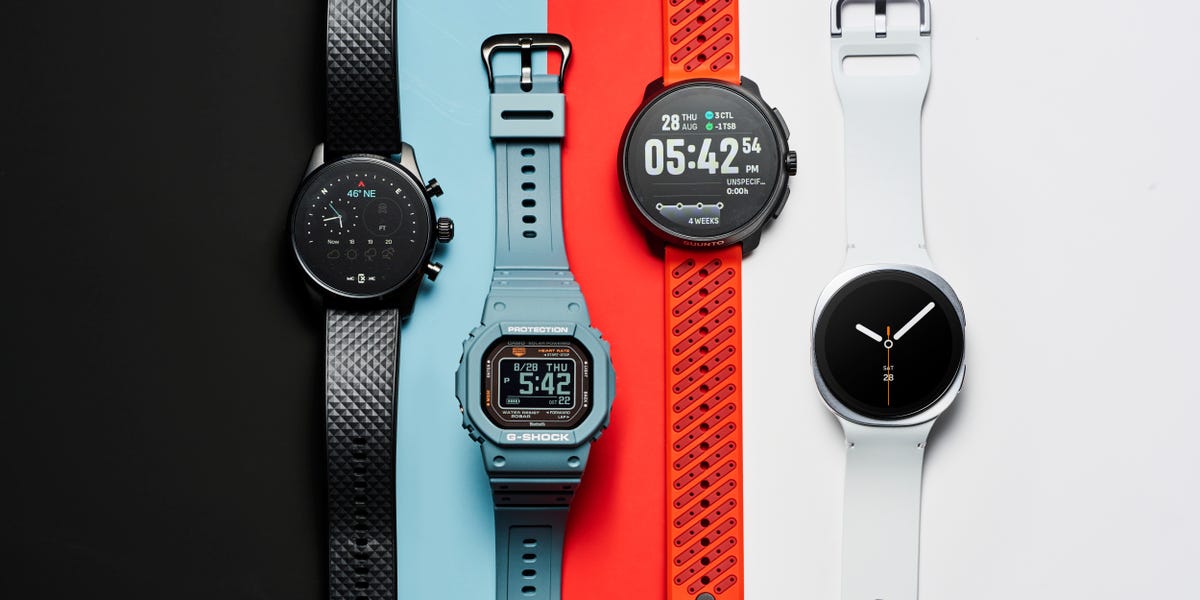
ProsFour new health metrics, led by Vitals featureFaster Snapdragon chip makes everything feel snappierBigger battery than the Watch8Raise-to-talk Gemini works without a wake wordConsNearly identical design and sensors to previous generationWith the Galaxy Watch9, Samsung didn’t mess with a good thing. The aluminum case, “squircle” shape, and bright 3,000-nit screen all carry over from the Watch8 that was our previous favorite—so at a glance you’d be hard-pressed to tell them apart. The key changes are under the hood: a bigger battery, a more power-efficient processor, and a smarter set of health tools that turn your sleep and workout data into advice you can act on.One of the most notable new additions is the Vitals tool, which learns your normal range for things like heart rate and blood oxygen, then flags you when something’s off. A jump in your resting heart rate or skin temperature, for instance, can signal a cold before you feel it—keep in mind these should be anecdotal. The other new features are for the data-driven crowd. A Heart Health Score rolls your sleep, activity, and blood-pressure trends into a single read on how your lifestyle is affecting your heart, with tips to improve it. My sleep schedule has been all over the place lately, making me feel lethargic at certain parts of the day, and the Watch9 has been recommending I go to bed earlier. Finally, a Fitness Index charts your body composition, cardio, endurance, flexibility, and strength on a spider graph so you can see where you’re strong and where you’re lagging.There are carryovers from the Watch8 too, including the Running Coach that builds a plan off a 12-minute test run, with well-structured workouts, and the Antioxidant Index, which reads the carotenoid levels in your skin for a rough sense of your fruit and vegetable intake (to be taken with a grain of salt).In a brief head-to-head test against the Apple Watch Series 11, the Watch9’s heart rate held within a few beats on runs and walks. I’ve been following a Couch to 5K program for the past four weeks, and the heart-rate readings during each run are reliable enough to pace by. Daily Cardio Load has also been a big help, nudging me to dial it back instead of pushing myself too hard, too soon.Samsung dropped the older Exynos chip for Qualcomm’s Snapdragon Wear Elite, and everything feels snappier, from starting a workout to pulling up a stat mid-run to talking to Google’s Gemini. Now you just lift your wrist to say a command, rather than first saying a wake word.The Watch9 keeps the excellent Dynamic Lug System, making it comfortable enough to sleep in, and its premium-yet-friendly design moves from a morning run to a business-casual meeting without looking out of place. It comes in 40mm and 44mm sizes with a wider band lineup, including Sport, Fabric, and a two-tone Misty. The battery is bigger on paper—390mAh on the 40mm, a 20 percent bump, and in my testing it still lands around a day of use. At $379.99, Samsung’s newest model costs a bit more than the Watch8 did at launch, but you’re getting the smartest, most feature-packed version yet.Read More: Best Fitness Trackers for MenBattery LifeUp to 30 hours with always-on display; up to 40 hours without Smart FeaturesVitals, Heart Health Score, Daily Cardio Load, Fitness Index, Running Coach, Antioxidant Index, Google Gemini (raise-to-talk) StyleLifestyle/Hybrid Band/StrapSport, Fabric, MistyFitness and Health TrackingYesCase Size40mm and 44mmProsBigger and brighter display than previous modelExcellent battery lifeWorks for multiple sportsSleek color bandsConsMay not be the best option for a black-tie eventWhen it comes to premium running watches, the latest Suunto Race (the Race 2) packs a serious punch at $499—or $599 for the Titanium Trail version. The display is larger and brighter than the Race 1 while being thinner. That said, at 49mm, the Race 2 isn’t a small watch. Men’s Health Senior Gear and Reviews Editor Ryan Brower put it to the test, noting: “While I’ve enjoyed testing it, the Race 2 would be nice to have in a smaller size.”That bigger size, though, makes room for a faster processor and an impressive 55 hours of battery life in GPS mode (or up to 30 days with daily use and no training). “The battery claims really hold,” Brower says. “I’ve only had to charge it a couple of times throughout months of testing. To be fair, I don’t wear it every day, but I did for a few stretches to get a sense of it.” Another big improvement is the redesigned charging clip, which Brower found far more effective and reliable than previous Suunto models that didn’t always connect easily.Performance-wise, the Race 2 delivers more than 115 sport modes. Brower put many of those programs through their paces—treadmill running, running, trail running, strength training, hiking, climbing, rowing (technically paddling), and even surfing—and each one worked smoothly, serving up plenty of useful metrics. GPS tracking proved fairly accurate, and features like training load and recovery provided deeper insights when synced with the Suunto Coach or other training apps. Building a regimen and letting the watch help implement it, Brower says, “can be a great tool for runners.”The Race 2 leans into a rugged aesthetic with its large round case and durable polymer or titanium build. Its style clearly favors sport and outdoor fits, so the 49mm case can feel oversized or out of place in formal or office clothes. The standard strap is a breathable silicone, perfect for sweaty workouts or trail runs, and the Titanium Trail model adds a premium case finish for those who want a more elevated look in casual settings.Read More: Garmin Vs. Apple WatchFeatures at a GlanceCase Size49 mmBattery LifePerformance GPS mode: 55 hours; Tour mode with lower GPS accuracy and HRM off: up to 200 hoursSmart Featuresadvanced touchscreen, offline maps with turn-by-turn navigation, and 115+ sport modesStyleAdventure / Outdoor PerformanceBand/StrapSiliconeFitness and Health TrackingYesAdvertisement - Continue Reading BelowProsLarger high-definition AMOLED display115+ sports modes including 22 new optionsFree offline maps and trusted navigation toolsFeatures LED backlight (Super Illuminator)ConsNot the best option for a formal eventWe got our hands on the G-Shock Move, and this thing is a beast—in the best way possible. Built with G-Shock’s signature toughness, it feels indestructible yet surprisingly comfortable on the wrist. I ran, lifted, and hiked with it, and it handled everything without a hiccup. Inside, you’ve got serious hardware: GPS, heart-rate monitoring, altimeter, compass, thermometer, and a gyroscope that tracks every stride, step, and elevation change with precision.What really impressed me was how capable it felt in different conditions. I tracked a few long runs with GPS fully active, and the data stayed consistent and accurate the whole time—no weird pace spikes or drop-offs. The battery life held up too; even when I pushed it hard, I still got several days before needing a recharge. And when it does run low, the solar-assisted charging converts sunlight into extra power, adding several hours—or even a day or two—of runtime if you’re outdoors. It’s rated for 200 meters of water resistance, so swimming, rain, and sweat are all fair game.Living up to its name, the G-Shock Move supports more than a dozen sports, from trail running and cycling to gym training and open-water swimming, while also monitoring sleep, recovery, and blood-oxygen levels. The display’s bright and easy to read mid-workout, and the interface feels intuitive enough to switch modes on the fly. For guys who demand a watch that’s as tough and versatile as they are, this one’s the real deal.Case Size51 mmBattery LifeNormal mode (continuous GPS reception): 16 hrs.; Long mode (intermittent GPS reception): 19 hrs.Smart FeaturesHeart rate monitoring, GPS, and various activity tracking sensors (accelerometer, gyroscope, magnetic, pressure, and thermoStyleRugged / Sport-FocusedBand/StrapSiliconeFitness and Health TrackingYesProsDual-band GPS and precision sensors for sports and wellness trackingDelivers up to 3 days of autonomy in low power modeInterface makes it simple to navigateLooks great with dressier fitsMade for iPhoneConsPricier than others on the list, but worth the investmentOur contributing editor and watch expert Ted Stafford, who styles every Men’s Health cover, was seriously impressed by the TAG Heuer Connected Calibre E5. “I was impressed by how well the E5 straddles the line between traditional style and modern innovation,” he says. “It wears beautifully on the wrist, with a sleek, stylish design and a comfort-first build. Its intuitive interface also makes it refreshingly simple to navigate, even on the move or during high-intensity activities.”In fact, Stafford recently met with Tag Heuer’s team in Boston to test the Connected Calibre E5. During his 5K run, he appreciated how easy it was to glance at messages, check his heart rate, and accurately track his activity—all without slowing down. He also noted that the stainless bracelet stayed comfortable and secure the whole time. Another standout feature is the ability to customize the watch face. “Whether you’re in the mood for a sporty Carrera or a bold Formula 1 look, the E5 lets you effortlessly switch styles to match your day,” he says. “This and all the other unique tech offerings make having a connected watch a win-win for me.”What really makes the E5 shine, though, is how much it packs under the hood. You get dual-band GPS for pinpoint tracking, heart-rate and blood-oxygen sensors, and full sleep and stress tracking that rivals top fitness-focused wearables. The new TAG Heuer OS runs smoother than ever, with cleaner visuals and tighter iPhone integration for those in the Apple ecosystem. Plus, it’s built like a tank with 50 meters of water resistance, a sapphire crystal display, and your choice of steel or titanium cases. Battery life clocks in at about two days of regular use, and fast charging gets you back to full in around 30 minutes.Features at a GlanceCase Size40 mm, 45mmBattery Life2 days for the 45mm model, 1.5 days for the 40mm modelSmart FeaturesRunning Focus, Integrated GPS and Altimeter, advanced wellness trackingStyleLuxury / High-EndBand/StrapSteelFitness and Health TrackingYesAdvertisement - Continue Reading BelowOther Smartwatches We LoveProsComes with Crash and Fall Detection with Emergency SOSVitals appWorks for swimmingConsHas least amount of battery life compared to othersThe Apple Watch SE 3 used to be the Apple Watch you bought because you couldn’t justify spending more. That’s no longer the case. Apple added features that actually change day-to-day use, including an always-on display, the S10 chip, double-tap and wrist-flick gestures, 5G cellular, and health features like Sleep Score and breathing irregularity detection through the Vitals app.Over several weeks of testing, the SE 3 held up as a daily driver without feeling like a compromise. The always-on display made a real while exercising, and performance felt snappy across the board, from launching workouts to setting timers with on-device Siri. Fast charging is the other underrated upgrade—a 15-minute top-up while showering in the morning was enough to carry the watch through the rest of the day and overnight for sleep tracking.Sleep Score is another useful addition. After a rough night (67 out of 100), our tester could see exactly why and adjusted accordingly, scoring a 90 the next night. The Vitals app runs quietly in the background, tracking wrist temperature and respiratory rate without requiring any input. It hasn’t flagged anything yet, but it’s the kind of passive monitoring that adds value over time.What you don’t get with the SE 3 is an ECG app, a Blood Oxygen app, hypertension notifications, or the edge-to-edge display on the Series 11. The bezels are noticeably chunkier, too, and on the smaller 40mm case the screen can feel a bit cramped. But at $250, those are reasonable tradeoffs. For most iPhone owners who want solid fitness tracking, safety features like Fall and Crash Detection, and an Apple Watch that doesn’t feel like the budget option, the SE 3 is the one to buy.Read More: Apple Watch SE3 ReviewFeatures at a GlanceCase Size40 mm, 44 mmBattery Lifeup to 18 hoursSmart Featureshealth and safety monitoring Crash Detection, Fall Detection, Sleep ScoreStyleLifestyle/HybridBand/StrapSiliconeFitness and Health TrackingYesAdvertisement - Continue Reading BelowProsAccurate dual-frequency GPSLightweight design disappears on your wristSharp display with excellent battery lifeIf you want a GPS running watch that nails the fundamentals and is relatively affordable, the Coros Pace 4 should be at the top of your list. At $249, it competes on accuracy, battery life, and display quality with watches that cost significantly more, and at 40 grams with a silicone strap, it’s light enough to forget you’re wearing it.The biggest upgrade from the Pace 3 is the AMOLED display, which is sharp and easy to read in bright sunlight. Battery life actually improved despite the brighter screen, jumping to 31 hours in max GPS mode with all satellite systems active, or 24 hours with always-on display enabled. A quick charge while you’re showering or eating a meal should top it off.GPS tracking is where Coros built its reputation, and the Pace 4 delivers. Dual-frequency satellite support promises clean, accurate tracks that hold up even alongside buildings and under tree cover. The Pace 4 also features voice logging, so after finishing a run, the watch prompts you to record your thoughts, which get transcribed and saved in the Coros app. The watch also uses breadcrumb navigation rather than full maps, so if you rely on turn-by-turn directions while exploring new routes, you’ll want to step up to the Coros Apex or a Garmin with offline maps.Case Size43 mmBattery LifeUp to 31 hours GPS; 24 hours always-on displaySmart FeaturesVoice logging with transcription, dual-frequency GPS, AMOLEDStyleSport/runningBand/StrapSiliconeFitness and Health TrackingYesProsAutomatically calls 911 if watch detects loss of pulseSleek enough to wear with casual fitsCan train with smarter with 40+ exercise modesCreates playlists for runsConsHave to charge everydayWomen’s Health fitness editor Nicolette Accardi put the new Google Pixel Watch 4 through its paces—and she says it’s one of the few fitness trackers that goes beyond counting steps. “Every fitness tracker can measure heart rate, calories, and steps, but few have standout safety features,” she says. “The Pixel 4 Watch can actually detect a loss of pulse, which could be lifesaving for anyone with cardiac issues—it automatically calls 911 within 20 seconds of detection.”Accardi also noted that this new generation adds “a more detailed look at sleep stages, which is especially helpful if you’re a runner like me.” She appreciated that it tracks stress levels, too—“something I struggle with—so I know when to take a moment to decompress.” When it comes to design, she describes the Pixel 4 Watch as “basic but sleek,” making it easy to wear with any outfit. “It’s a bit large on me, but I accidentally ordered the wrong size,” she admits. “If you have petite wrists, definitely go for the 41mm.”As for battery life, Accardi found it slightly overpromised: “Google says it lasts up to 40 hours, but I had to charge it every day.”Features at a GlanceCase Size41 mm, 45 mmBattery Lifeup to 30 hours, or up to 48 hours in Battery Saver modeSmart FeaturesGemini AI Assistant, Health Tracking InsightsStyleLifestyle/HybridBand/StrapSiliconeFitness and Health TrackingYesAdvertisement - Continue Reading BelowProsEasier to read than previous modelsGet help with Emergency SOS via satelliteCan receive hypertension notificationsGreat for swimming, diving, and high-speed water sportsThe Apple Watch Ultra 3 builds on what already made the Ultra line a favorite for serious exercisers and outdoor adventurers. The rugged titanium case and big 49mm face are still here, but the new model slims down the display borders for more screen space. Our fitness editor Brett Williams, NASM took it for a spin. “The Ultra 2, which is usually my go-to smartwatch, looks marginally smaller when compared side-by-side,” he says.What stood out most to him was the improved readability. “The large, bright display and straightforward layout make it easy for me to get the information I need at a glance,” he says. “With other brands’ devices, it sometimes takes me an extra moment to register what’s on the screen—and in the middle of a tough interval split, those moments add up.” Because of that, Brett says there’s “a good chance” he’ll keep using the Ultra 3 as his main fitness tracker.Battery life also got a noticeable bump—from a reported 36 to 42 hours. In testing, Brett got “closer to 45 hours before I needed to juice up.” Fast charging came in clutch, too: “I was set to embark on a 10-mile interval run when I realized I was at only 18 percent battery,” he says. “I popped the Ultra 3 on the charger while I got dressed and filled up my water pack, stretched, then took the device off power 15 minutes later at 36 percent.” Even after tracking his run for over an hour, he only burned through 12 percent of the battery.For adventurers, the new satellite communication feature adds extra peace of mind. You can send messages via satellite if you have a cellular plan—or trigger Emergency SOS even without one. Brett saw the demo firsthand at Apple Park: “It was all a bit complicated,” he says. “The Ultra 3 required a clear view of the horizon and took some time to actually connect to the satellite—but the distress signal was able to go through eventually.”Overall, Brett found the Ultra 3 to be a strong upgrade—bright, powerful, and reliable, even if it’s not the emergency device you’d fully depend on.Read More: Apple Watch Ultra 3Features at a GlanceCase Size49 mmBattery Lifeup to 42 hours of normal use and up to 72 hours in Low Power ModeSmart FeaturesActivity Tracker, Always On Display, Cycle Tracking, GPS, Heart Rate MonitorStyleLifestyle/HybridBand/StrapWoven textileFitness and Health TrackingYesProsMulti-week battery lifeFull-color topo maps with turn-by-turn navigationMilitary-grade durability and 10 ATM water resistanceThe Fenix 8 is the watch Garmin built for people who take their training and outdoor adventures seriously. It packs essentially every feature in Garmin’s arsenal into a rugged case with multi-week battery life, and the AMOLED version delivers all of it on a vibrant, high-resolution display that makes topo maps and training data genuinely enjoyable to look at.Where the Fenix 8 separates itself is navigation. Full-color topographic maps come preloaded, and you can follow turn-by-turn directions, see upcoming elevation changes through ClimbPro, and even build courses directly on the watch. For trail runners, hikers, and backcountry skiers, having offline maps on your wrist eliminates the need to pull out your phone. GPS accuracy is excellent thanks to multi-band GNSS support with SatIQ technology, which balances satellite precision against battery drain.Battery life is another area the Fenix 8 excels. The 51mm- AMOLED model stretches to roughly 29 days in smartwatch mode (though be careful in continuous GPS tracking during long hikes you’ll only get around 30 hours or less). That’s a different category from any Apple Watch or Samsung Galaxy Watch, and it means multi-day trips without packing a charger. The solar-equipped models push even further, up to 48 days with enough sun exposure.It features some of the most in-depth training features, too, including PacePro for race-day pacing strategy, Training Readiness scores that factor in sleep, recovery, and acute load, plus HRV tracking and detailed sleep analysis. The Fenix 8 also adds a built-in microphone and speaker for phone calls and voice commands, which is a first for the Fenix line. “This watch has everything that Garmin has to offer…” says Men’s Health Fitness and Reviews Editor Charles Thorp, NASM. “Rugged enough to perform in tough terrain, but sleek enough to fit in everywhere else.”The tradeoffs are size and price. The Fenix 8 is a large watch—the 51mm model measures 14.7mm thick—and it looks out of place with anything dressier than a quarter-zip. However, for athletes who log serious miles across multiple sports and want one watch that can handle all of it without compromise, the Fenix 8 earns the investment.Case Size43 mm, 47 mm, 51 mmBattery LifeUp to 29 days (51mm AMOLED)Smart FeaturesFull-color topo maps, turn-by-turn nav, ClimbPro, PacePro, mic & speaker, flashlight, AllTrails integrationStyleAdventure/Outdoor performanceBand/StrapSiliconeFitness and Health TrackingYesAdvertisement - Continue Reading BelowProsStreamlined user-friendly design40+ exercise modesExcellent battery lifeSleep trackingBuilt-in GPSConsOnly one face size availableFitbit’s full-featured, budget-friendly smartwatches have garnered legions of fans. The Fitbit Versa 3 guarantees everything most users want out of a smartwatch without the sky-high price tag.It tracks all the essentials, including 24/7 heart rate monitoring, stress levels (with an EDA sensor), skin temperature, and, yes, even sleep. It’s also Alexa/Google Assistant compatible, features a built-in GPS, and is even swimproof down to 50 meters. That’s not bad for a well-designed, brand-name watch that lists for just under $200 (though it’s on sale closer to $160 at the time of this writing). The screen on this latest model is also larger, curvier, and crisper than its predecessor. We also love the 6-plus-day battery life.Not surprisingly, it’s one of the best-reviewed budget smartwatches on Amazon, with more than 8,000 overwhelmingly positive reviews. There’s little to dislike here. The one-size-fits-all face and band size could be a disqualifier for some, although Fitbit has always done a great job ensuring that OSFA really does mean "one size fits all." Some reviewers also complain of a sometimes frustrating setup process. Still, for $200, this is a solid midrange smartwatch that almost stands shoulder-to-shoulder with the best Apple has to offer.Case Size40 mmBattery LifeUp to 6+ daysSmart FeaturesFitbit IncStyleLifestyle/HybridBand/StrapSiliconeFitness and Health TrackingYesAs the Style and Reviews Editor for Men's Health, Joseph covers all-things fashion and grooming. Previously, Cheatham was a commerce editor for Spy, and he has written for Travel + Leisure.Brandon Russell is a freelance writer covering gear and technology. He started his journey as a news writer at a small newspaper and later began reviewing smartphones, movies, and video games. In his free time, he enjoys the slower, more intentional experience of using a 35mm film camera and making short videos about movies he grew up watching.Reviewed byRyan BrowerFormer Senior Gear and Commerce EditorRyan Brower is the Senior Gear and Commerce Editor at Men’s Health, where he tests the best products in outdoor gear and tech. Baseball, surfing, and camping occupied most of his time growing up. He also trained in martial arts for 12 years and holds a third degree black belt. He has written about the outdoors for nearly two decades and was previously the Managing Editor, Content Performance at Gear Patrol. He is also a Certified Beer Server and previously covered the craft beer industry. Ryan currently lives on the water in New Jersey with his wife and their dog.
The 10 Best Smartwatches for Men, Tested by Style and Fitness Editors
Full Article
Original Source
Read the full article at Menshealth →KhanList aggregates and links to publicly available news content. We do not host full articles from third-party sources. Always verify important information with original sources.