
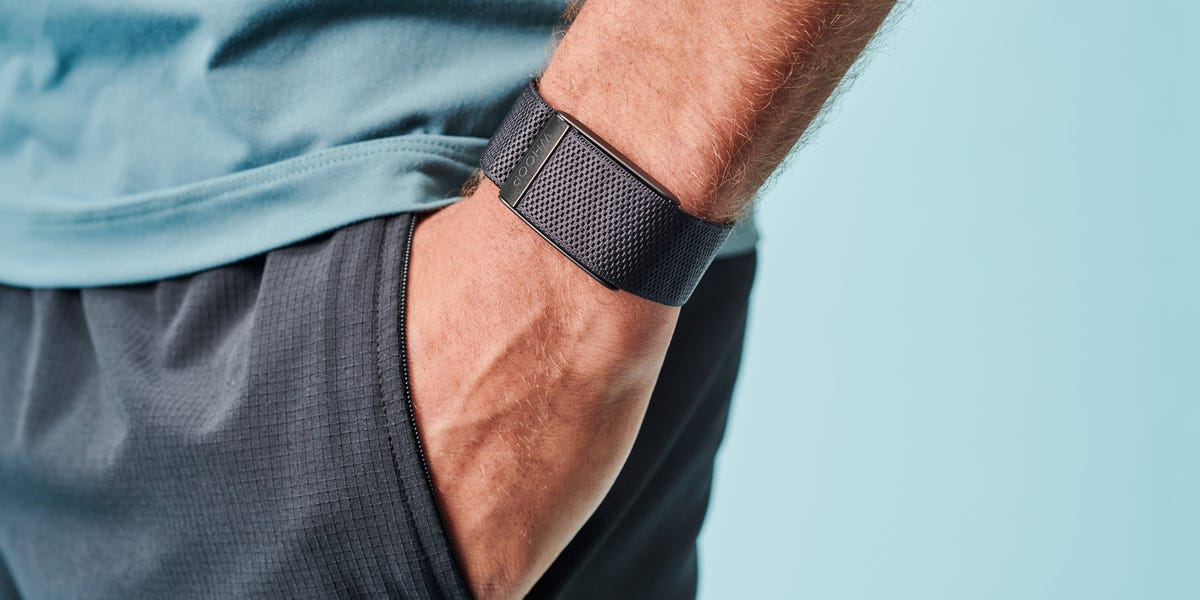
ProsSimple band designComfortable strapImproved activity trackingConsHeart rate monitoring may not be entirely accurate, just note that Whoop may be saying your heart rate is a little higher than it actually isNo display screen (which may be a bonus for some users)If you want a basic level fitness tracker, the Whoop PEAK membership with its new 5.0 band may be your answer. Men’s Health Fitness Director Ebenezer Samuel, C.S.C.S. backs this device for that reason. “Simplicity is what works here, because it's reliable, has great battery life, and I don't need to think about it,” he says. The Whoop 5.0 Band is a fitness tracker band, which means though it’s still decently functional, it does not have a display like most wrist devices. It tracks all of your data in the corresponding phone app, but it’s worth noting, you cannot see the data directly on your wrist.If you like the no-frills appearance, the Whoop 5.0 can definitely accomplish most of your tracking needs. “Whoop's activity sensing has improved over the years and continues to take steps,” says Samuel. It can track anything from running, cycling, and rowing to weightlifting, yoga, soccer, and even massage therapy. From our personal experience with Whoop, we love how it fits on the wrist. It is one of the more comfortable fitness trackers we’ve worn—the strap has a soft back, is woven with microfilament yarn, and can also be easily adjusted.Unfortunately, Samuel had some qualms with the heart rate monitoring. “The device isn't tremendously accurate in terms of tracking heart rate, which is important to note,” he says. “In general, note that whatever [Whoop] is telling you about heart rate, it's almost always overshooting.” This can be an issue because a lot of the other tracking metrics (calories, activity, etc.) are based around heart rate. However, if you just want something basic to wear on your wrist, count your steps, and give you a general look into your health and workouts, Whoop 5.0 Band with the Peak membership will do just that.Read More: Garmin Vs. Apple WatchStyleBandBattery LifeUp to 5 daysAvailable MetricsSteps, calories, heart rate, sleep, daily strain, recovery, a multitude of workout (“strain”) modesWater ResistanceUp to 10m ConnectivityiPhone, AndroidProsCompact, comfortable ringAmple HR workout optionsAwesome sleep and stress statsConsOura does require a $5.99 monthly fee to unlock full featuresMore expensive than other optionsOura was a pioneer in the smart ring space, and it’s still the best smart ring we’ve tested to date (and we’ve tested a lot). Multiple editors have been wearing an Oura Ring for the last ten years and can attest that each new iteration outkicks the competition. This particular release updated a few physical features: Oura shifted to a fully titanium build (vs. a titanium exterior, epoxy interior), added smaller and larger sizes, and ditched its three-nodule sensor design. This latest model eliminates the nodules that used to be on the inside of the ring and pinch into my finger on the Oura Ring 3. Those aren't required anymore with the new tech, so that is a huge improvement over the past model.The battery can also last up to eight days now, instead of just seven. And the updated software is available on all models, new and old. While Oura has always offered heart rate monitoring, the new software now features automatic heart rate monitoring, allowing you to detect and track your workout stats without hitting the “Record HR workout” button. This automatic detection feature also lends itself to workout monitoring for over 40 activities (a new capability compared to the past, solely cardio-focused tracking that Oura offered).The daytime stress features have also gotten an improvement—one of our favorites is illness detection. The Oura Ring 5 can detect changes in your stress stats and body temperature that may indicate an illness before you feel the entirety of the symptoms. A couple of months ago, one editor felt a slight earache when they woke up, and Oura called out they may have a cold coming on. The next day, that cold had arrived. It’s not always entirely accurate like this—there have been a few times the Oura Ring has said we were getting sick when it was actually just a hangover (oops).Even as Oura lovers, we’d be remiss not to call out one of the downsides to the product: In order to attain full use of the Oura Ring, you need to pay a monthly subscription fee of $5.99 (or $69.99 per year). There are other smart rings in the space that don’t require any fee (shout out to our second favorite product, the Ultrahuman ring), but with the updated technology and consistent top-of-the-line features, we deem the extra $69.99 per year a pretty minimal price to pay.For the most style-conscious users, the company also released a Ceramic version of the Oura Ring 4, which offers a unique look and additional color options.Read More: Our Hands-On Test of the Oura Ring 5StyleRingBattery LifeUp to 9 daysAvailable MetricsSteps, calories, sleep, heart rate, body temperature, menstrual cycle, blood oxygen, stress, 40 workout modesWater ResistanceUp to 100mConnectivityiPhone, AndroidAdvertisement - Continue Reading BelowProsSturdy and durableAbove average battery lifeEasy to read display screenConsTo be durable, this watch weighs more than othersNo touchscreen, but the buttons are easy to navigateAdventurers, look this way. We’re not exaggerating when we say this is the most rugged fitness tracker we have tested. The Garmin Instinct 3 AMOLED is packed with technology and has a thick face made for trail hikes, rock climbing, and even swimming (it’s water rated up to 100 meters). According to Men’s Health contributor Korin Miller, this Garmin can take a beating. “I accidentally banged it into several doorways and even scraped it against a kettlebell during a clumsy gym moment—it still looks brand new,” Miller says.In addition to its outwardly masculine look and durable design, the technology here is super simple to navigate, which can’t be said for all fitness trackers. Though there’s no touchscreen, Miller had the five buttons figured out within just a few minutes of receiving the product. And while you can track up to 30 different workout types, Miller praises the display for the easy-to-digest layout outside of workout mode. “The 390-by-390-pixel AMOLED display resolution is sharp and bright, allowing Garmin to jam a lot of stats on the home screen. At a glance, you can see your step count, heart rate, weather, date, time, and more. It’s arranged smartly in a way to deliver plenty of information without feeling overwhelming,” she says.But one of our favorite features? Garmin prioritizes a wind-down time, switching from a jam-packed interface to just a clock during the time you are typically sleeping (which you note during set-up). It’s worth mentioning that in order to be this rugged and durable, the Garmin Instinct 3 is also quite heavy at 53 grams. But if you’re going hard on the trails, there’s no better wrist partner.Read More: Our Hands-On Test of the Garmin Instinct 3Features at a GlanceStyleWatchBattery Life18 daysAvailable MetricsSteps, calories, heart rate, stress, sleep, blood oxygen, hydration, 30 workout modesWater ResistanceUp to 100mConnectivityiPhone, AndroidProsPolished appearanceFocus on overall wellness, not just fitnessBright screen perfect for reading health insightsConsBattery requires a more regular charge than other optionsNot compatible with iPhonesAt this cost, you’d expect a simple appearance, no touchscreen, and limited functionality. However, the Google Pixel Watch 5 has a beautiful, easy-to-navigate touchscreen, a smooth design, and almost all the metrics you’d get on a more high-end device.Google puts a big emphasis on overall wellness rather than just fitness tracking, focusing on breathing and stress management. “This is a very underrated device and it's gotten more accurate with the third edition,” says Samuel. “The breathing exercises don't reinvent the wheel, but the presentation is solid and the timing is good. Overall, in this market, there's a lot we don't fully understand about stress levels, and some of the algorithms are simplistic. But Google has smartly gotten us thinking about how we feel, and that's a good thing.”If this watch tracks stress, readiness, and sleep, what are the limitations of this budget-friendly device? Well, it doesn’t offer as many workout modes as most other fitness trackers, clocking in at just 41 options. You also have to charge it every day, and it’s only compatible with Android devices. But for such a clean, aesthetic appearance and great individual wellness metrics, we definitely consider this fitness tracker a steal.StyleWatchBattery LifeUp to 40 hours (with power saving mode) 30 hours (without)Available MetricsSteps, calories, sleep, heart rate (including ECG), blood oxygen, stress, skin temperature, 41 workout modesWater ResistanceUp to 50mConnectivityAndroidAdvertisement - Continue Reading BelowCredit: JL FOR MEN'S HEALTHProsBelow average price pointCompact designOver 95 sport modes and race pacing featuresTouchscreen displayConsAt a lower cost, this watch isn’t as powerful as some more expensive optionsIf you’re using it for training and continuous tracking, the battery life is only 30 hoursMost fitness trackers carry a hefty price tag, so if you’re in the market but not looking to sell out on this particular accessory, the Suunto Race S is the best value you’ll find. With a high definition AMOLED touchscreen, over 95 sport modes, and a water rating up to 50m, the specs here are just as good as you’ll find on many high-end fitness trackers. The AMOLED display on this watch is fantastic for its compact design. And personally, I think the Suunto Race S is superior to the larger model.A lot of fitness trackers in this price range (around $350) offer only more basic tracking, like steps and calories burned. That’s not the case here, there is more to this fitness watch than just a run tracker—there are workouts and other great fitness insights, like HRV, sleep monitoring, activity tracking and race pacing. Sure, it's not as powerful as a top-of-the-line Garmin, but it gets the job done and brings great value.Let’s chat about some of those features. Sleep tracking is having a moment and the Suunto Race S can track your sleep duration, timing, deep sleep, light sleep, heart rate, REM and HRV from sleep. One downside here? Wearing a watch to bed isn’t for everyone. Another cool feature worth digging into is race pacing. If you’re training for an upcoming marathon (or just life), the Race Pacer can help keep you on track when the mid-long run rut strikes. Overall, this is a great budget-friendly find—just note that if you opt for the titanium version over the stainless steel version, that will hike the price up by $120 (which makes it not as budget-friendly).Features at a GlanceStyleWatchBattery LifeUp to 13 daysAvailable MetricsSteps, calories, heart rate, sleep, stress, 95 workout modesWater ResistanceUp to 50mConnectivityiPhone, AndroidProsGreat for outdoor activitiesIdeal for Apple product usersDurable and highly functionalImpressive GPSConsIts larger build makes it great for outdoor activities, but not so great for working with weightsNot compatible with AndroidApple fans already know how great the Apple Watch Ultra 4 is. It features a large, durable aerospace-grade titanium body built for outdoor adventure. It’s water-rated up to 100m and boasts dual-frequency GPS. What’s that do for you exactly? It offers much more accurate tracking in tough environments (like densely populated cities, mountain terrain, and forests)—great for trail runners and climbers.Apple has always been at the top of the game for fitness tracking. The Ultra 4 offers all the typical metrics of the older Apple Watch models—activity rings, over 60 workout modes, blood oxygen, ECG, etc. But the Ultra 4 can be used as a dive computer, an emergency siren, and a compass that retraces your steps (ideal for those prone to getting lost mid-hike).A watch that can do this much won’t look dainty on the wrist, though. Men’s Health Senior Fitness Editor Brett Williams, NASM wrapped everything up nicely here. “The new design overhauled the sensor, which is on the rear of the watch and sits against the wearer’s wrist. Even though the casing is still the same 49-millimeter size as previous versions of the device and the sensor takes up the same amount of space.” Williams continues, “There’s now more surface area for device-to-skin contact for ECG readings, a new, circular optical sensing array, and larger, more efficient LEDs for heart rate sensing.”For us, the only real downside is that it’s a bit chunky on the wrist, but we’ll take it—the Apple Watch Ultra 4 is truly the full package for all iPhone users.Read More: Our Hands-On Test of the Apple Watch Ultra 4StyleWatchBattery LifeUp to 72 hours on low power (42 hours normal use)Available MetricsSteps, calories, sleep (including sleep apnea detection), heart rate (including ECG), blood oxygen, over 60 workout modesWater ResistanceUp to 100mConnectivityiPhoneAdvertisement - Continue Reading BelowProsSleek, modern and lightweight designSolar-powered or AMOLED optionsWealth of functions, including 100 workout modesConsBattery is drained significantly when GPS is onNo touch screen on Solar-powered optionIf you’ve ever been big into running, you’ve likely considered a Garmin watch. But the Garmin Fēnix 9 isn’t just great for run tracking—it tracks over 100 different types of workouts and can last up to 29 days on one charge. In addition to its functionality, the Garmin Fēnix 9 also boasts a high-end design. One of the thinner offerings in the way of chunky Garmins, this is the perfect fitness tracking watch for anyone who doesn’t want to wear anything too cumbersome on the wrist (plus it now comes in a 43mm size). This watch has everything that fitness tracking powerhouse Garmin has to offer packed into its low-profile casing.One of the coolest offerings? Garmin has both an AMOLED and a solar-powered option. The solar-powered watch can extend the battery life even further, but the screen is not quite as bright as the AMOLED option. The solar watch also does not have a touchscreen like the AMOLED one, making it a bit less convenient to have to click through the features via buttons.While the Garmin Fēnix 9 has the capabilities to track pretty much any metric you want tracked, the charging experience falls a bit short. While the battery can last up to 24 days in low-power mode, turning on GPS drops that to just under 24 hours of charge—a stark difference. Additionally, the charging cord is a bit short, so you might want to keep these USB-C charger extension cords on hand to charge your Garmin.Overall, this is a sleek, all-in-one package with a unique (and modern) solar-powered option. If you don’t mind a bit of a sub-par charging experience, you can’t get more premium than the Garmin Fēnix 9.Read More: Best Garmin WatchesStyleWatchBattery LifeUp to 24 days (18 days always on)Available MetricsSteps, calories, heart rate, sleep, stress, blood oxygen, over 100 workout modesWater ResistanceUp to 40mConnectivityiPhone, AndroidProsSeamless compatibility for Android usersAdvanced sleep trackingEnhanced AI health insightsVery reasonable price pointConsBody comp stats may be not be entirely accurate, but this is still a newer featureShorter battery life than some other competitors but will still last a full day before needing a rechargeNo iPhone? No problem. The Galaxy Watch9 can go anywhere thanks to a large scratch-resistant screen and a strong titanium case. One of our favorite features is the advanced sleep coaching that analyzes your sleep habits, suggests what you can do to improve, and is even FDA-approved to detect sleep apnea. We also appreciate the body composition reader—in just a few seconds, the Galaxy Watch9 works to tell you your vitals, and even provides a body fat estimate. These stats are prone to inaccuracy (few home devices can accurately track body fat), but we give props to Samsung for trying to push metrics to another level.The Galaxy Watch9 also delivers the features you expect in high-end smartwatches. That means accurate dual-frequency GPS specs and voice navigation. Nailing these (as Samsung does) is extra-critical, partly because the Galaxy Watch9 has some new competition for Android users (namely, from Google's Pixel Watch).Thanks to several generations of trial and error and new AI health insights, the Galaxy Watch gets the edge as our preferred pick for Android owners. There are more health insights and data in this watch than most competitors. Once you grant the device access to your health insights on your phone, it will make recommendations on sleep, exercise, and overall health, after you choose what your own personal goals are. I appreciate the design as well, which looks more like a classic watch than other smartwatch options.The array of features available and the materials used to craft the watch have been optimized a few times over, thus producing a seriously strong, long-lasting fitness tracker (and everyday smart watch) most users will be happy adding to their training arsenal.Read More: The Best SmartwatchesStyleWatchBattery Life1-2 daysAvailable Metrics Steps, calories, over 100 workout modes, sleep, blood oxygen, stress, ECG, blood pressure monitoringWater ResistanceUp to 50mConnectivityAndroidAdvertisement - Continue Reading BelowProsGreat basic starter trackingEasy to navigateCharging clamp for reliable chargingConsThe set-up took a bit of Googling and extra work for our testerThis is more of a basic, beginner-friendly product—you won’t find a lot of the more advanced features hereWhen you’re just starting out, you probably want a no-fuss fitness tracker to help get your bearings. The G-Shock Move is easy to navigate and offers just enough tracking to get you started. Men’s Health Grooming and Commerce Editor Sean Zucker tested it out for himself and likes how easy it is for newbies. “Thankfully, where the watch really excels is where it’s most meant to be used—when you’re working out or going for a run,” Zucker says. “Its face has a simple design and navigating it was a breeze, even for someone as technologically challenged as myself. It was easy to switch between lap/route times, heart rate/zone, homepage, etc. while I was running with only a couple of clicks (the watch itself only has 4 buttons so I appreciate the simplified design).”The G-Shock Move tracks all your basic needs: steps, running, walking, heart rate, blood oxygen, and even sleep recovery. Zucker also found it quite comfortable. “[It’s a] super comfortable watch, and handles sweat/rain with ease,” he says. “It doesn’t move around at all or get greasy after a long run/workout.” Though he did have a couple qualms with the functionality.“Now, I’m not someone who likes to wear a watch, let alone a fitness watch, all of the time but I will if I have a few minutes or I’m planning out a run,” says Zucker. “I’ll check in on what I’ve done that week and unfortunately, the app doesn’t let you access any of that info unless your phone is currently connected, which is, in my professional opinion, quite annoying.” Another small downside, Zucker did mention he had a tough time with initial setup.“It’s important to note that I am generally 100 years old and grumpy about this type of stuff, [but] still, the set up on this watch was a bit of a pain,” says Zucker. “There were a lot of ads (this extends to the app itself after you start using as well, very muddy).” If you can get past the setup and are okay with only being able to check past stats when you’re connected to the phone app, this is a great beginner-friendly tracker offering all the basic functions you need to kick off your fitness tracking journey.Features at a GlanceStyleWatchBattery Life14 hours (with GPS); 2 months (without GPS)Available MetricsSteps, calories, heart rate, sleep, blood oxygen, stress, 8 workout modesWater ResistanceUp to 200mConnectivityiPhone, AndroidProsExtremely lightweight and comfortableEasy-to-use app, compatible with both android and Apple devices.No subscription requiredReasonably pricedConsNo displayPremium insights unlocked through Google One membership, which feels a bit necessaryFitbit is back, with a vengeance. The Fitbit Air is the brand’s smallest and lightest tracker ever, weighing just 12 grams and featuring a design 25 percent smaller than the discontinued Luxe. Setup is simple through the new Google Health app, and the Air’s tracking features, including 24/7 heart rate, HRV, skin temperature, and sleep, run seamlessly in the background, with automatic workout detection and a reliable seven-day battery life.What truly elevates the experience is the integration of Google’s Health Coach AI, available through a Google Health Premium subscription, which is included for those who already have Google One. Food logging is a surprise standout—you can snap a picture of your meal, and the app accurately breaks down the macros. While the core tracking functions are available without a subscription, the real value comes from the Premium features like AI coaching, deeper analytics, and adaptive plans. But you don’t need the membership for the basic features.Some trade-offs to consider: The Air is screenless, so you can’t check notifications or your heart rate on the go, which may take some getting used to for smartwatch users. The default band can feel a bit stiff, and you charge it off-wrist. Still, the Fitbit Air is a compelling option for those who want minimalist, screenless health tracking without a hefty commitment.At $99 with no required subscription, it’s an accessible entry point for anyone who wants comprehensive health data and a genuinely helpful AI coach, especially those seeking a distraction-free, streamlined alternative to full-featured smartwatches.Read More: Our Full Review of the Google Fitbit AirStyleBandBattery LifeUp to 7 daysAvailable Metrics24/7 heart rate, heart rate variability, SpO2 (blood oxygen), skin temperature variation, sleep stages, and irregular heart rhythm alerts for atrial fibrillation.Water ResistanceUp to 50mConnectivityiPhone, AndroidCharles Thorp is the Fitness and Reviews Editor at Men’s Health, where he shares the best product recommendations in gym equipment, recovery tools, supplements, and more. Following an early life in athletics, Charles became a NASM-certified trainer and began writing programs alongside the most respected coaches in the world. Since entering the world of fitness content, Charles has had the opportunity to learn from and train alongside high performance individuals from the NFL, UFC, NBA, Formula 1, CrossFit, US Olympics, and Navy SEALs. When he’s not writing about training programs or gear, he can be seen at the gym or in the wild, putting them to the test.Ebenezer Samuel, C.S.C.S., is the fitness director of Men's Health and a certified trainer with more than 10 years of training experience. He's logged training time with NFL athletes and track athletes and his current training regimen includes weight training, HIIT conditioning, and yoga. Before joining Men's Health, he served as a sports columnist and tech columnist for the New York Daily News.
The 10 Best Fitness Trackers, Tested by Our Fitness and Tech Experts
Full Article
Original Source
Read the full article at Menshealth →KhanList aggregates and links to publicly available news content. We do not host full articles from third-party sources. Always verify important information with original sources.